

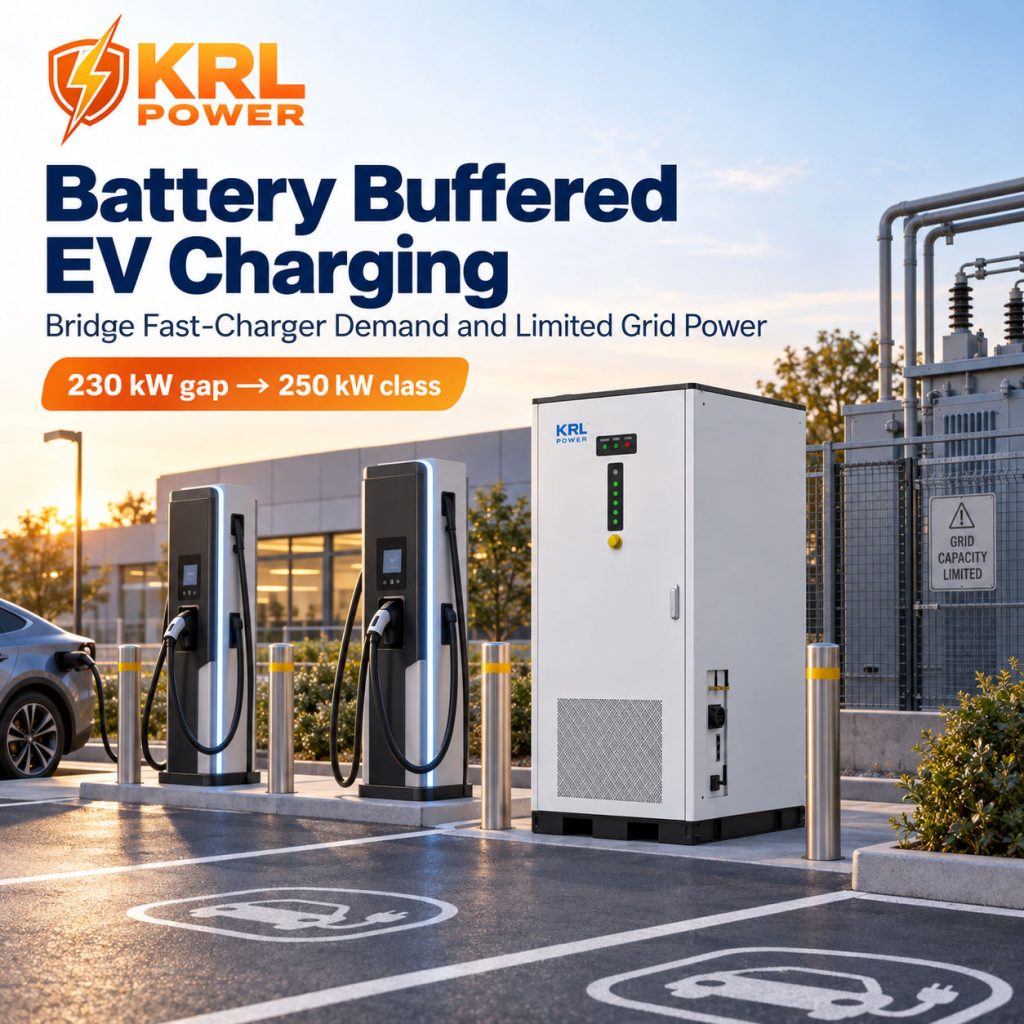
Battery-buffered EV charging works best when a site has enough daily energy but not enough instantaneous grid power. Two 150 kW fast chargers, 30 kW of facility load and 100 kW of available grid import create a 230 kW battery-support requirement. That already exceeds the 125 kW KRL-B261L class, so the first KRL screen moves to the 250 kW / 522 kWh KRL-B522L.
The purchase sequence should stay simple: charger concurrency → site power gap → KRL power class → support duration → battery energy → recharge window. Rated kWh comes after the power gap because a large battery cannot compensate for an undersized converter.
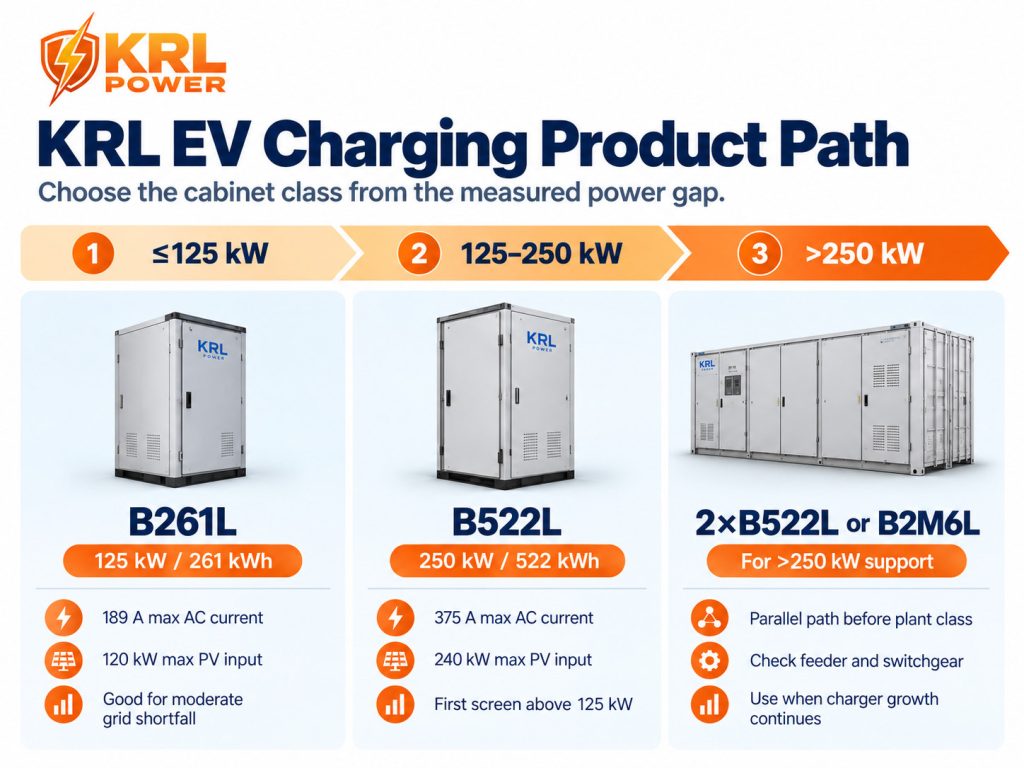
KRL’s KRL-B261L covers the 125 kW class with 261 kWh rated energy. The KRL-B522L raises that boundary to 250 kW and 522 kWh. Those published ratings let the charging duty decide the equipment class instead of choosing storage by battery capacity alone.
Calculate the Charging Power Gap Before Choosing Battery Energy
The battery only needs to cover the part of simultaneous demand that the site supply cannot provide. A safe first-pass equation is:
P_{BESS}=max(0,\ P_{EV}+P_{site}-P_{grid}-P_{PV,usable})
where:
- \(P_{EV}\) is the charger power expected to occur at the same time;
- \(P_{site}\) is coincident facility load;
- \(P_{grid}\) is grid import available for that operating condition;
- \(P_{PV,usable}\) is PV that can actually offset site demand during the same interval.
P_PV,usable is not PV nameplate capacity or the day’s maximum solar output. Midday generation should not justify a smaller battery power class for an evening charging peak. The published 120 kW and 240 kW PV-input values for B261L and B522L are also separate product limits; they should not be added to the 125 kW or 250 kW AC ratings to imply a higher AC output than KRL publishes.
| Charging condition | Required battery support | Initial KRL route |
|---|---|---|
| 2 × 100 kW chargers + 20 kW site load − 100 kW grid | 120 kW | KRL-B261L |
| 2 × 150 kW chargers + 30 kW site load − 100 kW grid | 230 kW | KRL-B522L |
| 3 × 150 kW chargers + 40 kW site load − 150 kW grid | 340 kW | Two B522L cabinets are the first parallel screen |
The 340 kW case should not jump straight to a plant-class system. Two B522L cabinets provide the next published 250 kW building block to evaluate. A 750 kW / 1.5 MWh or larger KRL plant-class route becomes more relevant when future charger growth, AC current, cable count, site layout or expansion strategy makes stacked 250 kW cabinets less attractive. The broader KRL C&I ESS class-selection path covers that step-up logic.
Use KRL-B261L When the Buffer Stays Inside 125 kW
Two 100 kW chargers, 20 kW of site load and 100 kW of grid import leave a 120 kW deficit:
200+20-100=120 kW
KRL-B261L provides 125 kW rated on-grid and off-grid power, 261 kWh rated battery energy, 189 A maximum AC current, 120 kW maximum PV input and a 400/230 Vac three-phase connection. KRL also publishes liquid battery cooling and parallel operation up to 10 units.
That 125 kW power class is what matters first. The combined charger nameplate is 200 kW, yet the grid already supplies 100 kW of the site requirement. Storage only needs to fill the remaining gap.
Energy is then checked from the duration of that 120 kW support:
| Support period | Initial energy requirement |
|---|---|
| 15 min | 30 kWh |
| 30 min | 60 kWh |
| 60 min | 120 kWh |
| 90 min | 180 kWh |
| 120 min | 240 kWh |
These are load-side duty values, not guaranteed delivered AC energy from a 261 kWh battery. Final usable energy still depends on the approved SOC window, conversion losses, operating reserve, auxiliaries, temperature and battery condition.
The buying advantage is a defined 125 kW entry point. A site with a 120 kW deficit does not need to jump automatically to a 250 kW cabinet because the charger nameplates look large. The kommersiële energiebergingskeuseproses should keep power and energy as separate checks for the same reason.
Move to KRL-B522L Once the Gap Passes 125 kW
Two 150 kW chargers, 30 kW of site load and 100 kW of grid import leave:
300+30-100=230 kW
One B261L is 105 kW short of that duty. KRL-B522L changes the equipment boundary to 250 kW rated on-grid power, 250 kW rated off-grid power, 522 kWh rated battery energy, 375 A maximum AC current en 400/230 Vac three-phase output.
The 230 kW request therefore enters the B522L class with about 20 kW of rating margin at the first screening stage. The move up is driven by converter power, not by the appeal of a larger kWh figure.
B522L also publishes 240 kW maximum PV input, 2 MPPT channels, liquid battery cooling, a diesel-generator port, parallel operation up to six units, IP65 battery enclosure and a −10°C to 55°C operating range. These parameters only matter when they change the project decision. The larger PV-input ceiling can reduce grid recharge pressure where coincident solar surplus exists; parallel capability creates a practical route beyond one 250 kW block.
Die 250 kW / 522 kWh solar-storage-diesel configuration shows how those hardware functions sit together in the B522L class.
Power Pass Does Not Prove the Energy Window
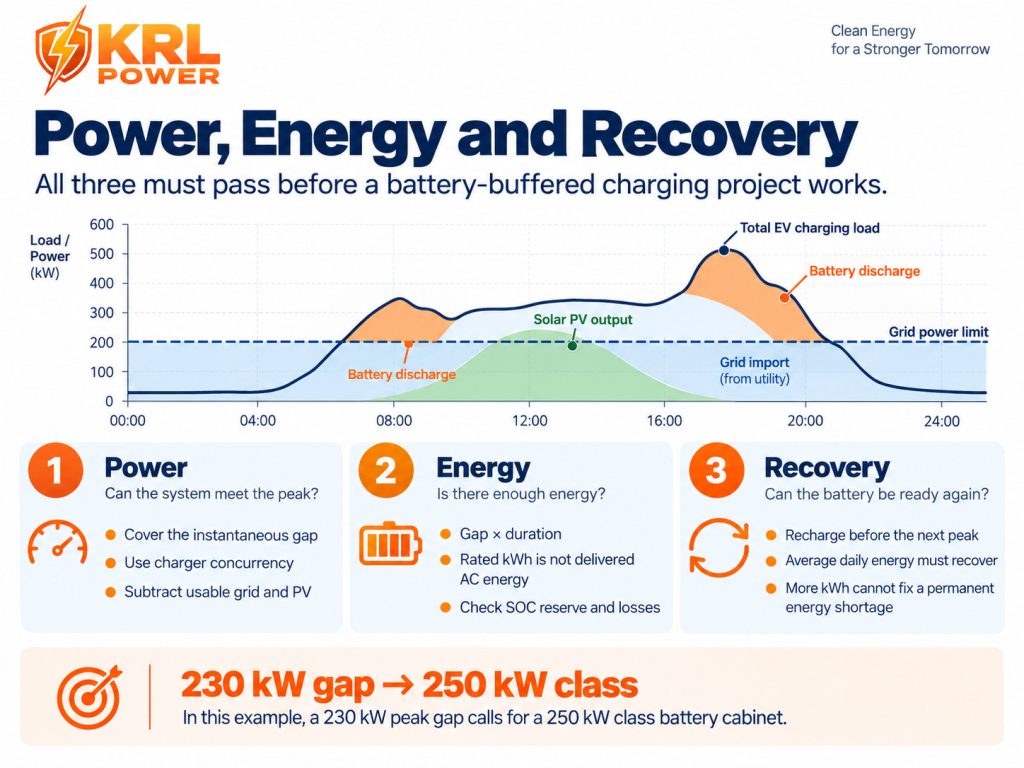
A 250 kW converter can solve the instantaneous deficit while the battery still lacks enough usable energy for the required operating period. The same 230 kW support creates very different energy requirements:
| Support duration | Initial energy requirement |
|---|---|
| 15 min | 57.5 kWh |
| 30 min | 115 kWh |
| 45 min | 172.5 kWh |
| 60 min | 230 kWh |
| 90 min | 345 kWh |
| 120 min | 460 kWh |
KRL-B522L’s 522 kWh figure is rated battery energy, not guaranteed AC energy at the chargers. Final project sizing must account for SOC limits, conversion losses, reserve policy, auxiliaries, temperature and battery condition.
Daily charger energy should not automatically become battery capacity. Grid power can keep serving the load and recharging the battery between peaks, so storage is sized for the buffering duty, not necessarily the full day’s EV energy. The kommersiële energiebergingsontwerpproses treats PCS power, battery energy and recharge capability as separate design questions.
Use First-Hour Demand to Test the Initial Charging Surge
The U.S. Joint Office of Energy and Transportation and NREL use First Hour en Design Day as one right-sizing method for battery-buffered DC fast charging. It is not a universal standard, but it is useful because it separates the first high-demand burst from the full-day energy balance.
Die NREL battery-buffered DCFC case study defines First Hour as one hour of concurrent vehicle charging from all ports, starting with a fully charged energy storage system. A KRL project should apply that concept to its own traffic and charger profile rather than copy the NREL corridor assumptions.
Suppose four 150 kW chargers are installed, but operating data shows only two normally overlap. Designing from all four nameplates assumes 600 kW of concurrent charger demand even though the expected high-power overlap is 300 kW. Ignoring concurrency entirely creates the opposite failure.
A practical energy expression is:
E_{buffer}=Σ max(0,\ P_{charger\ demand}-P_{available\ supply})×Δ t
The result feeds directly back into the product choice. If the concurrent power deficit stays within 125 kW and the validated energy budget fits the 261 kWh platform, B261L remains in the comparison. Once the deficit moves above 125 kW, B522L becomes the first KRL cabinet to screen, provided its usable-energy window also passes.
Use Design-Day Energy to Check Whether the Battery Can Recover
First Hour tests the surge. Design Day asks whether the same service can be repeated without the battery arriving at the next peak depleted.
NREL’s Design Day method requires the available grid power to be at least equal to the average Design Day charging demand, while the battery covers periods when charging demand rises above that grid level. That distinction prevents storage from being treated as a permanent energy source.
For a project-level adaptation where coincident PV is operationally available, the daily energy screen can be expanded to:
E_{available}=E_{grid}+E_{usable\ PV}
and compared with:
E_{required}=E_{EV\ charging}+E_{site\ load}
This PV-inclusive equation is a project extension, not the NREL Design Day criterion itself.
Weak peak power with adequate daily energy is a strong battery-buffer case. Persistent daily energy shortage is not. If one B522L passes the 250 kW power test but cannot recover enough SOC before the next charging block, adding another cabinet only makes sense when grid and usable PV still provide enough energy to refill the larger storage block.
Die Joint Office battery energy storage help sheet for EV charging stations describes the same basic operating principle: the BESS draws energy at a moderate rate and releases it rapidly when fast charging temporarily requires more power.
Use PV Input Only When It Improves the Recharge Window
Recharge determines whether the morning result can be repeated later in the day. KRL-B261L publishes 120 kW maximum PV input, while B522L raises that ceiling to 240 kW.
Suppose 180 kWh must be restored before the next busy period. Usable solar surplus averaging 90 kW for two hours represents:
90 kW×2 h=180\text{ kWh}
That is only an energy-balance illustration. Battery charge limits, SOC, conversion losses, site load and actual irradiance still apply.
The KRL advantage appears when the site has meaningful daytime solar surplus. A project with 180–200 kW of sustained usable surplus can make use of the B522L’s larger 240 kW PV-input class, subject to the full PV design and battery charge limits. Solar compatibility alone is not the selling point; the value is faster SOC recovery without forcing the entire recharge duty back through a constrained grid connection.
Compare One B522L With Two B261L as Different Architectures
The arithmetic is similar:
2×125 kW=250 kW
2×261\text{ kWh}=522\text{ kWh}
Yet the installation is not the same. One B522L concentrates the duty in a single 250 kW / 375 A cabinet. Two B261L units create two 125 kW / 189 A conversion blocks, two cabinet positions and two external connection paths.
| Project issue | One B522L | Two B261L |
|---|---|---|
| Nominal converter total | 250 kW | 2 × 125 kW |
| Gegradueerde batterye-energie | 522 kWh | 2 × 261 kWh |
| Maximum AC current class | 375 A | 189 A per cabinet |
| Physical arrangement | One cabinet | Two cabinets |
| Expansion style | Larger single block | More modular block layout |
| External connections | One main cabinet path | Two cabinet paths |
A compact charging hub with a 230 kW battery requirement may prefer one B522L because the duty fits one power block. A depot with physically separate charger groups may have a reason to compare two smaller cabinets. Protection, cabling, maintenance isolation, available area and future charger layout decide between them.
KRL’s two B261L versus one B522L comparison treats this as an architecture choice rather than an arithmetic one.
Expand the System Only When Charger Growth Changes the Duty
Future charger count matters only when it changes concurrency, duration or both. Starting from the 230 kW example, adding a third 150 kW charger creates a theoretical 380 kW gap if all three charge together:
450+30-100=380 kW
Three different growth patterns lead to different purchases:
- More ports, same concurrency: the 250 kW class may remain sufficient.
- Higher concurrency: two B522L cabinets become the first parallel screen before a plant-class route is considered.
- Same peak power, longer busy period: additional energy may be needed without increasing converter power.
B522L publishes parallel operation up to six units. Projects that grow beyond one cabinet still need transformer, switchgear, protection, cable-route, installation-area and recharge checks. The KRL C&I energy storage range provides the wider product path once the charging duty leaves the single-cabinet class.
Battery Buffering Cannot Fix a Persistent Energy Deficit
Storage solves a power-timing problem; it does not create daily energy. A depot that requires 3,600 kWh per design day while grid supply and usable PV can deliver only 2,900 kWh still has a 700 kWh/day shortfall:
3,600-2,900=700\text{ kWh/day}
More battery capacity only delays depletion. The durable fixes are more grid capacity, more usable generation, lower average charger demand, a longer recharge window, different fleet scheduling or another charging location.
That boundary strengthens the KRL recommendation rather than weakening it. B261L and B522L should be selected because their published power and energy classes fit a measured buffering duty, not because a larger battery can conceal an undersized energy supply.
Select the KRL Product From Power, Energy and Recovery Together
The final screen uses three questions: how large is the simultaneous deficit, how long must storage carry it, and can the site restore enough SOC before the next peak?
| Site result | Preliminary KRL path |
|---|---|
| Power gap ≤125 kW and validated energy window passes | KRL-B261L |
| Power gap >125 kW and ≤250 kW with adequate energy window | KRL-B522L |
| Power gap >250 kW but within a practical stacked-cabinet range | Two or more B522L cabinets, subject to system design |
| Charger growth or site architecture makes stacked 250 kW cabinets unattractive | Move to the KRL plant-class route |
| Power is adequate but one cabinet lacks the required energy window | Add energy capacity or revise the operating strategy |
| Average Design Day energy exceeds recoverable grid + usable PV energy | Correct the energy-supply problem before adding storage |
The product advantage is visible in the decision itself. B261L provides a 125 kW / 261 kWh entry class with 120 kW PV input. B522L moves the site to 250 kW / 522 kWh with 240 kW PV input, liquid battery cooling and a larger single-cabinet power block. The customer moves up only when measured charger duty, energy duration or expansion strategy requires it.