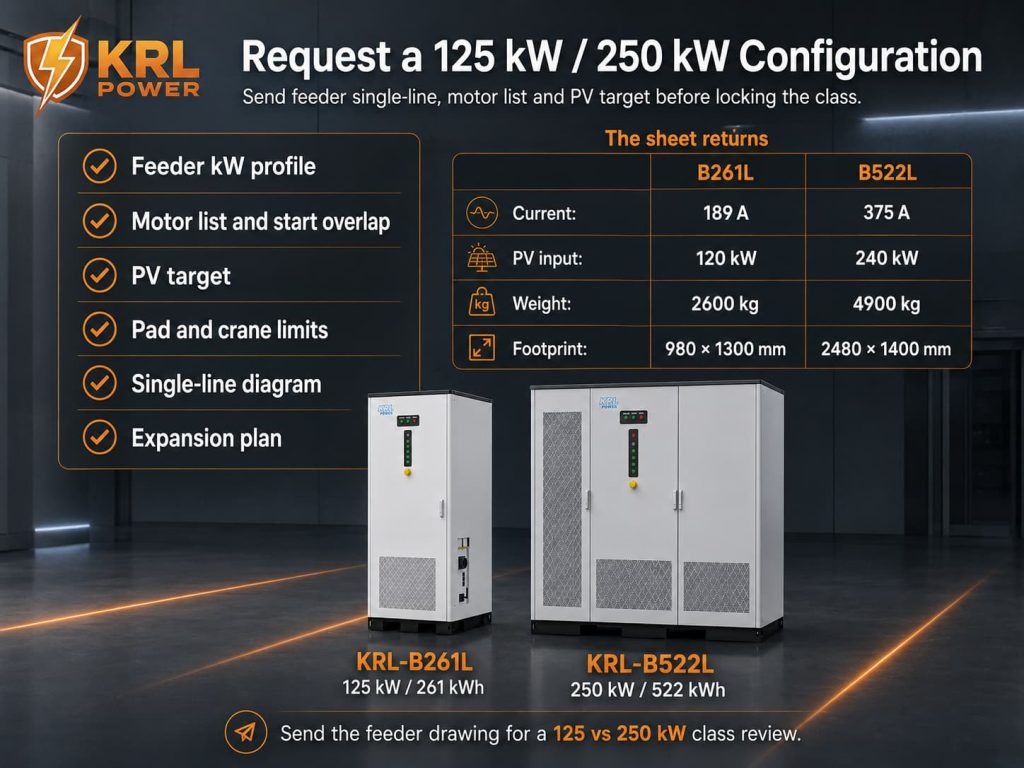

One feeder inside 125 kW and 189 A after motors start: buy one KRL-B261L 125 kW / 261 kWh.
One feeder that already overlaps at 140-180 kW, or needs 375 A and 522 kWh in one object: buy one KRL-B522L 250 kW / 522 kWh.
Two feeders that grow on different dates, each still inside 125 kW: buy two B261L cabinets.
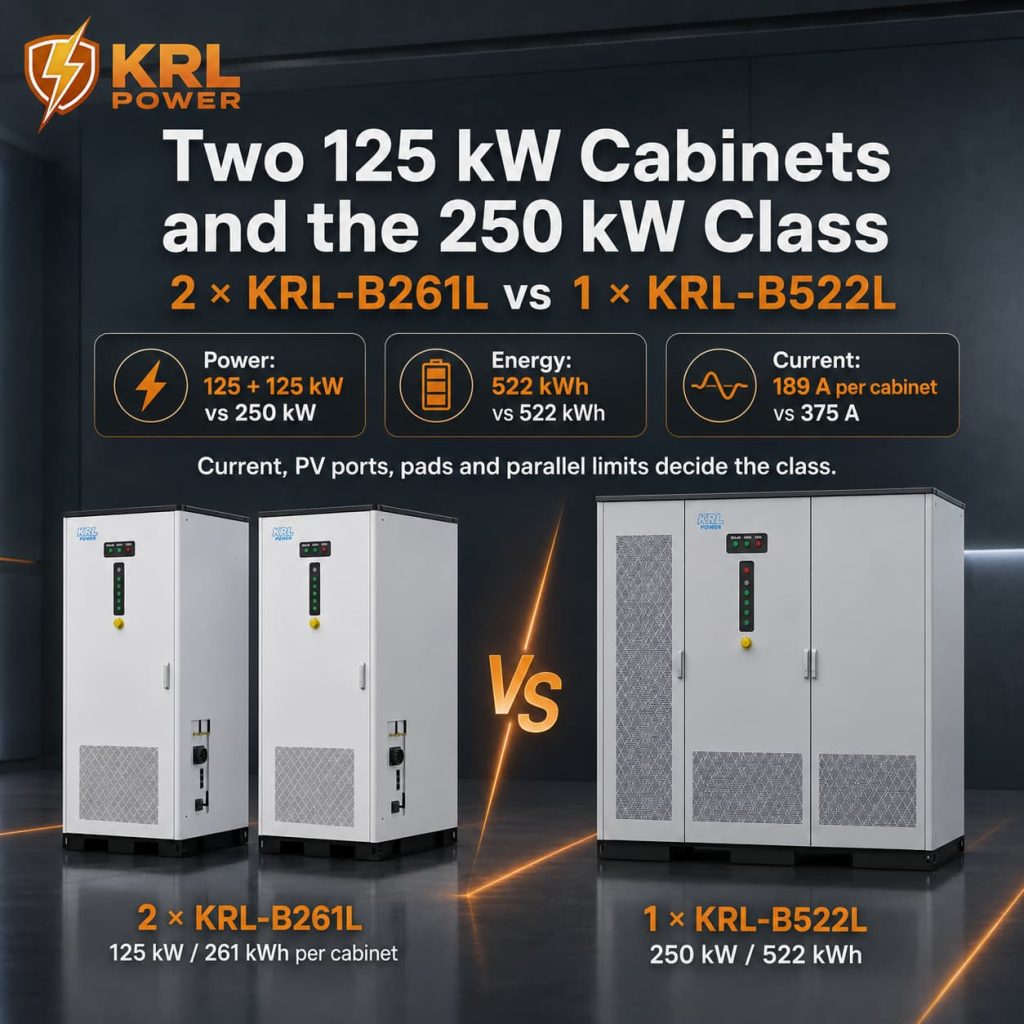
261 + 261 does print 250 kW and 522 kWh. That is the energy line. Current, PV ports and the pad stay on separate rows. I still price the pair and the single 250 kW cabinet as different machines. The rest of this page is the sheet that shows why.
| Quote line | What lands on site |
|---|---|
| One 375 A converter | Two 189 A converters |
| One 240 kW PV input | Two 120 kW PV inputs |
| One 4900 kg pad | Two 2600 kg pads |
| One diesel handshake | Two cabinets that both list a diesel port |
| One EMS object | Two boxes sharing one feeder plan |
KRL Krag keeps both classes on the outdoor list for that reason. The second box has its own ports, its own current limit and its own crane note.
What the two sheets print
I copy these rows into the comparison file and stop there. Empty cells on a live product page stay empty. I do not fill them from the other cabinet.
| Item | B261L | Two B261L | B522L |
|---|---|---|---|
| Model | KRL-B261L-125H3S-120M1-HX1 | two of that string | KRL-B522L-250H3S-240M2-HX1 |
| Power | 125 kW on-grid and off-grid | 125 kW + 125 kW | 250 kW on-grid and off-grid |
| Energy | 261 kWh | 522 kWh | 522 kWh |
| Max AC current | 189 A | 189 A per cabinet | 375 A |
| Voltage / frequency | 400 Vac / 230 Vac, 50/60 Hz | same | 400 Vac / 230 Vac, 50/60 Hz |
| Battery | 832 V, 314 Ah, LiFePO4 | two packs | 832 V, 628 Ah, LiFePO4 |
| Max PV | 120 kW | 120 kW + 120 kW | 240 kW |
| MPPT | 1 or 4 channels, 200 A | two separate inputs | 2 channels, 200 A + 200 A |
| Max PV voltage | 950 Vdc | same | 950 Vdc |
| MPPT window | 250-850 Vdc | same | 250-850 Vdc |
| Parallel limit | 10 | already two of ten | 6 |
| Diesel port | Yes | Yes on each | Yes |
| Switching | under 10 ms | under 10 ms each | under 10 ms |
| Communication | RS485 / WiFi | two nodes | RS485 / WiFi |
| Battery IP | IP65 | IP65 each | IP65 |
| Size | 980 x 1300 x 2320 mm | two footprints | 2480 x 1400 x 2050 mm |
| Mass | about 2600 kg | about 5200 kg on two lifts | about 4900 kg |
| Cooling | battery liquid, PCS intelligent | same on each | battery liquid, PCS intelligent |
| Window | -10 C to 55 C, 5-95%, under 2000 m | same | -10 C to 55 C, 5-95%, under 2000 m |
Energy matches. Wiring and steel do not.
261 / 125 is about 2.1 hours. 522 / 250 is about 2.1 hours. That is nameplate energy divided by nameplate power. Usable time is shorter. Four cuts come off before anyone should promise hours: the SOC window in the contract, DC to AC conversion, auxiliary load on the cabinet, and the reserve the operator refuses to empty. KRL does not publish one usable-energy percentage for every site. Hours belong in the configuration, measured at the agreed meter point.
If the feeder already needs 250 kW, the project language sits on the 522 kWh / 250 kW solar-storage-diesel cabinet page. This page is for the buyer still stacking two 125 kW boxes to avoid that drawing.
Shared lines that do not pick the class: LiFePO4, 832 V, liquid battery cooling, intelligent PCS cooling, fire protection listed Yes, IP65 on the battery, under 10 ms switching, diesel port Yes, RS485 / WiFi, -10 C to 55 C, 5-95% humidity, altitude under 2000 m. I leave those on both product pages. 125 kW or 250 kW still does the picking. So does 189 A or 375 A.
How the site usually presents itself
One feeder, 80-110 kW running, motors staggered. I keep one B261L on the table. Finish the start review before anyone locks 125 kW. A quiet Tuesday logger leaves the first ten seconds after an outage unproven. Night load on that same feeder can look even quieter. The class still follows the worst overlap, not the lunch-time average.
One feeder, 140-180 kW when two lines and a compressor overlap. I open B522L. Two B261L cabinets can print 250 kW and still hand the bus two 189 A converters. The plant asked for one 250 kW object. At 400 Vac three-phase, 125 kW near unity power factor sits around 180 A. The published ceiling is 189 A. 250 kW sits around 361 A. The published ceiling is 375 A. A 160 kW overlap already belongs on the 250 kW row before anyone talks about 522 kWh.
Two feeders that grow on different dates. Two B261L cabinets can be the honest buy. Feeder A stays on cabinet A. Feeder B stays on cabinet B. B261L still has room up to 10 if a third feeder appears later. The purchase order should keep the pair named as two B261L cabinets. The day someone ties those two AC outputs onto one process bus, the job has changed. That drawing needs a parallel study, protection settings and an EMS object that treats two converters as one feeder. I price that work before I call the pair a bargain.
The rest of the outdoor map lives in the commercial and industrial energy storage system selection guide. I only settle the 125-plus-125 shortcut here.
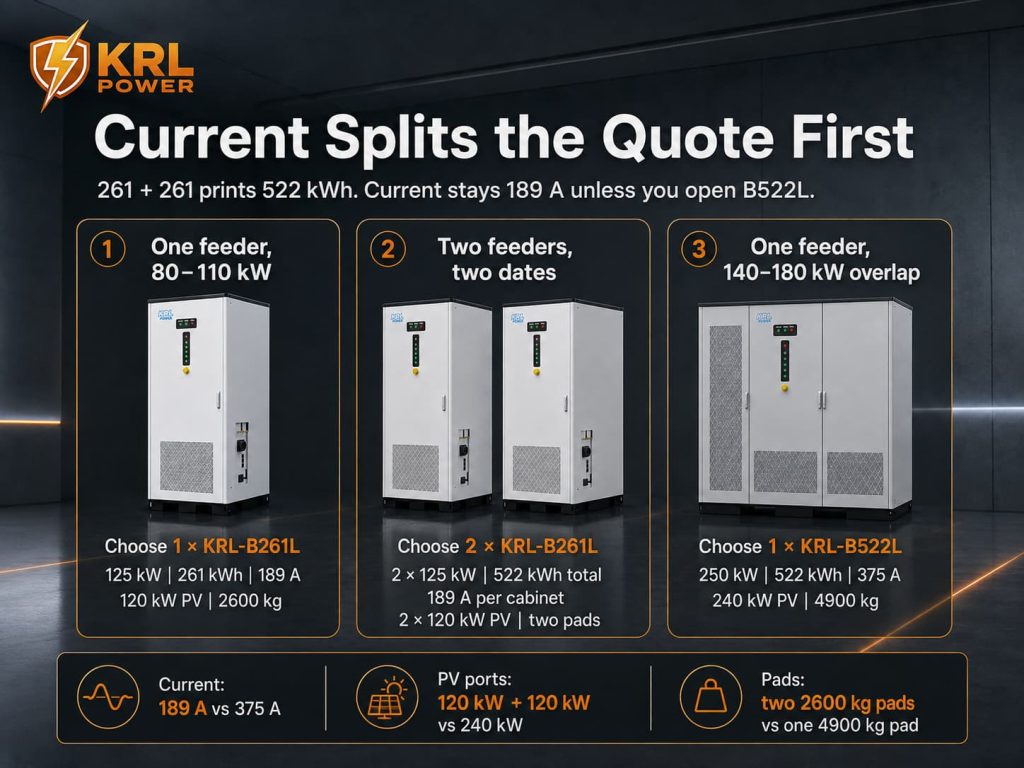
Current splits the quote first
189 A is the B261L ceiling. 375 A is the B522L ceiling.
Adding energy labels leaves each B261L on its own 189 A. If those two converters share one bus, EMS and protection have to coordinate them. B522L puts 375 A on one published converter.
I write the start package against that number.
- DOL motors on one feeder: check the first two seconds against 189 A or 375 A
- Soft starter or VFD: still write which machines close together
- Two dryers plus a compressor: one event on the logger
- Chargers that wake together: treat the wake as a start, even when the battery still looks full
The start math belongs with the motor-start page. This page keeps the current column honest. A 90 kW running log can still hide a 40 kW motor that closes with the dryer. That event lives on the current row. It does not live on the 261 kWh row.
Charging yards hit the same wall for another reason. Two DC chargers plus house load can sit above 125 kW while daily energy still looks modest. I size power before I size hours. A fuel-station layout that already lives at 250 kW is on the 250 kW / 522 kWh fuel-station energy storage page.
On-grid rated power and off-grid rated power are both 125 kW on B261L and both 250 kW on B522L. I do not treat the off-grid column as spare headroom. The sheet already printed the same kilowatt number on both sides.
Two ways to park two B261L cabinets
Keep them on two feeders. Cabinet A never sees feeder B. Each 189 A limit stays local. Each 120 kW PV port stays local. Each diesel port can follow its own feeder rule, or both can point at one generator if the start owner is written down. This is the drawing I accept when the plant grows as two processes.
Tie them to one process bus. The energy adds. The current limits stay two. Someone has to decide which cabinet takes the first motor, which cabinet takes the second, and what happens if one cabinet hits 189 A while the other still has room. Parallel number 10 on B261L allows that architecture. It does not erase the extra protection settings, the extra RS485 / WiFi node, or the extra spare-parts line. B522L avoids that conversation by putting 375 A on one converter.
I ask for the single-line before I accept either story. A verbal "we will parallel them later" is not a single-line.
PV ports stay where the sheet put them
B261L lists 120 kW PV, 950 Vdc max, 250-850 Vdc MPPT, 200 A, 1 or 4 channels.
B522L lists 240 kW PV, the same voltage window, 200 A + 200 A, 2 channels.
Two B261L cabinets reach 240 kW if both PV inputs are used and the roof is split. A single string plan into one cabinet still faces a 120 kW port.
Price the extra combiner, the extra trench and the extra MPPT map before anyone calls two cabinets cheaper. A roof already drawn as one 240 kW array wants the B522L port count. A roof that will be built in two phases can live on two 120 kW ports. Write the phase date next to the kW.
Diesel is listed Yes on both sheets. Two ports still need one start rule. Who closes the generator on nights: EMS, PLC, or a person. Write the name. Under 10 ms is the published changeover on both cabinets. A diesel set still needs seconds. In those seconds the signed load rides on the battery or it drops. Two cabinets do not shorten the generator start. They only add a second port that must obey the same rule.
Pads and cranes after the quote
| Buy | Footprint | Mass | Civil pack |
|---|---|---|---|
| One B261L | 980 x 1300 mm | about 2600 kg | one outdoor pad, one lift |
| Two B261L | two of those | about 5200 kg | two pads, two lifts, two cable sets |
| One B522L | 2480 x 1400 mm | about 4900 kg | one wider pad, one heavier lift |
B261L is the narrow cabinet: 980 mm wide, 2320 mm high. B522L is the wide cabinet: 2480 mm wide, 2050 mm high. A door that accepted the 980 mm box may reject the 2480 mm box. A pad poured 1.0 m wide will not take a 2.48 m footprint. Walk the route from the truck to the pad before the salesman leaves.
Two small cabinets can look easier to walk onto a tight yard. They can also book two crane visits. One 4900 kg cabinet is one visit and one set of anchors. Two 2600 kg lifts add up to about 5200 kg of steel plus a second set of AC cables, DC cables if PV is split, and earths.
A pad poured for 2.6 t will not hold 4.9 t. That invoice arrives after the salesman has left.
If the hall already sits at several hundred kilowatts, I stop stacking yard cabinets. Open KRL-B2M6L 1-2 MW / 2-6 MWh and name the exact model string: KRL-B1M5L-750H3S-720M6-HX1 or KRL-B2ML-1MH3S-960M8-HX1. B261L parallels to 10. B522L parallels to 6. Those limits stay inside the yard class. A 15 t or 19.5 t plant package is a different drawing.
Where the wrong class shows up
Lock 125 kW on a feeder that overlaps at 160 kW. The cabinet still has energy. The converter drops on the start. The line stops. Night-shift plants have already walked that sequence on the 2 a.m. factory blackout recovery page.
Buy two B261L cabinets and draw one 250 kW bus. You now own two current limits, two PV maps and two protection settings. The purchase order said 522 kWh. The electrician inherited two machines. Firmware updates arrive as two nodes. A fault on cabinet A can leave cabinet B holding a feeder it was never sized to hold alone.
Jump to B522L on a 90 kW feeder with no overlap. You paid for 250 kW and 4900 kg on a site that still fits 125 kW and 2600 kg. The extra steel does not calm the process. It does fill a pad that a second process might have used later.
Call two B261L a B522L in the tender. Spare parts, firmware, PV strings and the diesel handshake follow the wrong drawing. The storeman orders a 628 Ah pack language against a 314 Ah cabinet. The PV crew pulls 200 A + 200 A onto a port that lists 200 A.
Leave altitude off the inquiry and then park the cabinet above 2000 m. Both sheets cap altitude under 2000 m. Higher than that, ask for derating in writing. I do not invent the derating factor here.
What I ask for in the meeting
Name one protected feeder. If the meeting keeps adding halls, class is still open.
Write running kW, kVA and power factor from a logger that includes a bad day. Add each large motor, its kW and DOL / soft / VFD. Add which motors close in the same two seconds. Add the first ten seconds after the grid dies. Add PV target, 120 kW or 240 kW, and whether the roof arrives in one phase or two. Add diesel kept or removed, and the name of the start owner.
Then put that pack next to 189 A and 375 A.
I stay on one B261L when the pack stays inside 125 kW / 189 A and 261 kWh after reserve.
I open one B522L when one feeder needs 250 kW / 375 A, or 522 kWh in one object with one 240 kW PV map.
I buy two B261L cabinets when two feeders grow on two dates.
The outdoor list sits under KRL C&I energy storage systems. Drawing order before class is locked sits in how to design a commercial energy storage system.
Send the single-line, the motor list and the first-ten-second sheet. Class falls out of those three files.
Table you can paste into the inquiry
| Site fact | Class that fits | Cost if the class is wrong |
|---|---|---|
| 80-110 kW running, staggered starts | one B261L | extra 250 kW steel |
| 140-180 kW overlap on one feeder | one B522L | 189 A trips while 261 kWh is still full |
| Two feeders, two dates | two B261L | one 4900 kg pad on the wrong yard |
| Two B261L tied onto one process bus | parallel study first | two 189 A limits on a feeder that wanted 375 A |
| Roof already planned at 240 kW into one cabinet | B522L | 120 kW port rejects the extra string |
| Roof built in two phases at 120 kW each | two B261L or one B522L | decide before the first trench |
| Hall already at 400 kW and up | B2M6L model string | yard cabinets and plant current on the same drawing |
Questions I put on the vendor call
Which object holds 375 A: one converter, or two 189 A boxes?
How is PV landed: one 240 kW map, or two 120 kW maps?
Who owns the diesel start if two cabinets both list a port?
What pad and crane note sits next to 2600 kg and 4900 kg? Does the 980 mm cabinet fit the door that the 2480 mm cabinet will not?
If a third feeder appears, does the site still sit inside parallel 10 or parallel 6?
Which meter point will prove usable hours after the SOC window, conversion and reserve?
Ask those before the price column. Price follows class.