 Slaan oor na inhoud

One C&I cabinet can serve piekvlakking en outage backup, but both duties draw from the same battery energy. Before pricing, lock which duty owns the reserve.
Key buying decisions
- Primary duty: outage-first, bill-first, or a timed split the EMS can hold.
- Reserve: write backup reserve in kWh. KRL product tables do not publish a depth-of-discharge number.
- Power: size the converter on the higher kW requirement; size backup energy on the signed outage load and hours.
- Runtime: 261 kWh / 125 kW and 522 kWh / 250 kW are about 2.09 hours by simple nameplate division; 1.5 MWh / 750 kW is exactly 2 hours. These are not warranted backup runtimes.
- Escalation: if peak-window kWh plus reserve kWh do not fit one cabinet, compare a second cabinet with the next power class.
KRL classes in scope: KRL-B261L 125 kW / 261 kWh, KRL-B522L 250 kW / 522 kWh, en KRL-B2M6L plant-class BESS. Power class and energy duty are separate decisions; use the C&I ESS class-selection table when the converter class is not yet fixed.
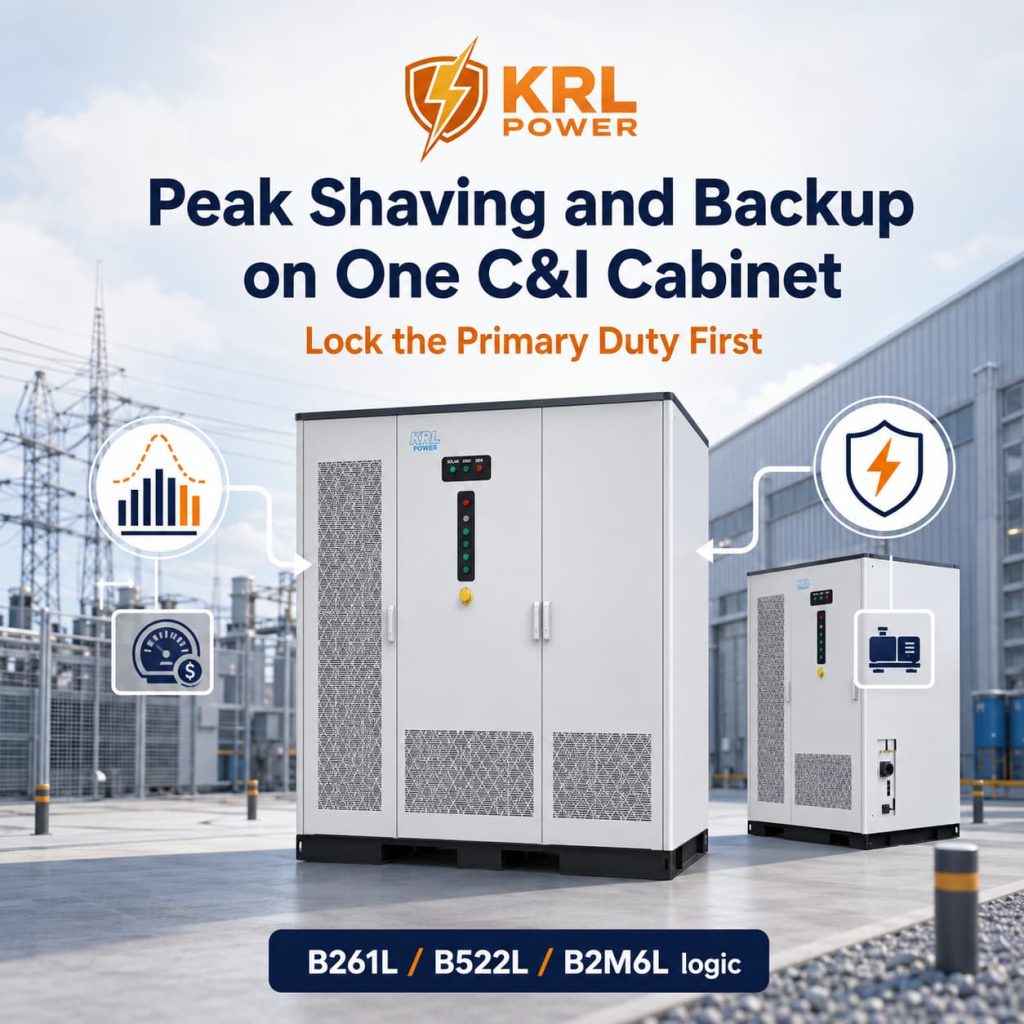
What the two jobs actually spend
Peak shaving runs on a timetable. The meter spike is known. The cabinet discharges into that window, then needs a recharge window before the next spike.
Backup runs on a date nobody put in the calendar. The signed load has to ride until the grid returns or the diesel owner starts the set.
Peak shaving needs four numbers on the logger before anyone prices it:
- Window start and stop
- kW in that window
- Days per week the window hits
- Recharge window after the discharge
Backup needs four different numbers:
- Signed load kW
- Signed hours
- Whether diesel stays
- Who owns the generator start
Add those two lists. If the sum already looks larger than 261 kWh or 522 kWh of usable energy the site will sign, one cabinet is already short.
| Job | Energy leaves the cabinet when | Energy must still be there when | What breaks if the job is ignored |
|---|---|---|---|
| Piekvlakvermindering | A tariff or demand window opens | The next recharge window closes | The bill stays high; the outage tank may already be low |
| Backup | The feeder dies | The signed hours are done | The line stops; the bill work is beside the point |
| Both, no reserve line | Either event | Neither event is guaranteed | The first long outage after a peak day exposes the quote |
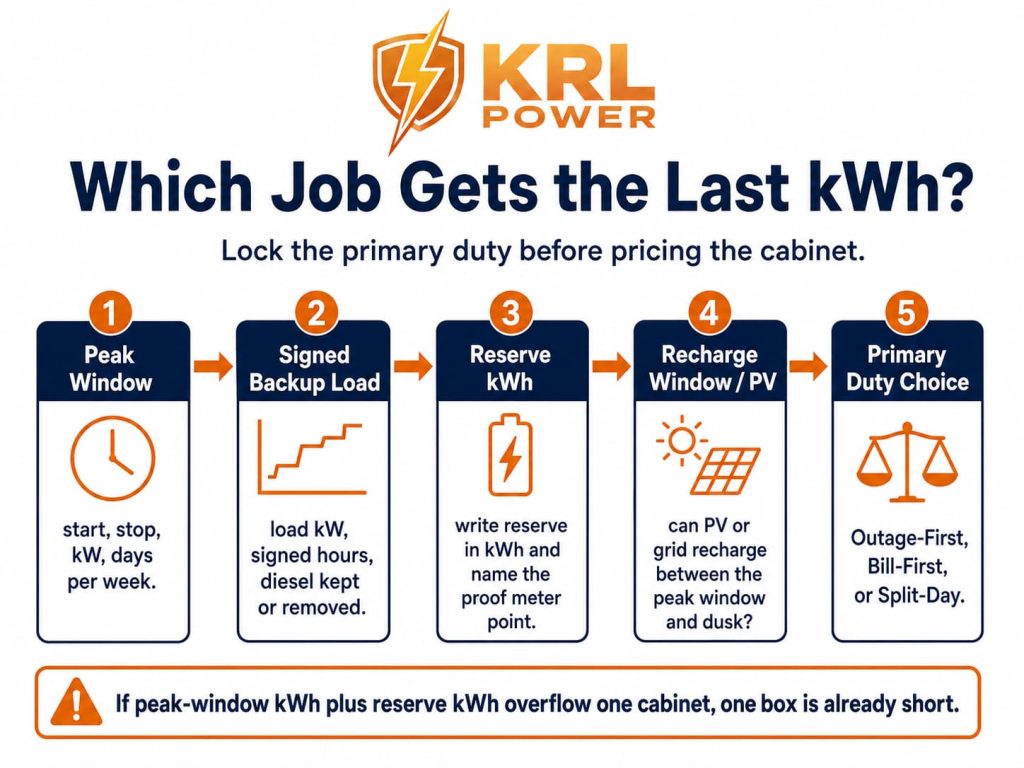
That double sentence on the form has a reason. On 31 July 2026 one commenter wrote that energy makes up 40% of manufacturers' cost in Nigeria, in a thread about factories and generation cost (X post, 31 Jul 2026). This is a single field comment rather than a national cost benchmark, but it illustrates why a manufacturer may ask one storage asset to reduce both grid cost and diesel runtime.
Diesel-hour math after duty is locked sits on the Industriële batterystoor vir dieselkostevermindering page. Night-shift dropout after a cabinet was already empty sits on the 2 a.m. factory blackout recovery bladsy.
Nameplate energy is not a second job
B261L publishes 261 kWh. B522L publishes 522 kWh. The B2M6L strings publish 1.5 MWh and 2 MWh. None of those pages add a second, hidden pile of kilowatt-hours for backup after a peak-shaving day.
261 kWh / 125 kW and 522 kWh / 250 kW are about 2.09 hours by simple nameplate division. 1.5 MWh / 750 kW is exactly 2 hours. Those are nameplate energy-to-power ratios, not warranted backup runtimes. A site that already spent energy at 16:00 and lost the feeder at 21:00 is a different sum.
Conversion sits in the middle. So does the SOC window the operator actually runs, and the reserve written for outage. KRL's published tables do not list a depth-of-discharge figure, so no DoD percentage is assumed here. Write the reserve in kWh and name the meter point that will prove it.
Work the paper hours only as a starting line, then subtract on site:
- Rated energy on the product page
- Minus conversion between DC and AC at the agreed meter
- Minus the SOC window the operator will actually run
- Minus the reserve kWh written for outage
What remains can do peak work. If nothing remains, the cabinet is backup-only.
Illustrative project assumption on B261L, without inventing a KRL percentage: 261 kWh / 125 kW is about 2.09 hours by simple nameplate division if the tank starts full and the load sits at rated power. If the project specification reserves 120 kWh for a signed night load, the peak window has to live in whatever is left after conversion and the operating SOC window. The reserve and peak window must therefore be written against the same 261 kWh nameplate energy budget.
The next sizing step is to test the written reserve against the peak window. If the two no longer fit one cabinet, the project needs a second cabinet or the next power class.
How the site usually writes the form
Common forms look like this:
- Afternoon peak cut plus a two-hour ride-through, with the quote spending the full 261 kWh or 522 kWh on both sentences. The first hot afternoon plus a late feeder fault is the test that quote never ran.
- Backup-only on the first line, then "also shave if possible" in a footnote. Six months later the EMS cycles every weekday, and the night outage meets a cabinet that already worked.
- Solar on the roof and a diesel set in the yard. Take PV, cut the peak, ride the outage, handshake the generator. Four jobs on one port.
The diesel port is listed Yes on B261L, B522L and both B2M6L strings. Under 10 ms is the published changeover. A diesel set needs seconds. In those seconds the signed load rides on whatever energy is left. Name the start owner: EMS, PLC, or a person.
PV landing and the diesel handshake by class sit with the hardware pages, and with the 522 kWh / 250 kW solar-storage-diesel cabinet note when the feeder is still inside 250 kW.
Incoming current can kill the plan before energy does. A warehouse-modification comment on 25 August 2026 described robotics forcing a new hookup and a substation run because the building had been wired for minimum expected use (X post, 25 Aug 2026). That remains an incoming-side constraint; dual duty does not change the published maximum AC-current limit of 189 A or 375 A, depending on model.
Lock the primary duty before the price column
Outage-first keeps the signed ride-through hours in the cabinet until the event. Peak shaving may use only the energy above that reserve. If the reserve already fills most of 261 kWh, B261L is a backup cabinet that can nibble a peak. Treat it that way in the quote.
Bill-first spends the capex on the peak window. Backup is whatever remains after the window, plus whatever PV can put back before dusk. If the feeder dies during the discharge window, the line sees a partial tank. Say that in the meeting. Finding it on the floor is late.
A split day is a control setting. Peak work before 18:00, reserve after 18:00, if the logger supports it and the EMS can hold it. The split does not mint extra kilowatt-hours.
| Primary duty | What the EMS is allowed to spend | What stays untouched | Wrong class of promise |
|---|---|---|---|
| Outage-first | Energy above the written reserve | Signed outage kWh | “Also shave the monthly peak” with no leftover kWh |
| Bill-first | The peak window | Only what remains after the window | “Also ride a two-hour night outage” after a full peak day |
| Split-day | Day window only | Evening reserve | A setting that nobody can show on a logger |
The inquiry should name one of those three operating modes explicitly before the price column is reviewed.
Motors still trip converters. An outage-first 125 kW cabinet still has to pass the start review, and the required ESS AC current must remain within the B261L published 189 A maximum AC-current limit. Motor-start current is covered in the 125 kW motor-start review, while the cabinet-class decision stays in the two B261L vs one B522L comparison. Dual duty does not change either electrical limit.
Where one cabinet stops holding both jobs
One cabinet runs out of room when any of these show up:
- Peak-window kWh plus reserve kWh already overflow the usable energy the site will write against 261 kWh or 522 kWh
- Peak kW and backup kW are different numbers, and the quote used only the smaller one
- The recharge gap between 17:00 and 21:00 has no PV and no grid window
- Diesel stays, but nobody owns the start, so the signed load rides only on leftover battery energy
Illustrative site example: afternoon HVAC plus a process line may present a 200 kW peak, while the signed night backup load may be 80 kW. Size the converter on the 200 kW peak requirement and calculate reserve energy from the 80 kW signed backup load and required hours. These are project assumptions, not KRL product ratings.
When the hall has already left 250 kW, energy arguments move with the plant box. That jump is the 750 kW / 1 MW BESS versus stacked yard cabinets page. A 750 kW or 1000 kW string still needs a reserve line. The larger nameplate does not create a second job for free.
Plastic and welding halls that already sit above one B522L are written on the 300 kW plastic-plant battery storage page and the 500 kW welding-plant energy storage page. Those project cases cover the load shape; the remaining procurement decision is how peak-shaving energy and outage reserve share the same battery capacity.
What belongs in the meeting pack
Bring this pack:
- Primary duty in one line
- Peak window: start, stop, kW, days per week
- Signed outage: load kW, hours, diesel kept or removed
- Reserve in kWh, plus the meter point that will prove usable hours
- PV kW, and whether the roof can recharge between the peak window and dusk
- Incoming transformer kVA and the motor list with start method
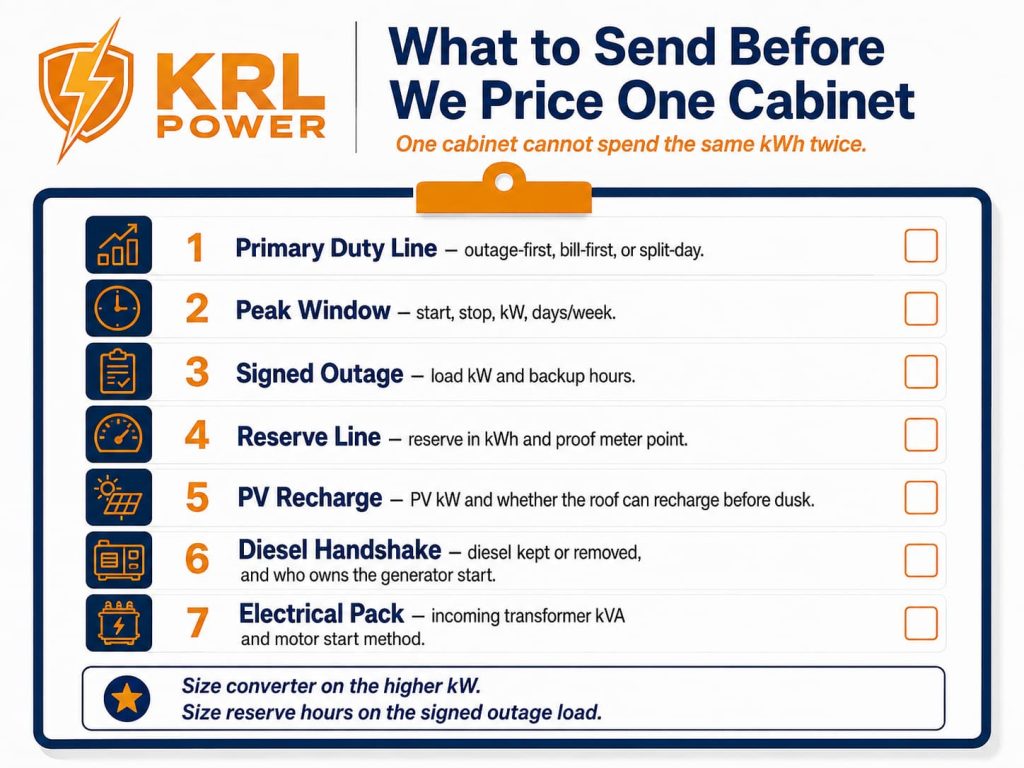
Dual duty does not waive the published maximum AC-current limits: 189 A, 375 A, 1130 A or 1500 A, depending on model.
After duty is locked, continue the buying path with the Keuse-gids vir kommersiële en industriële energiestoorstelsels en commercial energy storage system design. Product hardware is listed under KRL C&I-energiebergingstelsels.
Send the duty line, the peak window and the reserve kWh. Class and hours fall out of those three.
Table you can paste into the inquiry
| Site sentence | Primary duty | What to buy next |
|---|---|---|
| Ride the outage; bill cut is extra | Outage-first | B261L or B522L sized on signed load and reserve kWh |
| Cut the peak; outage is leftover | Bill-first | Same cabinets, EMS capped so reserve is whatever remains |
| Both numbers already exceed 261 kWh | One cabinet is short | Compare a second cabinet with the next power class |
| Example: peak kW is 200 and signed night backup is 80 | Two project load numbers | Size the converter on the 200 kW requirement; calculate reserve from the 80 kW signed backup load and required hours |
| Diesel stays | Handshake plus reserve | Name the start owner; under 10 ms is not generator start |
| Class still unknown | Stop | Set the 125 / 250 / 750 / 1000 kW class before assigning energy duty |
