

A 90 kW lunch-time trace looks safe next to a 125 kW nameplate.
Then the withering line, the dryer and the compressor start in the same two seconds. The converter drops out. The battery still has energy. The line still stops.
Public comments from plant floors keep landing on the same moment. On 26 August 2026, a small-factory owner wrote on X that a one-second electrical surge smoked a DC motor, took a line down, and left an $8,000 rewind and a week of missed shipments. That post is one operator’s Wednesday, not an industry average. It is the kind of minute a storage cabinet has to survive if it is standing in front of those motors.
KRL Power puts the converter, the battery, the cooler and the ports in one outdoor cabinet so that minute has a published rating to stand against. The KRL-B261L 125 kW / 261 kWh sheet gives the same 125 kW on-grid and off-grid, 189 A, transfer under 10 ms, PV up to 120 kW, a diesel port, battery liquid cooling, IP65 on the battery, and parallel up to 10. That is what lands on the pad. The start review still has to match those numbers. The sheet does not replace the motor list.
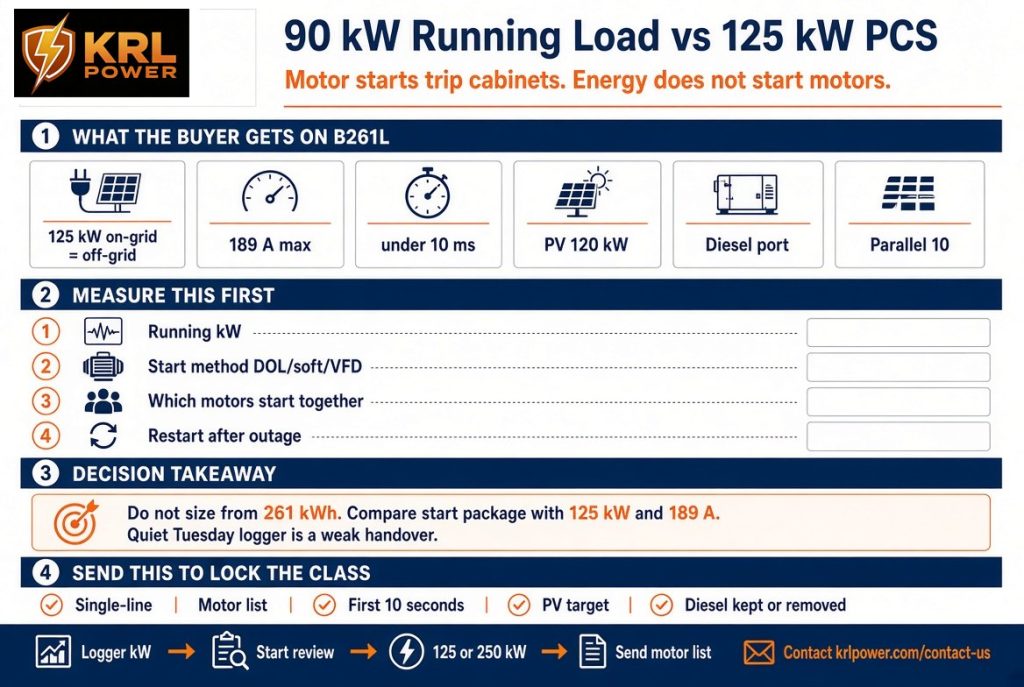
| What you measured | What buying B261L puts on the pad |
|---|---|
| 80–110 kW steady process load | 125 kW AC, same rating on-grid and off-grid |
| Grid dies on the process feeder | Transfer under 10 ms on the published PCS path |
| Roof PV in the 100 kW class | PV input already on the cabinet, max 120 kW |
| Long night after usable energy | Diesel port already on the cabinet |
| Second feeder later | Parallel published to 10 |
| Outdoor yard | Battery liquid cooling, IP65 battery, fire protection listed |
If you only screenshot one block, screenshot that.
Running kW and starting kVA are different instruments
I size the converter from the feeder that must stay up, then from the start sequence on that feeder.
Steady process load is the lunch-time logger. Starting current is the instant three contactors close. Direct-on-line motors take a harder bite than a soft starter. A VFD takes a different bite again. The B261L page does not publish a DOL inrush curve. So this page does not invent one.
What the page does publish:
- Model: KRL-B261L-125H3S-120M1-HX1
- 125 kW on-grid, 125 kW off-grid
- 400 Vac / 230 Vac, 50/60 Hz
- 189 A maximum AC current
- LiFePO4, 832 V, 314 Ah, 261 kWh
- Battery liquid cooling, PCS intelligent cooling
- Switching under 10 ms
- Altitude under 2000 m
Those lines are why B261L is the first screen for one factory feeder. The converter rating does not change when the grid drops. PV and diesel do not arrive as a second sketch. Cooling and IP65 are already on the outdoor sheet.
Ask the motor shop for nameplate kW, start method, and which machines can close together. Then compare that package with 125 kW and 189 A. If two dryers can still bump, the start review is still open.
The wider class map sits in the commercial and industrial energy storage system selection guide.
Three feeder shapes that keep coming back
These are not project case studies. They are the questions a measured feeder usually produces.
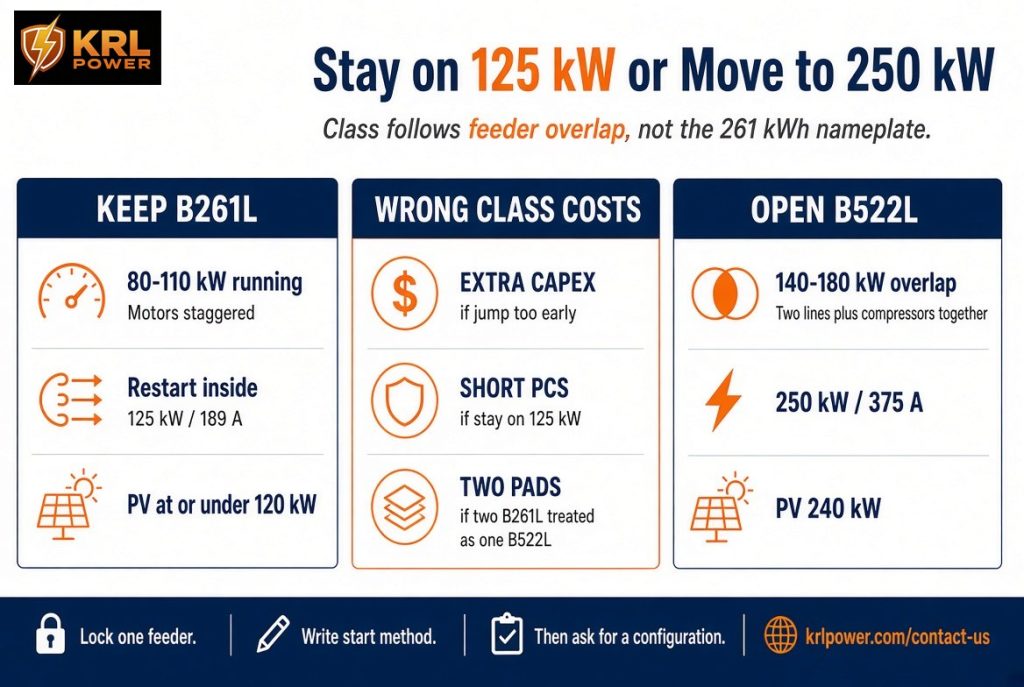
80–110 kW running, motors staggered. B261L is the first screen. Confirm start method. If the logger never saw two large machines start together, get that in writing from operations. A staggered start on paper can still collapse on a restart after an outage, when every interlock comes back at once.
110–125 kW running, or 80 kW with two DOL compressors. The nameplate still says 125 kW. Margin is already thin. Finish the start sequence before the cabinet is on the truck. If the overlap sits in the 250 kW class, open KRL-B522L 250 kW / 522 kWh. That sheet rates 250 kW and 375 A.
140–180 kW when two lines overlap. B261L power is already short. Energy may still look like “one 261.” The converter is the constraint.
Plant-scale current belongs on the KRL-B2M6L 1-2 MW / 2-6 MWh class. Orders use the exact model string: 750 kW / 1.5 MWh or 1000 kW / 2 MWh.
What 261 kWh does and does not buy you
261 / 125 is about 2.1 hours. That is published energy divided by published power.
Four cuts come off before anyone should promise hours:
- The SOC window written into the contract
- Conversion from DC to AC
- Auxiliary load on the cabinet itself
- Reserve the operator refuses to empty
KRL does not publish one usable-energy percentage for every site. This page will not invent one. Hours belong in the configuration, measured at the agreed meter point.
A motor-start event lasts seconds. Energy is the wrong instrument for that event. Current and converter rating are the right ones.
Same warning if the project later moves to 250 kW, 750 kW or 1000 kW. The arithmetic changes. The order of work does not.
Restart after the grid dies is the ugly case
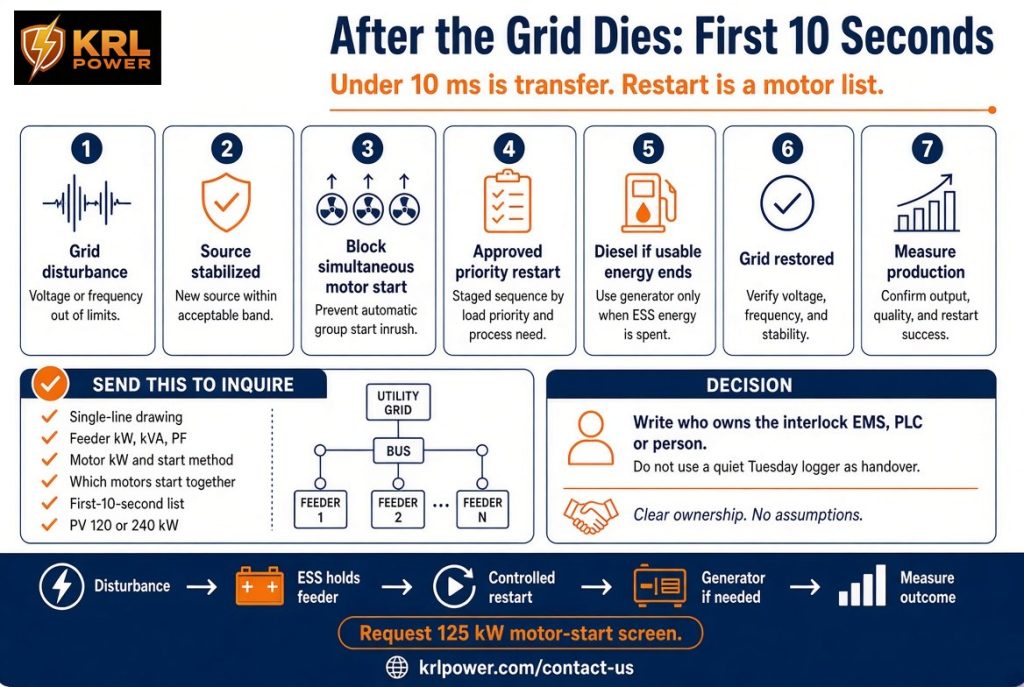
Under 10 ms is the published transfer time on B261L, B522L and B2M6L. Coolant does not create it. The PCS and the changeover path do.
A diesel set still needs seconds. In those seconds the signed load either rides on the battery or it drops.
The worse minute is the restart. Contactors that were staggered at 10 a.m. often close together when the interlocks come back. Soft starters that were in auto may be in bypass after a trip. That is why a 90 kW trace from a quiet Tuesday is a weak handover document.
Write the restart sequence into the file:
- Which motors are allowed to start in the first 10 seconds
- Which motors wait
- Who owns that interlock: EMS, PLC, or a human
- What happens if the diesel port has to pick up the rest of the night
Diesel hours after the converter class is fixed: industrial battery storage for diesel cost reduction.
Ports that sit on the same 125 kW box
PV and diesel are already on the B261L sheet. A second vendor does not need to invent those ports later.
| Port | Published on B261L |
|---|---|
| PV max | 120 kW |
| PV voltage | 950 Vdc max, MPPT 250–850 Vdc |
| PV current | 200 A |
| MPPT | 1 or 4 channels |
| Diesel generator port | Yes |
| Communication | RS485 / WiFi |
If the roof is already 150 kW, 120 kW is short. If two feeders will grow, parallel count is 10 on B261L and 6 on B522L. Two B261L cabinets add to 250 kW / 522 kWh on paper. They are still two converters, two pads and two PV inputs. Price them as different machines.
Project language for the 250 kW cabinet also sits on the KRL 522 kWh / 250 kW solar-storage-diesel cabinet page.
Five misses that look cheap on the quote
Buying 261 kWh to start three motors. Energy does not close a DOL contactor.
Treating 125 kW as a 20% spare over 100 kW running. Spare on a logger is not spare on a start.
Copying a VFD site onto a DOL site. Start method travels with the motor, not with the battery brochure.
Leaving the restart sequence out of the file. The quiet Tuesday trace will not repeat after an outage.
Pouring a 2.6 t pad and then moving the project to B522L. B261L is about 2600 kg. B522L is about 4900 kg. B2M6L published pairs sit near 15 t or 19.5 t.
Cost context without a made-up LCOE: commercial energy storage cost guide.
What to send before class is locked
- Single-line drawing
- The feeder that actually needs protection
- Measured kW, kVA, power factor
- Motor list: kW, start method, which ones start together
- Restart sequence after a trip
- Ambient and altitude
- PV target against 120 kW or 240 kW
- Diesel kept or removed
- Hours needed at the agreed SOC window
- Handover: transfer time, usable AC kWh at the meter
The outdoor list: KRL C&I energy storage systems. Applications: KRL industrial energy storage applications. Inverter-side notes: 100 kW energy storage inverter in C&I systems.
KRL Power contact channel. One feeder. Start method on the page. Usable energy at the agreed window.
More notes: KRL BESS knowledge center.