


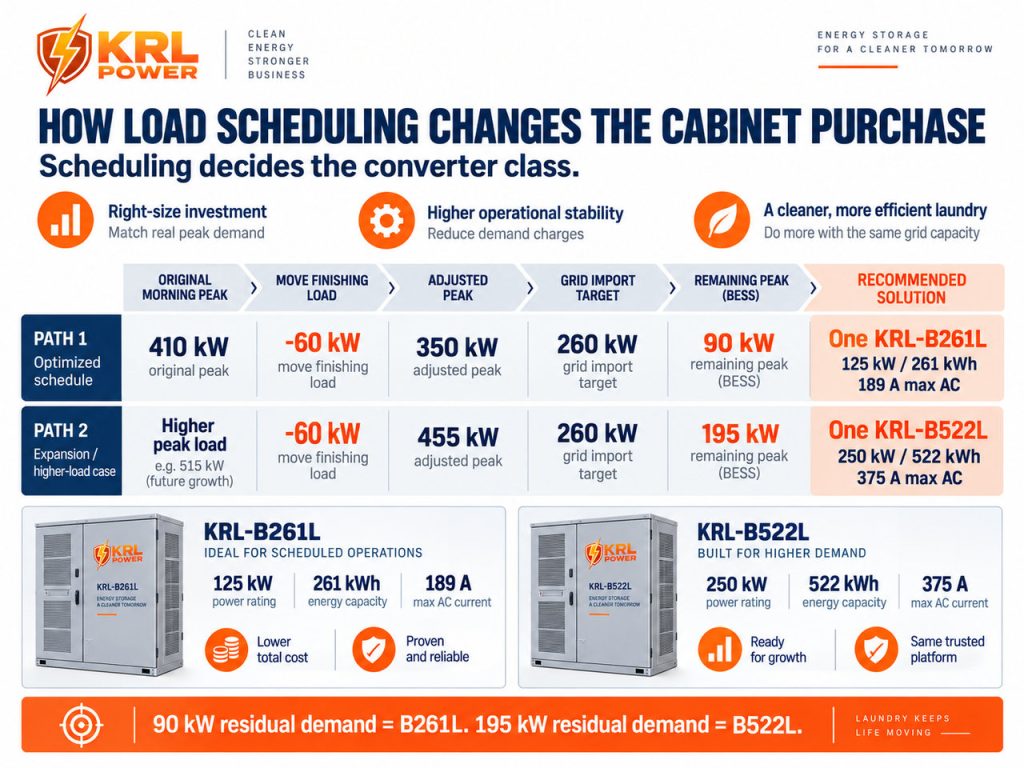
Morning demand charges can be set by a brief overlap of washing, drying and finishing, even where every batch must meet its delivery deadline. Move a 60 kW finishing stage into a genuine off-peak production slot and specify KRL-B261L (125 kW / 261 kWh) for the remaining 90 kW gap. That leaves 35 kW of nominal converter headroom without stepping up to a 250 kW cabinet.
Die B261L's 125 kW / 189 A limits support the first equipment screen. Expansion that leaves 195 kW on a common bus moves the purchase to B522L's 250 kW / 375 A class. A later move into the KRL cabinet and plant range should follow a new measured power or energy requirement, not an assumed growth allowance.
Separate the Billed Morning Peak from Motor Starting Current
The utility bill records sustained demand according to its tariff. A motor may draw a large starting current for a second and trip protection without creating the same average demand over a 15- or 30-minute billing interval. Read the interval data to size peak shaving; record voltage and current at higher resolution to assess starting behavior.
PG&E’s published demand-charge explanation identifies the highest 15-minute interval of the billing month for applicable business plans. This is one utility’s billing method, not a tariff assigned to this laundry. The site’s own agreement determines its demand interval, applicable peak windows and any ratchet before an avoided kW can be translated into a bill reduction. The half-hour schedule below uses constant loads within each displayed block; a 15-minute tariff requires matching 15-minute demand records before confirming the billed maximum.
| Record | What the designer can decide |
|---|---|
| Demand intervals at the billed meter | Power above the import target and total event kWh |
| Starting current and voltage trace | Motor inrush, voltage dip and PCS/protection coordination |
| Wash-to-dry-to-finish batch timing | The stage that can move without breaching a linen-delivery deadline |
| Transformer, main switchboard and single-line diagram | BESS connection, current limits and the meter affected by discharge |
Die KRL motor-start analysis for a 125 kW PCS addresses the overload and restart review for an extractor or compressor. The laundry's 125 kW versus 250 kW purchasing decision comes from its sustained post-scheduling peak; neither rated converter power nor a billing trace certifies motor-start ride-through.
Move One Finishing Stage and Change the Cabinet Purchase
The first shift cannot move its entire finishing line without risking the linen-delivery cut-off. One electrically heated finishing stage, however, has a 30-minute slot later in the morning. Moving that stage leaves washing and drying on schedule and takes 60 kW off the crowded 08:00 interval.
A laundry with a 260 kW grid-import target can schedule the work as follows. Its 60 kW finishing stage runs for 30 minutes, consuming 30 kWh whether it starts at 08:00 or 10:30. The later load rises from 170 kW to 230 kW, staying below the 260 kW target.
| Time | Load before staging | Load after staging | Production action |
|---|---|---|---|
| 08:00–08:30 | 410 kW | 350 kW | Move the 60 kW finishing block; preserve washer and dryer throughput |
| 08:30–09:00 | 335 kW | 335 kW | Keep the committed dry/finish sequence |
| 09:00–09:30 | 300 kW | 300 kW | Complete the morning batch |
| 10:30–11:00 | 170 kW | 230 kW | Finish the shifted work without exceeding the 260 kW target |
The 60 kW schedule change cuts the battery's required peak discharge from 150 kW to 90 kW. A single 125 kW B261L could not supply the original 150 kW gap; the published 250 kW B522L is the next single-cabinet class. At 90 kW, B261L passes the rated-power screen with 35 kW of nominal headroom. The buyer avoids stepping up a converter class for a finishing load that can run later without compromising throughput.
The plant manager controls that move: 10:30–11:00 must still meet the delivery schedule, and the shifted interval must stay below the import target. Continuous electric drying and hot-water demand need their actual running hours in the load profile. For gas-fired dryers, count electrical motors and auxiliaries, not the burner’s thermal input.
Die KRL commercial storage selection process begins with the same measured operating duty. Here, the decisive input is the post-scheduling load: it must fit B261L's converter and leave enough energy and charging time for the next linen batch.
Specify KRL-B261L for the 90 kW Residual Demand Gap
Specify one KRL-B261L for the scheduled 90 kW morning peak. It combines a 125 kW rated AC converter, 261 kWh rated LFP energy and a 189 A maximum AC-current rating in one cabinet, with battery liquid cooling and a 120 kW direct-PV input limit. Those published figures put the smaller unit on the first equipment drawing; the finish line's later operating slot removes the reason to order a 250 kW converter for this peak alone.
The 260 kW import target gives the following discharge profile after scheduling:
| Interval | Plant demand | B261L discharge | Delivered AC energy |
|---|---|---|---|
| 08:00–08:30 | 350 kW | 90 kW | 45 kWh |
| 08:30–09:00 | 335 kW | 75 kW | 37.5 kWh |
| 09:00–09:30 | 300 kW | 40 kW | 20 kWh |
| Morning total | 350 kW maximum | 90 kW maximum | 102.5 kWh |
At 08:00, the schedule removes 60 kW and B261L supplies 90 kW, taking grid import from 410 kW to the 260 kW target for that interval. The same dispatch must also meet the actual tariff's interval length. A lower monthly bill depends on whether another interval becomes the billed maximum; demand savings cannot be inferred from the cabinet label.
The remaining demand is 90 kW, leaving 35 kW nominal headroom against the B261L rating. At a balanced 400 V three-phase connection and unity power factor, that output corresponds to approximately 130 A; the cabinet lists 189 A maximum AC current. Voltage variation, reactive power and derating belong in the connection check. The separate energy test is 102.5 kWh delivered AC across the morning event after SOC restrictions, losses, auxiliaries and any protected reserve.
The buyer gains a clearly bounded single-cabinet specification: 125 kW for the residual peak, 261 kWh rated energy for the delivery assessment and 189 A maximum current for the feeder design. The cabinet also lists a direct-PV input and diesel port; those connections add options to a future design without increasing its 125 kW AC rating.
Specify KRL-B522L When the Residual Gap Reaches 195 kW
An expanded laundry has 485 kW at the main bus after feasible scheduling. Its 290 kW import target leaves a 195 kW battery requirement, above one B261L's continuous rating. Specify KRL-B522L: one cabinet provides 250 kW rated AC power, 522 kWh rated battery energy and 375 A maximum AC current, with battery liquid cooling.
The 195 kW peak leaves 55 kW of nominal converter headroom. At a balanced 400 V connection and unity power factor, approximately 281 A is required, within B522L's published 375 A maximum. The final feeder, protection and reactive-power settings still determine the approved operating current. A single 125 kW B261L cannot be counted as 195 kW of steady-state supply.
| Scheduled duty | KRL purchasing decision | Engineering consequence |
|---|---|---|
| 90 kW maximum; 102.5 kWh AC per morning event | One B261L | 125 kW rated converter covers the smaller steady-state peak |
| 195 kW for 90 minutes | One B522L as the first design | 250 kW power class; requires 292.5 kWh delivered AC |
| 195 kW for two hours | B522L with energy-duty review | 390 kWh delivered AC; reserves and losses narrow the operating window |
| Required discharge exceeds 250 kW | Parallel or plant-class configuration | One 250 kW converter no longer meets the duty |
A 90-minute period at 195 kW requires 292.5 kWh delivered AC. The 522 kWh nameplate creates an energy-design starting point, but the usable SOC window, conversion losses, temperature, auxiliaries and outage reserve determine the validated runtime. The two-hour case consumes 390 kWh on the AC side before those allowances.
Die 240 kW direct-PV input limit is twice B261L's published 120 kW. It gives an expanding laundry a larger solar-connection option where array design, MPPT allocation and available charging energy support it. PV input and AC output are different equipment limits: the B522L remains a 250 kW rated AC unit.
For this common-bus duty, B522L consolidates the required power into one converter instead of splitting it across two B261L cabinets. It also doubles the rated battery energy. A 90-minute, 195 kW event demands 292.5 kWh at AC, so the larger nameplate supports a more substantial energy-design starting point while the usable-energy check sets the actual discharge window.
KRL can compare the 195 kW duty with the B522L's current rating, delivered-energy window and planned solar connection before the laundry commits to a cabinet layout.
Can the Cabinet Recharge Before the Second Laundry Batch?
A laundry with a second linen batch at 14:00 has a harder test than a single morning peak: the battery must deliver again after a short charging window. Charging draws power through the import meter too. An unrestricted recovery schedule can create a new billed maximum at midday.
For the B522L duty above, 195 kW × 1.5 hours = 292.5 kWh of delivered AC. A midday window with only 60 kW of grid-import headroom from 09:30 to 13:30 supplies 240 kWh at the connection before charging losses. It cannot fully replace the morning's delivered energy. Buying a larger kWh nameplate alone does not create more electricity between batches.
On a day when the next batch begins at 16:00, a six-hour window with 70 kW of spare import offers 420 kWh before losses. The difference changes the purchasing review: a longer recharge window may recover the energy, whereas buying a larger battery does not fix a 240 kWh supply opportunity. Confirm charge/discharge losses, auxiliaries and coincident PV on the same metering boundary before locking the second-shift duty.
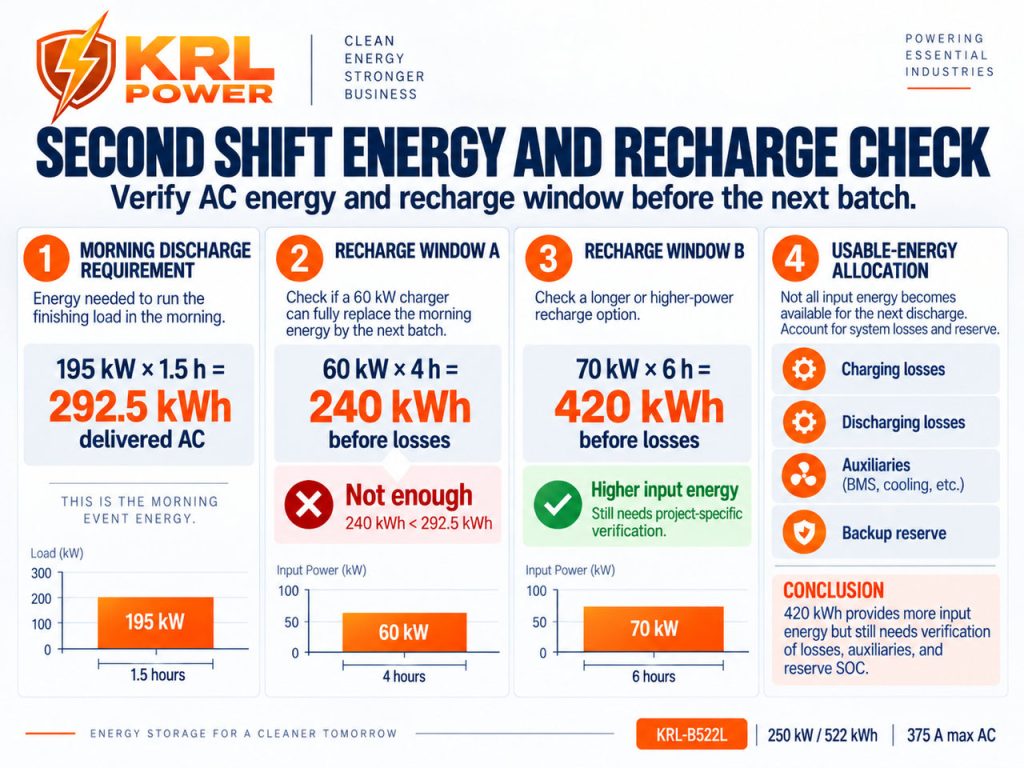
Backup reserve competes with this recharge budget. In the KRL peak-shaving and backup allocation, energy committed to an outage cannot also be scheduled into the second linen batch. The duty sheet should show both discharge windows, intervening charging and protected reserve.
Keep Heating Demand and Backup Promises in Separate Contracts
Morning peak shaving serves the billed meter. Backup serves an approved critical-load bus during an outage. Both duties draw from the same usable battery energy, so any mandatory backup reserve reduces how much the laundry can discharge into the tariff peak.
Some laundries need to preserve PLCs, pumps, ventilation, extraction controls or a controlled stop during outages. Keeping all electric dryers and heating elements energized for hours is a much larger obligation. The project load list must say whether the battery protects an orderly shutdown, partial throughput or unrestricted full-plant operation. Neither B261L nor B522L can be credited with instant, whole-factory continuity from its rated kWh alone.
Both models list under-10 ms on/off-grid switching and a diesel-generator port. Backup still requires a protected bus, switching/islanding logic, coordinated protection and an acceptable motor restart sequence. A controlled stop for selected pumps and PLCs is a different power and energy order from keeping every heated dryer running. Set the reserve for the actual protected loads, then give the remainder to peak shaving.
A short motor start is a separate protection and overload test. Staggering wash cycles may reduce overlap at the tariff meter but will not certify PCS ride-through at the instant a heavily loaded extractor accelerates. Record both tests without treating them as a single kW number.
Put the Cabinet Outside the Wet Process Zone
Both models publish battery liquid cooling and IP65 for the battery subsystem. A commercial laundry's wet processing hall exposes equipment to steam, washdown water and detergents; the battery's IP rating does not establish the complete cabinet's suitability for those conditions. Put the electrical assembly at a location supported by its installation documentation.
Specify an appropriate outdoor pad and electrical room interface. The site layout should establish access for maintenance and lifting, drainage, ventilation clearances, cable routes, impact protection and a fire strategy appropriate to the jurisdiction. Product pages list approximately 2,600 kg for B261L en 4,900 kg for B522L. This changes the lifting plan, foundation and future replacement route; one large cabinet is not just two small cabinets drawn side by side.
Die KRL liquid-cooling comparison places battery thermal management in the context of outdoor installation. Use the cabinet's ambient operating limit and service-clearance requirements on the site drawing; do not equate the battery cooling method with a promised maintenance-cost reduction.
Choose One B522L or Two B261L by the Electrical Arrangement
Two B261L units total 250 kW and 522 kWh on nominal addition. Their current paths, foundations, controls and PV inputs remain separate. One B522L publishes a 375 A maximum AC current and one integrated 250 kW converter; two B261L units publish 189 A per cabinet. At a laundry feeding one common 195 kW peak-shaving bus, the single B522L is the direct first purchase configuration.
Two B261L cabinets make sense when separate buildings receive capacity in stages and each feeder has its own approved connection. Their combined nameplates do not automatically supply 250 kW on one bus. The KRL one-versus-two-cabinet design compares the separate current paths and installation scope. For a single 195 kW laundry bus, the B522L's integrated converter remains the direct configuration.
B261L lists up to 10 units in parallel; B522L lists up to six. Parallel-count limits do not approve an interconnection by themselves. Where power rises into the several-hundred-kilowatt range, the KRL 750 kW / 1 MW configuration comparison brings plant-scale equipment into the purchase discussion alongside bus current, energy duty, space and delivery sequence.
Put the Scheduled Peak and the Second Batch on the Equipment Order
The equipment order should carry the operating schedule that produced the rating. An engineer reading the document needs the scheduled morning maximum, the critical overlap that cannot move, the delivered-energy requirement and the energy available before the next batch.
| Production result | KRL specification | What the owner gains |
|---|---|---|
| 60 kW finishing load moved; residual peak 90 kW and 102.5 kWh AC event | B261L: 125 kW / 261 kWh, 189 A max | One 125 kW converter class; 35 kW nominal power headroom |
| Expansion leaves 195 kW for 90 minutes on one bus | B522L: 250 kW / 522 kWh, 375 A max | One 250 kW power block; first energy screen at 292.5 kWh AC |
| Second batch follows with too little recharge energy | Adjust charging window or energy configuration | Prevent a system that can shave only the first shift |
| Critical controls require outage continuity | Dedicated backed-up bus and protected SOC | Keep an outage reserve available after morning dispatch |
The scheduled finishing move cuts the first case's converter requirement by 60 kW, leaving the 125 kW B261L to cover the 90 kW gap. A 195 kW residual peak on one bus moves the purchase to B522L's 250 kW class. The order should include both the morning discharge and the second-batch recovery duty; a cabinet that misses the next shift's peak cannot deliver the intended tariff result.
KRL can compare the B261L and B522L installation options against the approved production timetable and electrical connection, including where a staged two-cabinet design has an actual advantage.