 Skip to content

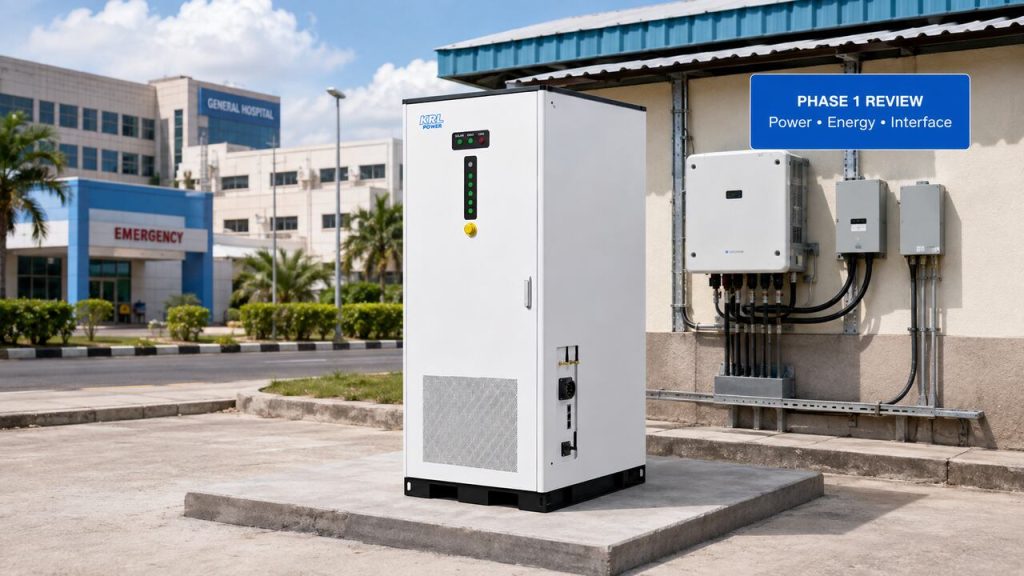
Factory expansion does not always require an immediate transformer replacement. When a new production line creates a measured, time-limited power deficit, specify KRL-B261L for the 125 kW class, KRL-B522L for the 250 kW class, or KRL-B2M6L when expansion reaches 750 kW or 1 MW. The battery must also have enough energy and a real recharge window between events.
The KRL-B261L 125 kW / 261 kWh gives a factory a defined smaller power block. The KRL-B522L 250 kW / 522 kWh doubles that cabinet power class. Expansion involving several feeders belongs in the KRL C&I ESS class-selection path before equipment is ordered.
Separate a Temporary Power Deficit from Permanent Transformer Undersizing
BESS solves a transformer-capacity problem when the factory has enough energy available over the operating day but cannot supply enough instantaneous power during specific production periods.
A plant may have a 500 kW usable import boundary while the existing process normally consumes 400–430 kW. Adding a machine that occasionally lifts plant demand to 600 kW creates a temporary 100 kW deficit. Battery storage can inject that missing 100 kW while keeping transformer import near the established limit.
The same logic fails when expansion pushes the plant above its supply capability for most of the day. A 500 kW connection feeding a new 620 kW continuous production profile has no meaningful recovery period. Storage would discharge while production is high and find insufficient spare grid capacity to recharge before the next cycle.
| Site condition | What it means for the BESS decision |
|---|---|
| New demand exceeds available import only during identifiable periods | Storage can target a defined power deficit |
| Excess demand lasts for a measurable number of minutes or hours | Required battery energy can be calculated |
| Spare import capacity or approved PV energy exists later | The battery can recover before the next event |
When all three are present, storage can defer an immediate transformer project while supporting factory expansion. When the third condition is absent, transformer or utility-capacity expansion remains part of the long-term electrical solution.
Calculate the Real Capacity Gap in kW, kVA and Amps
Transformer nameplate kVA is not the BESS power requirement. Start from the maximum import that the existing transformer, utility connection, protection scheme and operating policy can actually support. Compare that boundary with the new coincident factory demand.
Required BESS power = New coincident site demand − permitted transformer/grid import
A factory limited to 500 kW that reaches 600 kW after expansion creates 600 kW − 500 kW = 100 kW. That is a 100 kW battery-support requirement, not a 600 kW battery requirement.
Real factory systems also need an apparent-power and current check. At a three-phase connection: kVA = √3 × Voltage × Current / 1000 and approximately Current = kW / (√3 × Voltage × power factor).
Power factor matters. At 400 V and 0.95 power factor, a 100 kW contribution is about 152 A. A 210 kW contribution is about 319 A. KRL publishes 189 A maximum AC current for B261L and 375 A for B522L, so current can reject a configuration even when the simple kW calculation appears acceptable.
The KRL motor-start review covers the next constraint: a production line can remain below its running kW limit and still exceed the PCS envelope when compressors, pumps or process motors start together.
Specify KRL-B261L When the Deficit Stays Inside the 125 kW Class
KRL-B261L is the first product screen when factory expansion creates a measured deficit that remains inside the 125 kW cabinet class.
| B261L specification | Published value |
|---|---|
| Rated AC power | 125 kW |
| Rated battery energy | 261 kWh |
| Maximum AC current | 189 A |
| AC connection | 400/230 Vac |
| Maximum PV input | 120 kW |
| Switching time | <10 ms |
| Parallel capability | Up to 10 |
| Battery cooling | Liquid cooling |
| Battery enclosure | IP65 |
A factory with a 90–110 kW expansion deficit does not need to jump directly to a 250 kW cabinet merely because total factory consumption is much larger. The existing transformer continues carrying the permitted base import while B261L supplies the missing portion.
Consider a new production stage that creates a 100 kW deficit for 45 minutes: 100 kW × 0.75 h = 75 kWh. The power requirement fits the 125 kW class and the initial load-side energy requirement is 75 kWh.
That does not mean 261 kWh should be treated as 261 kWh of guaranteed delivered AC energy. Final operation must retain the agreed SOC window and account for conversion losses, cabinet auxiliaries, temperature, reserve requirements and battery condition.
The cabinet's published 120 kW PV input and diesel-generator port also give the project additional operating routes after the transformer-capacity problem has been solved.
Move to KRL-B522L When the Expansion Gap Reaches the 250 kW Class
Once the measured deficit moves beyond B261L's power or current boundary, specify KRL-B522L before forcing a smaller cabinet into a duty it cannot carry.
| B522L specification | Published value |
|---|---|
| Rated AC power | 250 kW |
| Rated battery energy | 522 kWh |
| Maximum AC current | 375 A |
| AC connection | 400/230 Vac |
| Maximum PV input | 240 kW |
| Switching time | <10 ms |
| Parallel capability | Up to 6 |
| Battery cooling | Liquid cooling |
A new process combination requiring 210 kW of support already excludes one B261L on power. At 400 V and 0.95 power factor, the corresponding three-phase current is approximately 210,000 / (√3 × 400 × 0.95) ≈ 319 A. That is inside the published 375 A B522L current boundary, subject to the complete project electrical review.
If that 210 kW deficit lasts 90 minutes, 210 kW × 1.5 h = 315 kWh. The preliminary power and energy screen points toward the 250 kW / 522 kWh cabinet. Delivered AC energy at the project's actual SOC limits still has to be confirmed before the order is frozen.
One B522L is also not automatically equivalent to two B261L cabinets. The two B261L versus one B522L comparison separates converter count, current paths, PV interfaces, pads, cabling and future expansion.
Move to B2M6L When Factory Expansion Becomes Plant-Scale
Several expanded production feeders can move the project beyond single-cabinet logic. The KRL-B2M6L plant-scale platform currently provides two published reference configurations.
| Configuration | Rated power | Rated energy | Maximum AC current | Maximum PV |
|---|---|---|---|---|
| KRL-B1M5L-750H3S-720M6-HX1 | 750 kW | 1.5 MWh | 1130 A | 720 kW |
| KRL-B2ML-1MH3S-960M8-HX1 | 1000 kW | 2 MWh | 1500 A | 960 kW |
A factory whose new lines create a 650 kW deficit for 90 minutes requires 650 kW × 1.5 h = 975 kWh. That duty has already moved beyond one 250 kW cabinet. The 750 kW / 1.5 MWh configuration becomes a logical first plant-scale screen because both required power and preliminary load-side energy remain below its published ratings.
The final choice can still be a parallel cabinet architecture where physical layout, staged expansion or feeder separation favors modular cabinets. KRL's 750 kW / 1 MW versus C&I cabinet comparison covers the point where repeated cabinets stop being the cleanest electrical architecture.
Size Battery Energy from Deficit Duration, Not Transformer Nameplate
Transformer capacity determines the power shortage. The length of that shortage determines the first energy calculation: Load-side energy requirement = Power deficit × duration.
| Power deficit | Duration | Initial load-side energy |
|---|---|---|
| 100 kW | 15 min | 25 kWh |
| 100 kW | 45 min | 75 kWh |
| 100 kW | 90 min | 150 kWh |
| 210 kW | 30 min | 105 kWh |
| 210 kW | 90 min | 315 kWh |
| 210 kW | 2 h | 420 kWh |
| 650 kW | 30 min | 325 kWh |
| 650 kW | 90 min | 975 kWh |
| 650 kW | 2 h | 1,300 kWh |
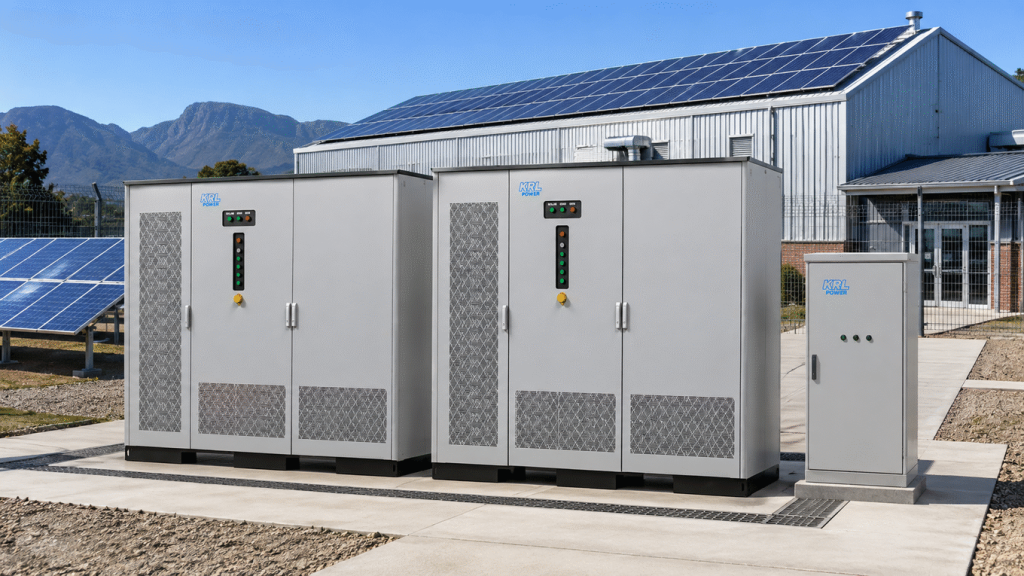
These figures describe energy required by the load during the constrained interval. They are not guaranteed battery runtimes. A 100 kW problem lasting 30 minutes and a 100 kW problem lasting four hours need the same PCS power but completely different battery-energy configurations. Selecting the system from transformer kVA alone misses that difference.
The broader KRL commercial energy storage selection guide separates power, battery energy and operating objectives before the project reaches detailed design.
Prove the Recharge Window Before Ordering the Battery
A BESS that successfully supports the first production peak can still fail the project if it cannot recharge before the next one. Available recharge energy can be screened from the unused import capacity between constrained periods.
Recharge headroom = Import limit − normal site demand
A plant with a 500 kW import limit may drop to 460 kW after the expanded production batch ends. That leaves 500 kW − 460 kW = 40 kW. Three hours at that level creates 40 kW × 3 h = 120 kWh gross grid headroom.
A previous 100 kW × 45 minute support event consumed 75 kWh at the load side. The 120 kWh gross grid headroom gives a credible preliminary recovery window, with final charging limits and losses still to be applied.
Now change the recovery period to only 20 kW of spare import for two hours: 20 kW × 2 h = 40 kWh. That cannot replace a 75 kWh load-side discharge before accounting for charging losses. The battery will enter the next production event at a lower SOC.
- Reduce the supported load.
- Extend the recharge period.
- Add an approved charging source such as usable PV.
- Increase grid or transformer capacity.
Storage shifts energy through time. It cannot create a missing daily energy supply.
EMS Must Hold the Transformer Import Limit in Real Time
A transformer-capacity BESS needs a control objective that is different from simple scheduled charging. The EMS must see the electrical boundary being protected and adjust battery output as factory demand changes.
At a simplified level: BESS output = Site demand − permitted import setpoint when site demand exceeds that setpoint.
If factory demand falls below the import target, discharge can reduce or stop. Charging must not push the transformer back above the same limit.
The measurement point matters. A meter placed on the wrong feeder can tell the battery that transformer loading is safe while another production feeder is already consuming the remaining headroom.
KRL's public product specifications list communication interfaces, but the project still has to define the actual meter, communication protocol, update rate, fail-safe behavior and control ownership.
The published <10 ms switching time is a different function. It describes the on-grid/off-grid switching path; it is not a published guarantee for the response speed of a transformer-import limiting algorithm. That distinction prevents two acceptance tests from being mixed into one requirement.
Check Switchgear, Cables and Motor Starts Before Calling the Project Solved
Reducing transformer import does not automatically reduce every current in the factory. Suppose a new 200 kW line is connected to an existing low-voltage board and a nearby BESS supplies 150 kW of it. The upstream transformer may see only the remaining 50 kW contribution, but the downstream bus, breaker and cable serving the production area can still carry the full combined load according to where the battery is connected.
- Transformer loading.
- Main switchboard rating.
- BESS connection breaker.
- Production feeder current.
- Cable ampacity.
- Short-circuit duty.
- Protection selectivity.
- Motor starting and restart sequence.
KRL publishes 189 A maximum AC current for B261L, 375 A for B522L, 1130 A for the 750 kW B2M6L configuration and 1500 A for the 1 MW configuration. Those figures turn the system from a kWh purchase into an electrical-integration decision.
Motor starts need another check. A 100 kW running deficit can briefly become a much harder converter duty when compressors, pumps or large motors close together. KRL's public cabinet pages do not provide a complete motor-inrush envelope, so the final project should use confirmed PCS transient data and the real machine starting sequence.
Thermal conditions also stay in the design. Both cabinet classes publish liquid battery cooling; the KRL liquid-cooling comparison shows why cooling selection and electrical rating should remain separate engineering checks.
Worked Case 1: Add a Batch Process Without Replacing a 500 kW Supply Immediately
Existing factory demand normally reaches 420 kW. Available transformer and grid import is limited to 500 kW. The new process adds 180 kW during one 45-minute production stage.
Maximum coincident demand becomes 420 + 180 = 600 kW. Battery requirement is 600 − 500 = 100 kW. Energy required during the 45-minute event is 100 × 0.75 = 75 kWh.
At 400 V and 0.95 power factor, 100 kW corresponds to approximately 152 A. KRL-B261L publishes 125 kW, 261 kWh and 189 A, putting this duty inside its first power/current screen.
After the batch ends, factory demand falls to 460 kW for three hours: 500 − 460 = 40 kW recharge headroom and 40 × 3 = 120 kWh gross headroom. The project therefore has a credible power class, preliminary energy window and recovery period. Final configuration still verifies usable battery energy, charge limits, losses, motor starts and protection.
Installing a 250 kW cabinet solely because the whole factory reaches 600 kW would oversize the PCS against the actual 100 kW transformer deficit.
Worked Case 2: A Second Production Line Pushes the Deficit Above 125 kW
Existing production consumes 640 kW during the relevant shift. The existing import boundary is 700 kW. A new line increases coincident demand to 910 kW for 90 minutes.
Required battery support is 910 − 700 = 210 kW. Required load-side energy is 210 × 1.5 = 315 kWh. At 400 V and 0.95 power factor, 210 kW is approximately 319 A.
One B261L is rejected immediately because 210 kW exceeds its 125 kW power rating. KRL-B522L publishes 250 kW / 522 kWh / 375 A, so it fits the preliminary power, current and rated-energy screen.
Production later drops to 590 kW for four hours: 700 − 590 = 110 kW and 110 × 4 = 440 kWh gross recharge headroom. That provides more preliminary recovery space than a case with only 80 kW of headroom for four hours, which would offer 320 kWh before charging losses and would already be too tight against a 315 kWh AC discharge event.
The recharge calculation changes the purchase decision even though both cases use the same 250 kW cabinet.
Keep the BESS Useful After the Transformer Is Eventually Upgraded
Deferring transformer work does not require the battery to become redundant when the electrical infrastructure is later expanded. Once the transformer bottleneck disappears, the same ESS can be reassigned to other duties that match the approved site design.
- Outage support for selected production loads.
- PV energy capture.
- Grid-import management.
- Generator coordination.
- Staged expansion of additional feeders.
- Controlled on-grid/off-grid operation.
B261L publishes 120 kW maximum PV input and a diesel-generator port. B522L raises PV input to 240 kW and also lists a diesel port. B2M6L extends those functions into larger plant power classes.
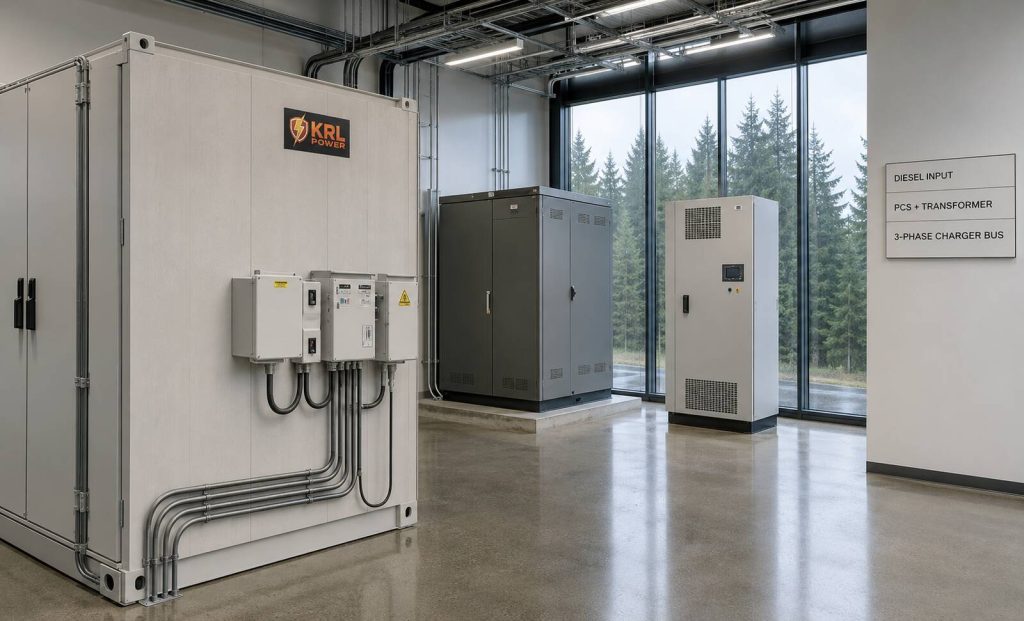
The wider KRL commercial and industrial ESS range allows the battery purchase to be evaluated as part of the factory's long-term power architecture, not only as a temporary transformer workaround.
A transformer-capacity project is strongest when the battery has a clear job on day one and another useful operating role after the grid connection catches up with production growth.
