


Bangladesh's 2026 rooftop solar incentive improves the case for factory solar, but it also makes one bad shortcut more tempting: exporting every surplus solar kWh simply because a tariff now gives that energy an obvious price. A factory with evening production, diesel consumption or unstable grid supply should first compare the value of exporting that energy with the value of storing it in BESS and using it later.
That choice can materially change the economics of the rooftop project.
The government published a special rooftop-solar incentive notice on 1 September 2026, and the national rooftop-solar programme now groups the incentive with the country's net-metering and implementation documents. Reporting on the scheme places the grid-feed tariff at Tk 10.50/kWh for eligible surplus rooftop generation under the new framework.
For a factory owner, the headline is easy to like:
Generate solar. Export the surplus. Get paid.
That headline leaves out the part that matters after sunset.
A kilowatt-hour exported at noon is gone.
If the same factory then buys electricity again at 18:00, starts a diesel generator at 20:00, or loses production during a grid interruption at 22:00, management has to ask whether selling that midday kWh was really its highest-value use.
Battery storage matters when keeping that energy on site is worth more than sending it away.
KRL Power does not need to convince a factory that rooftop solar works. The new policy is already pushing the market in that direction.
The more valuable question comes after the daytime load is covered:
What should the factory do with the next surplus solar kWh?
Bangladesh Has Changed the Rooftop Solar Economics
The September policy turns rooftop solar into a three-way energy decision, not merely a self-consumption project.
A factory can consume solar immediately, export eligible surplus electricity, or store part of the surplus for a later shift.
The government's National Rooftop Solar Programme now brings the incentive notice, the 2025 net-metering guideline and implementation material into the same policy framework. A separate September analysis reported an ambition of up to 4,000 MW of rooftop solar within one year, pointing specifically to factories, textile and garment facilities, warehouses, commercial buildings and other large rooftops as major deployment opportunities.
That matters because Bangladesh has exactly the kind of industrial load profile where the solar decision does not end at sunset.
Garment factories, dyeing plants, spinning mills, food processors and cold-chain operations can continue drawing substantial electricity after rooftop PV output begins falling.
The country's recent energy pressure makes that distinction even sharper. Reuters reported in September that Bangladesh's garment industry was dealing with power and fuel shortages; in the example it examined, 4A Yarn Dyeing was already obtaining around 40% of its energy from solar and was planning a battery system as part of a broader effort to reduce exposure to power disruption and rising fuel costs. That is a market example, not a KRL project, but it shows why industrial buyers are now looking beyond solar generation alone.
The policy is pushing more solar onto factory roofs, while operating reality is forcing factories to ask what happens after the panel has produced the electricity.
For multi-shift plants, this is where BESS becomes an operating decision rather than an accessory to solar.
The New Tariff Does Not Mean “Export Everything”
A tariff of Tk 10.50/kWh looks attractive because it gives surplus generation a visible number.
But the visible number is not automatically the highest number.
The mistake is treating the tariff as the whole value of the kWh.
A factory should compare three values:
| Solar energy path | Economic question |
|---|---|
| Direct self-consumption | What grid purchase does this kWh avoid immediately? |
| Grid export | What payment or credit does this kWh receive? |
| BESS → later factory load | What evening grid, diesel or interruption cost does this kWh avoid after storage losses? |
The wrong decision is to assume:
Export tariff = value of solar.
The correct decision is:
Export tariff = one possible value of solar.
Suppose a factory has strong midday PV production and its daytime production load already consumes most of it.
The first solar kWh should usually go straight into the factory load because there is no reason to route useful energy through a battery when the plant can consume it immediately.
The difficult decision begins only when:
PV generation > simultaneous factory load
Once PV output rises above simultaneous factory demand, the surplus can either leave through the approved export arrangement or enter storage.
A factory that automatically exports everything is making a financial decision without checking what happens six hours later.
That can be expensive.
If the factory buys power again after sunset, pays for diesel generation, or has a signed critical evening load, one stored kWh may be worth more internally than one exported kWh.
The new incentive gives surplus solar a clearer price; it does not remove the need to compare that price with the value of keeping the energy on site.
Calculate Whether One Stored kWh Is Worth More Inside the Factory
Start with the kWh, not the cabinet.
Do not start with a battery brochure.
Start with the value of the energy.
For export:
Export Value = Eligible Export Energy × Export Tariff
For storage:
Stored-Use Value = Avoided Grid/Diesel Cost + Avoided Peak Cost + Avoided Interruption Value − Storage Losses − Battery Operating Cost
Storage only earns a place if the later internal value beats the export alternative after losses and operating cost.
The factory should use its own electricity bill, diesel records and interval-load data.
Do not invent a national industrial tariff and pretend every plant pays the same price.
Do not assume every exported kWh receives the same treatment under every connection arrangement.
Use the actual meter, contract and operating profile.
Illustrative factory screen
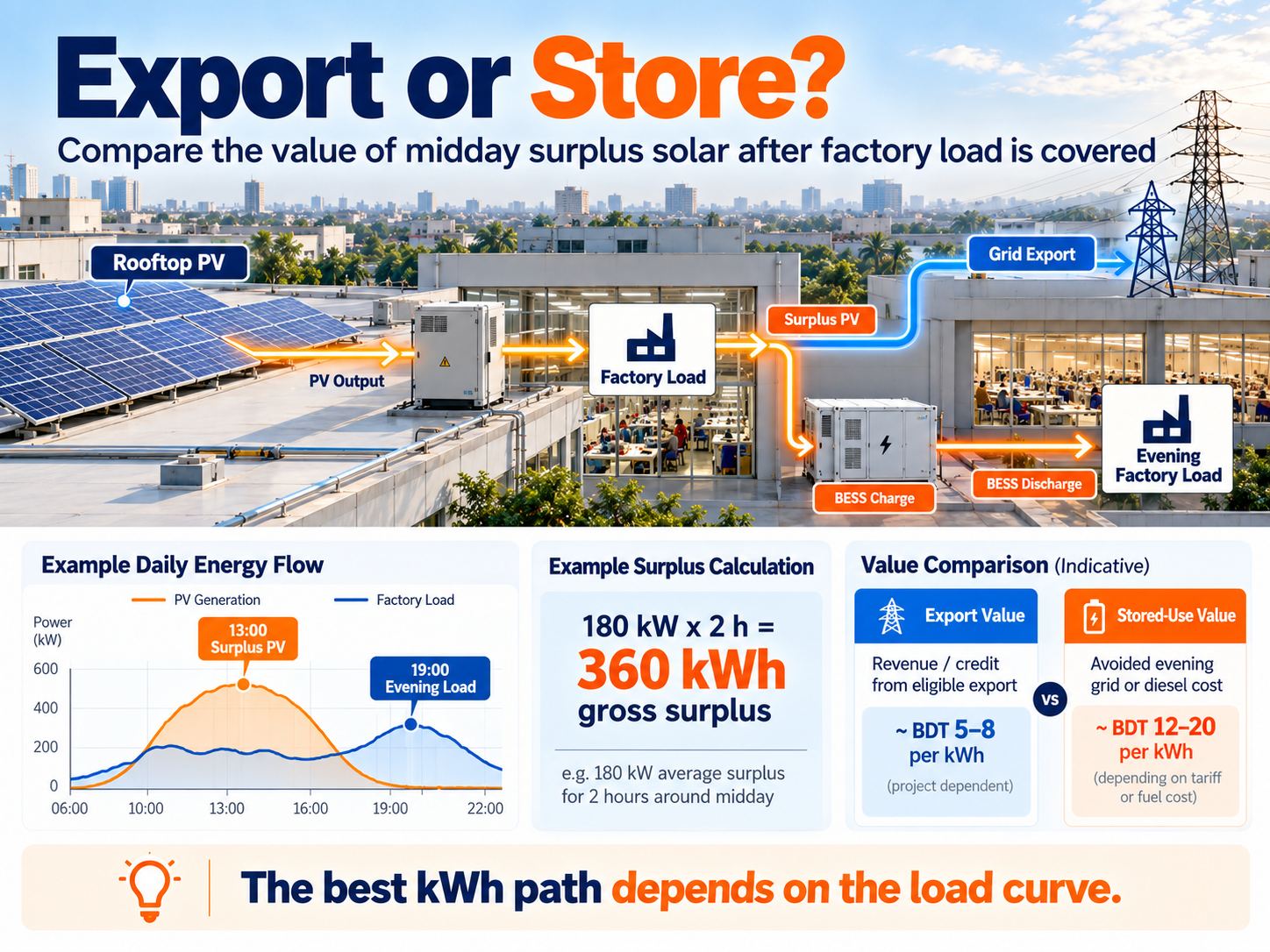
Assume a garment factory has 180 kW of repeatable surplus PV for two midday hours.
That represents:
180 kW × 2 h = 360 kWh of gross surplus solar energy
At that point, the factory has a real allocation decision.
If it exports the whole block, the commercial value comes from the applicable export mechanism.
If it stores the block, it can later offset part of an evening production load.
The battery does not magically return the full 360 kWh at the AC load. Conversion losses, auxiliaries, reserve SOC and battery operating limits have to be allowed for.
But the comparison is still obvious:
What does the factory earn by exporting the energy?
versus
What does the factory avoid by keeping part of that energy for the evening shift?
This is the point where the battery case either becomes commercially credible or falls apart.
If export is clearly more valuable and the factory has no evening deficit, no diesel exposure and no useful reserve requirement, do not force BESS into the project.
If evening self-use is more valuable, exporting everything is leaving money outside the factory gate.
Factories with Evening Loads Have the Strongest BESS Case
The strongest BESS case is rarely the factory with the biggest roof.
It is the factory with the biggest mismatch between when solar is available and when electricity is valuable internally.
That mismatch appears clearly in multi-shift manufacturing.
Imagine a factory whose rooftop PV peaks from late morning through early afternoon.
Production continues through the evening.
At 13:00, the site may have surplus solar.
At 19:00, the same site may be buying grid electricity or running diesel.
The plant may have enough energy across the day and still buy expensive power after sunset because generation and demand occur at different times. Storage closes that timing gap.
This is why garment production, spinning, textile processing, refrigeration, food processing and other long-shift industrial sites deserve a serious BESS screen.
For a multi-shift factory, the operating sequence is simple:
Daylight: PV feeds factory load first.
Midday surplus: excess PV either exports or charges BESS according to the approved control strategy.
Late afternoon / evening: BESS discharges into the factory load.
Long outage or depleted battery: retained grid/diesel architecture takes over according to the site design.
KRL's 250 kW / 522 kWh solar-storage-diesel architecture is directly relevant to this operating model because PV, battery, grid interaction and diesel support have to be coordinated as one energy system rather than bought as unrelated boxes.
The plant should stop asking:
“How many batteries fit beside the factory?”
It should ask:
“How many surplus solar kilowatt-hours are available, when does the factory need them back, and what converter power is required when they are discharged?”
Match the Surplus Solar Power to B261L or B522L
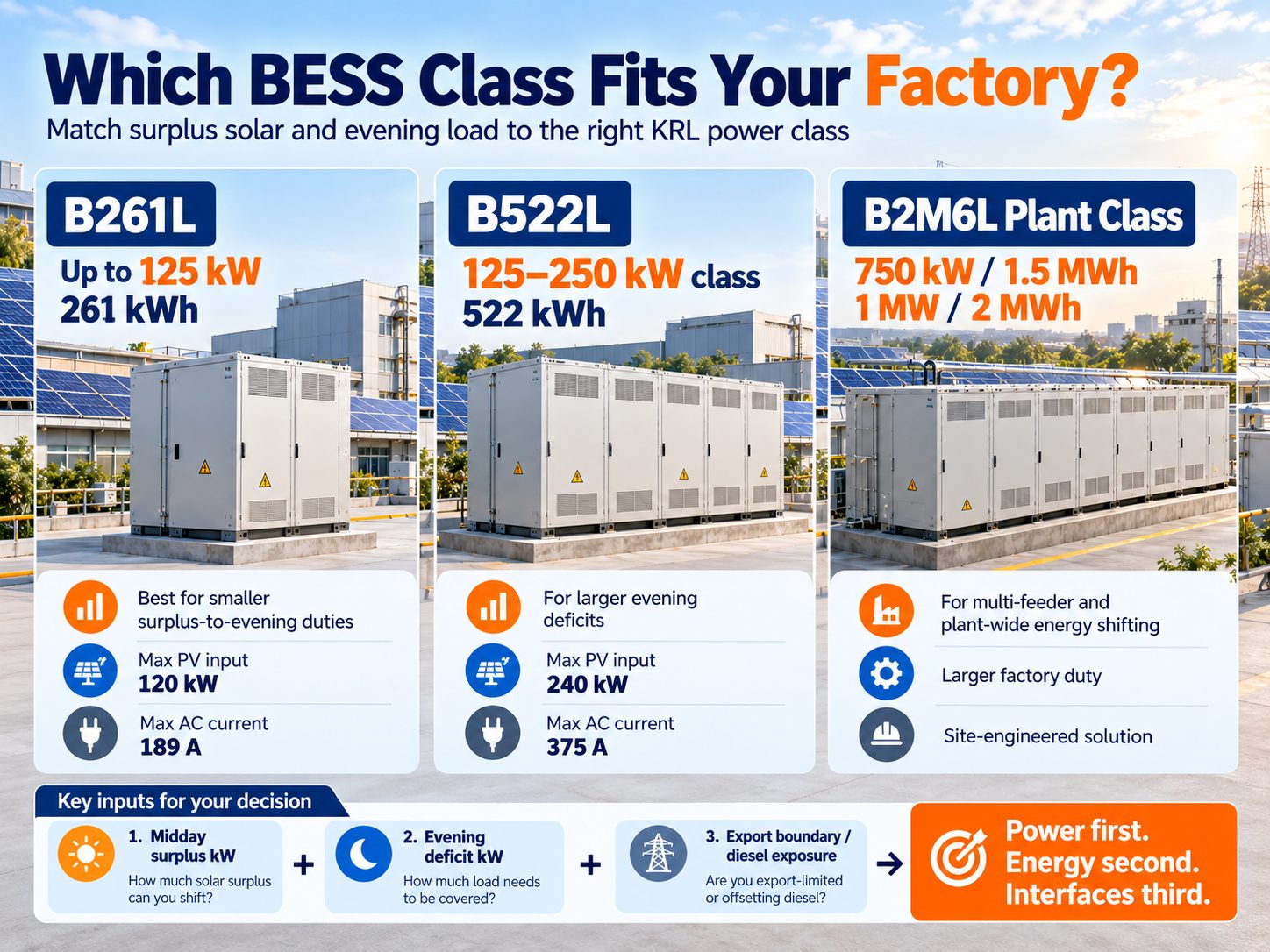
Once storage makes economic sense, size the KRL system in the order the plant will actually hit its limits: power → energy → interfaces.
KRL-B261L: first screen for the 125 kW class
If the verified battery discharge requirement stays inside 125 kW, start with KRL-B261L.
The published class provides:
| KRL-B261L | Published value |
|---|---|
| Rated AC power | 125 kW |
| Rated battery energy | 261 kWh |
| Maximum AC current | 189 A |
| Maximum PV input | 120 kW |
| Diesel generator port | Yes |
| Grid/off-grid switching | <10 ms |
A factory with a verified 90–110 kW evening battery duty does not need to begin by shopping for a 250 kW converter.
Start with B261L.
Then check whether 261 kWh rated battery energy can meet the required evening discharge window after project allowances.
KRL-B522L: do not squeeze a 180 kW duty into 125 kW
A measured 180 kW evening deficit has already settled the first power-class decision.
That is not a B261L job.
Start with KRL-B522L.
The published specification is:
| KRL-B522L | Published value |
|---|---|
| Rated AC power | 250 kW |
| Rated battery energy | 522 kWh |
| Maximum AC current | 375 A |
| Maximum PV input | 240 kW |
| MPPT channels | 2 |
| Diesel generator port | Yes |
| Grid/off-grid switching | <10 ms |
A 180 kW evening deficit does not become a 125 kW problem because the smaller cabinet is cheaper.
Use B522L.
That 125 kW boundary comes from the equipment rating, not from a preference.
The wider model boundary is already covered in KRL's C&I ESS class-selection table, so this article does not need to repeat every cabinet comparison.
For Bangladesh, the live decision is how much rooftop-solar surplus should enter those storage classes instead of leaving the site as export.
Do Not Size the Battery from Rooftop MW Alone
As Bangladesh adds rooftop solar, one sizing mistake is likely to become more common.
A factory says:
“We are installing 1 MWp of rooftop PV. Give us a 1 MW battery.”
Stop there.
1 MWp of rooftop solar does not equal a 1 MW BESS requirement.
PV nameplate tells you installed solar capacity. It does not tell you:
- how much the factory consumes at noon
- how much surplus remains after self-consumption
- how long the surplus lasts
- how much evening deficit exists
- whether export remains available
- how much battery reserve must be held
- whether diesel stays in the architecture
- whether the transformer and PCC support the intended charge/discharge route.
Consider a 1 MWp rooftop system.
If the factory consumes 850 kW while PV is producing 900 kW, the battery does not have a 900 kW charging opportunity.
The immediate surplus is only:
900 kW − 850 kW = 50 kW
That is the number that matters at that instant.
Now consider another hour:
PV = 950 kW
Factory load = 600 kW
Surplus:
950 − 600 = 350 kW
Now the charging-power question is completely different.
This is why KRL's commercial energy storage system design process should begin with interval data, not rooftop nameplate.
A serious Bangladesh rooftop-solar BESS study needs at least:
| Input | What it decides |
|---|---|
| 15/30-minute factory load | Actual simultaneous demand |
| Rooftop PV production curve | When surplus exists |
| Export boundary | How much surplus may leave the site |
| Evening load | How much stored energy can be reused |
| Required discharge kW | B261L vs B522L vs plant class |
| Required discharge hours | Battery energy requirement |
| Diesel operating record | Additional value of stored energy |
| Transformer/PCC data | Electrical connection boundary |
If the project skips those lines and buys storage from rooftop MW alone, the battery can easily be oversized, undersized or placed on the wrong electrical boundary.
The KRL commercial energy storage system selection guide should be used after the load and surplus curves have been established.
A 4,000 MW Rooftop Target Does Not Mean 4,000 MW of Batteries
A solar target is not a battery target.
Bangladesh's reported rooftop ambition is a solar target, not a storage target.
Some factories will consume almost all rooftop output directly.
They may need little or no battery for solar shifting.
Other factories will have large midday surpluses and strong evening demand.
They may have a compelling storage case.
Some will have excellent export economics and weak evening value.
They may prefer to export.
Some will have severe diesel exposure or unreliable evening supply.
For them, stored solar can carry a much higher internal value.
None of those projects is decided by the national rooftop target. The factory load curve does the deciding.
Bangladesh Factories Now Have a Three-Way Energy Decision
The new incentive makes rooftop solar easier to justify, but it does not decide what the factory should do with every surplus kWh.
Surplus PV now has three possible destinations in the factory energy model.
Use It
When the factory is consuming electricity at the same time the PV is producing it, direct self-consumption is the cleanest path.
No unnecessary battery conversion.
No export decision.
The solar electricity goes directly into productive load.
Sell It
When surplus exists and the approved export value is higher than the alternative internal use, export it.
When export has the stronger economics, exporting is the right decision; storage should not be forced into the project.
Store It
When the factory's later grid purchase, diesel generation, peak demand or interruption exposure makes the same kWh more valuable after sunset, store it.
That is where storage begins to earn its place in the project.
The decision is not:
Solar or battery.
It is:
How should solar, battery, grid and diesel divide the same 24-hour factory load?
For smaller surplus-to-evening duties, B261L gives the factory a 125 kW / 261 kWh starting class.
Once the verified discharge requirement exceeds 125 kW, stop forcing the smaller cabinet into the model and move to B522L.
When several factory feeders or plant-wide energy shifting push the project into the hundreds of kilowatts, move into KRL's plant-class B2M6L route.
The new Bangladesh rooftop policy has made one thing clear:
More solar is coming.
The factories that make the most money from it will not necessarily be the ones with the largest roofs.
They will be the ones that decide correctly what every surplus kWh should do next.