 Skip to content
By Liu, General Manager and R&D Engineer at KRL Power
20 Years of C&I Energy Storage Experience | Former Huawei R&D
Energy storage is no longer an optional addition for many commercial and industrial facilities. Where grid outages interrupt production, diesel costs continue to rise, or large photovoltaic arrays cannot be fully utilized, the energy system itself becomes a business-critical asset.
Factories, mining sites, industrial parks, data centers and remote facilities do not simply need a large battery. They need an energy hub capable of coordinating photovoltaic generation, battery storage, utility power, diesel generation and changing loads without creating a complicated collection of separately sourced equipment.
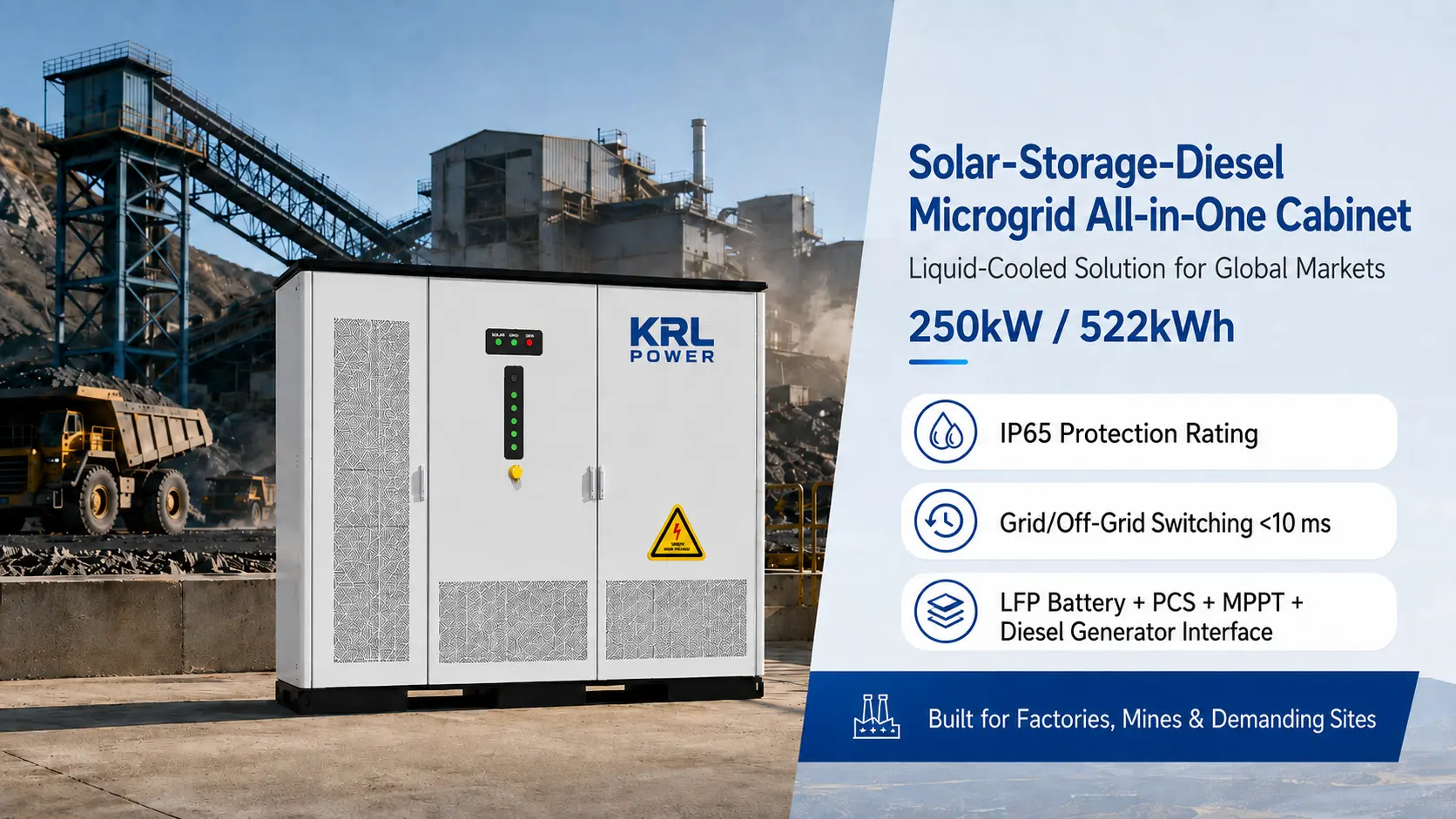
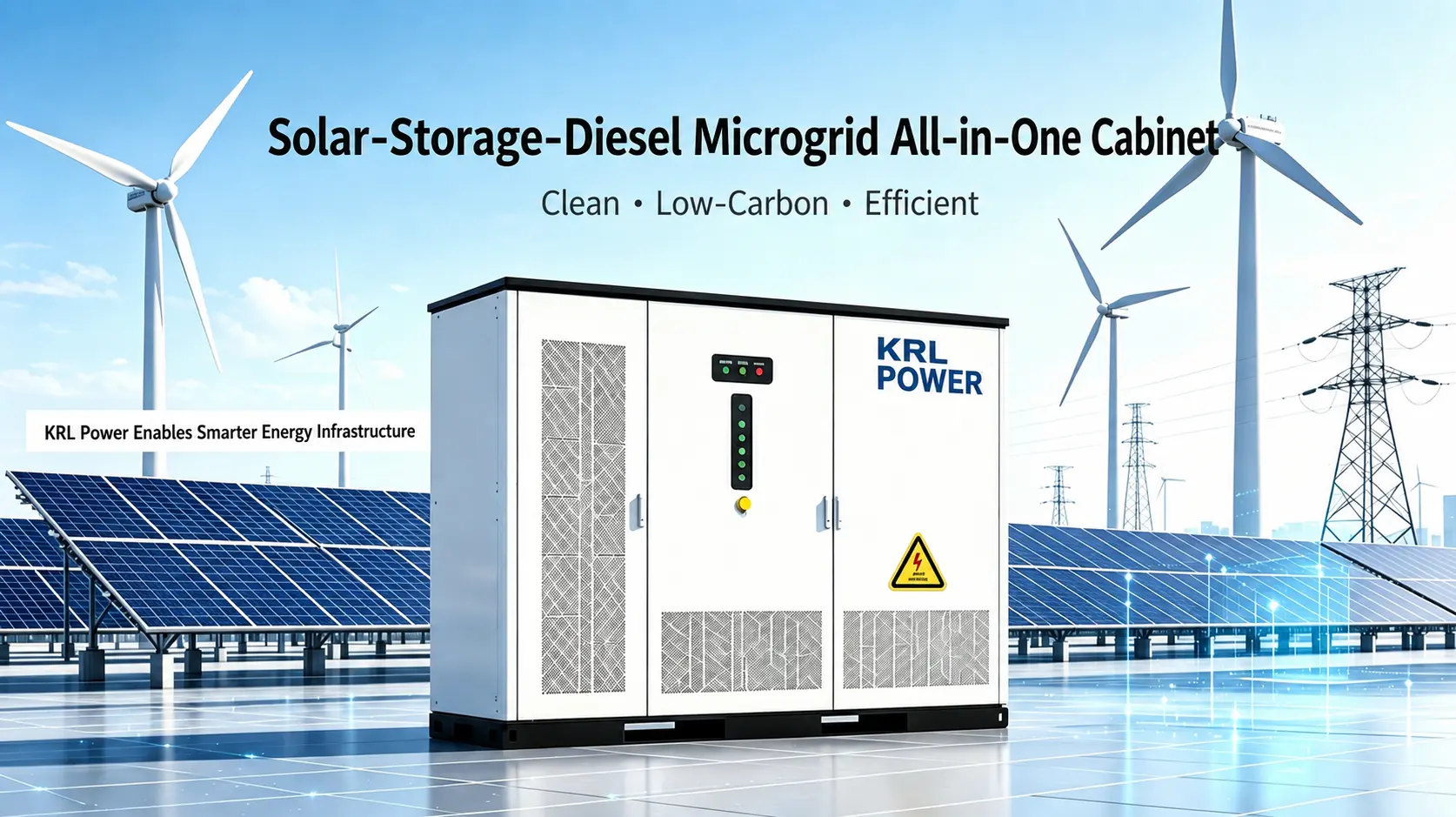
The KRL B522L 250kW/522kWh liquid-cooled energy storage system was developed for this requirement. It integrates a 522kWh lithium iron phosphate battery, 250kW bidirectional PCS, 240kW dual-channel MPPT, BMS, EMS and diesel generator interface into one highly integrated cabinet.
For buyers, the real value is not only its capacity. The system creates a controllable energy center that can reduce grid dependence, improve solar utilization, limit diesel operating hours and protect critical loads.
What Problem Is the Buyer Really Trying to Solve?
Most project inquiries initially focus on one number: How many kilowatt-hours do I need? That number alone is not enough to select a commercial energy storage system.
A technically sound configuration must answer four separate questions:
- How much continuous power must the system deliver?
- How many hours must the protected loads operate?
- How much photovoltaic power is available for daytime loads and battery charging?
- What should happen when both solar energy and stored energy are insufficient?
The 250kW PCS defines the cabinet's rated charge and discharge power. The 522kWh battery defines its nominal stored energy. These two values must be assessed together.
For example, a 522kWh battery can theoretically support a constant 250kW load for approximately 2.09 hours. It could theoretically support a 100kW load for approximately 5.22 hours. Actual runtime will be shorter after allowing for reserve state of charge, conversion losses, battery protection limits, temperature, ageing and transient load demand.
| Average supported load | Theoretical runtime from 522kWh |
|---|---|
| 250kW | 2.09 hours |
| 200kW | 2.61 hours |
| 150kW | 3.48 hours |
| 100kW | 5.22 hours |
These are preliminary energy calculations, not guaranteed operating times. Final sizing requires the site's interval load profile and the agreed usable SOC window.
Motor starting current is another important consideration. A facility with a 150kW average load may still exceed a 250kW PCS during the simultaneous starting of pumps, compressors, conveyors or HVAC equipment. Motor starting sequence, VFD configuration and peak demand must therefore be verified before final system selection.
One Cabinet for Solar, Storage, Grid and Diesel Coordination
The B522L is designed as a solar-storage-diesel microgrid all-in-one cabinet rather than a battery cabinet that depends on multiple external conversion devices.
Its correct system concept is: PV array → integrated dual-channel MPPT → DC energy system → battery and integrated PCS → AC distribution → industrial loads.
The grid and diesel generator are connected through the project's approved AC switchgear, protection and distribution design. The EMS then coordinates the available energy sources according to load demand, battery SOC, solar production, tariff periods and generator operating rules.
Because the B522L already includes 240kW MPPT capacity and a 250kW PCS, an additional external PV inverter or external MPPT should not be added to the standard topology unless a specific project requires a separately designed AC-coupled PV subsystem.
This level of integration reduces equipment interfaces, simplifies control responsibility and gives the EPC team a clearer commissioning boundary.
Why the KRL B522L Fits High-Power C&I Projects
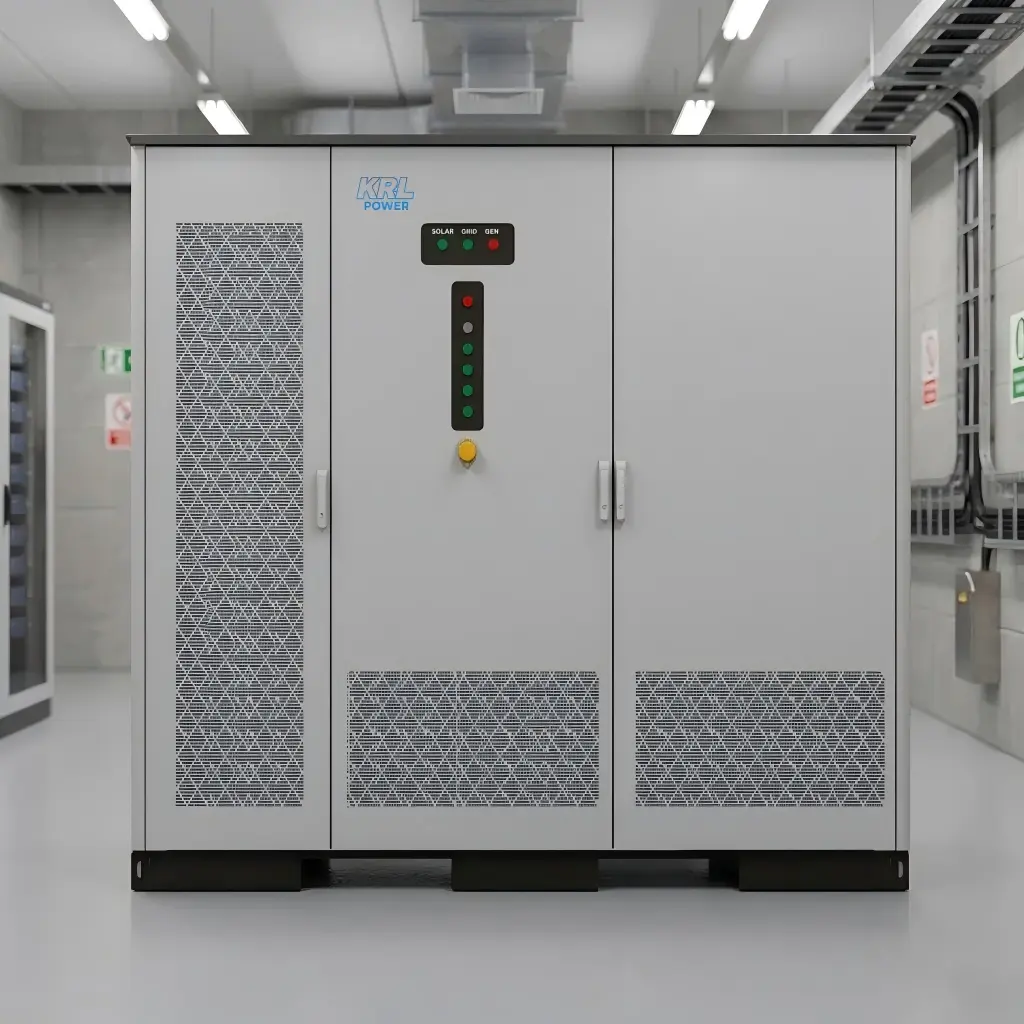
The B522L occupies an effective middle ground between smaller C&I cabinets and multi-megawatt containerized systems. A single cabinet can support substantial industrial loads without immediately forcing the buyer into a large container solution.
Balanced Power and Energy Capacity
The combination of 250kW rated PCS power and 522kWh battery energy provides approximately a two-hour nominal duration at full rated discharge. This suits peak shaving, photovoltaic energy shifting, short-to-medium outage support and solar-diesel microgrid operation.
Direct Connection for a Large PV Array
The integrated 240kW MPPT provides two MPPT channels with a 250–850Vdc operating range. This allows two PV sub-arrays or differently oriented PV strings to be managed without installing a separate standard PV inverter in the base architecture.
Grid-Connected and Off-Grid Capability
The same cabinet supports grid-connected and off-grid operating modes. During a grid failure, the system can transfer to off-grid supply in less than 10ms under the approved system configuration.
This rapid transition is valuable for production control, communications and many commercial loads. However, it should not automatically be treated as a replacement for every double-conversion UPS. Data-center servers, medical safety systems and exceptionally sensitive process controls may still require a dedicated UPS layer and coordinated transfer testing.
Diesel Generator Coordination
An integrated diesel generator interface allows the EMS to use the generator as a controlled backup source. Instead of running the generator continuously at inefficient low load, the system can prioritize photovoltaic energy and stored energy, then start or load the generator when battery SOC, load demand or operating schedules require it.
Liquid Cooling for Demanding Environments
Liquid cooling helps control temperature differences across the battery system and supports more consistent operation under high-power cycling. The confirmed operating temperature range for this configuration is -30°C to 55°C.
The battery cabinet is rated IP65. Final outdoor deployment must still consider drainage, flood level, ventilation clearance, fire separation, foundation loading, ambient dust, salt mist, altitude and local electrical codes.
KRL B522L Technical Specifications
| Item | KRL B522L specification |
|---|---|
| Model | KRL-B522L-250H3S-240M2-HX1 |
| Battery chemistry | Lithium iron phosphate |
| Rated battery energy | 522kWh |
| Nominal battery voltage | 832V |
| Rated battery capacity | 628Ah |
| PCS rated power | 250kW |
| On-grid/off-grid output | 400Vac/230Vac, three-phase |
| Rated frequency | 50Hz/60Hz |
| Maximum AC current | 375A |
| PV input power | 240kW |
| MPPT channels | 2 |
| MPPT voltage range | 250–850Vdc |
| Maximum PV voltage | 950Vdc |
| Grid/off-grid switching | Less than 10ms |
| Diesel generator port | Included |
| Control integration | BMS, PCS and EMS |
| Battery cooling | Liquid cooling |
| Battery cabinet protection | IP65 |
| Communications | RS485, WiFi or 4G, subject to configuration |
| Operating temperature | -30°C to 55°C |
| Parallel capability | Up to 6 cabinets, subject to system design |
| Approximate dimensions | 2480 × 1400 × 2050mm |
| Approximate weight | 4,900kg |
Buyers comparing different capacities can also review the complete KRL commercial and industrial energy storage product range.
How the Energy Hub Operates
Solar-Priority Operation
During daylight hours, photovoltaic energy first supports the active load. Available surplus power charges the battery. When solar output falls because of clouds or evening demand, the battery supplies the difference.
At the full 240kW PV input, the theoretical time to deliver 522kWh is approximately 2.18 hours. Actual recharge time is longer because the PV system may also be supporting facility loads, while charging power is affected by irradiance, SOC limits, temperature and conversion losses.
Peak Shaving and Electricity-Cost Control
In a grid-connected facility, the EMS can discharge the battery when grid demand approaches a contracted limit or during expensive tariff periods. It can recharge during lower-cost periods or when surplus photovoltaic generation is available.
The financial result depends on the local tariff. A buyer should provide demand charges, time-of-use prices, export restrictions and at least 30 days of load data before requesting an ROI calculation. For a wider project-planning view, see KRL's commercial and industrial ESS solutions.
Off-Grid Microgrid Operation
In remote locations, solar can serve as the primary energy source, the battery as the balancing and nighttime source, and the diesel generator as long-duration backup.
This arrangement can reduce fuel consumption, generator runtime, maintenance frequency and fuel-delivery risk. It does not mean the generator can always be removed. For a mission-critical off-grid site, the required diesel capacity depends on seasonal solar conditions, acceptable autonomy, battery recharge strategy and the consequences of prolonged bad weather.
Backup-Power Operation
When the utility fails, the cabinet can support the selected critical-load bus. Nonessential loads should normally be separated or automatically shed so that stored energy is not consumed by low-priority equipment. Facilities evaluating this function can also review KRL's guidance on commercial battery backup for power outages.
Where This System Creates the Most Value
- Factories and industrial parks: Reduce demand peaks, absorb rooftop PV energy and protect prioritized production equipment against short outages and unstable grids.
- Mines, oil fields and remote industrial sites: Displace part of the diesel generation while retaining generator backup for extended low-solar periods and unusually heavy loads.
- Data centers and communication facilities: Support facility-level resilience and energy-cost management while coordinating critical IT loads with the site's UPS and distribution architecture.
- Hospitals and emergency facilities: Provide an additional layer of energy resilience when critical and noncritical circuits are correctly separated and local backup regulations are satisfied.
- Commercial centers and EV-charging sites: Limit grid demand created by HVAC, refrigeration or simultaneous vehicle charging while increasing local solar consumption.
Scaling from One Cabinet to a Multi-Cabinet System
Up to six B522L cabinets can be configured in parallel, creating approximately 3.132MWh of nominal battery capacity and up to 1.5MW of aggregate PCS power.
Parallel capability should not be interpreted as simply connecting cabinets to the same cable. A multi-cabinet design requires appropriately rated busbars or a combiner cabinet, AC switchgear, protection coordination, transformer capacity, short-circuit analysis, grounding, communications and a site-level EMS strategy.
These interfaces should be reserved in the first-stage single-line diagram if the buyer expects future expansion. Planning them early avoids replacing undersized transformers, switchgear or cables later.
What the Buyer Should Confirm Before Ordering
- 24-hour load profile, preferably at 15-minute intervals
- Continuous load, peak load and motor-starting demand
- Critical and noncritical load separation
- Required backup duration
- Existing or planned photovoltaic capacity and string data
- Grid voltage, frequency, transformer capacity and outage pattern
- Diesel generator rating, voltage, controller and communication interface
- Required grid-connected, off-grid and black-start functions
- Site temperature, altitude, humidity, dust and flood conditions
- Current single-line diagram and protection arrangement
- Expected future expansion
- Delivery country, project schedule and Incoterms
- EPC, cabling, transformer, switchgear and commissioning scope boundaries
Once these details are available, KRL can confirm whether one B522L cabinet is sufficient or whether the project should use multiple cabinets or a larger containerized system.
Why Work Directly with KRL Power?
KRL Power is a source manufacturer with a battery manufacturing foundation dating to 2005 and engineering capability covering cells, PACKs, BMS integration and complete C&I energy storage systems.
For buyers and EPC partners, direct factory cooperation provides practical advantages: configuration can be aligned with the actual load profile, communication interfaces can be confirmed before production, and expansion requirements can be incorporated into the original electrical design.
The objective is not to sell the largest battery possible. It is to deliver the correct balance of power, energy, solar input, generator support and operating logic for the project.
Request a Project-Specific Configuration
The KRL B522L is a strong choice when a project requires 250kW-class power, approximately two hours of nominal full-power storage, large direct PV input and coordinated grid/diesel support in one integrated cabinet.
Send KRL your load profile, single-line diagram, PV information, generator specifications, site conditions and autonomy target. Our engineering team will prepare a preliminary architecture, equipment configuration and commercial quotation for your project.
Review the complete KRL B522L 250kW/522kWh product specification or contact KRL Power for a tailored solar-storage-diesel microgrid proposal.
FAQ
Can one B522L power a 250kW industrial load for two hours?
The nominal calculation is 522kWh ÷ 250kW = 2.09 hours. Actual runtime will be lower after reserve SOC, conversion losses, battery protection limits, ageing and auxiliary consumption are considered. KRL must review the load profile before confirming the guaranteed operating window.
Can the PV array connect directly to the cabinet?
Yes. The B522L includes a 240kW MPPT with two MPPT channels and a 250–850Vdc operating range. PV strings must be designed within the permitted voltage and current limits. A separate PV inverter is not required for the standard DC-coupled configuration.
Can the system completely replace a diesel generator?
It can significantly reduce generator runtime and fuel consumption, but complete replacement depends on the load, photovoltaic resource, required autonomy and seasonal weather. Critical off-grid facilities usually retain a generator for extended low-solar conditions unless sufficient additional battery and PV redundancy is installed.
Does the less-than-10ms transfer time make the system a UPS?
It provides fast grid-to-off-grid transition for many industrial and commercial loads, but it is not automatically a substitute for every dedicated UPS. Sensitive servers, medical devices and process-control systems should be tested with the complete UPS, switchgear and protection architecture.
How quickly can the 522kWh battery recharge?
At the theoretical maximum 240kW PV input, 522kWh represents approximately 2.18 hours of energy. Actual charging takes longer because solar output varies, facility loads may consume part of the PV power, and the BMS applies SOC, temperature and charging limits.
Can the B522L work with an existing solar system?
Yes, but the existing architecture must be reviewed. New PV strings may connect to the integrated MPPT within its voltage and current limits. If the site already has AC-coupled PV inverters, KRL must verify the control, anti-islanding, export limitation and off-grid compatibility.
Can six cabinets be connected in parallel immediately?
The product supports up to six parallel cabinets, but the total system requires correctly sized switchgear, busbars or a combiner cabinet, transformer capacity, communication links, protection coordination and site-level EMS control. Expansion interfaces should be reserved in the phase-one single-line diagram.
Is the entire system IP65?
The confirmed IP65 rating applies to the battery cabinet. Foundation design, cable entries, clearances, drainage, flood protection and the surrounding AC equipment must still be engineered for the installation environment.
What information is required for an accurate EXW or project quotation?
KRL requires the load profile, peak and continuous power, autonomy target, voltage and frequency, PV array data, generator information, single-line diagram, site conditions, delivery destination, project schedule and a clear scope boundary for switchgear, transformer, cabling, installation and commissioning.
Is the B522L suitable for future capacity expansion?
Yes. The system can form part of a phased multi-cabinet installation. The original design should reserve sufficient electrical capacity, physical space, communication interfaces and protection equipment so future cabinets can be added without rebuilding the main infrastructure.
