

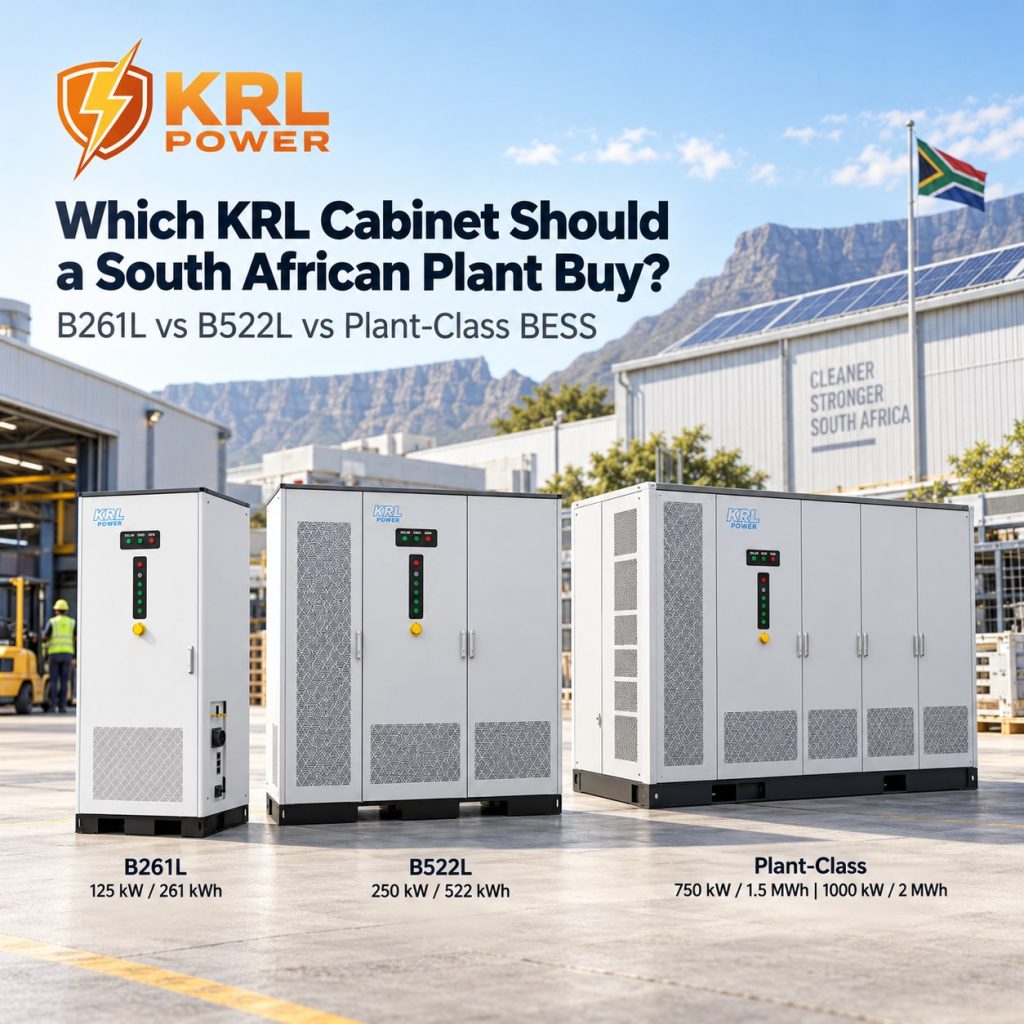
South African plants usually narrow the choice from a few site limits. The KRL-B261L sits in the 125 kW / 189 A class with 261 kWh rated energy. The KRL-B522L moves the plant to 250 kW / 375 A and 522 kWh. Once duty approaches 750 kW or 1 MW, the project has moved into KRL’s larger container route.
Power, current and energy can rule out a cabinet at different points. Normal production may stay below the kW rating while overlapping starts push current beyond the published class. Some sites keep plenty of kW headroom and still run short on energy during a long outage or night shift. KRL C&I-energiebergingstelsels cover several equipment classes; the measured duty decides which one belongs on the order.
| Site condition to verify | KRL product path | Published ratings to check first |
|---|---|---|
| Protected AC power remains within 125 kW, project current remains within 189 A, and the required usable-energy duty can be met from the 261 kWh nameplate | KRL-B261L | 125 kW / 261 kWh / 189 A |
| The smaller cabinet is constrained by power, current, energy duty, or a PV input requirement above its 120 kW interface | KRL-B522L | 250 kW / 522 kWh / 375 A / 240 kW PV input |
| The project duty is already in the 750 kW or 1 MW class and the energy requirement is around 1.5 MWh or 2 MWh | Larger KRL container configurations | 750 kW / 1,5 MWh of 1000 kW / 2 MWh |
The table is useful for the first screen. Motor-start sequence, power factor, usable SOC window, conversion losses, auxiliaries, reserve energy, site temperature and the approved electrical interface still need checking.
B261L works only while the 125 kW and 189 A limits still hold
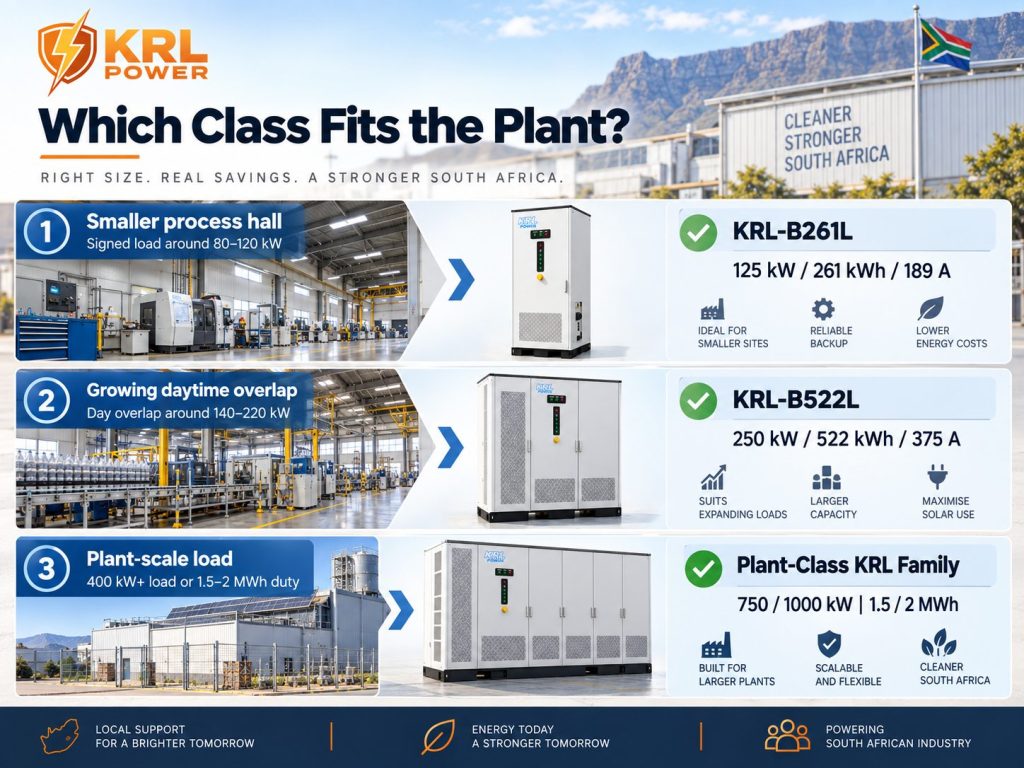
B261L publishes 125 kW AC power on-grid and off-grid, 189 A current, 261 kWh rated energy and 120 kW PV input. The listed order code is KRL-B261L-125H3S-120M1-HX1.
The battery is LiFePO4 at 832 V and 314 Ah. KRL also lists liquid cooling, a diesel port, switching under 10 ms, RS485 / WiFi, IP65 battery protection, operation under 2000 m, parallel operation up to 10 units and about 2600 kg cabinet mass.
Each number affects a different part of the installation. The 125 kW / 189 A pair is the first AC screen. The 120 kW PV input matters when direct solar input is part of the design. Cabinet mass becomes a delivery and civil issue when access, pad and lifting are planned.
261 kWh divided by 125 kW gives about 2.09 hours on paper. Delivered AC runtime depends on the agreed SOC window, conversion losses, auxiliaries, reserve SOC, operating temperature and any project capacity allowance.
Average kW can still look comfortable after the current limit has been crossed. Several motors starting in the same window can move the plant beyond 189 A. Sites with large DOL, star-delta, soft-starter or VFD loads should use the 125 kW PCS motor-start review before approving the smaller cabinet.
B261L remains viable when the measured duty fits its AC class and the delivered-energy window still works after project allowances.
B522L changes more than the cabinet size
B522L moves the site into the 250 kW / 375 A class with 522 kWh rated energy. Its listed order code is KRL-B522L-250H3S-240M2-HX1.
| Parameter | B522L | What changes at site level |
|---|---|---|
| Rated energy | 522 kWh | Larger energy block; delivered runtime still depends on project SOC and loss assumptions |
| AC power | 250 kW | Raises the protected operating-load class above B261L |
| Current | 375 A | Raises the available AC current class |
| Battery | LiFePO4, 832 V, 628 Ah | Published battery configuration for this model |
| PV-inset | 240 kW | Doubles the listed direct PV-input rating versus B261L |
| Afkoeling | Battery liquid cooling | Liquid cooling remains integrated in the cabinet |
| Diesel port | Ja | Keeps generator integration available |
| Oorskakel | Under 10 ms | Published changeover figure; site continuity still needs testing |
| Parallel | Up to 6 units | Provides a later expansion route |
| Massa | About 4900 kg | Changes crane, access, pad and civil planning |
One B522L and two B261L cabinets can both total 250 kW on paper. Their installation layout is different. B522L puts the duty on one 250 kW / 375 A cabinet. Two B261L units create two converters and repeated cabinet interfaces, with a more modular physical layout. Protection, cabling, maintenance, available space and expansion plans decide between the two layouts.
PV input can become the limiting interface before battery energy does. B261L lists 120 kW and B522L lists 240 kW. Sites needing the larger direct PV-input class can use the 522 kWh / 250 kW solar-storage-diesel cabinet as the closer reference.
B522L is listed for parallel operation up to six units. Transformer capacity, switchboard current, protection, cable routes and available area can stop expansion before that equipment limit is reached.
When the smaller cabinet is already tight on AC duty or PV input, compare the measured requirement with B522L before adding another small cabinet by default. KRL Power can review load, current, runtime target and PV requirement against the two classes.
Plant-scale duty changes the whole installation
At 750 kW or 1 MW, the project has moved beyond a simple cabinet-size comparison. Repeating smaller outdoor units adds lifting points, cable runs, protection interfaces and footprint. The larger configurations listed here are:
- 750 kW / 1.5 MWh: KRL-B1M5L-750H3S-720M6-HX1, 1130 A, 720 kW PV, about 15 t
- 1000 kW / 2 MWh: KRL-B2ML-1MH3S-960M8-HX1, 1500 A, 960 kW PV, about 19.5 t
- Container: 6058 × 2438 × 2896 mm
Procurement documents should use the exact order-model name. The broader family label is not a substitute for the specific 750 kW or 1000 kW order code.
Current rises to 1130 A or 1500 A, while PV input rises to 720 kW or 960 kW. At that scale, transformer capacity, LV or MV distribution, protection, cable routes, foundation load, crane access and the point of connection all move into the selection discussion.
Sites focused on Eskom bill reduction can continue with the 2 MWh C&I energy storage system. Plants already in the 1 MW duty class can use the 1 MW / 2 MWh factory backup system as the closer application reference.
The larger configurations in this source still list liquid cooling, diesel connection, switching under 10 ms and RS485 / WiFi. Electrical and civil scope changes most at this scale.
Put the site constraint next to the order code
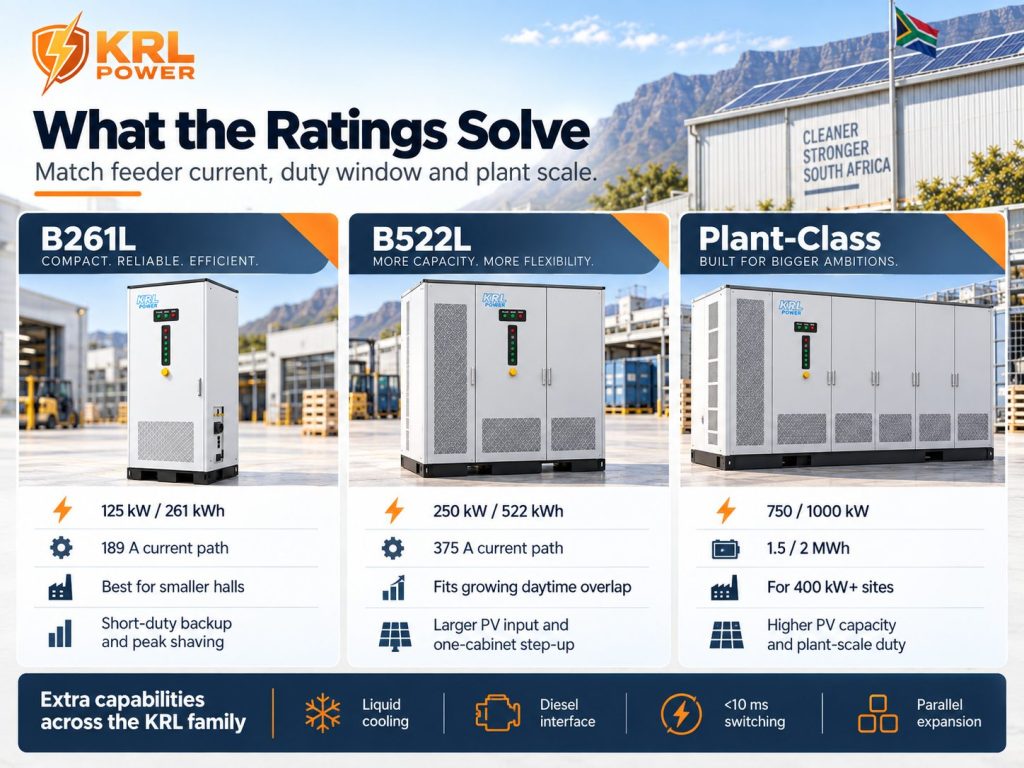
Record the site limit that forced the model choice: protected kW, AC current, delivered-energy duty, PV input, expansion strategy or installation scale. Generic “next size up” rule hides the reason for the purchase.
| Site evidence | Product path | Purchase check |
|---|---|---|
| Protected AC duty fits 125 kW and 189 A; required delivered-energy duty can be met from the 261 kWh nameplate after project allowances | B261L | Confirm power, current, usable-energy assumptions, PV input and motor-start behaviour |
| Protected duty or current exceeds the smaller cabinet class, the energy duty needs the 522 kWh block, or direct PV input needs the 240 kW class | B522L | Confirm 250 kW / 375 A, usable-energy assumptions, 240 kW PV input and the single- versus multi-cabinet architecture |
| Project duty is in the 750 kW or 1 MW class with about 1.5 MWh or 2 MWh of rated energy | Larger KRL container configuration | Confirm the exact order model, 1130 A or 1500 A path, transformer/distribution design, civil load and crane access |
Once the equipment class is clear, the Keuse-gids vir kommersiële en industriële energiestoorstelsels covers the next design checks. Diesel-heavy plants can also use Industriële batterystoor vir dieselkostevermindering when generator runtime is part of the operating case.
KRL Power can compare protected load, measured current, backup window, PV capacity and the existing generator arrangement before the model is fixed. The result should show both the equipment route and the site items that still need engineering confirmation.