 Slaan oor na inhoud

KRL Power approaches diesel-cost reduction for African factories by defining the protected load before selecting battery capacity. For factories with approximately 80–110 kW of measured continuous critical load, die KRL-B261L 125 kW / 261 kWh vloeistofgekoelde ESS provides a practical preliminary platform. Sites operating around 110–120 kW require a closer transient-load and motor-start review, while loads at or above 125 kW require additional available PCS power or a different architecture.
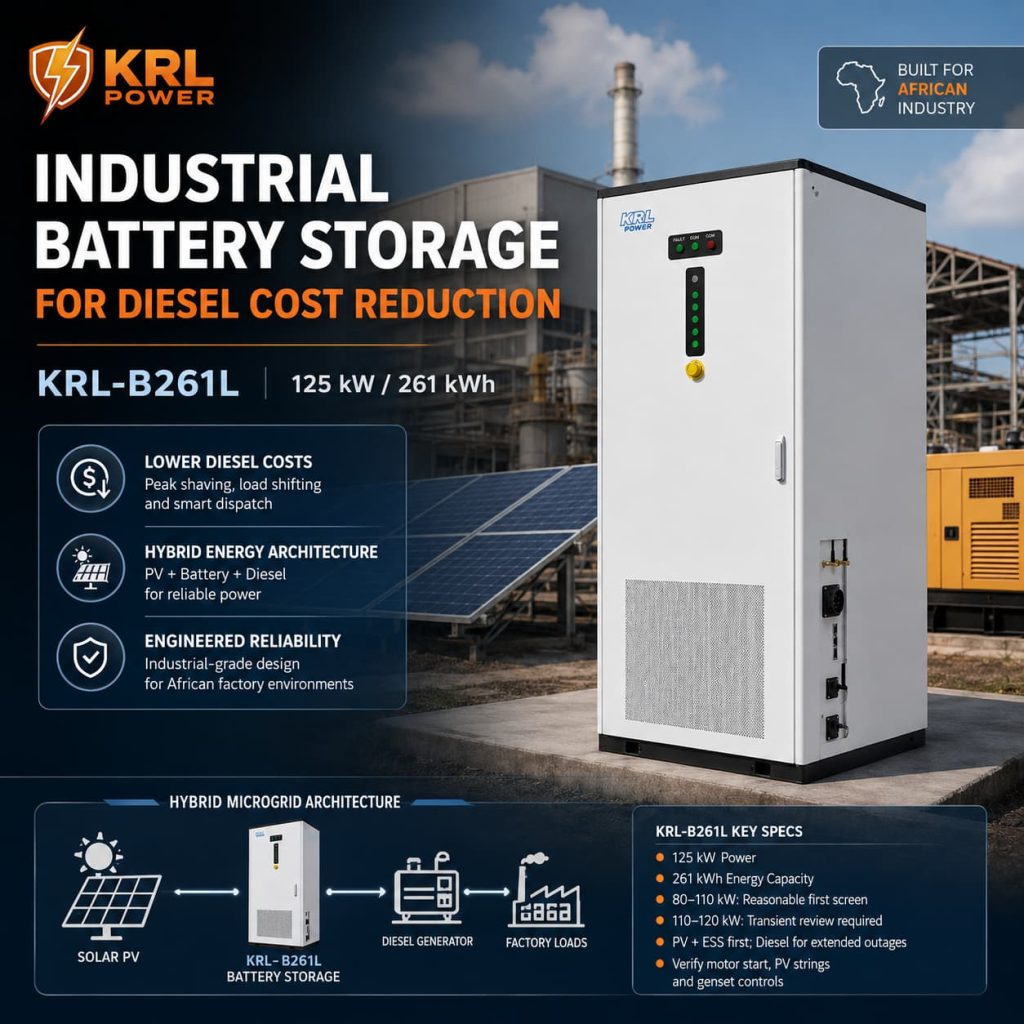
At a Glance: 125 kW / 261 kWh Factory Fit
| Factory requirement | Preliminary guidance |
|---|---|
| 80–110 kW continuous critical load | One 125 kW / 261 kWh cabinet is a reasonable first engineering screen. |
| 110–120 kW continuous load | Verify motor starts, simultaneous load steps and the confirmed PCS transient envelope. |
| ≥125 kW critical load | Evaluate additional PCS power, parallel capacity or a larger architecture. |
| Best use case | Frequent short outages combined with high diesel-generator runtime. |
| Preferred architecture | Grid + Solar PV + ESS + Existing Diesel + Critical Loads. |
| Teoretiese bedryfstyd by 100 kW | 2.61 hours before losses, auxiliaries and reserve SOC. |
| Primary engineering risk | Motor-start and transient demand can exceed the steady-state load. |
| PV boundary | Up to 120 kW published PV power; voltage, current and MPPT compatibility still require verification. |
| Diesel role | Existing generator retained for extended outages and reserve support. |
| ROI inputs | Measured diesel consumption, generator runtime, load profile, outage pattern and PV production. |
Decision summary: Use PV and ESS capacity for frequent daily energy events and preserve the generator for extended outages that exceed the economically selected battery autonomy.
Factory Diesel-Cost Pressure
Public comments from Nigerian factory operators and observers show how fuel exposure can affect individual businesses. One former factory operator wrote publicly on X that generator operation had consumed almost 50% of business income. Another factory user reported on X monthly diesel spending rising from ₦240,000 to ₦450,000. A separate observer recalled a Kano textile-factory closure after diesel reached ₦250 per litre, with about 200 workers going home.
These posts are individual operator experiences. They illustrate the severity of fuel exposure at specific sites and remain separate from industry averages or project ROI assumptions.
Broader reporting supports the underlying cost pressure. The PUNCH industry report documented factory operating pressure linked to diesel pricing and unreliable electricity supply. A World Bank Nigeria power-sector assessment also documented extensive business outages and reliance on higher-cost self-generation in its study baseline. The IEA Nigeria Energy Outlook described Nigeria as Africa’s largest user of oil-fired backup generators at the time of that report.
For procurement, the useful commercial question is: Which production loads generate revenue, which loads require continuity, and how many generator operating hours can storage economically displace?
Power and Energy Requirements: kW, kVA and kWh
A 261 kWh battery supporting an illustrative 100 kW load gives a simple nameplate calculation of 261 kWh ÷ 100 kW = 2.61 hours. The contracted operating window depends on reserve SOC, PCS losses, cabinet auxiliaries, thermal-management demand, battery operating limits, ambient conditions, ageing allowance and PV contribution.
| Parameter | Starting value | Procurement meaning |
|---|---|---|
| Rated ESS power | 125 kW | Continuous AC-load boundary published for the KRL-B261L. |
| Gegradueerde batterye-energie | 261 kWh | Nominal stored-energy value. |
| Illustrative factory load | 100 kW | Example critical-load assumption for calculation. |
| Ideal runtime | 2.61 h | Preliminary arithmetic before losses and reserve. |
| Usable runtime | Project-specific | Define the AC-delivered energy, reserve SOC and end-of-discharge condition. |
KRL Power’s factory BESS kWh vs kVA sizing analysis explains the same engineering split: power defines which machines can operate together, while energy defines the operating duration.
125 kW / 261 kWh Load-Fit Screening
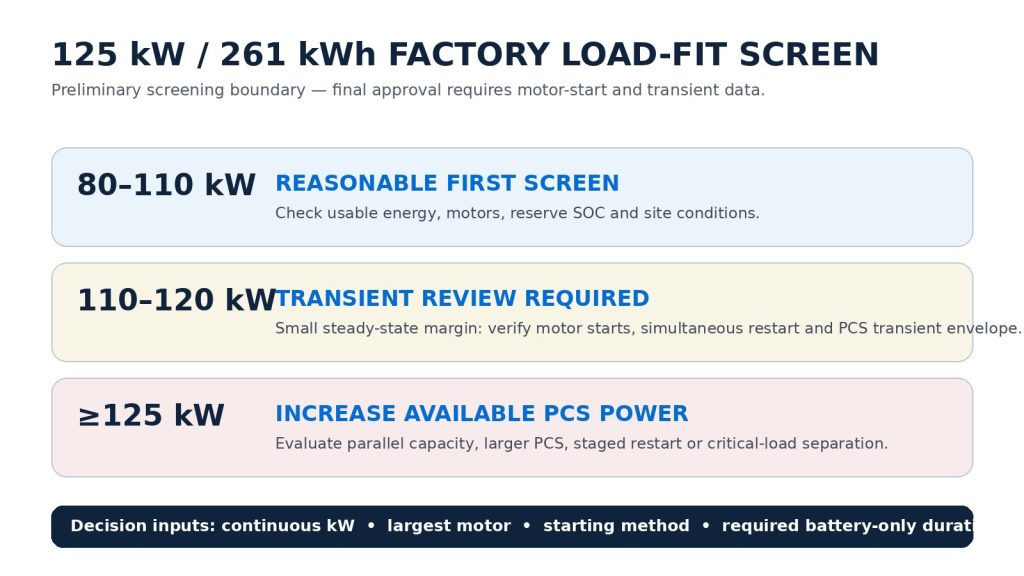
80–110 kW Continuous Critical Load
This range provides a practical preliminary screen for a 125 kW PCS because it retains some steady-state margin while the engineering team evaluates motors, restart events and usable-energy requirements.
110–120 kW Continuous Critical Load
At 120 kW continuous load, only 5 kW separates the steady-state demand from the 125 kW rated PCS power. The project should therefore use measured transient information and confirmed PCS capability.
- Largest motor rating and starting method
- Simultaneous motor or compressor restart events
- VFD, soft-starter and direct-on-line configurations
- Power factor and three-phase load allocation
- Transformer energisation where included in the protected bus
- Project-specific PCS overload or transient envelope
Critical Load at or Above 125 kW
Loads at or above the continuous PCS rating require a different power architecture. The preliminary review can assess additional PCS capacity, parallel cabinets, critical-load separation, staged restart and controlled load shedding.
For larger sites, KRL Power’s 300 kW factory battery storage sizing analysis shows how multi-hour production requirements convert into delivered AC energy and power boundaries.
Motor-Start and Restart Evidence
A factory can operate near 90 kW during stable production and still create a much larger short-duration demand when compressors, pumps, conveyors or other motors restart after a grid event.
- Air and refrigeration compressors
- Pumps and extraction fans
- Conveyors and crushers
- Saws and hydraulic equipment
- Welding equipment and other fast-changing industrial loads
A useful equipment schedule records continuous load, maximum simultaneous demand, largest motor, starting method, restart sequence, phase allocation, power factor and required autonomy.
KRL’s current public KRL-B261L page publishes 125 kW rated AC power en 189 'n maksimum wisselstroom. A complete public motor-start or short-duration overload curve is not stated on that page. Final approval for high-inrush loads should therefore use the project-specific PCS transient data.
Interpreting the Published <10 ms Switching Time
The KRL-B261L public specification lists a switching time below 10 ms. This figure describes the ESS transfer function. Production ride-through also depends on PLC power supplies, VFD undervoltage settings, contactor hold-in behaviour, control transformers, safety circuits and machine restart logic.
The site acceptance test should verify the agreed critical-load group under the intended operating modes so the acceptance evidence reflects the factory process.
Hybrid Microgrid Operating Sequence
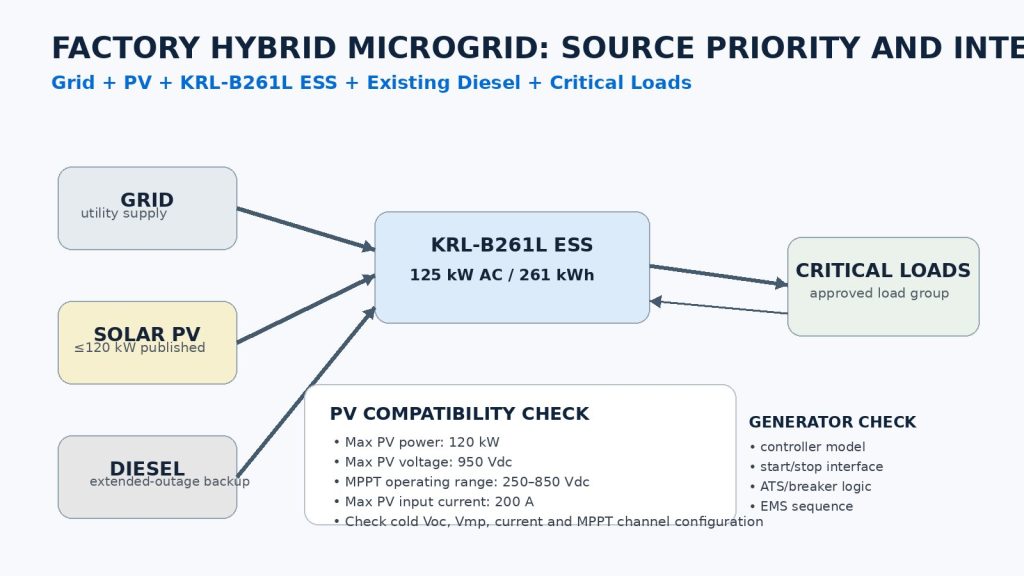
KRL Power’s Nigeria 125 kW / 261 kWh diesel-hybrid microgrid configuration provides a related architecture using PV, ESS and existing generators as coordinated resources.
Grid Available + Solar Available
PV can serve production demand first where the electrical topology permits. Available solar energy can charge the ESS according to the reserve strategy.
Grid Available + High Demand
The ESS can support selected demand peaks while preserving the backup reserve. Where the tariff supports a financial benefit, the same asset can also perform industrial battery storage peak shaving.
Backup reserve, peak shaving and load shifting all consume available battery power or energy. The EMS needs a clear priority hierarchy.
Short Grid Failure
The ESS can support the approved critical-load group during short interruptions. When the grid recovers before the generator-start threshold is reached, diesel operation can be avoided for that event.
Extended Grid Failure
The EMS monitors remaining SOC, critical load, PV production, reserve threshold and generator availability. The generator enters the operating sequence when the agreed reserve or runtime criterion is reached.
Generator Interface Compatibility Requirements
The KRL-B261L public page lists a diesel-generator port. Project compatibility still depends on the installed genset controller, start/stop interface, breaker or ATS logic, voltage and frequency, communications where used, and the approved EMS sequence.
| Generator input | Waarom dit saak maak |
|---|---|
| Manufacturer and model | Identifies the exact genset platform. |
| Controller model | Defines available start/stop, status and communication functions. |
| Rated kVA/kW | Supports operating-range and loading checks. |
| Output voltage/frequency | Confirms AC-system compatibility. |
| Start/stop interface | Defines command wiring or communications. |
| ATS/breaker arrangement | Defines transfer and isolation logic. |
| EMS sequence | Defines start threshold, warm-up, stop and recovery conditions. |
PV Interface and String Compatibility
KRL currently publishes the following KRL-B261L PV boundaries: 120 kW maximum PV power, 950 Vdc maximum PV voltage, 250–850 Vdc MPPT range, 200 A maximum PV input current, and 1 or 4 MPPT channels.
PV design should therefore verify cold-condition string Voc, operating Vmp, string current, total parallel current and the selected MPPT-channel configuration before the array is connected.
The published 120 kW PV value defines a power boundary. Electrical compatibility still depends on the string design and site conditions.
Diesel-Reduction ROI Inputs
The public X experiences establish customer pain points. Project savings require measured site data.
Existing Diesel Baseline
- Litres of diesel consumed per month
- Monthly delivered fuel cost
- Generator rating and operating hours
- Typical generator loading
- Service and overhaul history
- Grid-outage frequency and duration
Hybrid Operating Scenario
- Generator starts avoided
- Generator hours displaced
- Battery throughput
- PV contribution
- Remaining generator operation
- Conversion and auxiliary losses
- Required reserve SOC
Financial Output
- Jaarlikse vermyde brandstofkoste
- Generator maintenance savings
- Applicable tariff savings
- Eenvoudige terugbetalingsperiode
- Project cash-flow assumptions
KRL Power’s factory energy storage ROI calculation guide provides a related framework for evaluating operating conditions and financial assumptions.
Pre-Integrated ESS Procurement Boundary
An industrial ESS includes battery modules, BMS, PCS, EMS, thermal management, fire protection, AC/DC protection, switchgear, communications, PV interfaces and generator controls. Every interface needs an assigned engineering and warranty boundary.
| Procurement issue | Fragmented integration | Pre-integrated approach |
|---|---|---|
| Battery/PCS coordination | Site integration responsibility | Defined equipment interface |
| EMS-logika | Multiple control layers | Unified operating sequence |
| Afkoeling | Separate scope | Integrated thermal management |
| Generator-koppelvlak | Additional integration package | Planned control interface |
| Inbeding | More interfaces to validate | Reduced integration scope |
| Warranty | Multiple responsibility boundaries | Clearer system responsibility |
Buyers can compare the full KRL commercial and industrial energy storage system range while keeping the final project boundary tied to the selected model and signed project documents.
Thermal-Management and Environmental Checks
The KRL-B261L public specification lists liquid battery cooling and an operating-temperature range of −10°C to 55°C. Site suitability also depends on maximum ambient temperature, direct solar exposure, cabinet location, dust, humidity, altitude, cycling frequency, sustained power and any model-specific derating.
The procurement review should request the validated operating envelope for the intended duty and installation conditions.
System-Level ESS Safety Evidence
A complete safety review combines battery chemistry, BMS, thermal management, fire protection, electrical protection, EMS behaviour, enclosure design and site installation.
IEC 62933-5-1:2024 provides general safety considerations for electrical energy storage systems, including hazard identification, risk assessment and risk mitigation.
For electrochemical systems, IEC 62933-5-2:2025 provides additional system-level safety requirements and addresses risks arising from interactions between electrochemical storage and other ESS subsystems.
For lithium-ion battery-based systems, IEC 62933-5-4:2026 provides safety test methods and procedures for grid-connected lithium-ion BESS and builds on Parts 5-1 and 5-2.
These IEC documents serve as procurement references in this article. Product compliance or certification should be stated only when documentation for the exact supplied KRL configuration supports that claim.
Projects evaluating alternative chemistry can also review KRL Power’s solid-state and quasi-solid-state battery technology as a separate chemistry option within the wider system-level safety assessment.
EMS Reserve and Service Allocation
The EMS dispatch strategy determines generator start timing, reserve SOC, PV charging priority, peak-shaving permission, load priority and recovery behaviour.
| ESS duty | Primary requirement |
|---|---|
| Short-outage bridging | Power + reserve energy |
| Multi-hour backup | Energy |
| Motor restart | Transient power capability |
| Piekvlakvermindering | Power + discharge duration |
| Solar shifting | Energy + charging opportunity |
| Emergency reserve | Reserved SOC |
The proposal should show how power and energy are allocated so the same battery capacity is not counted simultaneously for conflicting services.
Praktiese beginkonfigurasie
| Komponent | Preliminary configuration |
|---|---|
| ESS | KRL-B261L |
| Gegradueerde energie | 261 kWh |
| Gegradueerde AC-krag | 125 kW on-grid / 125 kW off-grid |
| Batterychemie | Lithium-ystersfosfaat |
| PV power | 120 kW maximum published |
| Max. PV voltage | 950 V gelykstroom |
| MPPT range | 250–850 Vdc |
| Max. PV input current | 200 A |
| Diesel integration | Published generator port; project compatibility review required |
| Batterykoeling | Vloeistofkoeling |
| Uitbreiding | Public page lists Parallel Number: 10; site-level design remains project-specific |
A multi-cabinet project requires AC-bus sizing, fault-current review, protection coordination, EMS architecture, communications, power sharing and commissioning procedures.
Eight Procurement Checks Before Ordering
- Usable AC energy: define starting SOC, minimum SOC, ambient condition, auxiliaries, losses and AC-delivered energy.
- Continuous AC power: confirm the intended grid-connected and off-grid operating modes.
- Motor start: obtain project-specific PCS transient data for the largest restart events.
- Grid-loss behaviour: document the restart sequence for compressors, pumps, conveyors and other critical loads.
- Generator controls: confirm genset controller, start/stop interface, ATS or breaker logic and EMS sequence.
- PV compatibility: check Voc, Vmp, current and MPPT configuration against the published DC limits.
- Safety evidence: distinguish cell-level, battery-subsystem and complete-system documentation.
- System responsibility: assign performance and warranty boundaries for battery, PCS, EMS, cooling, PV and generator interfaces.
Factory ESS Decision Framework
| Factory condition | Recommended direction | Primary risk |
|---|---|---|
| 80–110 kW continuous critical load | Screen one 125 kW / 261 kWh cabinet | Poor utilisation if the system is oversized |
| 110–120 kW + large motors | Perform transient and restart review | Insufficient PCS margin |
| ≥125 kW critical load | Increase available PCS power | Continuous overload |
| Frequent short outages | Prioritise ESS bridging | Excess generator starts continue |
| Multi-hour outages | Increase usable energy or retain diesel | Battery reserve reaches the limit early |
| Strong daytime PV | Coordinate PV + ESS dispatch | Available solar remains under-used |
| Bestaande PV | Verify DC electrical limits | String or MPPT mismatch |
| Existing generator | Verify controller and transfer interface | Integration failure |
| Future expansion | Engineer the modular path now | Duursame herontwerp later |
Eindaanbeveling
The public Nigerian operator experiences show why diesel dependence deserves engineering and financial review. Their value is the customer pain signal; the project model should use the factory’s own measured data.
For a factory carrying approximately 80–110 kW of continuous critical load, die KRL-B261L 125 kW / 261 kWh vloeistofgekoelde ESS is a practical preliminary platform for diesel-reduction assessment. A factory operating around 110–120 kW should proceed through a detailed transient and motor-start review. Loads at or above the PCS rating require additional available power.
Recommended operating concept: Grid + Solar + ESS first → Diesel when the agreed reserve or runtime threshold is reached.
Additional industrial sizing and application examples are available through the KRL Power BESS-kennisentrum.
V&A
Can battery storage reduce factory diesel consumption?
Yes. An ESS can cover selected periods that would otherwise require generator operation, especially frequent short outages. The actual reduction depends on measured load, outage behaviour, PV production, battery reserve policy and generator runtime.
Is one 125 kW / 261 kWh cabinet suitable for an 80–110 kW factory load?
It is a reasonable preliminary screen when the continuous critical load remains in that range. Final approval still requires usable-energy, motor-start, transient-load and site-condition checks.
What if the critical factory load is 110–120 kW?
This range requires a closer transient-load review because the steady-state margin relative to a 125 kW PCS is small. Confirm the largest motor, simultaneous restart events and project-specific PCS transient capability.
How long can 261 kWh support a 100 kW factory load?
The ideal nameplate calculation is 2.61 hours. The contracted operating time is lower after reserve SOC, conversion losses, auxiliaries and other operating conditions are included.
Why are kW, kVA and kWh all important for factory BESS sizing?
kW and kVA describe power demand and equipment capability, while kWh describes energy and operating duration. Industrial sizing needs both the instantaneous load and the required runtime.
Can a monthly electricity bill be used to size the ESS?
A monthly bill supports energy-cost analysis, while final equipment sizing needs simultaneous load, motor-start, power-factor, outage and runtime data.
Why does motor starting matter for a 125 kW PCS?
Motors, compressors and pumps can create short-duration demand above their normal running load. Final selection should compare measured or documented starting events with the confirmed PCS transient envelope.
Does the published <10 ms switching time guarantee production ride-through?
The figure describes the ESS switching function. Actual production ride-through also depends on PLC supplies, VFD undervoltage settings, contactors, safety circuits and machine restart logic, so the critical-load group should be tested during acceptance.
Can the KRL-B261L integrate with an existing diesel generator?
The public product page lists a diesel-generator port. Project integration still requires review of the generator controller, start/stop interface, ATS or breaker arrangement, voltage, frequency and EMS operating sequence.
Does a 120 kW PV rating mean any 120 kWp solar array is compatible?
Compatibility also depends on cold-condition Voc, operating Vmp, input current and the selected MPPT configuration. The PV strings should be checked against the published KRL-B261L DC limits.
Can the same ESS perform peak shaving and backup?
Yes, when the EMS reserves enough power and energy for the required backup duty. Peak shaving, load shifting and emergency reserve compete for available battery capacity and need a defined priority.
Can multiple KRL-B261L cabinets be used for a larger factory?
The public page lists a parallel number of 10. A multi-cabinet project still requires site-specific AC-bus, protection, communications, EMS and power-sharing design.
How should factory diesel-saving ROI be calculated?
Use actual fuel consumption, generator runtime, generator loading, maintenance cost, outage data, factory load, PV production and the proposed ESS dispatch strategy. Individual social-media experiences should remain separate from the project savings model.
Does this diesel-reduction sizing approach apply to factories in Nigeria?
Yes. The engineering method is relevant to Nigerian factories facing unstable grid supply and regular generator use. Final sizing should use the site’s measured load, local electrical conditions, outage pattern, generator data and available PV.
Can the same KRL-B261L screening method be used for factories elsewhere in Africa?
Yes. The same power, energy, motor-start, PV and generator-interface checks can be used as a preliminary method across African industrial sites, with final design adjusted for local grid rules, climate, site voltage and project requirements.
What information should an African factory send KRL Power for a diesel-reduction ESS proposal?
Provide the critical-load profile, largest motors and starting methods, generator manufacturer and controller, monthly diesel consumption, outage history, existing or planned PV, required autonomy and available installation space.
