
For a factory, the cost of a power interruption goes beyond the diesel consumed afterward. A stopped production machine can mean lost output, interrupted batches, manual restarts and delayed deliveries. Rooftop solar reduces daytime grid consumption, but an existing grid-connected PV system does not automatically keep production running during an outage.
KRL Power's proposed approach is to integrate battery storage with the factory's existing solar, utility supply and diesel generator. Storage supports approved loads during interruptions; the energy management system coordinates available power; and the generator remains available for longer outages.
This article examines three preliminary configurations for Bangladesh factories with approximately 250 kW, 500 kW and 1 MW load requirements. The aim is to select the right investment for the production process, rather than purchase battery capacity without a clear operating plan.
Upgrade the Power System You Already Own
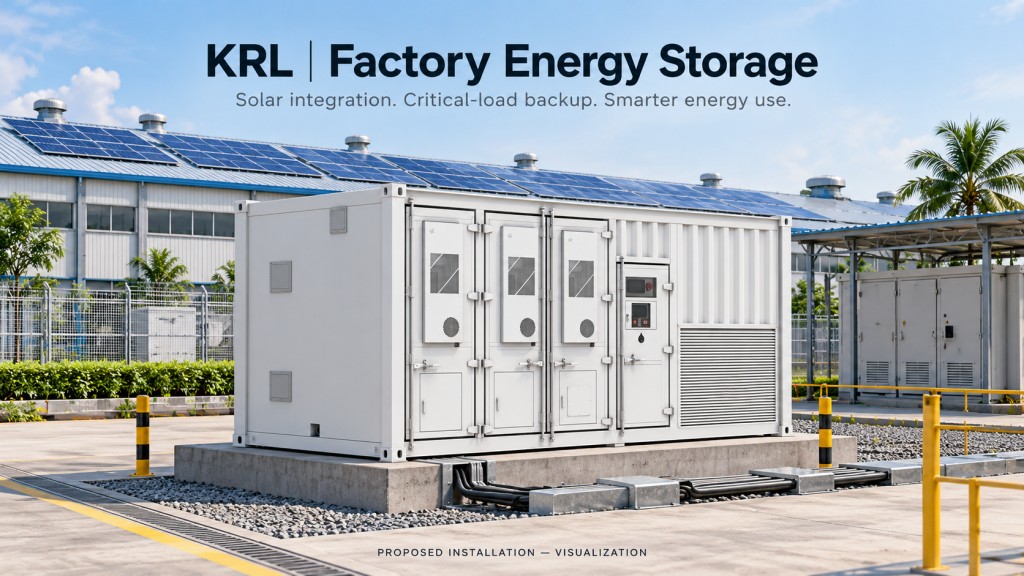
The supplied project briefs describe 415 V, 50 Hz factories with existing PV, generators and automatic transfer switches. The 250 kW enquiry includes 350 kWp of AC-coupled solar and a 750 kVA generator. The larger-load brief identifies a 1.2 MW generator and alternative 500 kW or 1 MW load cases.
These are separate sizing cases, not one combined factory installation.
Explore KRL commercial and industrial energy storage solutions as an integration route. The proposed benefit is to preserve suitable existing assets while adding controllable backup energy and a coordinated operating strategy.
Three Configurations, Three Purchasing Decisions
| Factory requirement | Preliminary equipment arrangement | Battery energy | Selection priority |
|---|---|---|---|
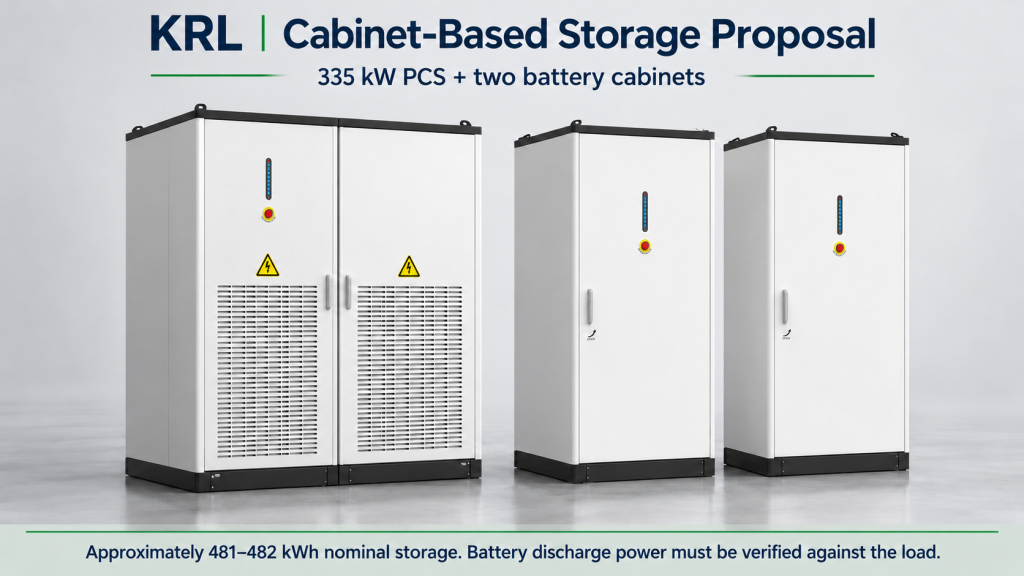
| Approximately 250 kW, including motors | One 335 kW hybrid inverter with two approximately 241 kWh battery clusters | Approximately 481–482 kWh, subject to final BOM | Confirm battery power capability and motor starts |
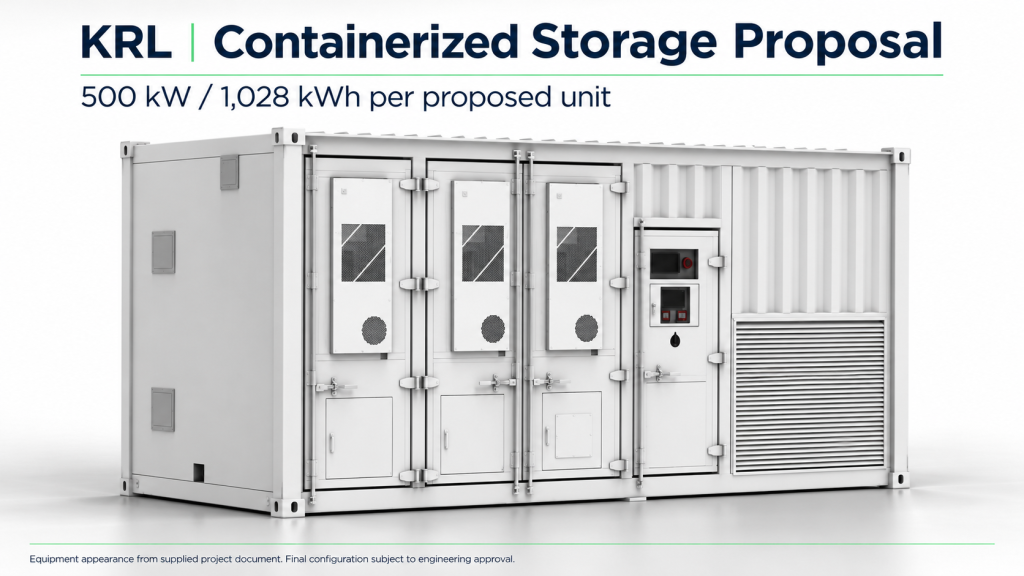
| Approximately 500 kW | One 500 kW / 1,028 kWh containerized system | 1,028 kWh nominal | Validate essential demand and required runtime |
| Approximately 1 MW | Two 500 kW / 1,028 kWh systems | 2,056 kWh nominal | Validate parallel control, switchgear and load sharing |
These configurations are based on the supplied project schedules. They are project-specific options for a KRL Power proposal, not a claim that their original equipment codes are standard KRL catalogue models. The final quotation should identify the supplier, model, included components and warranty responsibilities.
KRL's containerized energy storage product range provides a related procurement reference, but its catalogue ratings must not be substituted for the project-specific 1,028 kWh equipment without approval.
Why the 250 kW Case Needs More Than a 335 kW Inverter
The smaller factory includes air conditioning, motors and water pumps. Selecting an inverter above the stated load is a sensible starting point, but battery power must support it.
The battery schedule specifies a maximum 0.5C charge/discharge rate. Applied approximately to 481–482 kWh, that implies around 240–241 kW of nominal DC power before conversion losses. It does not establish 250 kW of continuous battery-only AC output.
The final design should therefore evaluate additional battery capacity, a verified higher-power battery option, a smaller protected-load group, or coordinated generator support. Solar assistance is useful when available, but should not be assumed for a night-time backup guarantee.
Motor starting also needs a separate check. The inverter schedule lists 1.5-times overload for 200 milliseconds in VSG mode; this is not proof that every motor can start. Obtain motor ratings, starting methods and acceptable voltage dips. Soft starters, variable-frequency drives and staged restarts may reduce the required peak.
Specify Two-Hour Backup as Delivered Energy
The larger configurations have approximately two hours of nominal energy relative to rated power. Actual autonomy depends on starting SOC, usable SOC range, conversion losses, auxiliary demand and battery condition.
For illustration, assume a 90% usable energy window and 95% discharge conversion efficiency:
| Configuration | Illustrative available AC energy | Runtime at stated full load |
|---|---|---|
| 500 kW / 1,028 kWh | 1,028 × 0.90 × 0.95 = 879 kWh | About 1.76 hours |
| 1 MW / 2,056 kWh | 2,056 × 0.90 × 0.95 = 1,758 kWh | About 1.76 hours |
These calculations exclude auxiliaries and aging and are not performance guarantees. A 500 kW load requiring two hours needs 1,000 kWh delivered at the AC load. Under the same assumptions, the nominal battery requirement is approximately 1,170 kWh before additional margins. For 1 MW, it is approximately 2,340 kWh.
Alternatively, 1,028 kWh could support an average 400 kW load for approximately 2.20 hours under those assumptions. This is why measuring the protected load can improve both reliability and budget efficiency. KRL's commercial energy storage selection guide offers a broader framework for comparing power, energy and integration requirements.
Keep Existing AC-Coupled Solar Working with the New System
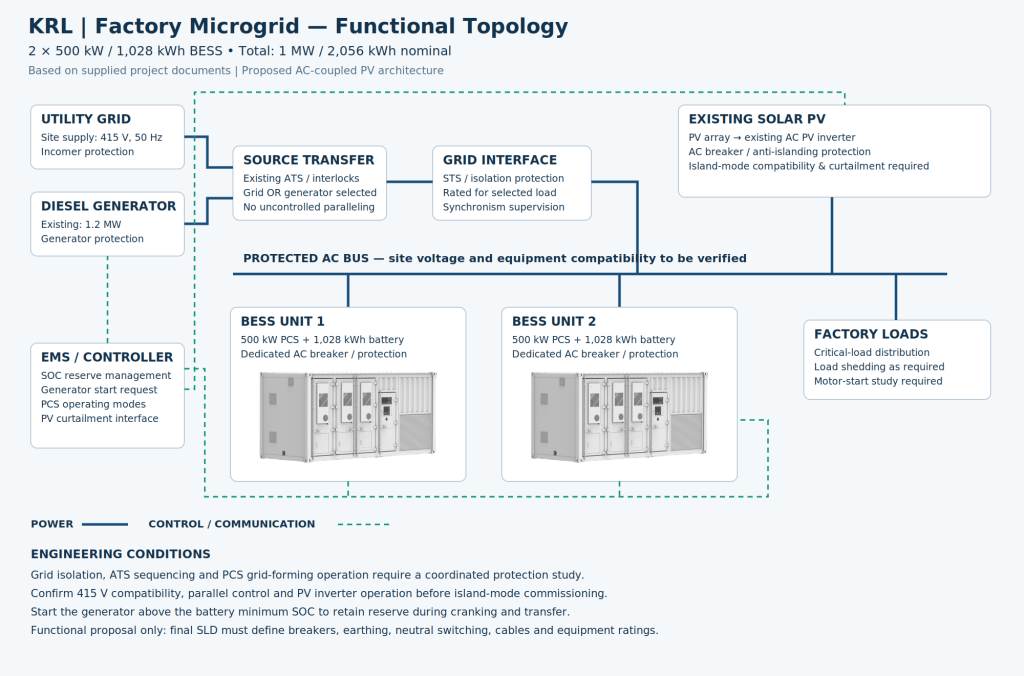
The enquiries identify existing AC-coupled PV. The baseline proposal should retain suitable solar inverters and coordinate them with the battery PCS and site controls.
During a utility outage, the PCS must establish a stable island before compatible PV can participate. The PV inverter's island operating compatibility, reconnection timing and curtailment interface need verification. Battery storage alone does not make every grid-tied inverter suitable for an islanded microgrid.
Optional integrated DC MPPT is a separate design choice for compatible new PV strings. It should not be confused with the existing AC-coupled array or described as standard equipment when the final BOM lists it as optional.
For the 350 kWp installation, the brief's 3.7 equivalent generation hours suggest approximately 1,295 kWh per day if that figure represents delivered daily yield. If it is an irradiation assumption, system losses must still be applied. In either case, factory daytime consumption comes first: total PV generation is not the same as energy available to recharge the battery.
EMS Operation: From Normal Production to Extended Outages
The operating document describes solar priority, storage assistance, utility support and diesel emergency backup. For a backup-focused factory, that priority should be implemented with a protected reserve rather than unrestricted battery discharge.
| Operating condition | Proposed control objective |
|---|---|
| Utility healthy | Use solar, manage battery charging and maintain the agreed outage reserve |
| Utility abnormal | Isolate the grid and support the approved essential-load bus |
| Extended outage | Dispatch compatible PV and storage while monitoring energy and power reserve |
| Reserve approaching minimum | Start the generator early enough to complete a validated transfer |
| Utility restored | Verify stable grid conditions, complete the approved transfer sequence and recharge reserve |
The generator start threshold should normally sit above the battery's hard discharge limit. Waiting until discharge stops can leave the load unsupported during generator startup and connection.
Generator integration also needs an explicit agreement. The supplied operating description includes both manual breaker closing and automatic engagement. A fully automatic solution therefore requires confirmed ATS or synchronization hardware, interlocks and commissioning tests; an automatic start signal alone is insufficient.
Fast Transfer Must Protect the Actual Production Equipment
The preliminary schedules list switching below 20 milliseconds. Treat this as an equipment specification to verify in the complete installation, not an unconditional no-interruption promise.
A production controller, contactor or sensitive electronic device may respond differently from a resistive test load. The acceptance test should therefore include representative production equipment and the most demanding agreed operating scenario.
Confirm 415 V compatibility in both on-grid and off-grid modes. The container schedule lists a grid voltage range that includes 415 V, but gives 400 V as its nominal off-grid output. Likewise, generator kVA should not be treated as interchangeable with kW.
The two-container design also needs coordinated parallel operation and a properly rated common interface. Two separate nameplates do not establish a complete 1 MW microgrid by themselves.
Build the Business Case Around Measurable Savings
Storage can create value through reduced diesel operation, better use of available solar, fewer disruptive restarts and tariff-based energy management where applicable.
A practical calculation is:
Annual net benefit = avoided diesel cost + additional solar value + verified electricity savings + defensible downtime savings − added operating costs.
Avoid counting the same displaced energy twice. Use generator fuel records, load profiles, tariffs, outage history and maintenance costs. Include charging losses, servicing and eventual battery replacement assumptions.
The presentation's 30%–50% diesel runtime reduction is not a measured result for these sites. The achievable reduction needs a dispatch simulation and an agreed baseline. KRL's commercial energy storage ROI calculation guide can help structure the comparison before investment approval.
Safety, Installation and a Clear Supply Boundary
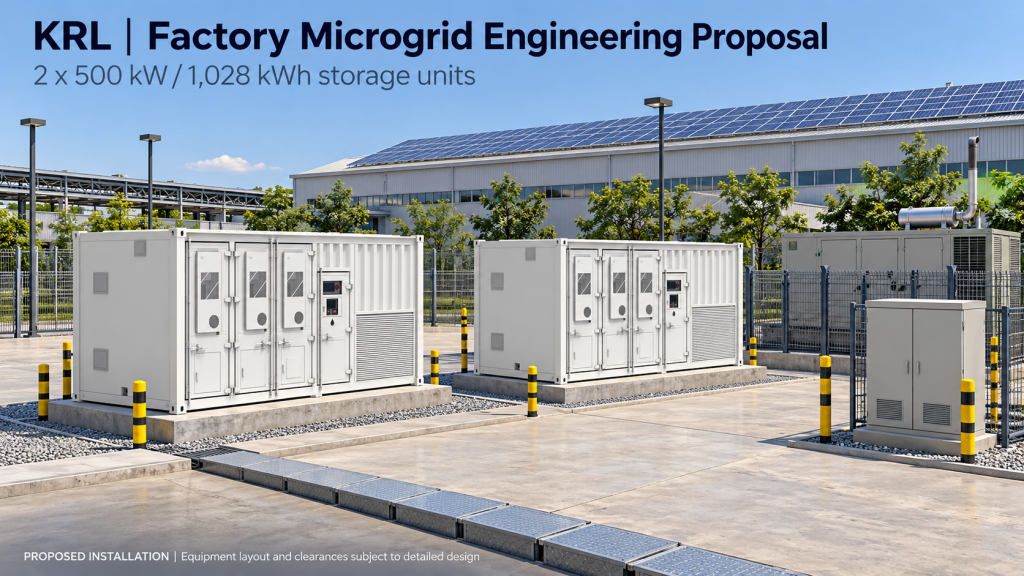
The detailed equipment schedules specify IP54 for the listed assemblies. The smaller battery arrangement is air cooled. Do not substitute generic IP66 or liquid-cooling claims for these project specifications.
Confirm ventilation, ambient-temperature derating, drainage, flood exposure, foundation capacity, service access and fire protection. The larger equipment schedule gives a container length of approximately 12.2 metres; this should not be quoted as a 20-foot unit.
Request the certificates, transport documentation and test reports applicable to the actual supplied models. Cycle-life figures depend on test conditions and are not equivalent to an unconditional service-life warranty.
The preliminary equipment lists exclude onsite connection cables. The commercial offer should separately identify cabling, switchgear, civil works, protection, installation, commissioning, training, spare parts and warranty support. A clear supply boundary helps the customer compare complete installed solutions rather than incomplete equipment prices.
Why Discuss This Project with KRL Power?
KRL's value in this enquiry should be demonstrated through a coordinated proposal: the battery, PCS, transfer arrangement, existing PV and generator need to work as one system.
Ask for a load-based equipment recommendation, an agreed single-line diagram, an operating sequence and measurable acceptance criteria. Those deliverables turn a preliminary capacity selection into a purchase decision the factory can evaluate.
Frequently Asked Questions
FAQ
Can the system reuse our existing rooftop solar?
Does 1,028 kWh guarantee two hours at 500 kW?
Is the 335 kW inverter enough for a 250 kW motor load?
Will the generator start and connect automatically?
Can we begin with a 500 kW system and expand later?
How much diesel will we save?
Are these configurations standard catalogue products?
What information is needed for an accurate quotation?
Request Your Factory-Specific Configuration
Start with the production loads you cannot afford to lose. Request a KRL factory backup proposal with your electricity bill, available electrical drawings and essential-load list. Ask for the recommended configuration, delivered-energy basis, integration scope and commercial quotation together, so the purchase decision reflects the whole working system.
Engineering basis: two supplied October 2026 preliminary project presentations and the supplied operating-conditions description. This is a proposed application analysis, not a commissioned case study. Calculations are illustrative; final performance requires an approved equipment schedule and acceptance tests.