

KRL Power prepared this inkqubo yokugcina amandla yorhwebo guide for an anonymized Nigerian hospital procurement scenario: existing solar PV, an initial 250 kWh-class storage phase and a future 1 MW power objective. The buyer needs an outdoor C&I system with an integrated inverter and a documented battery and PCS warranty scope. This article gives the hospital, EPC and electrical consultant a procurement sequence for defining the first-phase duty, testing its interfaces and preserving the future expansion boundary.
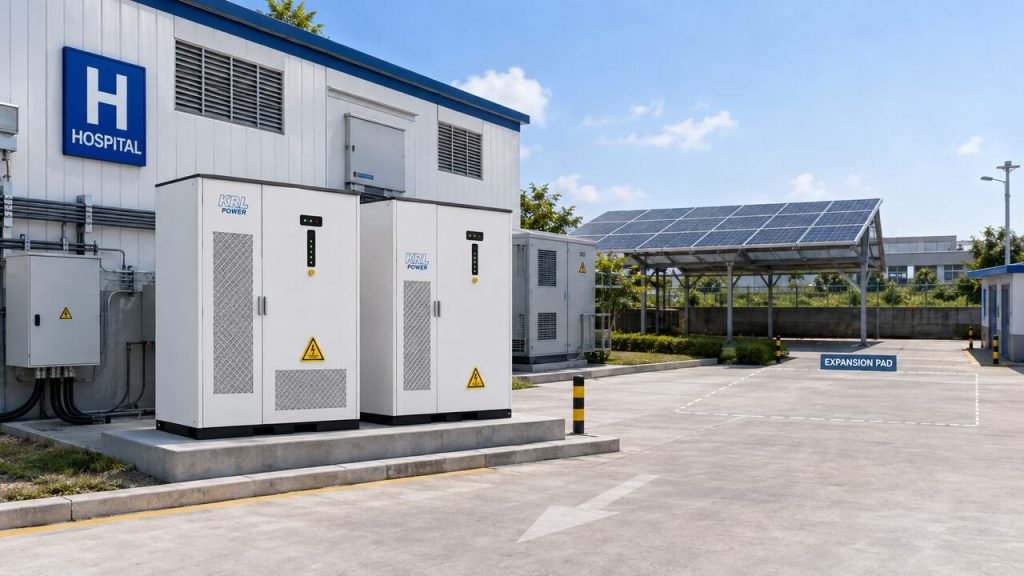
The immediate decision is to specify the phase-one operating duty and issue the same technical inputs to every bidder. A defined load hierarchy, a model-specific selection, a documented PV interface and an expansion interface plan allow the hospital to compare complete proposals on a common basis.
Use the Procurement Scenario as the Project Input List
This anonymized buyer requirement is a procurement scenario. The final project requires an electrical study, site survey, approvals and an approved equipment selection. The table separates the buyer’s request from the information required for a project decision.
| Project input from the requirement sheet | Inkcazelo yokufunwa kweempahla | Information needed before final selection |
|---|---|---|
| Nigerian hospital site | Review local grid behavior, weather exposure, import route and site service plan | Site address, ambient design conditions and local approval path |
| I-PV yelanga ekhoyo | Establish the PV inverter, control interface and protection arrangement | PV single-line diagram, inverter model, firmware and available AC/DC capacity |
| Initial target: about 250 kWh | Select a published product class close to the required energy range | Essential-load profile, runtime target, reserve setting and auxiliary load |
| Future target: 1 MW | Protect future switchgear, controls, land area and cable routes | Expansion phasing plan, power target, energy target and final operating modes |
| Outdoor C&I installation | Confirm enclosure, foundation, access, lifting and cable-entry conditions | Site layout, civil drawings, flooding risk and cable routes |
| Integrated inverter and LiFePO4 preference | Verify the actual battery–PCS architecture and published model data | AC voltage, phase arrangement, generator interface and protection study |
The 250 kWh request describes initial energy. The 1 MW target describes future power. Each value needs its own approved design basis, including the operating duty, protection, controls and equipment layout. Tender documents should define both horizons so suppliers can price a complete first phase and identify the expansion provisions.
Define the Hospital Load Hierarchy Before Selecting Energy Capacity
Hospital demand contains loads with very different consequences and operating patterns. A single site total can hide the difference between a life-safety circuit, a diagnostic suite, a pharmacy cold chain, a water pump and an administrative office. The electrical team should turn the site load record into a priority schedule before choosing cabinet energy or PCS rating.
- Group A — continuity-critical circuits: circuits defined by the hospital’s licensed electrical designer and protected through the approved hospital electrical architecture.
- Group B — clinical support circuits: laboratory, pharmacy, diagnostics, communications, water and building-services loads with an agreed restoration sequence.
- Group C — revenue and operations circuits: registration, billing, lighting, kitchen or accommodation loads selected by the hospital operating team.
- Group D — deferrable circuits: loads that can be scheduled around the available energy window under the hospital’s written operating rules.
For each group, the facility engineer should supply interval demand data, motor-start assumptions, the required support duration, existing UPS and generator details, the planned state-of-charge reserve and the solar PV generation record. This input creates a defined energy basis for every supplier. It also allows the hospital to compare preliminary quotes on the same loads and runtime objective. The broader method is consistent with KRL Power’s commercial energy storage system design guidance, which starts with the operating objective and site inputs.
Use the First Phase for a Defined Operating Duty
An initial 250 kWh-class cabinet has a useful role when the site specifies its duty in advance. Examples include solar self-consumption during an agreed daytime period, demand management for selected loads, generator support under a written sequence, or backup for a defined essential-load group. Each duty needs a separate control schedule and acceptance test.
| Operating duty | Inputs for the hospital | Evidence to request in the proposal | Acceptance evidence |
|---|---|---|---|
| Solar self-consumption | PV output curve, daytime load and tariff period | PV interface, charge schedule and export assumptions | Meter trend showing the agreed charge and discharge periods |
| Essential-load support | Priority circuits and required duration | One-line diagram, transfer sequence and power limit | Witnessed functional test against the approved load schedule |
| Generator coordination | Generator rating, controls and fuel objective | Generator interface, command authority and interlocks | Tested start, load-transfer and restoration sequence |
| Demand management | Meter point, tariff structure and demand target | EMS logic, setpoint owner and meter arrangement | Meter export showing the agreed operating window |
The hospital should assign one owner to each operating rule. The owner of the EMS dispatch logic, the owner of the PV interface, the owner of the transfer equipment and the owner of the operating schedule should appear in the project responsibility matrix. KRL’s BMS, PCS and EMS overview offers useful vocabulary for this discussion, while the selected project documents establish the binding interface details.
Compare Published KRL Cabinet Options for the 250 kWh Phase
The customer requirement is approximately 250 kWh. KRL’s public catalogue lists two nearby 125 kW C&I cabinet configurations. The selection depends on the approved load schedule, site environment, installation plan and future-system architecture.
| Isigqibo | Hospital question | Project evidence |
|---|---|---|
| Amandla | How much approved load energy must the first phase supply during the stated operating window? | Interval demand data, critical-load schedule, reserve setting and usable-energy calculation |
| Power | What continuous and short-duration power must the selected circuits draw, including agreed motor-start conditions? | Load study, motor data, protection review and approved transfer sequence |
| Ukwandisa | What final topology will carry the future 1 MW objective? | Approved single-line diagram, switchgear study, controls narrative and equipment layout |
| Published KRL model | Amandla ombane we-AC amiselweyo | Amandla alinganisiweyo | Cooling / protection | Published expansion signal | Fit to the customer brief |
|---|---|---|---|---|---|
| KRL-B241 | 125 kW on-grid and off-grid | 241 kWh LiFePO4 | Industrial air conditioner; IP54 | Up to 10 units in parallel | Closest published energy class to the requested air-cooled first phase |
| KRL-B261L | 125 kW on-grid and off-grid | 261 kWh LiFePO4 | Liquid cooling; battery enclosure IP65 | Up to 10 units in parallel | Nearby energy class when the project team prefers the published liquid-cooled configuration |
The KRL-B241 public page lists a 120 kW PV input, 400/230 Vac, 50/60 Hz, a generator interface, RS485/WiFi and a stated switching time below 10 ms. Its public dimensions are 1,190 × 1,170 × 2,260 mm and its stated weight is approximately 2,520 kg. The KRL-B261L page lists 120 kW PV input, 400/230 Vac, 50/60 Hz, a generator interface, RS485/WiFi, a stated switching time below 10 ms and up to 10 parallel units. The KRL-B261L 125 kW / 261 kWh product page records the published model details.
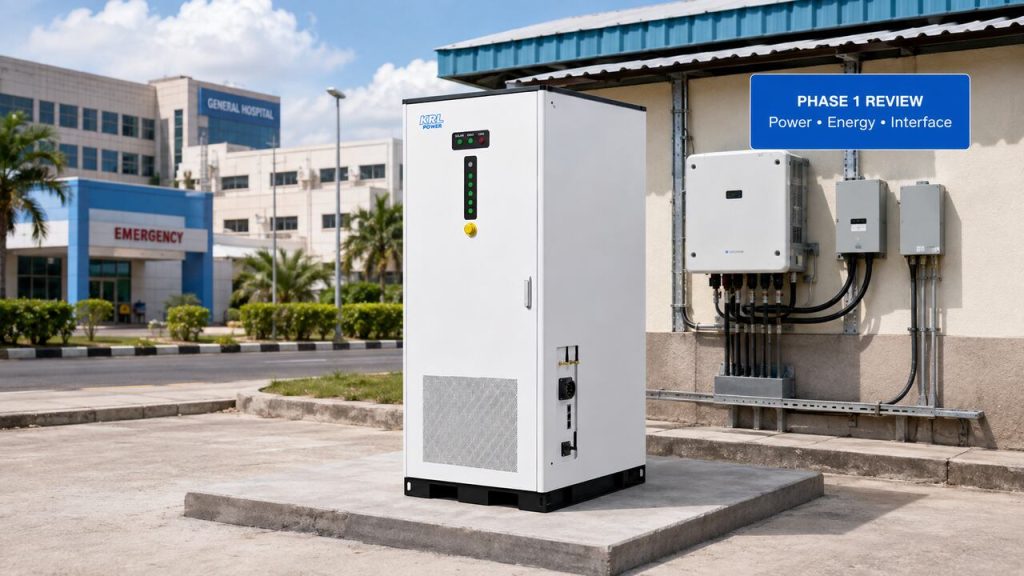
The supplier must confirm the selected system’s final topology, protection, controls, equipment arrangement and operating modes. The site engineer must also confirm the actual AC architecture, energy boundary, auxiliary consumption and operating limits before either cabinet enters a final proposal. Product-level source review can begin with the KRL-B241 125 kW / 241 kWh product page.
Document the 1 MW Expansion Boundary in the First-Phase RFQ
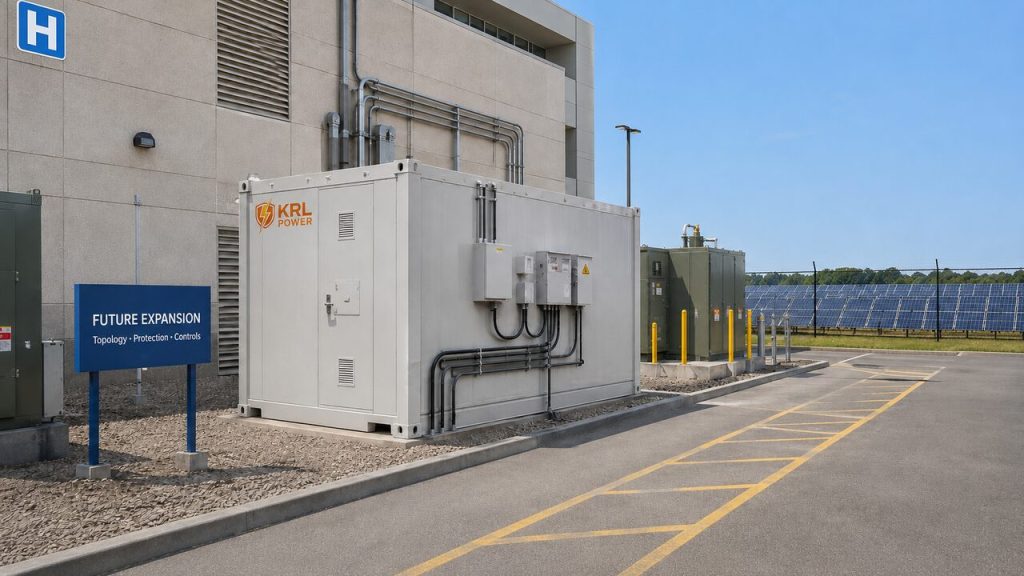
A 1 MW future power objective needs explicit space in the first-phase RFQ. The tender, civil layout, single-line diagram and controls schedule should reserve the approved expansion boundary. Future usable energy, equipment topology and protection remain project-specific engineering decisions.
Electrical and Civil Provisions
- Reserve the required low-voltage switchboard positions, feeder routes and protection locations for the approved expansion concept.
- Establish the final point of common coupling, meter points and neutral/earthing arrangement on the single-line diagram.
- Plan equipment pads, equipment access, lifting paths, cable trenches, drainage and maintenance clearances for each later phase.
- Record the available PV connection point and future PV growth assumptions separately from the BESS expansion plan.
- Include the final fault-level study, selectivity study and local approval requirements in the EPC scope.
Controls and Operating Provisions
- Define EMS command authority across hospital facilities, PV controls, generator controls, BESS PCS and any building-management gateway.
- Keep a version-controlled register for meter maps, network addresses, alarm priorities, firmware versions and settings files.
- Specify the operating sequence for normal grid operation, solar charging, generator support, planned maintenance, island operation where applicable and restoration.
- Establish role-based access for operating staff, service personnel and the project control owner.
Commercial Provisions
- Request an itemized phase-one bill of materials plus a separate expansion allowance schedule.
- Ask each bidder to state inclusions and exclusions for civil works, switchgear, protection, control integration, freight, commissioning and local approvals.
- Request product-specific warranty documents, operating conditions, service contacts and claim-evidence requirements. Compare each bidder’s model code, scope owner and claims-evidence route.
- Establish the document handover package: drawings, settings exports, serial numbers, test records, user manuals and training records.
The KRL product catalogue currently contains both cabinet and container product classes. A future 1 MW requirement warrants a dedicated technical comparison with KRL’s published 1 MW / 2 MWh-class container configuration. Its public table provides a reference point. The hospital expansion design remains subject to the final project study.
Review the Existing Solar PV Interface Before Issuing the RFQ
The hospital’s existing solar PV must enter the technical review as a defined interface. Give each shortlisted supplier the PV inverter model, AC or DC coupling arrangement, installed capacity, protection layout, communication protocol and operating settings. The selected solution needs a model-specific engineering review.
- PV inverter data sheets and site commissioning records.
- Current single-line diagram and distribution-board schedule.
- PV generation history and hospital import-meter data.
- Current backup equipment and transfer-equipment diagrams.
- Existing generator nameplate data and controller details, where generators remain part of the site.
- Communications map, internet and cybersecurity rules, plus alarm escalation contacts.
For practical selection context, the hospital team can review KRL Power’s C&I system-selection guide kunye ne 100 kW energy storage inverter guide. The final proposal should identify the selected model combination, drawings, control limits and test schedule.
Issue a Hospital-Ready Proposal Package
A consistent inquiry package gives every bidder the same basis for equipment, integration, commissioning and service scope. It also creates a clear comparison between complete project offers and partial equipment prices.
| Proposal requirement | Why it belongs in the request |
|---|---|
| Exact BESS and PCS model number | Connects every stated parameter to an identified product |
| Rated power and rated energy | Sets the published starting point for the project calculation |
| Usable-energy calculation basis | Shows operating window, reserve, auxiliary consumption and conversion boundary |
| PV, generator and grid interfaces | Establishes the connection and control scope |
| Essential-load schedule | Links battery operation to hospital continuity priorities |
| Site layout and civil requirements | Sets access, foundation, drainage, cable and clearance responsibilities |
| Protection and controls schedule | Establishes meter ownership, alarm routing and command authority |
| Commissioning and acceptance plan | Defines evidence needed before handover |
| Warranty and service matrix | Identifies covered equipment, operating conditions, response process and claims evidence |
KRL Power can review this package with the hospital’s selected load schedule and electrical documents. The KRL C&I energy storage system range gives a verified product-family starting point. The project proposal should identify one precise configuration and its responsibilities.
Plan Acceptance Testing Around the Hospital Operating Sequence
The handover plan should follow the operating duties written into the contract. A product demonstration becomes valuable when it verifies the agreed power boundary, monitoring path, alarm response and restoration sequence.
- Validate equipment identity, serial register and installed single-line diagram.
- Test the agreed PV charge schedule and meter readings.
- Test the priority-load sequence approved by the hospital facilities team.
- Validate communication signals, alarm delivery, emergency controls and command ownership.
- Record generator coordination where it is included in the approved operating mode.
- Export the final settings, firmware register and user access matrix.
- Capture training attendance, maintenance instructions and escalation contacts.
- Approve a witness-test schedule that assigns the hospital, EPC and supplier responsibilities for each test and each close-out record.
These records help the hospital operate the first phase and prepare an orderly expansion. KRL’s commercial backup-power guidance can help frame the continuity questions that belong in the operating plan.
Decision Path for the Hospital Procurement Scenario
The procurement scenario supports a clear sequence: define the hospital load hierarchy and phase-one duty; select a published 241 kWh or 261 kWh class after the electrical study; reserve switchgear, layout and controls capacity for the approved future scale; and compare supplier proposals through one technical and commercial matrix.
This process converts an approximate 250 kWh request into a controlled C&I storage procurement package. It gives the hospital a documented route toward its 1 MW objective and assigns responsibilities across solar PV, the BESS, site electrical works and operating teams.
Imibuzo Ebuzwa Rhoqo
What information does a hospital need before requesting battery storage?
Provide the essential-load hierarchy, interval load data, required support duration, solar inverter details, generator data, single-line diagram, installation layout and desired operating modes.
Is about 250 kWh a KRL Power model name?
It is a customer energy target. KRL’s publicly listed nearby cabinet options include the 241 kWh KRL-B241 and the 261 kWh KRL-B261L. The final selection follows the approved site design.
How does a hospital calculate BESS runtime?
The project engineer calculates runtime from the approved load schedule, usable-energy boundary, reserve setting, auxiliary consumption, conversion losses and operating conditions for the selected configuration.
Can an initial hospital BESS expand toward 1 MW?
A phased plan can support future growth when switchgear, protection, cable routes, controls, layout and commercial boundaries are designed for the approved expansion concept.
Which KRL model is closest to a 250 kWh air-cooled request?
The published KRL-B241 has 241 kWh rated energy, 125 kW rated AC power, industrial air conditioning and IP54 protection. The project team should review the exact site conditions and system architecture.
What does the KRL-B261L add to the comparison?
The published KRL-B261L has 261 kWh rated energy, 125 kW rated AC power, liquid cooling and a battery enclosure rated IP65. It needs a model-specific project review.
Can the BESS work with existing hospital solar PV?
The selected BESS architecture needs review against the exact PV inverter model, coupling arrangement, voltage, protection, communication interface and operating settings.
What should a hospital include in an energy-storage single-line diagram?
Include the BESS, PCS, PV, generator where applicable, utility connection, meter points, protection equipment, transfer equipment, essential-load boards, earthing arrangement and command interfaces.
Who should control hospital BESS dispatch?
The project controls schedule should name the authority for EMS setpoints, PV coordination, generator commands, alarms, emergency controls and operator access.
What acceptance tests belong in a hospital BESS handover?
Test the contracted operating modes, priority-load sequence, communications, alarms, emergency controls, meter data, restoration process and document handover.
How should warranty terms be compared?
Compare the exact equipment covered, operating conditions, capacity or performance boundary where stated, service responsibilities, evidence requirements, exclusions and claim process.
Which documents help with a future BESS expansion?
Retain final drawings, equipment register, protection files, meter map, network map, settings exports, firmware list, test records, service history and the expansion design basis.
What is a suitable first step for a Nigerian hospital with existing PV?
Assemble the hospital load schedule, solar inverter documents, existing single-line diagram and required continuity duties, then request a model-specific technical review.
Does this guidance apply to Nigerian hospitals?
Yes. It addresses a Nigerian hospital procurement brief. Local electrical codes, import requirements, site conditions and approvals belong in the final project review.
Can the same approach support hospitals in other African markets?
Yes. The load hierarchy, interface review and phased-expansion process apply across markets, with local grid, climate, approval and service requirements defined for each site.
Why does the article use an anonymous hospital case?
The case preserves the customer’s procurement context while protecting private project identity and avoiding an unsupported delivery claim.