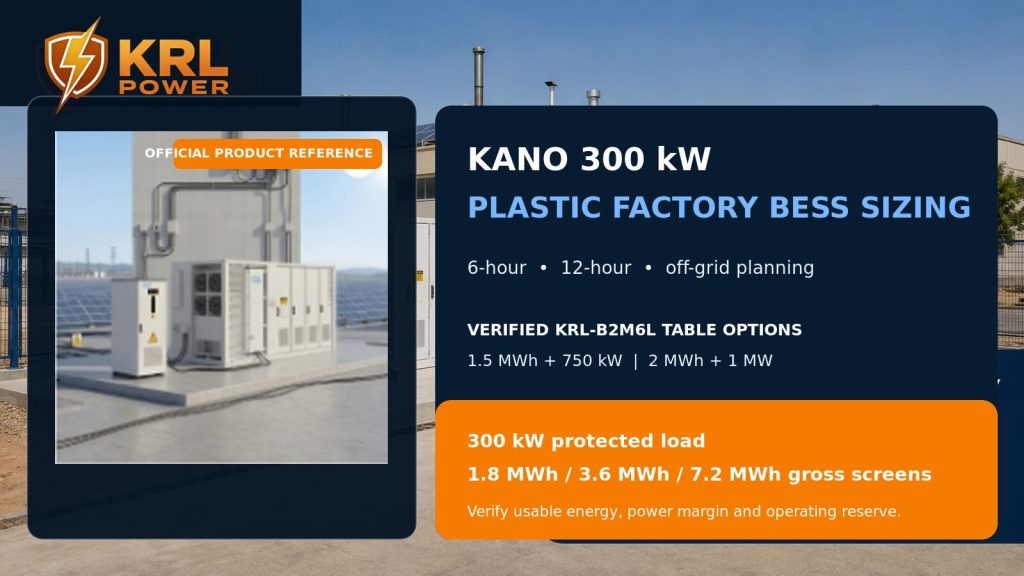
Ugcino lwebhetri yefektri eNigeria kufuneka lukhusele umthwalo wemveliso kunye nolandelelwano olulawulwayo lokucima. A Isityalo seplastiki esiyi-300 kW Ukusetyenziswa 1.8 MWh kwiiyure ezintandathu, 3.6 MWh kwiiyure ezilishumi elinambini, kwaye 7.2 MWh kwiiyure ezingamashumi amabini anesine xa umthwalo okhuselweyo uhlala kwi-300 kW. Okuqinisekisiweyo Inkqubo yokugcina amandla yezikhongozeli i-KRL-B2M6L udweliswe esidlangalaleni 1.5 MWh / 750 kW kwaye 2 MWh / 1 MW iimilo.
Isiphumo siqondile:
- I- Inguqulelo ye-1.5 MWh ayibandakanywa kumthwalo weeyure ezintandathu kwi-300 kW. kuba ixesha elifanelekileyo lokusebenza kwegama layo liyeyihora ezintlanu phambi kokulahlekelwa, izixhobo ezincedisayo kunye neyedekhi.
- I- Inguqulelo ye-2 MWh ngumgqatswa wokuqala opapashiweyo weeyure ezintandathu., kodwa imarjin yayo yegrose ye-200 kWh ayinakuxhasa isiqinisekiso sexesha lokusebenza ngaphandle kwedatha yamandla e-AC anokusetyenziswa.
- A Ijelo leeyure ezilishumi elinesibini lidinga i-3.6 MWh ehanjiswe kumthwalo.. Ingcamango yeeyunithi ezimbini ihlala iyingcamango yokuhlola umthamo de i-KRL iqinisekise ukusebenza ngokunxuseneyo.
- A Usukelo olupheleleyo lokuzimela ngogridi lufuna i-7.2 MWh ngosuku. kunye nokulahleka kwenkqubo nokubuyiselwa kwesipaji. I-PV, i-BESS kunye nokuveliswa ngedizili kufuneka balungelelanise ibhalansi yamandla kwiyure nganye.
I-KRL inika abathengi iqonga elisebenzisekayo lokuqalisa: amandla aphezulu e-PCS, iingeni ezithe ngqo ze-PV, isibuko segenerator yedizili, amanqanaba okusebenza kwi-on-grid nakwi-off-grid, ukupholisa ibhetri elulwelo, isilinganiso se-IP65 kwisixhobo esincinci sebhetri kunye noluhlu olupapashiweyo lokusebenza ngaphandle. Isigqibo sokuthenga sisaxhomekeke kwixesha lokusebenza elinokulinganiswa, iprofayile yemthwalo yefektri kunye nesakhiwo senkqubo esityikityiweyo.
Guqula iMfuno ye-300 kW ibe yiMandla e-AC Ahanjisiweyo
Amandla ebhetri kunye namandla ebhetri ziphendula imibuzo eyahlukileyo yokufunyanwa:
- Amandla kwi-kW nakwi-kVA: Ingaba i-PCS ingakwazi ukumelana nomthwalo oqhubekayo, ukuqaliswa kweenjini kunye nokunyuka komthwalo?
- Amandla anikezelweyo kwi-kWh: Inokuqhubeka ixesha elingakanani inkqubo yokuvelisa ekhuselweyo?
- Gcina amandla: Ingaba isityalo singakwazi ukukhupha izinto eziseleyo, sigcine ukupholisa, kwaye siqalise ijeneretha phambi kokuvalwa?
Ubalo lwegama kuphela umgca wokuqala:
Load-side energy = protected average load × operating time
Ubalo oluthembekileyo yile:
Delivered AC energy = rated battery energy × usable SOC fraction × AC efficiency × retained capacity − auxiliary energy
Runtime = delivered AC energy ÷ protected average load
| Ujoliso lokusebenza | Imfuneko kwicala lomthwalo yi-300 kW | Isalathiso somthamo we-KRL kawonke-wonke | Inqanaba langoku lobunjineli |
|---|---|---|---|
| Ukuphinda ufake kwiiyure ezi-6 | 1.8 Megawatt-yure | Iyunithi enye eyi-2 MWh | Umgqatswa; kufuneka isiqinisekiso samandla e-AC asetyenzisekayo |
| Ukuphinda ufake iiyure ezili-12 | 3.6 Megawatt-iyure | Ingqikelelo yezixhobo ezimbini zomthamo oqhelekileyo | Uyilo oluhambelanayo olungqiniswanga |
| Amandla omthwalo eeyure ezingama-24 | 7.2 MWh/ngemini | Ingcamango yeeyunithi ezine zomthamo oqhelekileyo | Kufuneka isilinganiso esidityanisiweyo sesiqingatha ngesiqingatha. |
No parallel capability, redundancy or control architecture is assumed in the two-unit and four-unit concepts. KRL’s public B2M6L table lists individual configurations and does not publish a multi-container topology.
Umthwalo oqhelekileyo olinganisiweyo unokutshintsha isiphumo kakhulu:
| Umthwalo oqhelekileyo okhuselweyo | iiyure ezi-6 | Iiyure ezili-12 | iiyure ezingama-24 |
|---|---|---|---|
| 150 kW | 0.9 MWh | 1.8 Megawatt-yure | 3.6 Megawatt-iyure |
| 225 kW | 1.35 Megawatt-yure | 2.7 Megawatt-iyure | 5.4 Megawatt-iyure |
| 300 kW | 1.8 Megawatt-yure | 3.6 Megawatt-iyure | 7.2 Megawatt-iyure |
Sebenzisa idatha yemitha yomzuzu omnye okanye yemizuzu elishumi elinesihlanu ukufumanisa umyinge okhuselweyo. Rekhoda umthwalo ophezulu wangaxeshanye ngokwahlukileyo kuba ukulinganisa ubungakanani bamandla kunye nokulinganisa ubungakanani be-PCS kusebenzisa iingeno ezahlukileyo.
Khusela inkqubo yokukhusela iplastiki ngexesha lokulahlekelwa yigridi nokuqalisa kwakhona
Umatshini weplastiki unokuphulukana nemveliso kunye nexesha lemveliso xa umbane unyamalala ngexesha lokufudumeza, lokukhupha, lokutofa okanye lokupholisa. Ishedyuli yemithwalo kufuneka iqulathe iimeko zokusebenza ezine.
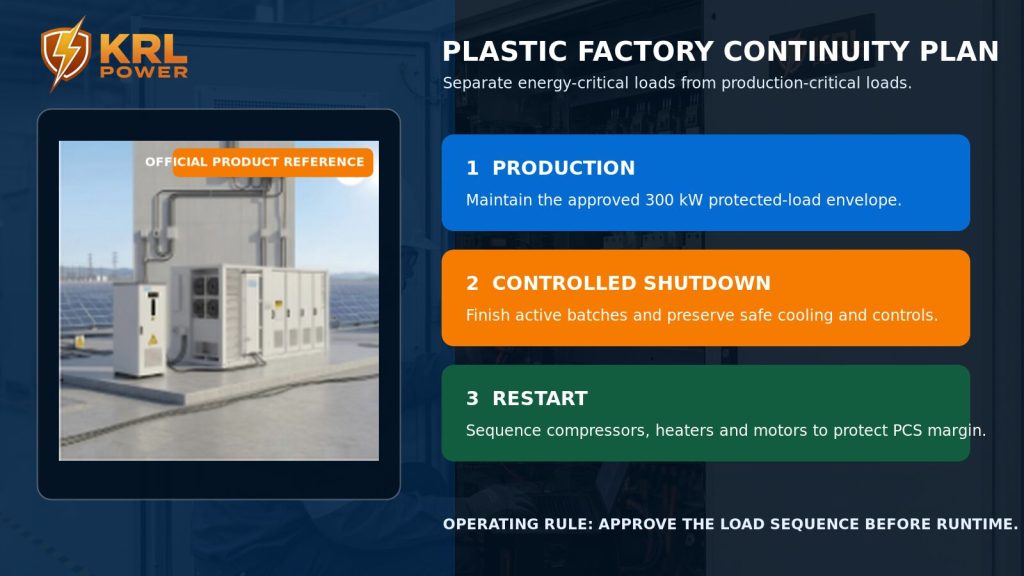
Uveliso oluqhelekileyo
Nceda urekhode i-operating kW, i-kVA, i-power factor kunye ne-phase current ze:
- Oomatshini bokukhupha okanye bokubumba ngokutofa
- Izifudumezi zomphongolo, zedayi nezomoldi
- Iiyunithi zamandla e-hydraulic kunye nee-servo drive
- Izichisi, iinqaba zokupholisa kunye neempompo zokujikelezisa
- Izixhobo zokucinezela umoya
- Iigránulátála, iikónévha kunye neenkqubo zokutyisa izinto
- Ii-PLCs, iikhompyutha zemizi-mveliso, izixhobo zonxibelelwano kunye neenkqubo zokhuseleko
Ukulahlekelwa yiGridi Ngesiquphe
Linganya okwenzekayo ngexesha loluntu Ngaphantsi kwemilisekhondi eli-10 Isithuba sokutshintshela:
- Ukunyamezela kwe-PLC kwimithombo yamandla
- Ukuqhubeka kwe-VFD kwi-DC-bus
- Iikontaktha ezikhululayo ngexesha lokuphazamiseka kwevoltheji
- Iimpompo zokupholisa ekufuneka ziqhubeke ngaphandle kokulibaziseka kokuqalisa kwakhona
- Izitshixo zokhuseleko ezifuna ukusetwa ngesandla
- Isinyuko esiphezulu somthwalo esiboniswe kwi-PCS
Inani le-B2M6L lokutshintsha kufuneka livavanywe kwisixhobo ngasinye esibalulekileyo. Iisekethe zolawulo ezibuthathaka zisenokufuna i-UPS yolawulo ezimeleyo.
Ukuvalwa Kokwenziwa Kweemveliso Ngokulawulwa
Reserve energy must cover the plant’s approved shutdown procedure, including any required:
- Ukuhlamba izinto okanye ukucoca ibharali
- Ulawulo lweheater ngexesha lomjikelo wokucoca
- Ukubola kunye nokupholisa inkqubo
- Ukuhamba komoya nokukhupha umoya
- I-PLC, izixhobo zokulinganisa nonxibelelwano
- Iinzame zokuqalisa ijeneretha nexesha lokuzinza
Isipaji kufuneka siboniswe ngo I-kWh nemizuzu, kunye nolandelelwano oluzenzekelayo lokucima umthwalo. Ixabiso lipesenti ye-SOC lodwa alingqini ukuba ukucima kunokugqitywa.
Ukuqaliswa kwakhona kwemveliso
Ukuqalisa ngokupholileyo okanye ngokufudumeleyo kunokudala incopho eyahlukileyo kunokusebenza okuqhelekileyo. Uphononongo kufuneka luquke:
- Ukubuyiselwa kokufudumeza ngaxeshanye
- Ukuqaliswa kwe-compressor ne-chiller
- Ukukhawuleziswa kwempompo ye-hydraulic okanye kwemoto ye-extruder
- Conveyor and material-feeding restart
- Minimum time before saleable production resumes
Kwezika-R.L. Iinkqubo zokugcina amandla zorhwebo nezoshishino provide the product-family reference. The selected PCS must be approved using the plant’s operating sequence and measured waveform data.
Verify PCS Current, Motor Starts and Factory-Bus Voltage
KRL ipapasha 750 kW grid-connected and off-grid rated power for the 1.5 MWh version and 1,000 kW for the 2 MWh version. Both exceed 300 kW on a steady-state power screen.
For a 400 V three-phase system:
I = P ÷ (√3 × V × power factor)
- Kwi PF 1.0, 300 kW is approximately 433 A.
- Kwi PF 0.9, 300 kW is approximately 481 A.
- KRL ipapasha 1,130 A maximum AC current for the 750 kW version.
- KRL ipapasha 1,500 A maximum AC current for the 1 MW version.
These values show steady-state current headroom. Approval still requires:
- PCS overload curve and overload duration
- Motor-start current and acceleration time
- Largest simultaneous load step
- Phase imbalance and neutral current
- Harmonic spectrum from VFDs and rectifiers
- Voltage recovery after load application
- Frequency response in off-grid mode
- Transformer energization and auxiliary-start sequence
The product table states 400/230 Vac, L1/L2/L3/N/PE. The EPC must measure the actual factory bus and define:
- Nominal and permitted voltage range
- Required transformer ratio and impedance, when applicable
- Neutral connection and earthing arrangement
- Generator-neutral switching
- Islanded earth-fault detection
- PCS fault-current magnitude and duration
- Breaker and relay selectivity under PCS-limited current
A 1 MW PCS rating does not prove that traditional downstream breakers will clear an islanded fault. The protection study must use the manufacturer’s current-limiting and fault-response data.
Six-Hour Configuration: One 2 MWh Unit Remains a Candidate
I- 1.5 MWh / 750 kW version has an ideal runtime of:
1.5 MWh ÷ 300 kW = 5 hours
It cannot meet six hours at 300 kW even before project deductions.
I- 2 MWh / 1 MW version has an ideal nameplate runtime of:
2 MWh ÷ 300 kW = 6.67 hours
Its gross 200 kWh margin equals 40 minutes at 300 kW. The technical offer must convert that margin into a delivered-energy guarantee by stating:
- Beginning-of-life usable AC energy
- End-of-warranty usable AC energy
- Minimum and maximum SOC
- Conversion efficiency at the expected load
- Battery, PCS and HVAC auxiliary consumption
- Kano ambient-temperature derating
- Emergency shutdown reserve
- Recharge time from grid, PV and generator
One 2 MWh KRL-B2M6L can be approved for six hours only if KRL guarantees at least 1.8 MWh of delivered AC energy under the agreed load, power factor, ambient conditions and reserve policy.
If the guarantee falls below 1.8 MWh, the buyer can:
- Remove lower-priority loads from the protected bus.
- Start the diesel generator at a higher SOC threshold.
- Review additional capacity after KRL confirms the permitted system architecture.
Twelve-Hour Configuration: Define the Multi-Unit Architecture
Twelve hours at 300 kW requires 3.6 MWh delivered to the load. Two 2 MWh units create a 4 MWh nominal-capacity concept with a 400 kWh gross margin.
The quantity calculation does not establish a working system. KRL must issue:
- Approved single-line diagram
- Number and rating of PCS outputs
- Common AC-bus and transformer arrangement
- EMS master–follower or distributed-control method
- Steady-state and transient power-sharing tolerance
- Grid and generator synchronization sequence
- Communication-loss response
- Protection coordination and fault-current study
- Operation with one unit isolated for maintenance
- Capacity, throughput and warranty measurement across all units
The commercial value of twelve hours comes from avoided production interruption. Compare the incremental CAPEX with:
- Contribution margin protected during the additional six hours
- Scrap avoided during controlled production continuity
- Diesel fuel and maintenance avoided
- Labour and restart hours avoided
- Delivery penalties or order delays avoided
Kwezika-R.L. C&I energy storage engineering capabilities describe integrated controls, liquid cooling and modular system concepts. The project contract must identify the exact functions included in the quoted multi-unit design.
Full Off-Grid Configuration: Close the Hourly Energy Balance
A continuous 300 kW load uses 7.2 MWh each day. An 8 MWh nameplate concept cannot create energy; the system must replenish the battery while production continues.
The daily calculation is:
Required daily generation = factory load energy + BESS losses + auxiliaries + reserve recovery
Required PV energy = required daily generation − diesel-generated energy
The model needs synchronized hourly data for:
- Factory kW and kVA by operating state
- Kano solar resource and seasonal variation
- PV temperature, dust, availability, clipping and curtailment
- BESS SOC, efficiency, power limits, auxiliaries and aging
- Generator fuel curve, minimum loading, start time and ramp rate
KRL ipapasha 960 kW maximum PV power, eight MPPT channels, a 250–850 Vdc MPPT range and 950 Vdc maximum PV voltage for the 2 MWh version. The final design must confirm:
- Whether those PV limits apply independently to each supplied unit
- Approved string voltage and current at Kano temperatures
- PV power available to the load while the battery charges
- Maximum combined charging power from PV, grid and generator
- External AC-coupled PV compatibility
- PV curtailment at high SOC
- Low-sun and generator-outage reserve
The public diesel-generator port confirms interface intent. It does not confirm synchronizing, reverse-power protection, generator droop, dispatch logic or simultaneous charging capability.
A practical control sequence should define:
- PV supplies the active factory load.
- Surplus PV charges the battery within approved limits.
- BESS responds to rapid load and solar changes.
- The generator starts at a defined SOC, forecast or production-risk threshold.
- The generator supplies firm energy and approved battery-charging power.
- PV is curtailed when generation exceeds load plus permitted charging power.
- Load shedding protects the controlled-shutdown reserve.
Kwezika-R.L. Nigeria diesel-hybrid energy storage solution kwaye Nigeria industrial energy storage planning provide related architecture references. The signed proposal must contain the Kano project’s own simulation and control sequence.
Verified KRL-B2M6L Public Parameters
| Ipharamitha | 1.5 MWh + 750 kW | 2 MWh + 1 MW |
|---|---|---|
| Umzekelo | KRL-B1M5L-750H3S-720M6-HX1 | KRL-B2ML-1MH3S-960M8-HX1 |
| Ikhemistri yebhetri | I-Lithium iron phosphate | I-Lithium iron phosphate |
| I-voltage yebhetri exeliweyo | 832 V | 832 V |
| Rated capacity | 1,884 Ah | 2,512 Ah |
| Amandla aphezulu e-PV | 720 kW | 960 kW |
| I-voltage ephezulu ye-PV | 950 Vdc | 950 Vdc |
| MPPT operating range | 250–850 Vdc | 250–850 Vdc |
| Maximum PV input current | 200 A × 6 | 200 A × 8 |
| Iitshaneli ze-MPPT | 6 | 8 |
| Grid-connected rated power | 750 kW | 1,000 kW |
| Amandla axabiswe ukusebenza ngaphandle kwenethiwekhi | 750 kW | 1,000 kW |
| I-voltage ye-AC | 400/230 Vac, L1/L2/L3/N/PE | 400/230 Vac, L1/L2/L3/N/PE |
| Isantya esilinganisiweyo | 50/60 Hz | 50/60 Hz |
| Umlinganiselo ophezulu wamandla ombane otyibilikayo | 1,130 A | 1,500 A |
| Ukutshintsha ixesha | Ngaphantsi kwemilisekhondi eli-10 | Ngaphantsi kwemilisekhondi eli-10 |
| Diesel-generator port | Ewe | Ewe |
| Unxibelelwano | RS485 / WiFi | RS485 / WiFi |
| Battery protection rating | Ipasi yomgangatho we-IP65 | Ipasi yomgangatho we-IP65 |
| Fire-protection system | Ewe | Ewe |
| Ukukholisa ibhetri | Ukupholisa ngamanzi | Ukupholisa ngamanzi |
| PCS cooling | Intelligent cooling | Intelligent cooling |
| Iqondo lobushushu lokusebenza | -10°C to 55°C | -10°C to 55°C |
| Humidity | 5% to 95% RH | 5% to 95% RH |
| Altitude | <2,000 m | <2,000 m |
| Dimensions | 6,058 × 2,438 × 2,896 mm | 6,058 × 2,438 × 2,896 mm |
| Ubunzima obuqikelelwayo | 15,000 kg | 19,500 kg |
The product title references a wider range, while the public table lists only these two configurations. The quotation should use one of the exact table models and identify every approved project option.
Convert KRL Capabilities Into Contract Evidence
The buyer’s stated decision factors are warranty, cycle life, cell brand and total system CAPEX. Each factor needs a measurable document.
Product and Control Evidence
Use KRL’s BMS and PCS integration capability to define:
- Signal and protocol list
- Operating modes and transitions
- Alarm severity and response
- Communications-loss fallback
- Remote access and data ownership
- Software and firmware change control
Cell and Supply Evidence
KRL provides OEM and ODM battery engineering and describes battery supply-chain management. The contract should lock:
- Cell manufacturer and model
- Cell production batch traceability
- Module, rack, PCS and BMS models
- Approved-substitute procedure
- Final bill of materials
Test and Certification Evidence
Kwezika-R.L. battery testing and certification capability describes capacity, resistance, cycling, high-rate, short-circuit, environmental, ingress-protection and transport testing.
Where applicable, request evidence against the latest project-specified editions:
| Evidence reference | Procurement purpose |
|---|---|
| IEC 62619:2022 | Industrial lithium cell and battery safety |
| IEC 62933-5-2:2025 | Electrochemical energy storage system safety |
| IEC 62477-1:2022 | Power electronic converter safety |
| IEC TS 62933-3-3:2022 | Backup and energy-intensive application planning |
| IEC TS 62933-2-2:2022 | Application duty-cycle and performance testing |
The RFQ should request the certificate holder, model, report number, issuing body, edition, scope and matching bill of materials. No compliance claim should be accepted without model-specific evidence.
Warranty Evidence
The signed warranty schedule should define:
- Warranty start date
- Calendar years and warranted throughput
- Allowed daily cycles and depth of discharge
- Beginning-of-life and end-of-warranty usable AC energy
- Capacity-test conditions and meter boundary
- Temperature, Ireyithi ye-C and maintenance limits
- Cell, module, rack, PCS and HVAC coverage
- Labour, travel, freight and customs responsibility
- Response, diagnosis and remedy times
- Claim records and exclusions
- Spare-parts availability
Compare CAPEX With Diesel and Production Losses
Use a common cost boundary for all three options:
| Cost boundary | Include |
|---|---|
| Ubusisi | Battery, PCS, BMS, EMS, HVAC, fire system and auxiliaries |
| Electrical balance | Switchgear, transformer, protection, metering, cabling and earthing |
| I-PV | Modules, structures, DC equipment, installation and cleaning access |
| Generator integration | Controls, synchronizing, protection and fuel interface |
| Site work | Foundation, drainage, fencing, fire separation and access |
| Delivery | Transport to Kano, lifting, insurance, taxes and duties |
| Services | Studies, FAT, SAT, commissioning and training |
| Ukuphila kwento | Maintenance, spares, software support and capacity testing |
Use customer records for the commercial model:
Annual avoided outage loss = avoided production-stop hours × contribution margin per hour
Annual diesel saving = baseline diesel cost − hybrid-system diesel cost
Incremental payback = additional CAPEX ÷ annual additional benefit
Required inputs include:
- Generator fuel consumption at several load levels
- Delivered diesel price in Kano
- Grid-outage hours by month
- Production contribution margin per hour
- Scrap and restart cost
- Generator maintenance and overhaul cost
- Monthly PV yield
- Battery replacement and service assumptions
Kwezika-R.L. factory energy storage ROI calculation can support the model. Final values should come from fuel invoices, meter exports and production records.
Select the Configuration by Production Risk
| Option | Engineering position | Commercial fit | Ukuthenga ngemeko |
|---|---|---|---|
| 1.5 MWh / 750 kW | Excluded for six hours at 300 kW | Shorter backup or reduced protected load | Recalculate using measured average load |
| One 2 MWh / 1 MW unit | First six-hour candidate | Defined outage bridge with diesel support | Guarantee ≥1.8 MWh delivered AC energy |
| Two-unit concept | Twelve-hour nominal screen | Long outage crossing production shifts | KRL-approved parallel architecture |
| Full off-grid hybrid | 7.2 MWh/day load basis | Site requiring continuous production without dependable grid energy | Hourly PV–BESS–diesel simulation |
The six-hour option limits initial storage quantity but carries the tightest energy margin. The twelve-hour option can protect an additional production shift and requires a verified multi-unit design. Full off-grid operation adds PV generation, firm diesel energy, advanced controls, protection and a larger maintenance scope.
KRL is a strong candidate for the Kano project because the verified B2M6L platform combines a high-power PCS, multi-MWh LiFePO4 storage, direct PV inputs, a diesel-generator port, on-grid and off-grid ratings, liquid cooling and an outdoor operating range. KRL must convert those public capabilities into a model-specific quotation with guaranteed energy, approved controls, test evidence and a clear commercial boundary.
Imibuzo Ebuzwa Rhoqo
Can the 1.5 MWh KRL-B2M6L configuration support a 300 kW plastic factory for six hours?
No. The ideal nameplate quotient is five hours at 300 kW, before conversion losses, auxiliaries, reserve and temperature effects. The 1.5 MWh configuration can support a shorter operating window or a reduced protected load after engineering review.
Can one 2 MWh KRL-B2M6L run a 300 kW load for six hours?
It is the first published candidate because six hours requires 1.8 MWh at the load. Approval requires a signed guarantee of at least 1.8 MWh delivered AC energy under the agreed SOC window, losses, auxiliaries, ambient conditions and shutdown reserve.
How much delivered energy does a 300 kW factory need for twelve hours?
The load requires 3.6 MWh before project losses and reserve. Two 2 MWh units create a nominal-capacity screen, but KRL must approve the parallel topology, power sharing, protection, controls, maintenance state and warranty measurement.
How much daily load energy is required for continuous 300 kW off-grid operation?
A constant 300 kW load consumes 7.2 MWh in twenty-four hours. The generation plan must also cover BESS losses, auxiliaries and reserve recovery through an hourly PV, battery and diesel simulation.
Do the published 750 kW and 1 MW PCS ratings provide enough power for the factory?
Both ratings exceed 300 kW on a steady-state screen. Final approval still requires the measured kVA, power factor, motor-start current, phase imbalance, harmonics, transformer inrush and PCS overload curve.
Does the published transfer time below 10 ms make the B2M6L a UPS?
The table publishes a switching time below 10 ms. Each PLC, VFD, contactor and control power supply must pass a ride-through test, and sensitive control circuits may still require a dedicated control UPS.
What factory-bus voltage does the public B2M6L table list?
The public table lists 400/230 Vac with L1, L2, L3, neutral and protective earth. The EPC must verify the actual plant voltage, earthing, neutral switching, transformer requirements and protection coordination.
What PV input limits are published for the two B2M6L configurations?
The 1.5 MWh configuration lists 720 kW maximum PV power, six MPPT channels and 200 A per channel. The 2 MWh configuration lists 960 kW, eight MPPT channels and 200 A per channel. Both list 950 Vdc maximum PV voltage and a 250–850 Vdc MPPT range.
Can the B2M6L operate with an existing diesel generator?
The public table lists a diesel-generator port. The project must still define synchronization, generator controls, reverse-power protection, charging limits, dispatch thresholds, transition logic and communications.
Is the complete B2M6L installation IP65?
The public table states IP65 for the battery. The quotation must identify the ratings of the PCS, auxiliary panels, connectors and completed field interfaces and must also define drainage, access and fire separation.
Does KRL publish the model-specific warranty, cycle life and cell brand on the B2M6L page?
Those model-specific commercial terms are not stated in the public parameter table. The signed quotation should identify the cell manufacturer and model, usable-energy obligation, throughput or cycle terms, test method, exclusions and remedy.
Which factory data should be used before the BESS configuration is approved?
Use interval kW and kVA, power factor, per-phase current, major motor-start recordings, the controlled-shutdown sequence, restart sequence, outage history, diesel records, ambient conditions and the required reserve.
Why is the KRL-B2M6L a practical candidate for this plastic-factory requirement?
Its public table combines multi-MWh LiFePO4 storage, 750 kW or 1 MW on-grid and off-grid power, direct PV inputs, a diesel-generator port, liquid battery cooling, battery IP65 and an outdoor operating range. The purchase decision still requires project-specific guarantees.
Which KRL configuration is the first candidate for six-hour factory battery storage in Nigeria at 300 kW?
The published 2 MWh and 1 MW KRL-B2M6L configuration is the first capacity candidate. It becomes an approved six-hour solution only after KRL guarantees at least 1.8 MWh of delivered AC energy under the agreed project conditions.
How should Kano conditions affect a plastic-factory BESS design?
Keep the equipment inside the published -10°C to 55°C operating range and verify temperature derating, dust management, drainage, solar soiling, ventilation, clearances and maintenance access for the actual site.
Where can a Nigerian plastic factory request a verified KRL-B2M6L proposal?
Use the KRL Power contact page and identify the 300 kW protected-load schedule, six-hour or twelve-hour target, factory bus, motor starts, shutdown reserve, generator, PV scope and site conditions so the quotation can define a model-specific system boundary.