 Aller au contenu

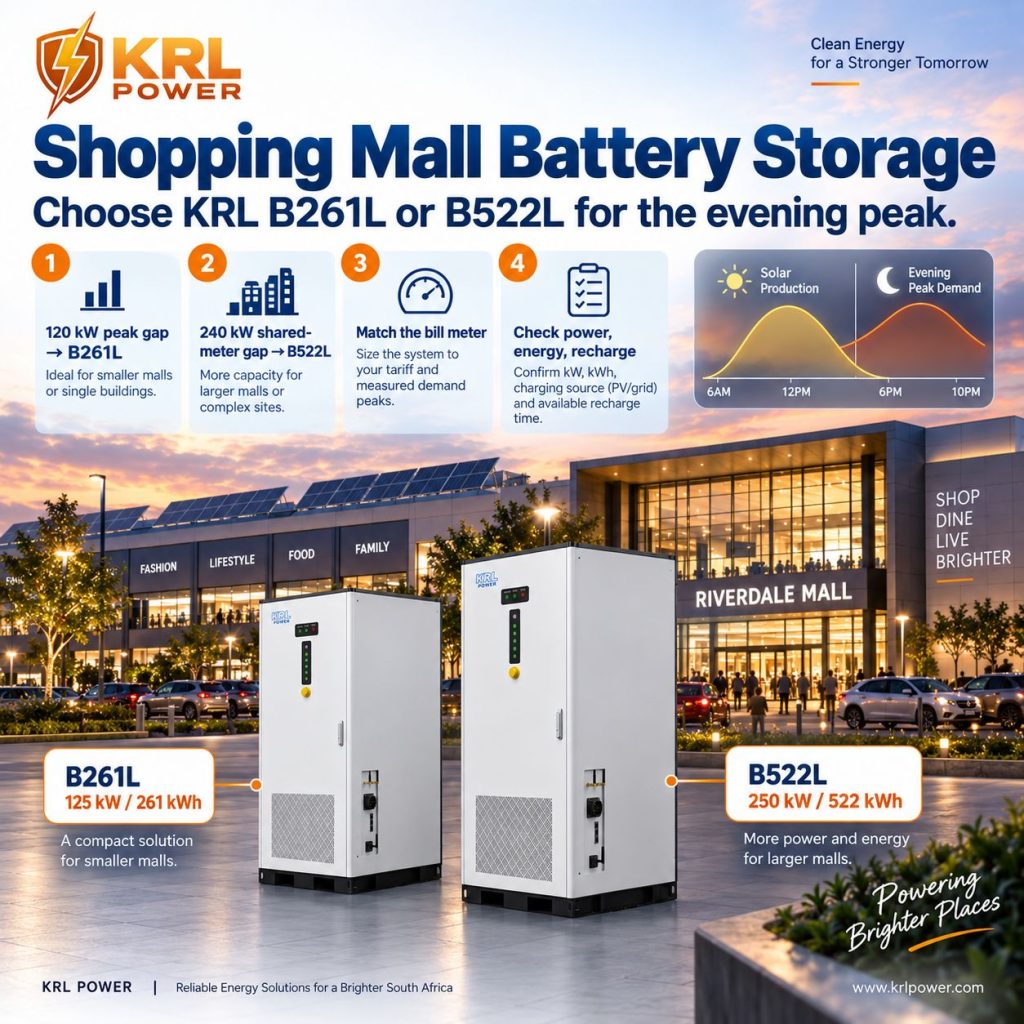
Shopping mall battery storage should be sized against the meter that records the evening peak. In this worked example, a 120 kW common-area deficit calls for KRL-B261L (125 kW / 261 kWh); a 240 kW shared-meter deficit moves the purchase to KRL-B522L (250 kW / 522 kWh).
KRL gives the owner two clearly specified purchasing paths, without automatically paying for the larger cabinet. The published B261L specification et B522L specification provide the AC power, current and rated energy behind each recommendation. For site growth, use the KRL cabinet-to-container range.
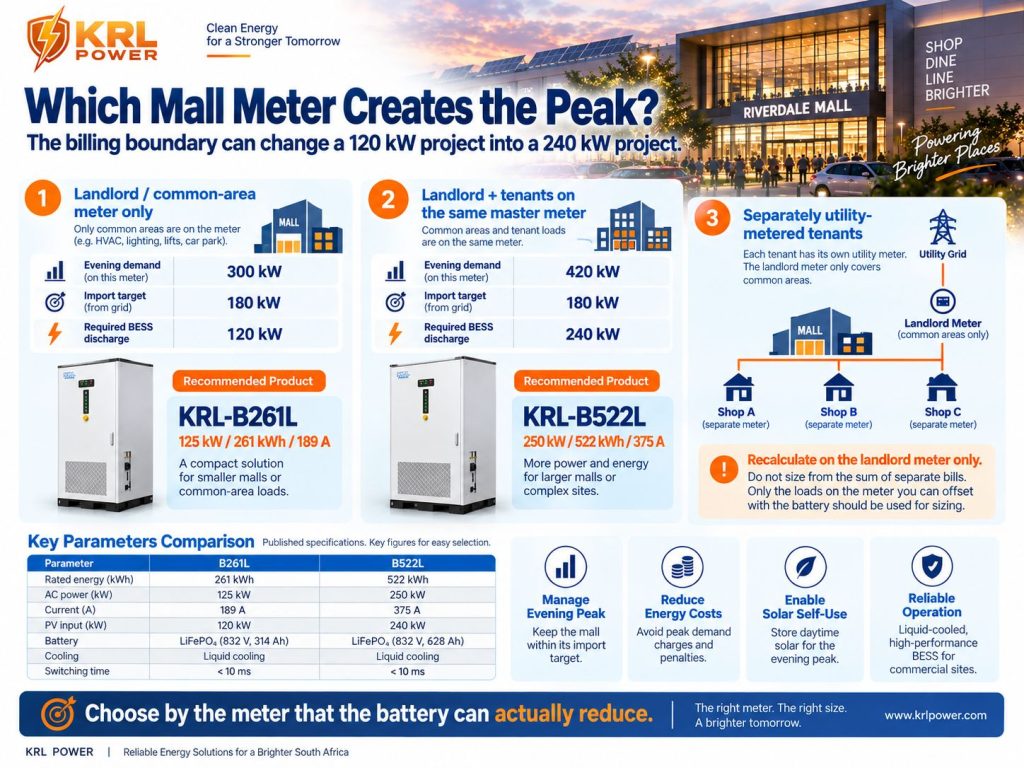
Which Mall Meter Can KRL Storage Actually Reduce?
Start with the utility meter that determines the owner’s bill. A landlord common-area meter may cover central HVAC and lighting, while a master meter may include tenant circuits as well. A tenant submeter downstream of that master meter is not the same as a separate utility connection. The single-line drawing must also show a BESS connection capable of influencing the chosen meter.
Consider a mall targeting 180 kW of grid import. The following loads and readings are illustrative design assumptions, not a KRL installation or measured customer result.
| Connected load at the relevant meter | Evening demand | Import target | Required BESS discharge | First KRL screen |
|---|---|---|---|---|
| Landlord/common-area load only | 300 kW | 180 kW | 120 kW | B261L: 125 kW / 261 kWh |
| Landlord plus tenants behind the same main meter | 420 kW | 180 kW | 240 kW | B522L: 250 kW / 522 kWh |
| Tenants billed through separate utility connections | Depends on landlord meter | 180 kW | Recalculate on landlord connection | Do not size from the sum of separate bills |
Select B261L as the 120 kW case’s first product configuration. Its published 125 kW output and 189 A maximum current define the 400/230 Vac three-phase interface. The operating model must hold a tight 5 kW nameplate margin; a higher measured peak, current excursion or derating moves the order to the larger class.
Choose B522L for the 240 kW shared-meter case. It places 250 kW of rated AC power, 375 A maximum current and 522 kWh of rated battery energy in one cabinet. B261L cannot deliver that power on its own. The 10 kW nameplate margin remains a design limit: check the highest relevant interval, current, temperature and dispatch allowance before confirming the 180 kW import target.
This distinction protects the purchase. Separately billed tenant circuits do not justify a larger cabinet unless the battery can affect the relevant utility meter. A shared master meter can justify B522L even where the landlord-only case fits B261L.
Identify Which Mall Loads Actually Create the Evening Peak
Evening demand can combine central HVAC, chillers, escalators, corridor lighting, car-park ventilation and restaurant extraction. Tenant refrigeration and lighting may add another block. Metering boundaries matter because separate readings do not automatically prove which utility bill will fall.
| Measured load | Question that changes the KRL choice |
|---|---|
| Central HVAC and chillers | Do compressor stages coincide with the evening import peak? |
| Escalators, car parks and corridor lighting | What stays on after rooftop PV begins falling? |
| Food court and tenant loads | Are these circuits behind the master meter and electrically connected to the BESS-supported bus? |
| Separately utility-metered tenants | Are they outside the owner’s billing and electrical boundary? If so, exclude them from this system’s peak-saving claim. |
| Existing mall EV chargers | Are they included in the actual master-meter profile, or managed under a separate charging project? |
Le commercial ESS selection guide covers the general load audit. For the mall, isolate the demand recorded by the billing meter during its evening peak. The EPC must confirm the AC bus, bidirectional flow, metering and protection.
Choose KRL-B261L for the 120 kW Common-Area Peak
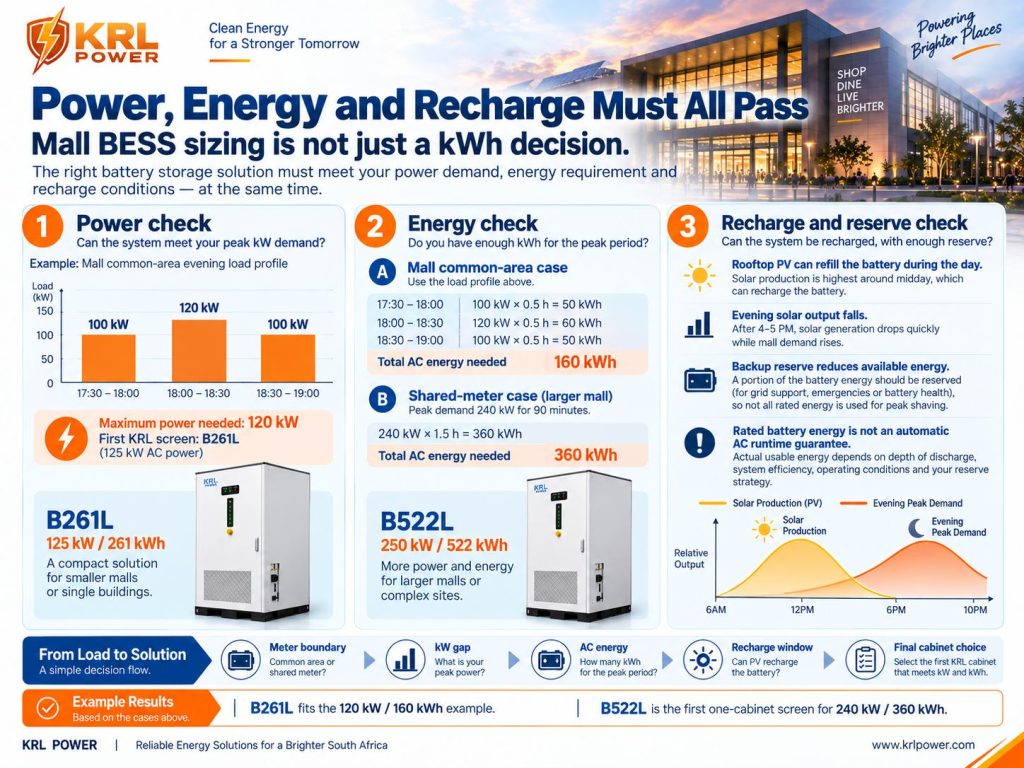
The example landlord meter has a 120 kW deficit. Specify the B261L class first. KRL-B261L brings 125 kW AC, 261 kWh rated energy, 189 A maximum current, liquid-cooled batteries and a 120 kW maximum direct-PV input into one specified product. This meets the first power screen without committing to the larger 250 kW class.
| Interval | Site demand | Battery power needed | AC energy needed |
|---|---|---|---|
| 17:30–18:00 | 280 kW | 100 kW | 50 kWh |
| 18:00–18:30 | 300 kW | 120 kW | 60 kWh |
| 18:30–19:00 | 280 kW | 100 kW | 50 kWh |
| Total | — | 120 kW maximum | 160 kWh |
160 kWh of delivered AC energy is the second purchase gate. B261L’s 261 kWh is rated battery energy, so the usable SOC window, losses, cooling auxiliaries and any backup reserve must still leave at least 160 kWh at the agreed meter. The buyer gets a clear two-part equipment decision: a 125 kW converter class and a documented evening energy target.
Buying B261L for this duty keeps the design on one 125 kW cabinet instead of assuming every mall needs a 250 kW unit. Equipment-cost savings cannot be stated until the two installed quotations are compared.
Specify KRL-B522L for the 240 kW Shared-Meter Peak
A shared main meter showing 420 kW against a 180 kW target needs 240 kW of battery discharge. Order a B522L-class design, not a single B261L. KRL-B522L supplies a 250 kW AC converter, 522 kWh rated battery, 375 A maximum AC current and liquid cooling in one cabinet. KRL also publishes parallel operation up to six units for future system designs.
| Peak duration | Energy requested at the AC side, before design allowances |
|---|---|
| 30 minutes | 120 kWh |
| 60 minutes | 240 kWh |
| 90 minutes | 360 kWh |
| 120 minutes | 480 kWh |
A 90-minute block demands 360 kWh delivered at the AC measurement point. Battery-side energy must be higher after conversion losses, and any protected reserve reduces the available discharge window. B522L’s rated 522 kWh makes it a credible starting class, but delivered AC energy still has to be checked at the agreed meter and battery condition.
B522L places the 240 kW duty on one 250 kW AC converter, with 522 kWh rated energy and a 240 kW PV-input ceiling. Those figures double B261L’s published rated energy and PV-input power. For a shared-meter mall, the result is one larger power block, a longer energy-design starting point and a larger possible direct-PV interface.
Use Rooftop PV to Refill the Battery, Not to Invent Evening Power
The mall’s roof can charge the battery during the day. Evening shoppers and food-court loads may remain high after solar production falls; the discharge plan must use the PV output actually present at that hour. An after-sunset peak can require the whole power gap from KRL’s AC converter.
If a mall has usable daytime surplus, that energy can recharge a KRL battery before the evening peak. B261L publishes 120 kW maximum PV input and B522L publishes 240 kW maximum PV input. These are PV-input limits, not additions to the 125 kW or 250 kW AC output rating.
An 80 kW solar surplus lasting two hours supplies 160 kWh before storage losses. It cannot by itself restore the example’s 160 kWh of delivered AC discharge. A 300 kW rooftop output serving 250 kW of simultaneous mall load leaves only 50 kW for charging. Existing AC-coupled PV needs an approved electrical and controls design; its inverter output cannot be treated as power entering a cabinet’s dedicated DC PV port.
KRL’s liquid-cooling comparison explains the cabinet thermal-management architecture. Liquid cooling supports the equipment choice; it does not guarantee a charging rate or a usable-energy figure that the operating model has not confirmed.
Show the Owner Which Electricity Charge Can Actually Change
The business case should follow the shopping mall’s tariff and meter arrangement. Demand charges may depend on the highest measured interval, contracted capacity or another local billing rule. Some charges are fixed, and independently billed tenants may not share the landlord’s demand-charge benefit.
Illustrative USD tariff calculation, not a KRL project result: if the applicable demand charge is $15/kW-month and the billed monthly maximum falls by 120 kW, its gross demand-charge component falls by $1,800 for that month. This is not a savings promise. The actual demand-billing rule, recharge electricity, losses and installed cost determine the financial result.
A March 2024 shopping-mall case study from Energy Toolbase documents industry deployment using Socomec storage and an EMS for backup and demand management. It helps prove market relevance, but it is not a KRL installation or a forecast for this mall. The KRL purchase case is established from this mall’s bill, peak records and the B261L/B522L ratings.
Decide Between One B522L and Two B261L Cabinets
Two B261L cabinets add up to 250 kW / 522 kWh nominal, matching one B522L on paper. They are not the same installation. One B522L places the 250 kW class on one converter and a 375 A equipment path; two B261L units create two 125 kW conversion blocks with 189 A maximum AC current per cabinet, and their respective PV inputs and connections must be arranged separately.
Specify one B522L for the example’s 240 kW block on a suitable common bus. Two B261L units suit independently staged feeders or a split installation when the connection design and parallel operation are approved. The existing KRL two-cabinet versus single-cabinet comparison covers the cable, pad and installation detail.
Preserve Backup Only After the Peak-Energy Allocation Is Set
Shopping-centre owners may also want essential lights, payment systems, refrigeration or controls to remain powered during outages. That is a separate electrical and energy obligation. A cabinet that discharges 360 kWh into the evening peak cannot promise the same 360 kWh again to a night outage unless it has recharged.
Choose the primary duty before selling both outcomes. If backup is mandatory, reserve its validated usable energy and leave only the remainder available to reduce the evening peak. Off-grid service also needs an approved critical-load bus, switching arrangement, protection design and restart study. The published sub-10 ms switching figure for KRL cabinets is not a blanket guarantee that an entire mall, including every escalator and chiller, will transfer without interruption.
Le KRL peak-shaving and backup allocation guide explains how the same stored energy can be assigned to different duties.
Expand the KRL System When the Mall Adds More Load or Longer Hours
A new cinema wing, food court or fast-charging area can change the peak’s height, duration or both. Recalculate on the same relevant meter and confirm the electrical bus before adding capacity. KRL lists B522L for up to six units in parallel subject to system design; the first larger-cabinet screen for a power deficit above 250 kW may be two B522L units.
Once several feeders or a plant-scale project push the duty toward 750 kW or 1 MW, evaluate the exact container configuration and site installation, rather than accumulating cabinets automatically. The KRL 750 kW / 1 MW class comparison sets out those plant-level choices.
A bigger battery cannot fix a mall whose average daily electricity requirement exceeds available grid and generation energy. Storage shifts supply between hours; the energy must still be replaced.
Put the Meter Result on the Purchase Order
| Purchase-order line | B261L common-area case | B522L shared-meter case |
|---|---|---|
| Billed meter and bus | Landlord-only meter, suitable BESS connection | Shared master meter, approved common AC bus |
| AC duty | 120 kW peak, 160 kWh over the sample event | 240 kW peak; 360 kWh for a 90-minute sample |
| Cabinet capability | 125 kW, 261 kWh rated; 189 A max | 250 kW, 522 kWh rated; 375 A max |
| Release condition | Confirm 5 kW power headroom and at least 160 kWh delivered AC | Confirm 10 kW power headroom and at least 360 kWh delivered AC |
| Next change to evaluate | A higher measured peak or added backup reserve | Longer peak duration, additional unit or plant-scale load |
KRL Power provides the two cabinet classes this worked example needs: B261L for a 120 kW landlord peak and B522L for a 240 kW shared-meter peak. The published AC limits, rated energy, liquid-cooled battery and PV-input ratings show exactly what is being purchased. Lock the meter, duration and approved connection on the design sheet; the chosen cabinet can then be assessed against a measurable demand reduction.
