 Aller au contenu

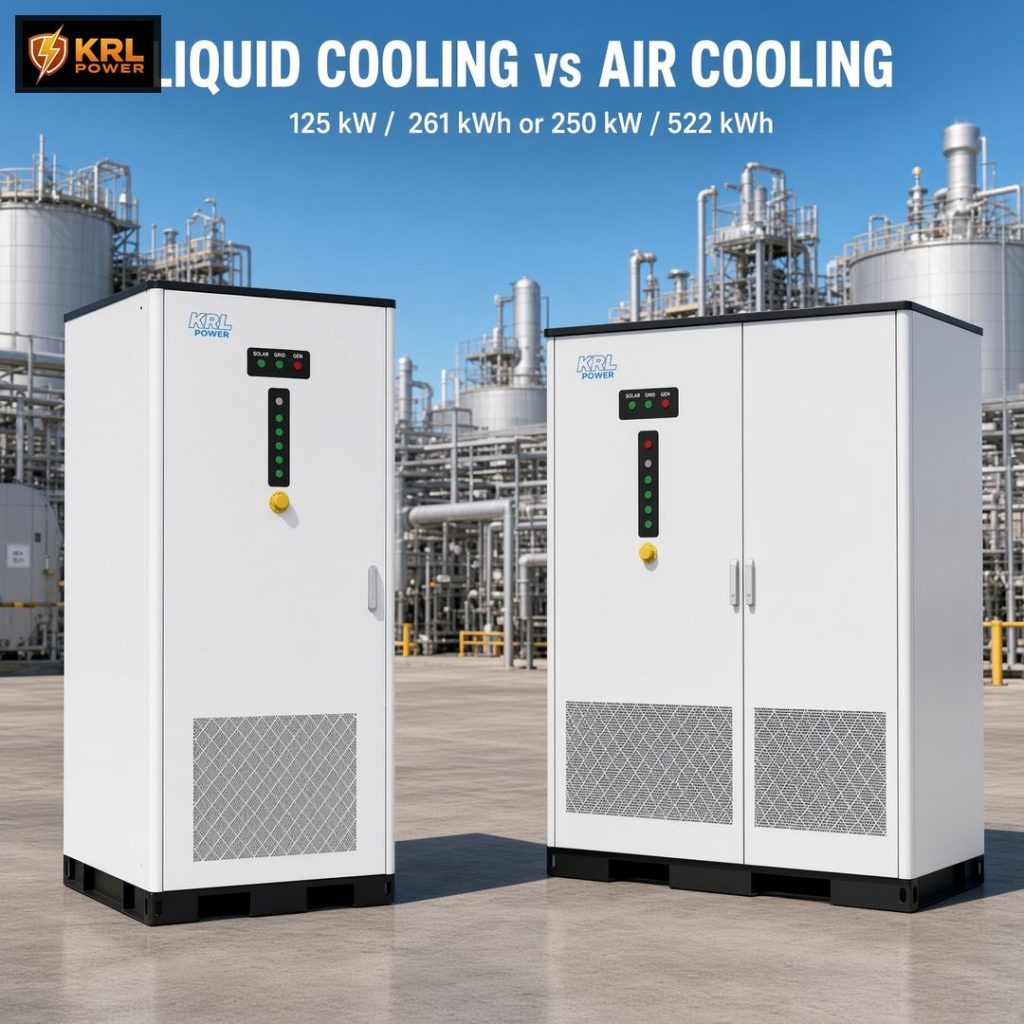
South African plants rarely arrive at this choice by comparing cabinet capacities in isolation. The feeder sets the power limit; the operating window sets the energy requirement. Motor overlap, PV input and an existing diesel set can move the decision again. KRL Power puts those functions in the same outdoor liquid-cooled product family, so the useful question is which cabinet still fits the plant as it operates today.
| Plant condition | KRL product | Ratings that matter first |
|---|---|---|
| Signed load around 80-120 kW and 189 A still holds | B261L | 125 kW / 261 kWh / 189 A |
| Day overlap has moved into roughly 140-220 kW | B522L | 250 kW / 522 kWh / 375 A |
| Signed load is 400 kW and up, or required energy is already 1.5-2 MWh | B2M6L family | 750 / 1000 kW and 1.5 / 2 MWh |
The table is only a starting point. Plants can sit below 125 kW most of the day and still outgrow B261L when several motors close together. Another site may have comfortable current headroom but need more stored energy through the night.
B261L fits the smaller process hall until the feeder says otherwise
Load shedding may hit in the afternoon, but the cabinet still has to carry the actual signed list: process controls, lighting and the motors allowed to overlap.
One hall might run near 80-120 kW. Starts remain controlled and 189 A is still enough on the incoming path. That is the natural range for the KRL-B261L 125 kW / 261 kWh, model KRL-B261L-125H3S-120M1-HX1.
Its published figures are 125 kW AC power on-grid and off-grid, 189 A current, 261 kWh rated energy and 120 kW PV input. The battery is LiFePO4 at 832 V and 314 Ah. KRL also lists liquid cooling, a diesel port, under-10 ms switching, RS485 / WiFi, IP65 battery protection, altitude under 2000 m and parallel operation up to 10 units. Cabinet mass is about 2600 kg.
The energy number is easy to misread. At 125 kW, 261 kWh works out to roughly two hours on paper. An 80 kW signed load lasts longer. Full-power operation through an eight-hour night does not fit that energy class.
Current can become the harder limit first. Two dryers starting close together may push the site beyond 189 A even if the normal running load looks modest. At that point the smaller cabinet is short on feeder duty, not necessarily short on energy.
Liquid cooling and the diesel port are useful because they are already part of the cabinet specification. Plants with a generator in the yard do not need a separate product family just to keep that interface available.
B522L makes sense once the 125 kW cabinet starts getting crowded
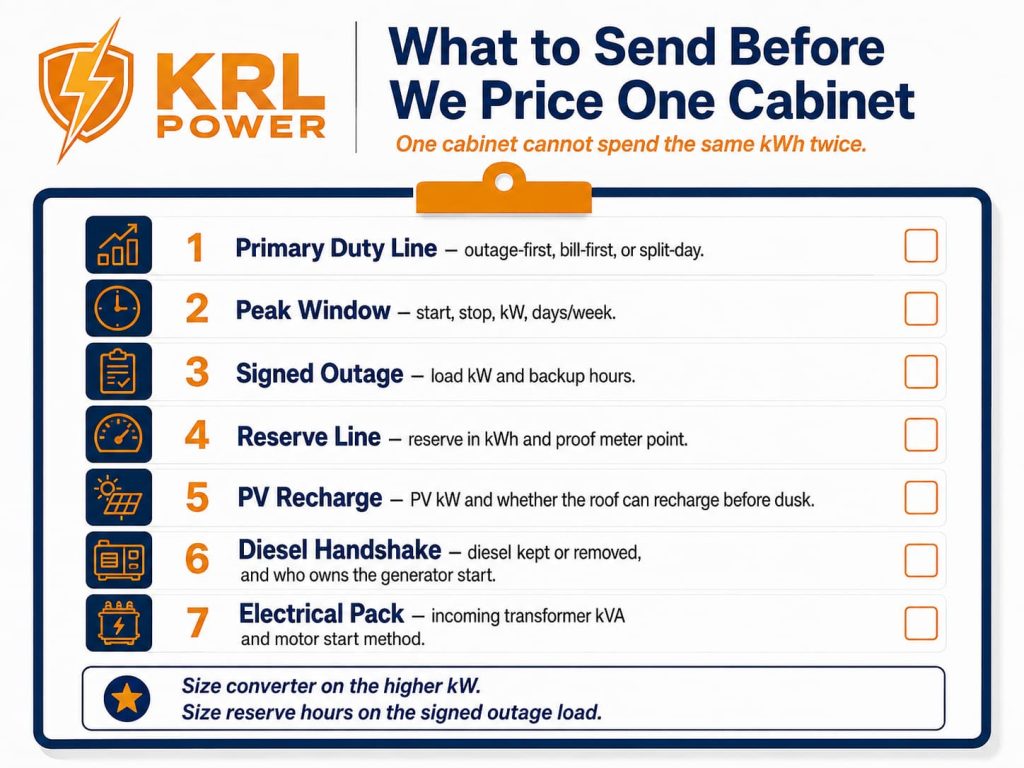
Second production lines, extra cooling or a charger bay can move afternoon overlap into the 140-220 kW range. The problem is no longer theoretical once the load is regularly leaning on the 125 kW limit.
Le KRL-B522L 250 kW / 522 kWh moves the site to one 250 kW converter and a 375 A current class. The order model is KRL-B522L-250H3S-240M2-HX1.
| Paramètre | B522L |
|---|---|
| Puissance nominale | 522 kWh |
| AC power | 250 kW |
| Current | 375 A |
| Batterie | LiFePO4, 832 V, 628 Ah |
| Entrée photovoltaïque | 240 kW |
| Refroidissement | Battery liquid cooling |
| Diesel port | Oui |
| Commutation | Under 10 ms |
| Parallel | 6 |
| Messe | About 4900 kg |
Two B261L cabinets can also provide two 125 kW converters, but the result is not the same installation. B522L puts the 250 kW duty on one converter, one 375 A path and one roughly 4.9 t cabinet.
The roof can push the project in the same direction. B261L publishes 120 kW PV input; B522L publishes 240 kW. Sites that need the larger solar input can use the Armoire solaire-stockage-diesel de 522 kWh / 250 kW as the relevant configuration.
KRL lists parallel operation up to six B522L units. That gives the plant room to add another 250 kW block later without pretending that future expansion has to be installed on day one.
Plant-scale loads call for a different piece of equipment
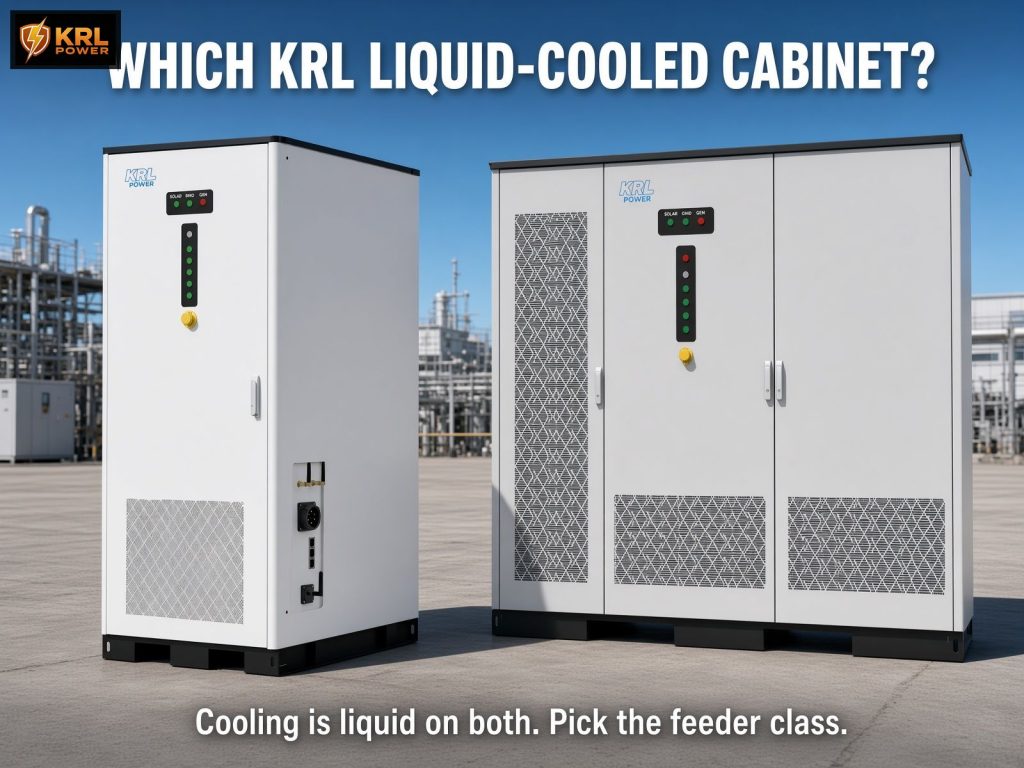
Sites already carrying 400 kW or more, or needing 1.5-2 MWh through the operating window, are no longer dealing with the same installation problem. Several small cabinets mean several lifts, more cable runs and more repeated interfaces around the yard.
KRL's larger route is the KRL-B2M6L family:
- 750 kW / 1.5 MWh: KRL-B1M5L-750H3S-720M6-HX1, 1130 A, 720 kW PV, about 15 t
- 1000 kW / 2 MWh: KRL-B2ML-1MH3S-960M8-HX1, 1500 A, 960 kW PV, about 19.5 t
- Container: 6058 × 2438 × 2896 mm
Those numbers change the job around the storage system. The current path rises to 1130 A or 1500 A. PV input rises to 720 kW or 960 kW. The equipment itself becomes a roughly 15 t or 19.5 t plant item in a 20-ft box.
Sites examining storage mainly around Eskom bill reduction can continue with the 2 MWh C&I energy storage system. Plants whose signed duty has already reached the 1 MW class can use the 1 MW / 2 MWh factory backup system as the closer reference.
Liquid cooling, diesel connection, under-10 ms switching and RS485 / WiFi remain part of the same family. What changes most is the scale of the electrical and civil work around the unit.
Put the reason for the model choice on the order
Purchase lines are easier to defend when the selected model can be tied to one or two site limits instead of a vague preference for more capacity.
| Site evidence | Product path | Purchase check |
|---|---|---|
| 80-120 kW signed load, motor overlap stays within 189 A, energy duty remains short | B261L | 125 kW / 261 kWh / 189 A |
| 140-220 kW overlap, 189 A no longer holds, or the roof needs the larger PV port | B522L | 250 kW / 522 kWh / 375 A / 240 kW PV |
| Plant duty is already hundreds of kW and energy has reached 1.5-2 MWh | B2M6L family | 750 or 1000 kW, 1130 or 1500 A, 1.5 or 2 MWh |
The full outdoor range is listed under Systèmes de stockage d'énergie KRL C&I. Broader model comparison is covered in the Guide de sélection des systèmes de stockage d'énergie à usage commercial et industriel.
Diesel-heavy sites can continue with stockage industriel par batterie pour réduire les coûts du diesel. Plants sizing around an overnight stoppage can use Rétablissement de l'alimentation électrique après une coupure générale à l'usine à 2 heures du matin.
