 Skip to content

Egypt farm battery storage is not simply a question of matching a battery cabinet to the horsepower printed on a pump nameplate. The correct system must satisfy three separate duties: run the irrigation pump, store enough energy for the outage window, and recover that energy fast enough when utility power briefly returns.
This article responds to an anonymized Egypt farm inquiry. The customer has two three-phase well pumps, one 60HP and one 80HP, which are not intended to operate simultaneously. During a long outage, the 80HP pump is the priority backup load. The reported running data is approximately 380V, 90A and about 59.3kW, with a target of roughly 10 hours of pumping per day for two consecutive outage days. Utility power may then return for only 4–5 hours.
- 💧 Primary backup load: one 80HP three-phase irrigation pump.
- ⏱️ Required duty: approximately 10 hours/day for two outage days.
- ⚡ Grid condition: long outages followed by only about 4–5 hours of utility availability.
- ☀️ Current solar scope: no PV is required in Phase 1; the customer prefers a battery-only backup system.
- 🌡️ Environment: summer temperature can reach about 45°C, making thermal management important.
- 🔋 Recommended product direction: KRL 2MWh / 1MW integrated liquid-cooled 20ft BESS.
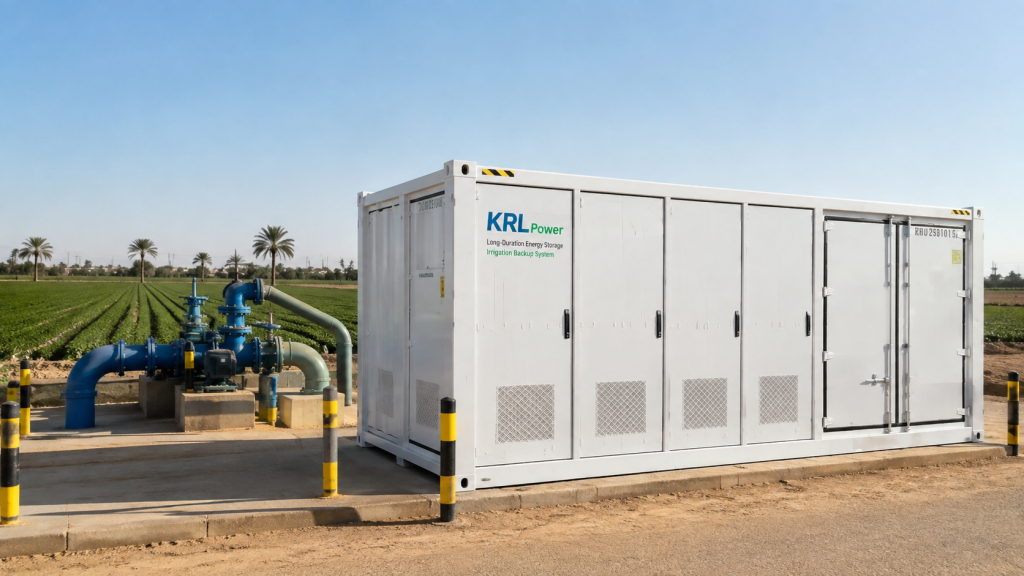
Egypt Farm Battery Storage Requirements: Long-Duration Energy and Fast Grid Recharge
Many farm backup projects are power-limited: the challenge is starting a large motor. This project is different. The pump's steady running demand is relatively modest compared with the selected 1MW PCS, but the required operating hours are long and the grid recovery window is short. That makes energy capacity and recharge strategy just as important as discharge power.
| Project input | Customer data | What it means for the BESS |
|---|---|---|
| 80HP pump | Approx. 380V, 90A, reported running power ≈59.3kW | Sets the preliminary continuous backup load |
| Backup operation | 10h/day × 2 days | Creates about 20 hours of required pumping during a major outage |
| Utility return | Only about 4–5 hours | Requires much faster battery recovery than a small PCS platform can normally provide |
| PV | None in current scope | Battery must be charged from the grid in Phase 1 |
| Ambient temperature | Up to about 45°C | Supports using a liquid-cooled outdoor containerized system |
Step 1: Calculate the Irrigation Energy Requirement
Using the customer's reported running power as a preliminary design value, the irrigation energy requirement is approximately 59.3kW × 10 hours/day × 2 days = 1,186kWh. This is the theoretical AC load energy required by the pump over the two-day outage window.
It would be a mistake to order a 1.2MWh battery simply because the calculated load energy is about 1.186MWh. The battery also needs an operating SOC window, conversion allowance, auxiliary consumption, thermal-management energy, high-temperature margin and lifecycle reserve.
| Sizing layer | Why it must be included | Commercial consequence |
|---|---|---|
| Nominal pump energy | Covers the stated 20-hour operating duty | About 1.186MWh from the supplied running-power figure |
| SOC reserve | Avoids designing around 100% battery depletion | Raises required nameplate energy |
| PCS and auxiliary losses | Battery-to-AC delivery is not lossless | Raises required battery energy |
| Hot-weather margin | Egypt summer conditions can affect real operating limits | Supports a more conservative capacity choice |
| Ageing margin | The buyer expects reliable backup beyond commissioning day | A minimal new-battery design can become inadequate later |
Step 2: Verify That 59.3kW Is the Actual Electrical Input
The reported 59.3kW figure is useful for preliminary sizing, but it should be verified before final manufacturing release. An 80HP motor is close to 59.7kW in mechanical horsepower conversion, so a similar number may represent rated mechanical output rather than the actual AC electrical input under field conditions.
- 📸 Motor nameplate: rated kW/HP, current, efficiency, power factor and duty class.
- 📈 Measured running power: actual kW at the farm's normal pumping condition.
- ⚙️ Starting method: DOL, star-delta, soft starter or VFD.
- 💧 Pumping condition: confirm the well level/head values and which pump they belong to.
- 🔌 Voltage quality: confirm the real three-phase voltage during normal grid operation.
Recommended KRL 2MWh / 1MW BESS Configuration
Why the 2MWh KRL Platform Is a Better Fit Than a Minimal-Capacity Battery
For this duty, KRL should position the 2MWh platform as a resilience-first solution rather than a mathematically minimal battery. The 2MWh capacity provides practical headroom above the theoretical pump energy requirement and avoids designing the project too close to the battery's operating boundary.
- 🔋 Longer usable backup window: more energy reserve above the calculated irrigation requirement.
- 🌡️ Better tolerance to hot conditions: useful for an Egypt outdoor project.
- 📉 Lifecycle headroom: allows the system to remain useful as the battery ages.
- 🧠 Operating flexibility: leaves room for BESS auxiliaries, reserve SOC and real-world load variation.
- 🚜 Lower irrigation risk: an undersized BESS can interrupt pumping exactly when the farm is most vulnerable.
KRL 2MWh / 1MW Integrated BESS: Product Fit for This Project
Based on the latest product data provided for this project, KRL's 2MWh integrated 20ft BESS is the preferred product platform.
| KRL product parameter | Latest product data | Value for the Egypt farm |
|---|---|---|
| Lithium battery energy | 2MWh | Provides long-duration energy headroom for two-day irrigation backup |
| PCS power | 1MW | Supports strong on-grid/off-grid conversion capability and rapid battery recovery when the grid returns |
| MPPT power | 960kW, 8 MPPT inputs | Not required in the current battery-only phase, but creates a direct path for future PV integration |
| Operating modes | On-grid and off-grid, seamless switching | Allows the BESS to continue serving approved loads when utility power is lost |
| Integrated controls | BMS / PCS / EMS | Reduces field integration complexity and enables coordinated dispatch |
| Cooling | Liquid cooling | Important for thermal management in a hot agricultural environment |
| Container format | 20ft | Practical outdoor packaged architecture for a farm project |
| Battery enclosure protection | IP65 | Supports outdoor battery deployment subject to complete site engineering |
| Communication | RS485, WiFi or 4G | Allows local and remote operating visibility |
The 1MW PCS is much larger than the pump's steady running demand. KRL should explain this transparently instead of pretending the pump itself needs 1MW. The product is being selected because it is an integrated 2MWh-class platform with strong recharge capability, grid/off-grid functionality, future PV readiness and project scalability.
Why the 4–5 Hour Grid Return Window Makes the 1MW PCS Valuable
After a major outage, the farm may have consumed roughly 1.2MWh of stored energy. To replace 1.186MWh within 5 hours requires about 237kW of average charging power before losses; doing so within 4 hours requires about 297kW. Therefore, the project clearly benefits from a product capable of charging far faster than a 100–125kW-class PCS.
| Grid return window | Theoretical average power to replace 1.186MWh | Engineering implication |
|---|---|---|
| 5 hours | ≈237kW before losses | A small 125kW charger would not restore the consumed energy in time |
| 4 hours | ≈297kW before losses | The site needs several hundred kW of practical charging capability |
| KRL 1MW PCS platform | Product conversion capability is well above the recharge requirement | Actual charge power can be limited by the grid, transformer, BMS and project settings |
This point is critical: the actual recharge rate is not automatically 1MW just because the PCS is rated at 1MW. The farm's transformer rating, grid import limit, other operating loads, battery charge limits and EMS settings must all be checked before a final recharge-time guarantee is made.
Battery-Only System Architecture, Pump Control and Site Design
Current Architecture: Battery-Only Backup, No Solar Required
The customer currently believes a battery-only solution is more economical than purchasing a complete PV + storage package. KRL should respect that requirement in Phase 1. The project architecture should therefore show no solar modules and no external PV inverter.
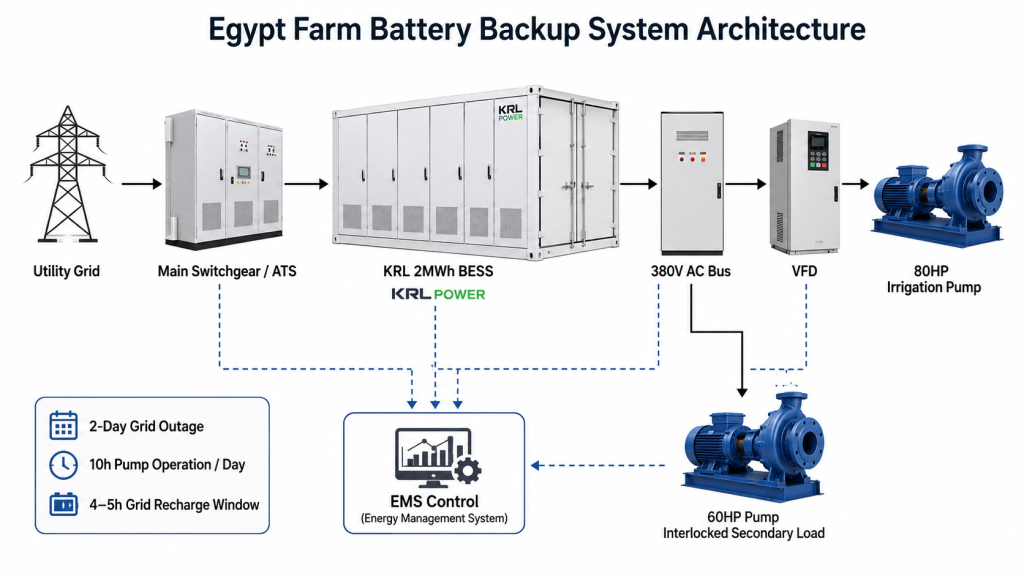
- Utility Grid: charges the BESS whenever power is available.
- Main Switchgear / ATS: manages source transition and electrical distribution.
- KRL 2MWh / 1MW BESS: stores energy, supplies backup power and manages charging/discharging through the integrated PCS and EMS.
- 380V AC Bus: supplies the irrigation system.
- VFD: strongly recommended to control the 80HP motor start.
- 80HP Pump: priority irrigation load during outages.
- 60HP Pump: secondary load; interlock prevents simultaneous operation unless a later study approves it.
Why a VFD Should Be Part of the Pump Backup Strategy
The BESS has more than enough rated PCS power for the steady 80HP pump load, but large motors can still create undesirable starting transients. A VFD provides a controlled ramp and is the preferred approach for a battery-backed irrigation pump.
- ⚙️ Controlled starting: reduces inrush and abrupt voltage disturbance.
- 🔋 Cleaner BESS load profile: avoids designing around an unnecessary direct-on-line starting shock.
- 💧 Process control: allows more flexible pump speed and flow where the hydraulic design permits.
- 🧪 Better acceptance testing: start ramp, run current and protection behavior can be specified and reproduced during commissioning.
Outdoor Installation and 45°C Summer Conditions
The farm can consider either indoor or outdoor placement. For a 2MWh packaged system, an outdoor 20ft container is generally the cleaner engineering direction, especially when the installation area can be prepared specifically for the BESS.
- 🌡️ Thermal conditions: confirm site temperature, direct solar exposure and any derating requirements.
- 🏗️ Civil works: provide a level foundation, drainage and replacement route.
- 🚧 Impact protection: use bollards or barriers where farm vehicles operate nearby.
- 🌬️ Dust: include maintenance planning for a dry agricultural environment.
- 🔌 Electrical access: keep switchgear and cable runs short, serviceable and clearly isolated.
- 📶 Communications: use RS485, WiFi or 4G according to the site's monitoring infrastructure.
The 960kW MPPT Is Not Needed Today—but It Changes the Future
The customer currently does not want PV. That means the Phase 1 quotation should not add solar modules simply because the BESS includes MPPT. However, the integrated 960kW MPPT with 8 inputs gives the project a powerful future option.
| Project phase | Energy source | How the KRL platform is used |
|---|---|---|
| Phase 1 | Utility grid only | Battery-only resilience; MPPT remains unused |
| Future PV expansion | Grid + PV + battery | Selected PV arrays can be integrated through the built-in 960kW MPPT architecture |
| Weak-grid microgrid mode | Grid / PV / battery | Integrated EMS can coordinate multiple energy sources without replacing the original 2MWh BESS platform |
For SEO and sales conversion, this is a stronger message than forcing PV into the initial proposal: the customer can buy the backup system now and keep a clear solar-upgrade path for later.
Two-Day Outage and 4–5 Hour Recharge Operating Strategy
| Operating stage | BESS role | EMS priority |
|---|---|---|
| Grid available before outage | Charge and maintain backup reserve | Keep the battery at the approved readiness SOC |
| Outage Day 1 | Run the 80HP pump for the approved irrigation window | Protect reserve for Day 2 |
| Outage Day 2 | Continue priority irrigation load | Prevent nonessential loads from consuming the remaining reserve |
| Grid returns for 4–5 hours | Recover discharged energy | Charge at the highest approved rate allowed by grid, transformer and battery limits |
| Ready state | Stand by for the next outage | Restore the required reserve SOC before releasing optional loads |
Final Engineering Inputs, RFQ Scope and Commercial Decision
What Must Be Confirmed Before KRL Issues the Final BOM and Price
The customer information is now strong enough to recommend the 2MWh product platform, but not yet strong enough to promise a final recharge time or release the manufacturing BOM. KRL should request the following data in one technical clarification.
- 📸 80HP motor nameplate photo: confirm rated kW, current, efficiency, power factor and duty.
- 📊 Measured pump data: actual running kW/kVA and operating current.
- ⚙️ Starting method: confirm whether a VFD is already installed or must be included.
- 🏭 Transformer rating: essential for determining how much of the 1MW PCS can actually be used for recharge.
- ⚡ Maximum grid import: confirm the utility or site limit during the 4–5 hour charging period.
- 🧾 Other farm loads: determine how much grid capacity remains available while the BESS is charging.
- 📍 Site layout: installation photos, available area, cable route, dust and access conditions.
- 🔄 Outage pattern: shortest interval between long outages, not only the average outage duration.
Why Battery-Only Can Be the Right Phase 1 Decision
The customer's cost logic is reasonable: excluding PV lowers first-stage CAPEX and focuses the investment on the immediate business problem—keeping irrigation running during outages. But the buyer should understand that the battery does not create electricity; it shifts grid energy from available periods into outage periods.
- 💰 Lower initial scope: no PV modules, racking or PV-field installation in Phase 1.
- 🎯 Direct resilience value: investment is concentrated on the outage problem.
- 🔄 Grid dependence remains: the BESS still needs enough utility availability to recover its reserve.
- ☀️ Future flexibility: integrated 960kW MPPT means PV can be added later if fuel/electricity economics or grid reliability make it attractive.
For related resilience design principles, KRL buyers can also review the battery backup for power outages engineering guide. It helps separate critical-load backup requirements from ordinary peak-shaving applications before an EPC or farm operator requests final pricing.
Why KRL Power Is a Strong Fit for This Agricultural BESS
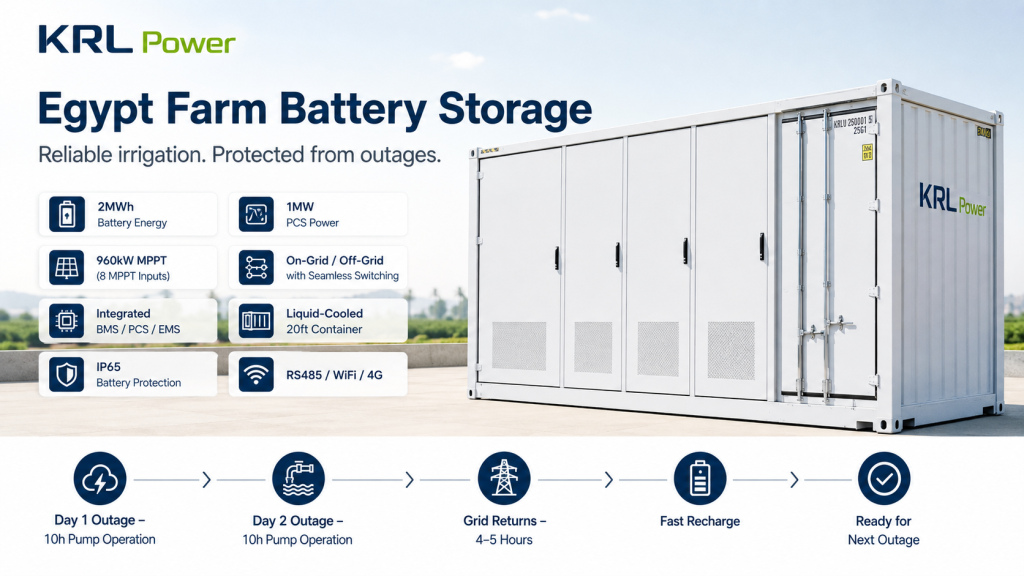
For this project, KRL Power's value is not simply that the container stores 2MWh. The product combines battery energy, 1MW PCS, EMS, BMS, liquid cooling, grid/off-grid operation, communications and future PV capability in one platform. That reduces integration risk and gives the farm a clear upgrade path.
- 🔋 2MWh long-duration energy: appropriate for the customer's extended irrigation duty.
- ⚡ 1MW PCS: strong power-conversion headroom and rapid-recharge potential.
- ☀️ 960kW / 8-input MPPT: future PV integration without changing the core platform.
- 🧠 Integrated BMS / PCS / EMS: coordinated operation from one system architecture.
- 🌡️ Liquid cooling: suitable for demanding C&I thermal conditions.
- 📶 RS485 / WiFi / 4G: supports remote diagnostics and operations visibility.
For additional product context, link this project article to the KRL C&I Energy Storage System collection and the KRL 2MWh-class container BESS product page.
RFQ Checklist for an Egypt Irrigation BESS
| RFQ field | What the buyer should provide | Why KRL needs it |
|---|---|---|
| Pump electrical data | Nameplate, running kW/kVA, current, PF and starter/VFD | Confirms discharge power and motor-start behavior |
| Duty schedule | Hours per day and maximum consecutive outage days | Confirms required usable energy |
| Grid availability | Typical and minimum hours after an outage | Confirms required recharge strategy |
| Grid/transformer capacity | Transformer kVA and maximum import | Determines achievable charge power |
| Site conditions | Temperature, dust, indoor/outdoor location and access | Confirms installation architecture |
| Future PV intent | Yes/no and possible target kWp | Determines whether the built-in 960kW MPPT should be reserved in the SLD |
| Commercial scope | EXW/FOB preference, installation, commissioning and delivery location | Makes quotations commercially comparable |
Conclusion: Design for the Outage Cycle, Not Just the Pump Nameplate
The core engineering lesson from this Egypt farm is that the 80HP pump alone does not determine the BESS. The two-day outage sets the energy requirement, while the 4–5 hour grid return window determines how aggressively the system must be able to recharge.
For the current project information, the KRL 2MWh / 1MW liquid-cooled 20ft BESS is a credible and commercially clear product direction. Its 2MWh battery capacity provides long-duration reserve, its 1MW PCS gives strong recharge headroom, and its 960kW integrated MPPT leaves the customer a future path to PV without changing the core storage platform.
The final proposal should still be conditional on the 80HP motor data, transformer rating, allowable grid import and actual site conditions. That is a better sales approach than promising a runtime or recharge time that the available data cannot yet prove.
FAQ
Why does this Egypt farm need a 2MWh battery energy storage system?
The customer wants the 80HP irrigation pump to operate about 10 hours per day during two consecutive outage days. Using the reported 59.3kW running power gives about 1,186kWh of theoretical load energy before reserve SOC, conversion losses, auxiliaries, temperature margin and battery ageing. A 2MWh platform provides a more practical long-duration margin.
Why use a 1MW PCS when the irrigation pump only runs at around 59.3kW?
The pump itself does not need 1MW. The larger PCS is valuable because the grid may return for only 4–5 hours, so the BESS must recover a large amount of energy quickly. It also supports the integrated 2MWh platform, grid/off-grid operation and future expansion.
Does the current Egypt farm project need solar PV?
No. The current requirement is battery-only backup using the utility grid as the charging source. The KRL product nevertheless includes 960kW MPPT with 8 inputs, so PV can be added later without replacing the main BESS platform.
Can the 2MWh battery be fully recharged in 4–5 hours?
The product has 1MW PCS capability, but actual charging power depends on the battery charge limit, transformer capacity, maximum grid import, other site loads and EMS settings. KRL should verify those limits before promising a final recharge time.
How much average charging power is needed to replace the energy used in the two-day outage?
Using the supplied 59.3kW pump figure, the two-day duty consumes about 1.186MWh. Replacing that amount in 5 hours requires roughly 237kW average power before losses, while a 4-hour window requires roughly 297kW before losses.
Should the 80HP pump use a VFD with the BESS?
A VFD is strongly recommended. It reduces motor-start stress, gives the BESS a smoother load transition and makes pump-start behavior easier to validate during commissioning.
Can the 60HP and 80HP pumps run at the same time?
The current customer requirement states that the two pumps do not operate simultaneously. KRL should therefore keep them interlocked unless a later electrical and hydraulic study specifically approves simultaneous operation.
Is the KRL 2MWh BESS suitable for outdoor installation on an Egypt farm?
The latest supplied product data describes a liquid-cooled 20ft container with IP65 battery-cabinet protection. It is a strong outdoor candidate, but the final project must still address foundation, temperature, dust, direct sun, drainage, cable routing, impact protection and maintenance access.
What information is still required before KRL issues the final quotation?
KRL should confirm the 80HP motor nameplate, measured running power and power factor, starting method or VFD, transformer rating, maximum grid import, other site loads during recharge, final installation location and the shortest interval between major outages.
