 Skip to content

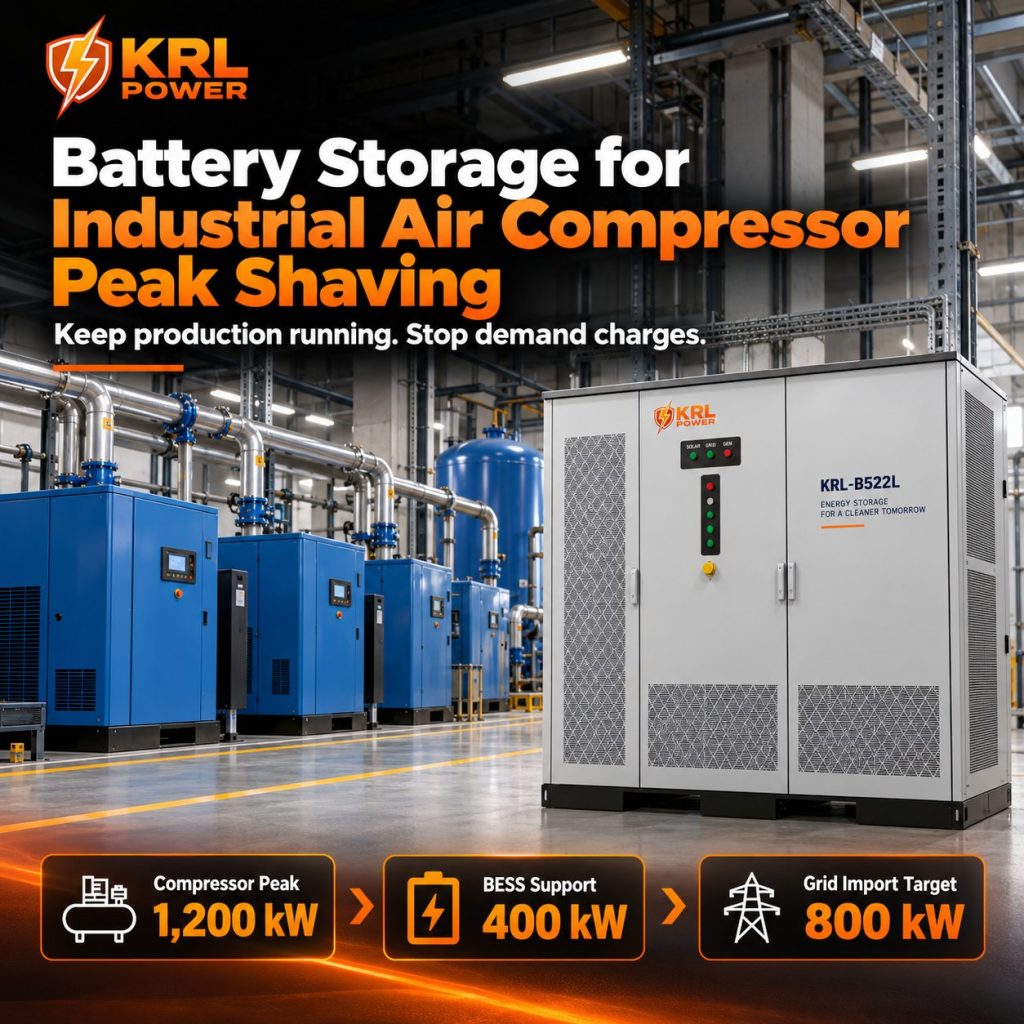
A compressor room can add 200, 300 or 400 kW to plant demand before the production manager notices anything unusual on the floor. When that extra load lasts long enough to enter the utility demand interval, it can set a much higher billed peak even though the rest of the factory operates normally.
KRL Power battery storage attacks that measured power gap directly. A site requiring up to 125 kW of battery support starts with KRL-B261L; a requirement above 125 kW and up to 250 kW moves to KRL-B522L. A 400 kW compressor-driven peak is already beyond one B522L and moves the first screen to two B522L cabinets or a larger plant-class route.
The engineering sequence is measured plant peak → target grid demand → required BESS kW → peak duration → event energy → recharge window. This keeps converter power, battery energy and recovery on separate checks instead of choosing storage from nominal kWh alone.
The Hidden Cost of the Fourth Utility: Compressor Load Shows Up at the Meter
Compressed air is essential to production, but the electrical load is highly visible at the plant meter. Large motors load and unload as pressure changes, multiple machines can overlap, and the electrical demand can jump even when line output remains unchanged.
Leak repair, pressure optimization and sequencing should still be completed because wasted air creates wasted electrical demand. The remaining full-production requirement is different: when the plant genuinely needs the air, the compressors still need electrical power.
The Peak-Demand Trap Is Sustained kW, Not a Seconds-Long Starting Spike
Motor inrush and billed demand are not the same event. Direct-on-line, star-delta and VFD starting methods change the short starting-current profile, but a demand charge is normally determined by the tariff's measured demand interval. A seconds-long inrush should not be treated as though it automatically becomes a 15-minute billed peak.
The expensive condition is sustained overlap. If several compressors load together and total plant demand stays elevated through a billing interval, the meter can register a new maximum. Where the tariff uses a 15-minute interval, the BESS needs enough kW to hold grid import below the target for that interval, not merely enough transient capability to catch motor start.
This is also why the broader peak-shaving and backup design logic separates meter-control duty from backup duty. The same cabinet can participate in both only when the PCS, SOC reserve and operating controls have been designed for both jobs.
Use the Measured Compressor Gap to Select the KRL Power Class
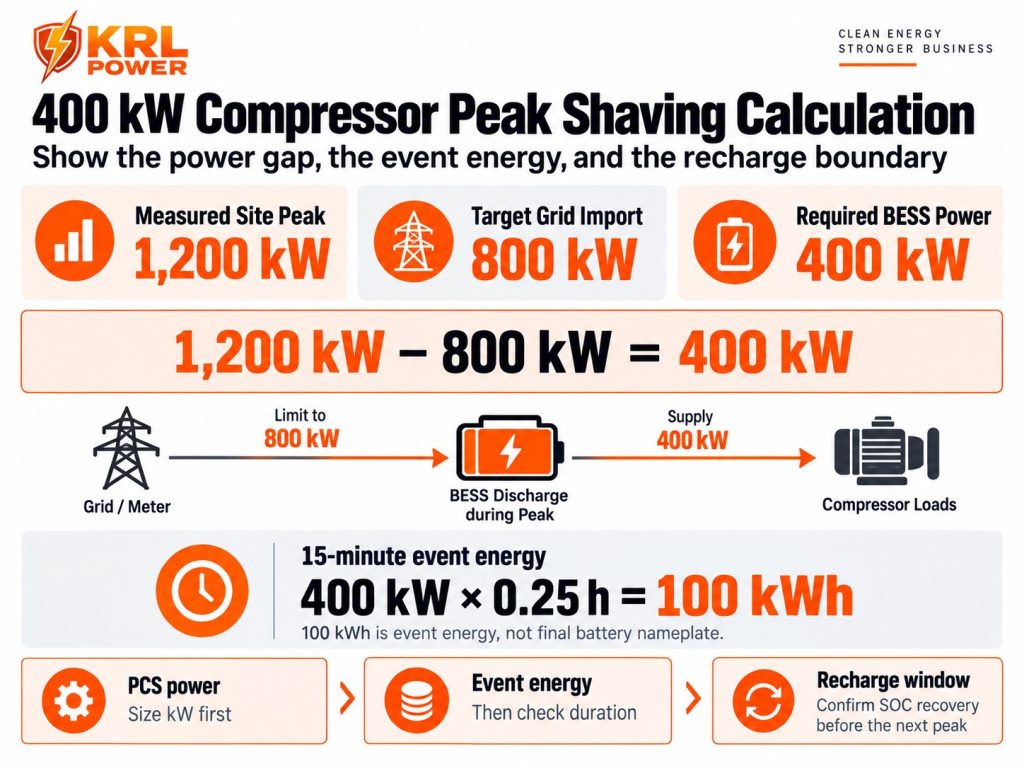
The first-pass peak-shaving equation is simple:
Required BESS kW = Measured plant peak − Target grid demand
For a plant that reaches 1,200 kW and wants the utility meter held near 800 kW:
1,200 kW − 800 kW = 400 kW
| Measured peak-shaving gap | Initial KRL product path | Published power / energy |
|---|---|---|
| Up to 125 kW | KRL-B261L | 125 kW / 261 kWh |
| Above 125 kW and up to 250 kW | KRL-B522L | 250 kW / 522 kWh |
| 400 kW example | 2 × KRL-B522L | 500 kW / 1.044 MWh nominal |
| Larger plant-scale duty | KRL-B2M6L route | 750 kW / 1.5 MWh or 1 MW / 2 MWh |
KRL-B261L publishes 125 kW / 261 kWh, a 189 A AC-current class and parallel operation up to 10 units. KRL-B522L publishes 250 kW / 522 kWh, a 375 A AC-current class and parallel operation up to six units. The KRL C&I ESS class-selection path keeps those cabinet boundaries visible before a project is pushed into a larger system.
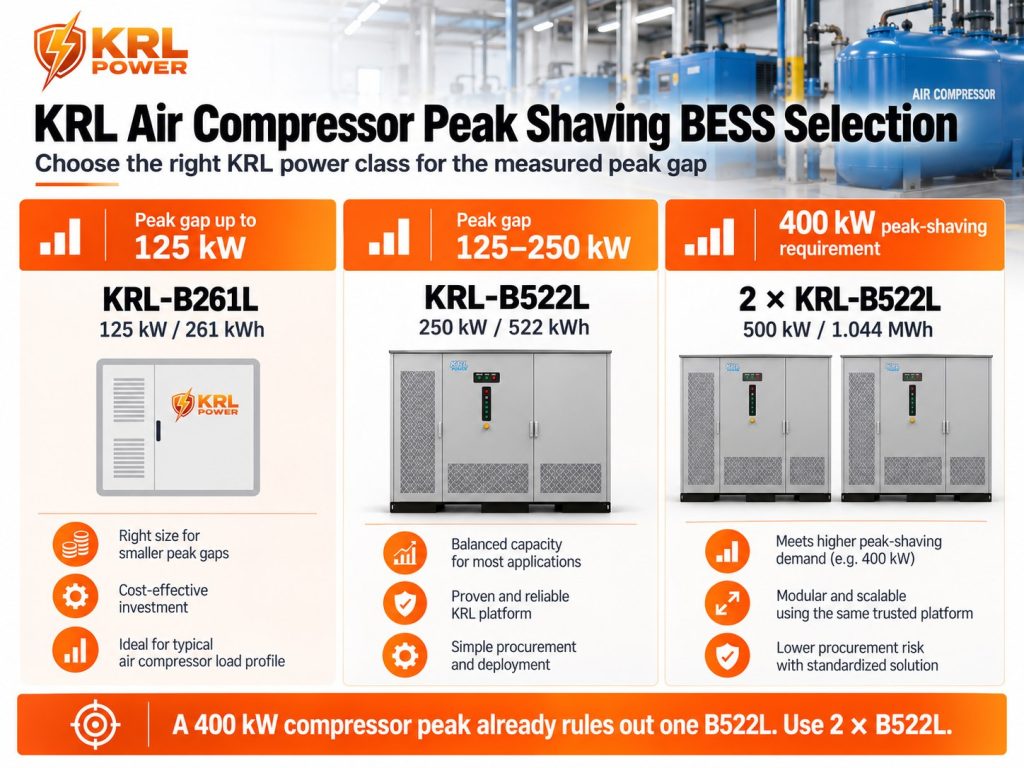
One B522L cannot satisfy a 400 kW battery-power requirement because its published power class is 250 kW. Two B522L cabinets provide 500 kW nominal converter power and 1.044 MWh rated battery energy, leaving 100 kW of nameplate power headroom in the worked example. That does not prove the final usable-energy window; it proves the first power screen.
Once cabinet count, AC current, cable routing or expansion strategy makes stacked 250 kW blocks unattractive, compare the 750 kW / 1 MW plant-class BESS route and the KRL-B2M6L platform against the project boundary.
BESS Complements VFDs, Leak Repair and Compressor Sequencing
VFDs, leak audits, lower pressure where process limits allow it and better compressor sequencing can reduce wasted electrical demand. Those measures should not be skipped. Their job is to make the air system itself more efficient.
Battery storage solves a different problem: it changes how much of the remaining production demand must come through the utility meter during the expensive interval. A VFD can soften acceleration and match motor speed to air demand; it does not supply the missing 400 kW when the factory genuinely requires that power.
The commercial energy storage selection process should therefore begin after the compressor-side efficiency work has defined the real residual load. That prevents the BESS from being sized around avoidable waste.
Calculate Event Energy After the kW Requirement Is Known
The 400 kW requirement above is a power result. Battery energy depends on how long that support must continue. For a 15-minute demand interval:
400 kW × 0.25 h = 100 kWh
100 kWh is load-side event energy, not the final battery nameplate. The project still needs an approved SOC window, conversion-loss allowance, reserve, auxiliaries, temperature limits, battery condition and the possibility of repeated peaks. Recharge also has to occur without creating a second demand peak.
The 250 kW / 522 kWh B522L system configuration shows the larger cabinet class used when the compressor gap is above the 125 kW entry class. For much larger industrial duties, the industrial battery-storage sizing logic illustrates the same need to separate converter power, energy duration and the site electrical boundary.
Turn the Demand Reduction Into a Financial Screen
Consider a plant with three 200 HP compressors. Its normal plant load is 800 kW, while compressor cycling can push the measured peak to 1,200 kW. A 400 kW reduction would hold the grid target near 800 kW during the peak interval.
At a demand-charge rate of $18/kW, a verified 400 kW reduction in the billing determinant represents:
400 kW × $18/kW = $7,200 per month
$7,200 × 12 = $86,400 per year
That figure is a tariff screen, not a guaranteed project saving. The full calculation must confirm the actual demand-charge rule, monthly peak recurrence, battery dispatch success, energy charges, recharge cost, losses, operating reserve and any applicable local incentive or tax treatment.
Flatten the Compressor Peak Without Cutting Production
The strongest compressor-storage project starts with a measured peak, not a cabinet size. Define the highest sustained plant demand, the target grid import, the compressor overlap that creates the peak and the time the event remains above the target. Those four inputs expose the required kW and the first energy window.
KRL then has a clear equipment path: B261L for the 125 kW class, B522L for the 250 kW class, two B522L cabinets for a 400 kW worked example, and B2M6L when the project moves into a larger plant-scale block. The purchase remains tied to measured compressor duty instead of an arbitrary battery size.
