South African edge data centers and telecom sites continue to face voltage events, short interruptions and residual load-reduction risk even after formal load shedding has eased. Recent public discussions around Cape Town data-center approvals and repeated local outages at facilities in the region show that operators still treat power continuity as a daily operational risk rather than a solved problem. Telecom teams publicly describe load shedding and infrastructure threats as constant pressure on network uptime. These conditions make the choice of storage architecture a direct commercial decision.
| Item | Specification |
|---|---|
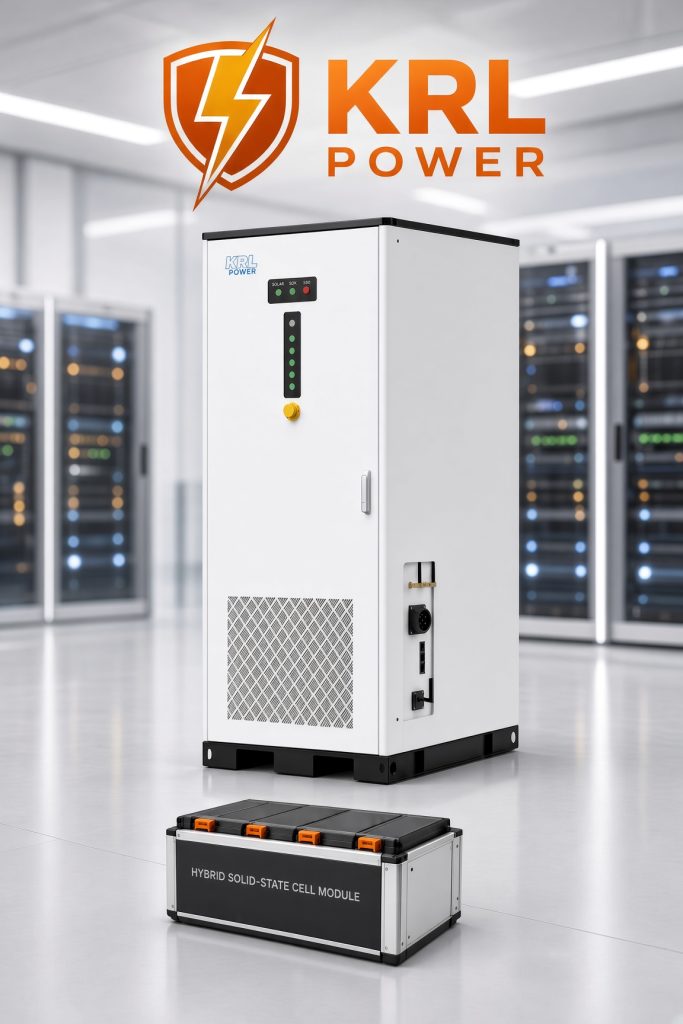
| Recommended Starting System | 125 kW / 261 kWh liquid-cooled pre-integrated ESS |
| Primary Use Case | Edge data centers, telecom base stations, small colocation sites |
| Key Functions | UPS-grade bridging, peak shaving, diesel optimisation, solar integration |
| Cooling | Liquid cooling |
| Optional Upgrade | Hybrid solid-state / quasi-solid-state cells for higher-safety sites |
| Typical Architecture | Grid + ESS + existing diesel + optional PV + critical IT/telecom loads |
South Africa Critical Infrastructure Power Reality
Operators report three recurring issues:
- Short grid events that still trip sensitive IT and radio equipment
- High diesel runtime and fuel cost when generators remain the primary response
- Limited space and strict safety expectations when batteries sit near servers or base-station electronics
A storage system that only provides energy capacity without fast, predictable transfer leaves these sites exposed.
Why Edge Data Centers and Telecom Sites Require Different Criteria
These facilities differ from ordinary commercial buildings in four practical ways:
- Continuous critical load (servers, radios, cooling, control systems)
- Very low tolerance for transfer time
- Limited floor space, often indoor or adjacent to high-value equipment
- Insurance and audit focus on battery safety documentation
A system sized only for factory peak shaving frequently fails the transfer-time or safety review required at an edge data hall or telecom shelter.
Matching 125 kW Power and 261 kWh Energy
| Parameter | Value | Practical Meaning |
|---|---|---|
| Rated Power | 125 kW | Continuous support for typical edge IT + cooling loads |
| Rated Energy | 261 kWh | Meaningful bridge time plus reserve |
| Theoretical runtime at 100 kW | ≈ 2.6 hours | Ideal calculation only |
| Real usable runtime | Shorter | Affected by SOC window, losses, auxiliaries and reserve policy |
Sizing must start from the measured critical load profile. Oversizing ties up capital. Undersizing leaves the site short during longer events. The 125 kW / 261 kWh configuration forms part of KRL Power’s C&I energy storage systems.
Recommended Architecture
Grid → Intelligent EMS → 125 kW / 261 kWh liquid-cooled ESS → Critical loads. Existing diesel generator retained as long-duration backup. Optional solar PV for daytime self-consumption and reduced diesel use.
- Grid available → ESS charges and limits peak demand
- Grid fails → ESS bridges while diesel starts
- Diesel running → ESS absorbs load steps and shortens generator runtime
- Solar available → Priority to critical loads, excess into battery
This architecture follows the same design principles used in larger industrial solutions such as the KRL 522kWh solar-storage-diesel microgrid cabinet.
Why Factory Pre-Integrated Liquid-Cooled Design Matters
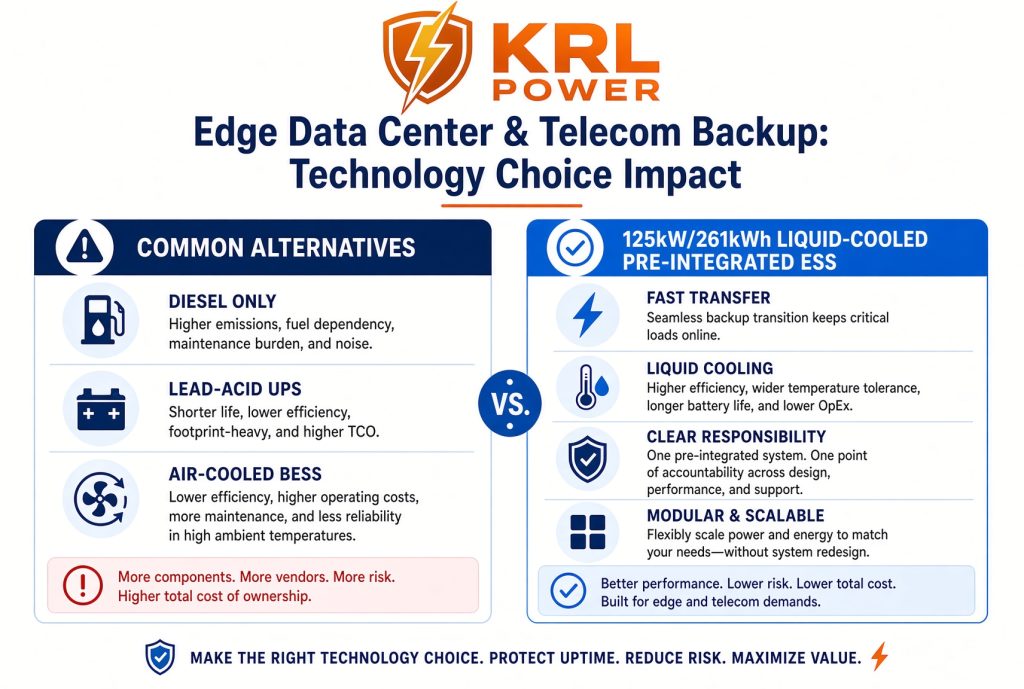
| Aspect | Multi-supplier Build | Pre-integrated Liquid-cooled System |
|---|---|---|
| Transfer performance | Difficult to guarantee | Factory-tested |
| Thermal consistency | Variable | Unified liquid cooling |
| Commissioning time | Longer, multi-party | Shorter, single responsibility |
| Warranty boundary | Fragmented | Clear single-party accountability |
| Expansion | Often requires redesign | Modular growth path |
At edge sites the cost of interface failure appears as downtime and SLA exposure rather than simple extra labour. These benefits are consistent across KRL’s commercial and industrial ESS solutions.
Safety Requirements Near Critical Equipment
When batteries are placed indoors or beside high-value IT and radio equipment, cell chemistry, thermal management and fire protection form part of the commercial risk assessment. For higher-scrutiny locations the hybrid solid-state / quasi-solid-state option available through KRL’s solid-state battery technology supplies an additional safety margin. Internal comparative tests show longer thermal propagation delay and improved mechanical-abuse performance relative to conventional cells. These results strengthen the safety case; they do not eliminate all risk under every condition.
Complete safety model = Chemistry + BMS + Liquid cooling + Fire protection + Electrical protection + EMS reserve logic.
Thermal Management Under South African Conditions
High ambient temperature and continuous duty cycles reduce the predictability of air-cooled systems. Liquid cooling maintains tighter cell-temperature uniformity across the published operating range and supports repeated high-power cycles with less performance drift.
EMS Functions That Affect Daily Operation
- Instant bridging during grid events
- Controlled diesel start and reduced runtime
- Peak demand limiting on the grid connection
- Solar self-consumption priority
- Configurable reserve SOC for critical loads
- Event logging for compliance and insurance records
Further project examples and architecture references appear in the KRL BESS knowledge center.
Practical Starting Configuration
| Component | Recommendation |
|---|---|
| ESS | 125 kW / 261 kWh liquid-cooled pre-integrated |
| Battery option | Standard LFP or hybrid solid-state for higher-safety sites |
| Diesel | Existing generator retained as long-duration backup |
| Solar | Optional, sized to daytime critical load |
| Control | Intelligent multi-source EMS |
| Enclosure | Outdoor-rated or indoor-compatible liquid-cooled cabinet |
Expansion is achieved by adding parallel cabinets when load or autonomy requirements grow.
Key Procurement Questions for Data Center and Telecom Buyers
- What usable AC energy is guaranteed under the agreed SOC window and temperature conditions?
- What measured transfer time is achieved to the critical load?
- How does the system respond to simultaneous IT load steps and cooling restarts?
- What thermal management method is used and what cell-temperature differential is maintained under continuous duty?
- What battery chemistry and safety test documentation accompany the quotation?
- Can the system coordinate with the existing diesel generator without manual intervention?
- Who holds single-party responsibility for system-level performance and warranty?
- What factory test and site acceptance criteria are included?
These questions reflect the engineering standard applied by the team at KRL Power.
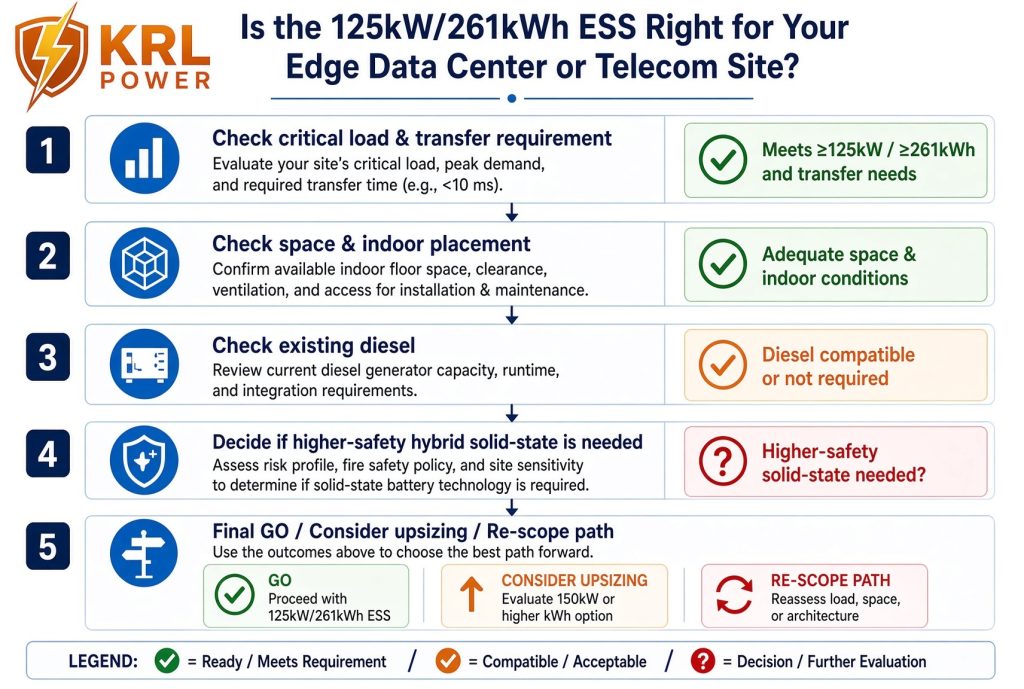
Decision Framework: Matching System to Site Risk
| Site Condition | Preferred Path | Consequence of Mismatch |
|---|---|---|
| Short interruptions, moderate load | 125 kW / 261 kWh liquid-cooled | Higher diesel runtime and fuel cost |
| Indoor or near-critical placement | Hybrid solid-state option | Insurance or safety-review delays |
| Limited space, fast deployment needed | Factory pre-integrated cabinet | Longer commissioning and interface problems |
| Existing diesel already installed | ESS + diesel hybrid control | Missed reduction in generator hours |
| Future load growth expected | Modular expansion architecture | Costly redesign later |
Final Recommendation
For most South African edge data centers and telecom sites, a 125 kW / 261 kWh liquid-cooled pre-integrated ESS balances transfer performance, thermal stability, deployment speed and clear responsibility. When the battery will sit indoors or beside high-value equipment, include the hybrid solid-state cell option in the risk evaluation.
Submit measured critical load, existing generator details, available space and any solar target. The engineering team at KRL Power will return a site-specific architecture and preliminary configuration.
الأسئلة الشائعة
Why is a 125 kW / 261 kWh liquid-cooled ESS a practical starting point for edge data centers and telecom sites in South Africa?
It delivers continuous power for typical edge critical loads, supplies meaningful bridge energy, and arrives as a factory-tested liquid-cooled package that reduces on-site integration risk.
How should usable runtime be calculated from the 261 kWh nameplate?
Subtract SOC-window limits, conversion losses, auxiliary consumption, temperature effects and the required critical reserve. Divide the resulting delivered AC energy by the protected average load.
What architecture is recommended when a diesel generator already exists on site?
Retain the diesel as long-duration backup. Use the ESS for instantaneous bridging, load-step support and reduced generator runtime under coordinated EMS control.
Why choose factory pre-integrated construction for edge sites?
Transfer performance, thermal design and control interfaces are validated before shipment, shortening commissioning and clarifying warranty ownership.
When should the hybrid solid-state cell option be prioritised?
When the battery is placed indoors or near high-value IT/telecom equipment and the insurance or safety review places high weight on thermal-propagation and mechanical-abuse performance.
What layers form the complete safety architecture?
Cell monitoring, intelligent BMS, liquid cooling, integrated fire protection, rated enclosure, and EMS-managed reserve and load-shedding logic.
How does liquid cooling perform under South African ambient conditions?
It maintains tighter cell-temperature uniformity across the published operating range and supports repeated high-power cycles with less performance drift than typical air-cooled designs.
Which EMS functions directly protect uptime and operating cost?
Instant bridging, controlled diesel start, peak-demand limiting, solar priority, configurable critical reserve and event logging.
What minimum data is required for a reliable proposal?
Measured critical-load profile, existing generator rating and start behaviour, available space, any solar capacity, and required autonomy or reserve policy.
What technical questions must every competitive quotation answer?
Usable AC energy guarantee, measured transfer time, thermal performance data, chemistry and safety documentation, diesel coordination method, single-party responsibility and acceptance-test scope.
Is the 125 kW / 261 kWh liquid-cooled platform considered for South African edge data centers and telecom sites?
Yes. Its power and energy ratings, liquid cooling and diesel-hybrid capability match the load and reliability requirements of many small-to-medium critical sites currently being upgraded.
Which local conditions most influence ESS specification for these sites?
Residual voltage events, high ambient temperature, limited indoor space and strict insurance expectations around battery safety and documented transfer performance.
How can a South African operator request a site-specific 125 kW / 261 kWh proposal?
Submit critical-load data, generator details, space constraints and any solar target through the KRL Power contact channel. The engineering team returns a tailored architecture and preliminary bill of materials.
What are the nameplate power and energy ratings of the recommended pre-integrated ESS?
125 kW continuous AC output and 261 kWh rated energy in a factory-assembled liquid-cooled cabinet.
Which higher-safety cell chemistry is offered as an optional upgrade?
Hybrid solid-state / quasi-solid-state cells that demonstrate extended thermal-propagation delay and improved mechanical-abuse performance in internal comparative testing.
Which operating modes are natively supported by the recommended architecture?
Grid-connected peak shaving, instantaneous bridging on grid loss, diesel-hybrid support, solar self-consumption priority and configurable critical-load reserve under a single EMS.