Suid-Afrikaanse rand-datacenters en telekommunikasieterreine bly kragspanningsgebeurtenisse, kort onderbrekings en oorblywende vragverminderingrisiko in die gesig staar, selfs nadat formele beurtkrag verlig is. Onlangse openbare besprekings oor die goedkeuring van datacenters in Kaapstad en herhaalde plaaslike onderbrekings by fasiliteite in die streek toon dat operateurs steeds kragvoorsieningskontinuïteit as 'n daaglikse operasionele risiko beskou eerder as 'n opgeloste probleem. Telekommunikasiespanne beskryf openlik beurtkrag en infrastruktuurdreigemente as konstante druk op netwerk-uptime. Hierdie toestande maak die keuse van bergingsargitektuur 'n direkte kommersiële besluit.
| Item | Spesifikasie |
|---|---|
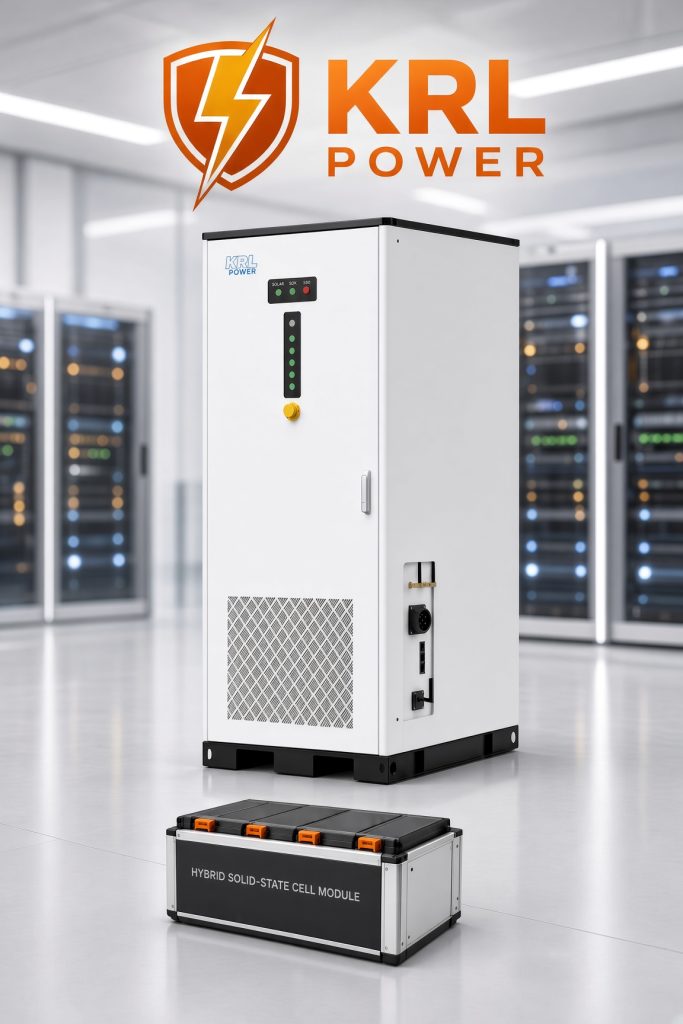
| Aanbevole beginstelsel | 125 kW / 261 kWh vloeistofgekoelde voor-geïntegreerde ESS |
| Hoofgebruikgeval | Randdatacenters, telekommunikasiebasisstasies, klein kolokasieterreine |
| Sleutelfunksies | UPS-graadbrugging, piekvlakvermindering, dieseloptimalisering, sonintegrasie |
| Afkoeling | Vloeistofkoeling |
| Opsionele opgradering | Hibriede vaste-toestand / kwasi-vaste-toestand selle vir terreine met hoër veiligheid |
| Tipiese argitektuur | Rooster + ESS + bestaande diesel + opsionele PV + kritieke IT/telecom-laste |
Suid-Afrika Kritieke Infrastruktuur Krag Realiteit
Operateurs rapporteer drie herhalende probleme:
- Kort netwerkonderbrekings wat steeds sensitiewe IT- en radio-toerusting laat afskakel.
- Hoë dieselbedryfstyd en brandstofkoste wanneer kragopwekkers steeds die primêre reaksie is
- Beperkte ruimte en streng veiligheidsvereistes wanneer batterye naby bedieners of basisstasie-elektronika geplaas word.
'n Stoorsisteem wat slegs energiekapasiteit bied sonder vinnige, voorspelbare oordrag laat hierdie terreine blootgestel.
Waarom Edge-datacenters en telekommunikasieterreine verskillende kriteria vereis
Hierdie fasiliteite verskil op vier praktiese maniere van gewone kommersiële geboue:
- Deurlopende kritieke las (bedieners, radio's, verkoeling, beheerstelsels)
- Baie lae toleransie vir oordragstyd
- Beperkte vloeroppervlakte, dikwels binne of langs hoëwaarde-toerusting
- Versekering en oudit fokus op dokumentasie oor batteryveiligheid
'n Stelsel wat uitsluitlik vir fabriekpiekvermindering ontwerp is, misluk dikwels die oordragstyd- of veiligheidsondersoek wat by 'n randdata-saal of telekommunikasieskuiling vereis word.
Ooreenstemmende 125 kW krag en 261 kWh energie
| Parameter | Waarde | Praktiese betekenis |
|---|---|---|
| Gegradueerde krag | 125 kW | Deurlopende ondersteuning vir tipiese rand-IT- en verkoelingslaste |
| Gegradueerde energie | 261 kWh | Betekenisvolle brugtyd plus reserwe |
| Teoretiese bedryfstyd by 100 kW | ≈ 2.6 hours | Slegs ideale berekening |
| Echt bruikbare uitvoeringstyd | Korter | Beïnvloed deur die SOC-venster, verliese, bykomstighede en reserwebeleid |
Groottebepaling moet begin by die gemeet kritiese vragprofiel. Oorbenutting bind kapitaal. Onderdimensionering laat die terrein tekort skiet tydens langer gebeure. Die 125 kW / 261 kWh-konfigurasie vorm deel van KRL Power’s C&I energy storage systems.
Aanbevole argitektuur
Grid → Intelligent EMS → 125 kW / 261 kWh liquid-cooled ESS → Critical loads. Existing diesel generator retained as long-duration backup. Optional solar PV for daytime self-consumption and reduced diesel use.
- Grid available → ESS charges and limits peak demand
- Grid fails → ESS bridges while diesel starts
- Diesel running → ESS absorbs load steps and shortens generator runtime
- Solar available → Priority to critical loads, excess into battery
Hierdie argitektuur volg dieselfde ontwerpbeginsels wat in groter industriële oplossings soos die gebruik word. KRL 522 kWh sonkrag-opberg-diesel mikro-netkas.
Waarom fabrieksvoor-geïntegreerde vloeistofgekoelde ontwerp saak maak
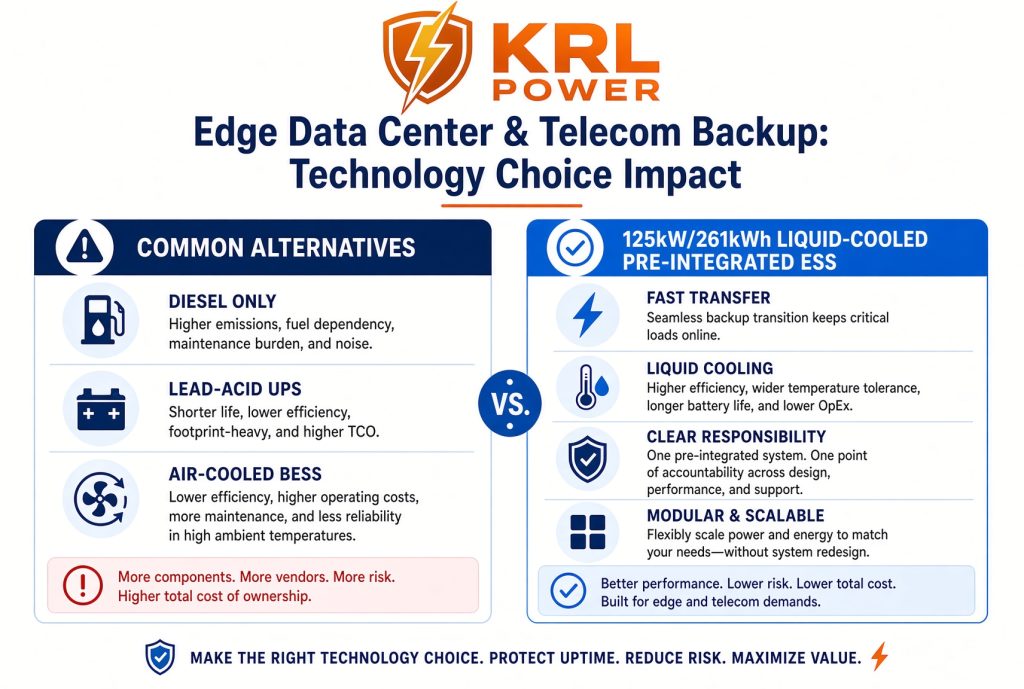
| Aspek | Multi-verskaffer-bou | Voorgeïntegreerde vloeistofgekoelde stelsel |
|---|---|---|
| Oordragprestasie | Moeilik om te waarborg | Fabrieksgetoets |
| Termiese konsekwentheid | Variabele | Geïntegreerde vloeibare verkoeling |
| Opdragtyd | Langer, meerkantig | Korter, enkele verantwoordelikheid |
| Waarborggrens | Gefragmenteer | Duidelike eenpartyverantwoordelikheid |
| Uitbreiding | Dikwels benodig dit 'n herontwerp. | Modulêre groeipad |
By randwerwe verskyn die koste van koppelvlakfaling as stilstandtyd en SLA-blootstelling eerder as bloot ekstra arbeid. Hierdie voordele is konsekwent oor KRL’s commercial and industrial ESS solutions.
Veiligheidseise naby kritieke toerusting
Wanneer batterye binne of langs hoëwaarde IT- en radio-toerusting geplaas word, vorm selchemie, termiese bestuur en brandbeskerming deel van die kommersiële risikobeoordeling. Vir plekke wat aan meer noukeurige ondersoek onderwerp word, is die hibriede vaste-toestand / kwasi-vaste-toestand-opsie beskikbaar deur KRL’s solid-state battery technology verskaf 'n bykomende veiligheidsmarge. Interne vergelykende toetse toon 'n langer termiese voortplantingsvertraging en verbeterde meganiese misbruikprestasie in vergelyking met konvensionele selle. Hierdie resultate versterk die veiligheidsargument; hulle elimineer nie alle risiko onder elke omstandigheid nie.
Volledige veiligheidsmodel = Chemie + BMS + Vloeistofafkoeling + Brandbeskerming + Elektriese beskerming + EMS-reservelogika.
Termiese Bestuur onder Suid-Afrikaanse toestande
Hoë omgewingstemperatuur en deurlopende diensiklusse verminder die voorspelbaarheid van luggekoelde stelsels. Vloeistofkoeling handhaaf 'n nouer seltemperatuur-eenvormigheid oor die gepubliseerde bedryfsreeks en ondersteun herhaalde hoë-krag-siklusse met minder prestasie-afwyking.
EMS-funksies wat die daaglikse werking beïnvloed
- Onmiddellike oorbrugging tydens roostergebeurtenisse
- Gekontroleerde dieselstart en verminderde looptyd
- Spitsvraagbeperking op die netwerkverbinding
- Prioriteit vir son-selfverbruik
- Konfigureerbare reserve-SOC vir kritieke laste
- Geleentheidslogging vir nakomings- en versekeringsrekords
Verder verskyn projekvoorbeelde en argitektuurverwysings in die KRL BESS kennisentrum.
Praktiese beginkonfigurasie
| Komponent | Aanbeveling |
|---|---|
| ESS | 125 kW / 261 kWh vloeistofgekoelde voorgeïntegreerde |
| Battery-opsie | Standaard LFP of hibriede vaste toestand vir terreine met hoër veiligheid |
| Diesel | Bestaande generator behou as langdurige rugsteun |
| Sonkrag | Opsioneel, afgestem op die kritieke dagtydlading |
| Beheer | Intelligente multi-bron EMS |
| Omheining | Buite-gegradeerde of binne-geskikte vloeistofgekoelde kas |
Uitbreiding word bereik deur parallelle kaste by te voeg wanneer die las- of outonomievereistes groei.
Belangrike inkoopvrae vir datasentrum- en telekommunikasie-kopers
- Watter bruikbare AC-energie word onder die ooreengekome SOC-venster- en temperatuurtoestande gewaarborg?
- Watter gemete oordragstyd word bereik by die kritiese lading?
- Hoe reageer die stelsel op gelyktydige IT-belastingstappe en verkoelingherbeginne?
- Watter termiese bestuursmetode word gebruik en watter seltemperatuursverskil word onder deurlopende diens gehandhaaf?
- Watter batterychemie en veiligheidstoetsdokumentasie vergesel die kwotasie?
- Kan die stelsel met die bestaande dieselgenerator koördineer sonder handmatige ingryping?
- Wie dra alleenverantwoordelikheid vir stelselvlakprestasie en waarborg?
- Watter fabriekstoetse en terrein-aanvaardingkriteria is ingesluit?
Hierdie vrae weerspieël die ingenieursnorm wat deur die span by KRL Krag.
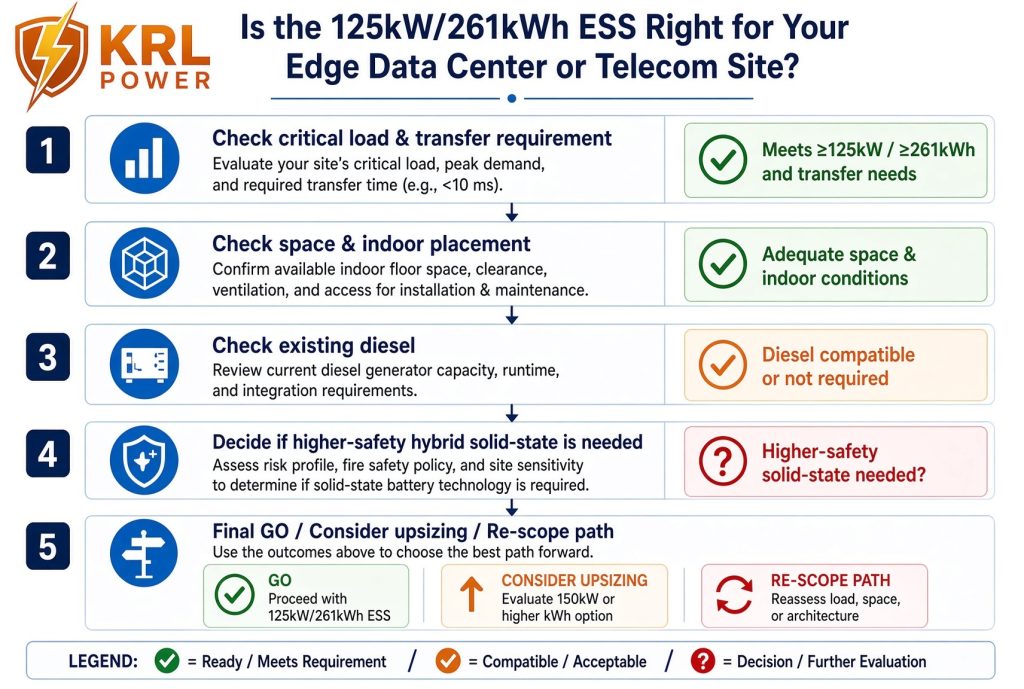
Besluitraamwerk: Toewysing van stelsel aan terreinrisiko
| Toestand van die terrein | Voorkeurpad | Gevolg van wanpassing |
|---|---|---|
| Kort onderbrekings, matige belasting | 125 kW / 261 kWh vloeistofgekoel | Hoër diesel-looptyd en brandstofkoste |
| Binnenshuise of byna-kritiese plasing | Hibriede vaste-toestand-opsie | Versekering- of veiligheidsbeoordelingsvertragings |
| Beperkte ruimte, vinnige ontplooiing nodig | Fabrieksvoorgeïntegreerde kas | Langer inbedryfstelling en koppelvlakprobleme |
| Bestaande diesel reeds geïnstalleer | ESS + dieselhibriede beheer | Misgelopen vermindering van generatorure |
| Toekomstige vraggroei word verwag | Modulêre uitbreidingsargitektuur | Duursame herontwerp later |
Eindaanbeveling
Vir die meeste Suid-Afrikaanse randdata-sentrums en telekommunikasieterreine balanseer 'n 125 kW/261 kWh vloeistofgekoelde, vooraf geïntegreerde ESS oordragprestasie, termiese stabiliteit, ontplooiingsnelheid en duidelike aanspreeklikheid. Wanneer die battery binnenshuis of langs hoëwaarde-toerusting geplaas word, sluit die hibriede vaste-toestandselopsie in die risiko-evaluering in.
Dien die gemeete kritiese las, besonderhede van die bestaande generator, beskikbare ruimte en enige sonteiken in. Die ingenieurspan by KRL Krag sal 'n terreinspesifieke argitektuur en voorlopige konfigurasie teruggee.
V&A
Waarom is 'n 125 kW/261 kWh vloeistofgekoelde ESS 'n praktiese beginpunt vir randdata-sentrums en telekommunikasieterreine in Suid-Afrika?
Dit lewer deurlopende krag vir tipiese randkritieke laste, verskaf betekenisvolle brugenergie, en kom as 'n fabrieksgetoetsde vloeistofgekoelde pakket wat die risiko van integrasie op die perseel verminder.
Hoe moet die bruikbare bedryfstyd uit die 261 kWh-naamplaat bereken word?
Trek SOC-vensterlimiete, omskakelingsverliese, bykomstigheidsverbruik, temperatuur-effekte en die vereiste kritiese reserwe af. Deel die resulterende gelewerde wisselstroomenergie deur die beskermde gemiddelde las.
Watter argitektuur word aanbeveel wanneer 'n dieselgenerator reeds op die perseel bestaan?
Hou die diesel as 'n langdurige rugsteun. Gebruik die ESS vir onmiddellike oorbrugging, lasstapondersteuning en verminderde generatorlooptyd onder gecoördineerde EMS-beheer.
Waarom kies jy vir fabrieksvoor-geïntegreerde konstruksie vir randwerwe?
Oordragprestasie, termiese ontwerp en beheerkoppelvlakke word voor versending gevalideer, wat inbedryfstelling verkort en die waarborgbesit verduidelik.
Wanneer moet die hibriede vaste-toestand-selopsie geprioritiseer word?
Wanneer die battery binnenshuis of naby duur IT-/telekommunikasie-toerusting geplaas word en die versekering- of veiligheidsbeoordeling groot gewig heg aan die prestasie ten opsigte van termiese verspreiding en meganiese misbruik.
Watter lae vorm die volledige veiligheidsargitektuur?
Selmonitering, intelligente BMS, vloeibare verkoeling, geïntegreerde brandbeskerming, beoordeelde omhulsel, en EMS-bestuurde reserwe- en afskakelingslogika.
Hoe presteer vloeibare verkoeling onder Suid-Afrikaanse omgewingstoestande?
Dit handhaaf 'n nouer seltemperatuur-eenvormigheid oor die gepubliseerde bedryfsreeks en ondersteun herhaalde hoë-krag-siklusse met minder prestasie-afname as tipiese luggekoelde ontwerpe.
Watter EMS-funksies beskerm direk die uptime en bedryfskoste?
Onmiddellike oorbrugging, beheerde dieselstart, piekvraagbeperking, sonprioriteit, konfigureerbare kritieke reserwe en gebeurtenisregistrasie.
Watter minimumdata word benodig vir 'n betroubare voorstel?
Gemeten kritiese-ladingsprofiel, bestaande generatorgradering en startgedrag, beskikbare ruimte, enige sonkapasiteit, en vereiste outonomie- of reservereël.
Watter tegniese vrae moet elke mededingende kwotasie beantwoord?
Gebruikbare AC-energiegarantie, gemeet oordragtyd, termiese prestasiedata, chemie- en veiligheidsdokumentasie, dieselkoördinasiemetode, eenpartyverantwoordelikheid en omvang van aanvaardingstoetse.
Worden die vloeistofgekoelde platform van 125 kW/261 kWh oorweeg vir Suid-Afrikaanse randdata-sentrums en telekommunikasieterreine?
Ja. Die krag- en energiegraderinge, vloeibare verkoeling en diesel-hibriede vermoë stem ooreen met die las- en betroubaarheidsvereistes van baie klein tot medium kritieke terreine wat tans opgegradeer word.
Watter plaaslike toestande beïnvloed die ESS-spesifikasie vir hierdie terreine die meeste?
Oorstaande spanningsgebeurtenisse, hoë omgewingstemperatuur, beperkte binnenshuise ruimte en streng versekeringsvereistes rondom batteryveiligheid en gedokumenteerde oordragprestasie.
Hoe kan 'n Suid-Afrikaanse operateur 'n terreinspesifieke 125 kW / 261 kWh-voorstel aanvra?
Stuur kritiese-ladingdata, generatorbesonderhede, ruimtebeperkings en enige sonmikpunt deur die KRL Power-kontakkanaal. Die ingenieurspan lewer 'n op maat gemaakte argitektuur en 'n voorlopige materiaalstaat.
Wat is die naamplaatkrag- en energiewaardes van die aanbevole vooraf-geïntegreerde ESS?
125 kW deurlopende AC-uitset en 261 kWh beoordeelde energie in 'n fabrieksgeassembleerde vloeistofgekoelde kas.
Watter hoër-veiligheidselchemie word as 'n opsionele opgradering aangebied?
Hibriede vaste-toestand / kwasi-vaste-toestand selle wat in interne vergelykende toetse 'n verlengde termiese-propagasievertraging en verbeterde meganiese-misbruikprestasie toon.
Watter bedryfsmodusse word inheems deur die aanbevole argitektuur ondersteun?
Roostergekoppelde piekvermindering, onmiddellike oorbrugging by roosteronderbreking, diesel-hibriede ondersteuning, prioriteit vir son-eigenverbruik en konfigureerbare kritieke-lasreserwe onder 'n enkele EMS.