
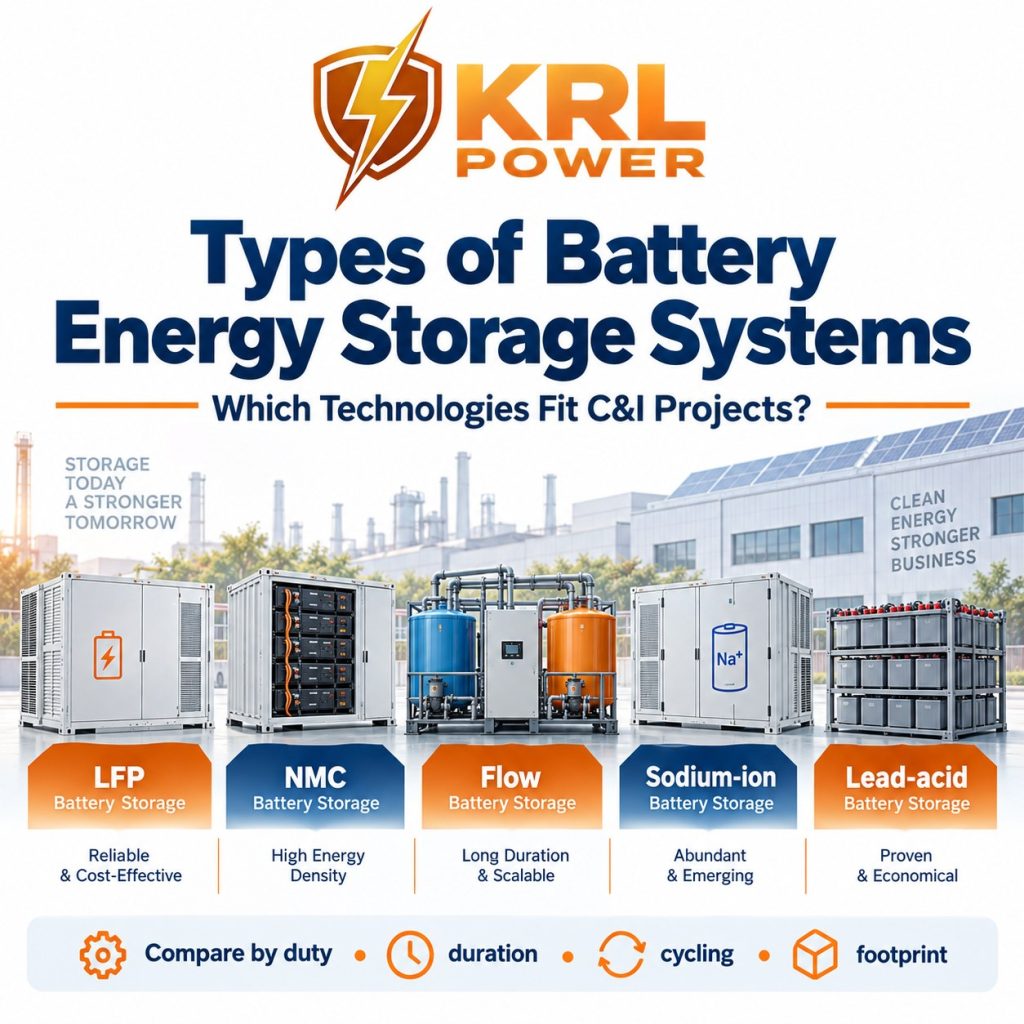
Types of battery energy storage systems should be separated by the job they need to perform, not by chemistry name alone. C&I buyers can narrow the field by checking discharge duration, cycling frequency, available space, thermal conditions and commercial evidence. NREL’s 2024 commercial battery-storage assumptions identify LFP as the primary stationary-storage chemistry, while other technologies remain relevant under different project constraints. NREL 2024 ATB
How to Compare Types of Battery Energy Storage Systems
“Type” can describe several different things. Chemistry, discharge duration, system architecture and application are separate classification layers, and mixing them leads to weak comparisons.
LFP and NMC are lithium-ion chemistries. Flow batteries store electrolyte outside the electrochemical stack. Lead-acid and sodium-ion belong to other electrochemical families. A two-hour system and an eight-hour system describe duration, not chemistry. AC-coupled and DC-coupled describe architecture.
| Classification basis | Examples | Decision it affects |
|---|---|---|
| Chemistry | LFP, NMC, sodium-ion, lead-acid, flow | Cell behavior, degradation, thermal profile and maturity |
| Duration | 30 min, 2 h, 4 h, 8 h | Required stored energy relative to power |
| argitektuur | AC-coupled, DC-coupled, hybrid | Conversion and control boundary |
| Toepassing | Peak shaving, backup, PV shifting | Operating duty |
| Installation class | Cabinet, container, plant-scale | Footprint, electrical interface and civil scope |
The classification step should come before the kommersiële energiebergingskeuseproses. A project that has not defined its duty has no reliable basis for choosing a chemistry.
Start With the Operating Duty
The plant duty should remove unsuitable technologies before cabinet quotations are compared.
A factory shaving a 45-minute demand peak does not have the same storage problem as a site shifting solar energy for six hours. Converter power may be similar, while the energy inventory, cycling burden and installation footprint can be very different.
| Operating duty | First technology questions |
|---|---|
| Short repeated peak shaving | Power capability, cycle duty, recharge window |
| 1–4 h daily energy shifting | Energy density, cycling and thermal management |
| Longer-duration shifting | Cost and footprint of adding energy |
| Standby backup | Calendar aging, readiness and maintenance |
| Space-constrained factory | Energy density, cooling and service clearance |
| High-temperature site | Published operating limits and cooling design |
| High-cycle industrial duty | Throughput, degradation and replacement strategy |
Cell chemistry does not define the complete BESS. Controls and conversion still sit around the battery, which is why BMS, PCS and EMS architecture should be reviewed as a separate system decision.
LFP Is the Mainstream C&I Baseline
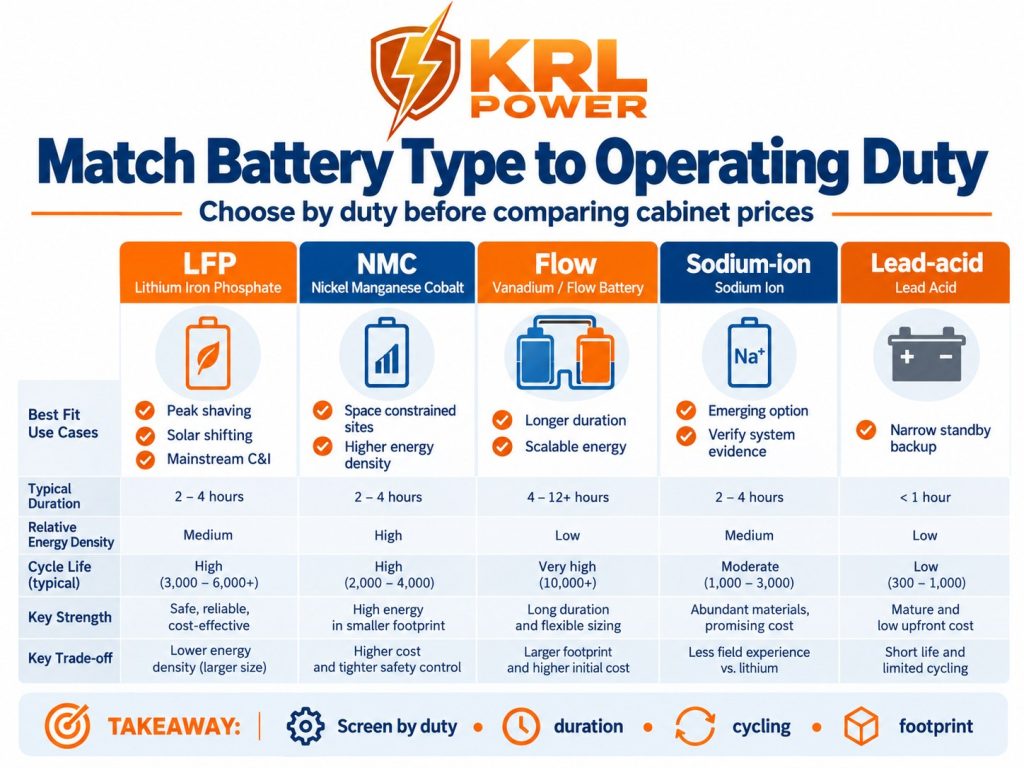
LFP is a practical starting point for many current C&I projects. NREL’s 2024 Annual Technology Baseline models commercial battery storage across 1–8 hour durations and states that LFP became the primary chemistry for stationary storage starting in 2021. That makes LFP a well-supported baseline for mainstream stationary projects, not a universal answer for every duty. Source: NREL 2024 Commercial Battery Storage
The useful question is not whether LFP is popular. It is whether the site duty fits the way a packaged LFP system adds power and energy.
Longer duration normally means more installed battery capacity. More energy can require extra racks, cabinets or containers, along with additional cooling, auxiliary load, protection scope and site area.
Check LFP against the actual project:
- required discharge duration,
- daily or occasional cycling,
- usable installation area,
- ambient conditions,
- thermal-management strategy,
- future expansion requirement.
Nominal kWh is only one part of that screen.
KRL Power’s current C&I-energiebergingstelsels sit in this LFP industrial-storage branch. KRL becomes relevant after the project has already established that a packaged lithium-ion BESS fits the duty.
NMC Becomes Relevant When Density Carries Real Value
NMC can offer higher gravimetric energy density than LFP at cell level. IEA’s 2026 comparison lists current leading cell values up to about 265 Wh/kg for NMC, 205 Wh/kg for LFP and 175 Wh/kg for sodium-ion. Those figures describe cells, not complete C&I BESS enclosures, so they should not be copied into system-level sizing. Source: IEA Global EV Outlook 2026
A crowded plant room may value density far more than a factory with an outdoor yard available for storage equipment. Cooling, cycling duty, thermal behavior, fire design and lifecycle requirements still remain part of the decision.
The procurement question is not which chemistry has the highest Wh/kg. It is whether higher density removes a real site constraint strongly enough to justify the rest of the engineering trade-off.
For many stationary C&I projects, available site area reduces the value of maximum energy density. In a restricted indoor installation, the same comparison can produce a different result.
Flow Batteries Change the Power-to-Energy Relationship
Traditional redox flow batteries use externally stored electrolyte, and DOE identifies separate scaling of power and energy as one of their key architectural advantages. DOE also notes that this independence does not apply equally to every hybrid flow-battery design, so the exact technology still has to be checked. Source: U.S. DOE Flow Batteries Technology Strategy Assessment
That difference becomes more important as duration grows.
| Project requirement | Packaged lithium-ion route | Flow-battery route |
|---|---|---|
| Increase power | Add PCS and battery capability | Increase stack or power capability |
| Increase duration | Add installed battery capacity | Increase electrolyte storage |
| Tight footprint | Higher energy density helps | Tank volume becomes important |
| Short C&I duty | Strong established route | Duration advantage may add little |
| Long-duration duty | More battery modules required | Independent energy scaling becomes more relevant |
A site that needs far more discharge hours without a similar increase in kW may have a reason to evaluate flow technology.
That is not a cost verdict. Tank area, electrolyte, auxiliaries, project maturity, service capability and installed cost still decide whether the architecture survives the project screen.
Sodium-Ion Needs System-Level Evidence
Sodium-ion is moving into stationary-storage discussions because fixed installations do not value gravimetric energy density in the same way as electric vehicles. IEA’s 2026 battery analysis identifies stationary battery storage as one of the applications where sodium-ion is expected to be better suited, while also noting its lower energy density than current LFP and NMC cells. Source: IEA Global EV Outlook 2026
Weight still affects transport, foundations and installation. It is rarely the only decision driver at a factory. Cycle behavior, temperature performance, material supply, installed cost and system maturity can carry more weight.
The gap between an attractive cell and a bankable BESS is important.
Before accepting a sodium-ion proposal, the EPC or owner should verify:
- rated power and energy,
- usable operating window,
- cycle conditions,
- thermal limits,
- certification,
- fire-test evidence,
- BMS behavior,
- warranty conditions,
- replacement and service availability.
A technology can pass the chemistry screen and fail the project screen. Procurement should follow the offered system evidence, not the label alone.
Lead-Acid Still Fits Narrow Standby Duties
Lead-acid remains relevant where the battery spends most of its life charged and only discharges during occasional backup events. The U.S. DOE lead-acid handbook lists stationary batteries for backup emergency power, telecommunications equipment and uninterruptible power supplies, which supports this narrower standby positioning. Source: U.S. DOE Lead-Acid Storage Batteries Handbook
That operating pattern is very different from daily peak shaving or solar shifting.
Repeated cycling brings lifetime throughput, usable capacity, maintenance, floor area and replacement schedule into the comparison. A battery that is acceptable for standby service is not automatically a good fit for high-throughput industrial energy shifting.
The useful distinction is standby duty versus repeated cycling. “Old” and “new” are not engineering categories.
Factories looking primarily at outage support can separate that decision from daily energy shifting by using a dedicated commercial battery backup assessment.
Duration Can Change the System Architecture
Power alone does not define a BESS.
The same 250 kW requirement produces very different energy inventories as the discharge window grows:
| Duty | Initial energy requirement |
|---|---|
| 250 kW × 0.5 h | 125 kWh |
| 250 kW × 1 h | 250 kWh |
| 250 kW × 2 h | 500 kWh |
| 250 kW × 4 h | 1,000 kWh |
| 250 kW × 8 h | 2,000 kWh |
The PCS target remains 250 kW. Stored energy rises sixteen-fold between the first and last cases.
Cabinet count, land requirement, cooling equipment, recharge time and auxiliary demand can all change with that increase. At longer durations, the technology shortlist itself may change.
These figures are only a first energy calculation. Final capacity also depends on the agreed SOC window, conversion losses, auxiliary consumption, reserve policy, degradation allowance and acceptance condition.
Projects that have already selected lithium-ion can move into commercial energy storage system design once the power and duration boundary is stable.
Site Constraints Can Reject a Technology That Meets kW and kWh
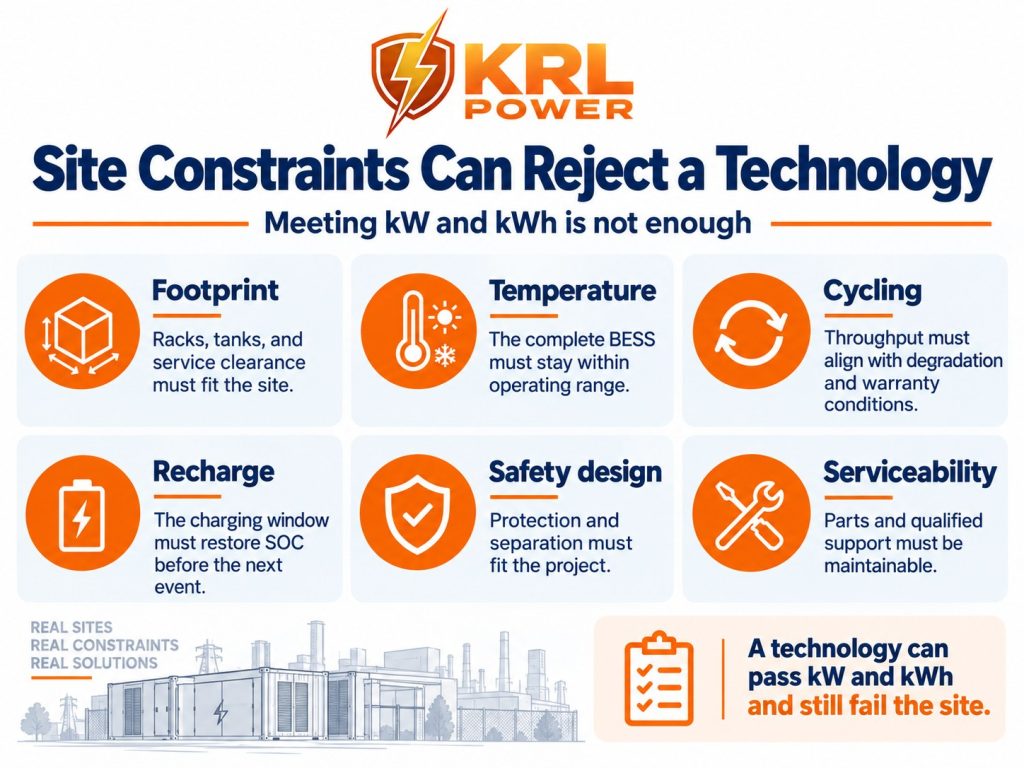
A battery type can meet the initial power and energy target and still fail the site.
| Constraint | Rejection condition |
|---|---|
| Footprint | Racks, tanks, aisles or maintenance clearances exceed available space |
| Structure | Equipment mass or loading exceeds civil limits |
| Temperatuur | The complete BESS cannot maintain its required operating range |
| Cycling | Intended throughput conflicts with degradation or warranty conditions |
| Recharge | Available charging window cannot restore SOC before the next event |
| Safety design | Required protection or separation cannot be accommodated |
| Serviceability | Critical parts or qualified support cannot be maintained |
Thermal management deserves its own review. Chemistry and cooling method are related, but they are not the same decision. The liquid-cooling versus air-cooling comparison should be checked at complete-system level.
The plant buys a BESS, not a laboratory cell. PCS, BMS, EMS, enclosure, cooling, protection, auxiliaries and site electrical design determine whether the chemistry works in the installation.
KRL Power Sits in the Packaged LFP Branch
KRL Power’s current public C&I storage route belongs to the LFP packaged industrial BESS category.
KRL-B261L is published in the 125 kW / 261 kWh class. KRL-B522L is published in the 250 kW / 522 kWh class. Those values belong to the individual models and should not be generalized across the full KRL range.
Projects that have already selected LFP can continue into the KRL C&I BESS class-selection path and compare cabinet or larger plant classes against the measured duty.
The technology map should remain honest about the boundary. Current KRL evidence used for this article does not establish KRL products in flow, sodium-ion, NMC or lead-acid storage, so those technologies are not presented as KRL offerings.
That keeps the technical comparison useful even before the reader chooses a supplier.
Choose the Technology Before Comparing Cabinet Prices
Among the main types of battery energy storage systems, no single chemistry fits every C&I duty. The operating duty should lead the decision.
LFP is a strong commercial baseline for many current C&I projects. NMC becomes more interesting where density removes a meaningful site constraint. Flow batteries deserve attention as long-duration energy grows relative to power. Sodium-ion needs system-level commercial evidence. Lead-acid still serves narrower standby duties.
A practical screening sequence is:
duty → power → duration → cycling → footprint → environment → system evidence → equipment class
A technology that fails one of those boundaries should leave the shortlist before cabinet prices dominate the discussion.
KRL projects enter the product-selection stage after that process has already pointed toward an LFP industrial BESS. Sites focused specifically on peak reduction can then move into the industrial peak-shaving application instead of repeating the technology comparison.