

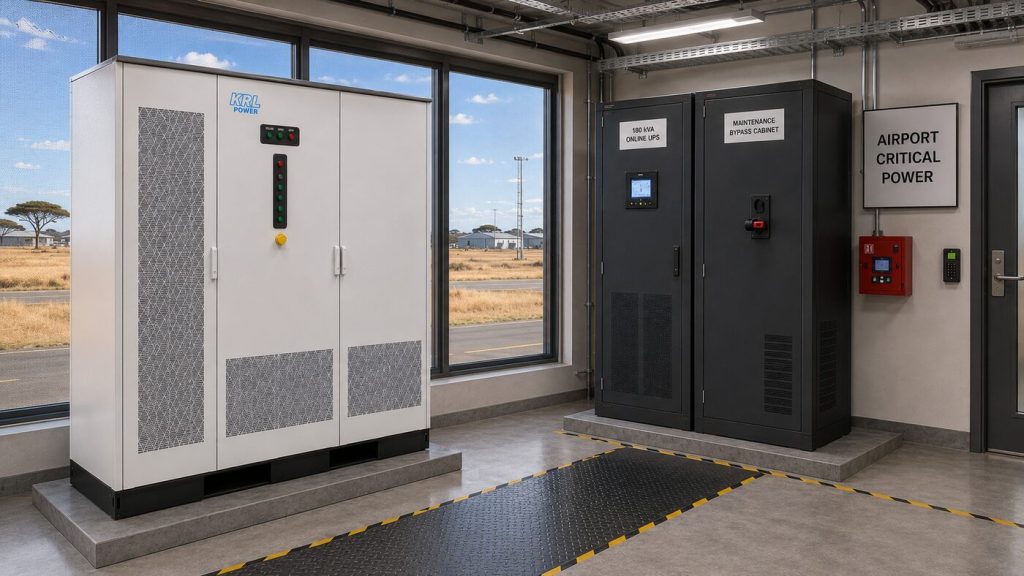
For the South African airport indoor UPS project, the proposed KRL Power energy-storage platform is the KRL-B522L 250 kW / 522 kWh liquid-cooled energy storage system. The customer has specified a 180 kVA three-phase airport load, a 380–415 Vac supply, a vertical cabinet layout, SABS safety evidence, engineering drawings, authentic product photographs, and a one-year whole-system warranty. The B522L's published 250 kW AC rating, 400/230 Vac AC specification, and 375 A maximum AC current form a credible power basis for that request.
The delivered airport package should contain one KRL-B522L cabinet, a named 180 kVA online UPS, static bypass equipment, maintenance bypass equipment, protected-load distribution, and an engineering package that fixes responsibility across the entire power path. The KRL cabinet supplies the energy-storage and bidirectional PCS layer. The online UPS supplies continuous conditioned output to the critical airport bus.
h2 The Proposed Product Configuration
| Customer requirement | Proposed equipment response | Published KRL basis |
|---|---|---|
| 180 kVA three-phase airport load | KRL-B522L as the 250 kW storage and PCS platform, paired with a named 180 kVA online UPS | 250 kW grid/off-grid AC rated power |
| 380–415 Vac supply | 400 Vac three-phase system design with project-specific protection and cable sizing | 400/230 Vac; 50/60 Hz |
| Indoor, vertical installation | One vertical cabinet in a dedicated technical room with an approved access and service layout | 2,480 × 1,400 × 2,050 mm; approx. 4,900 kg |
| UPS uninterrupted-power duty | Online UPS and static bypass serve the critical bus; B522L supports the storage and PCS layer | Published switching figure: <10 ms |
| SABS evidence | Certificate and test-document register for the exact offered equipment package | No SABS certificate is listed on the public B522L page |
| One-year whole-system warranty | One scope and escalation matrix across BESS, UPS, bypass, controls and commissioning | Customer commercial requirement |
The B522L offers greater published power headroom than KRL's 125 kW cabinet products. A single KRL-B261L 125 kW / 261 kWh system of KRL-B241 125 kW / 241 kWh system has a published 125 kW AC rating, which is below a 180 kW unity-power-factor load. The 250 kW B522L leaves a published 70 kW margin at that load point.
- Proposed KRL storage and PCS platform: KRL-B522L, 250 kW / 522 kWh.
- Required UPS layer: a specified 180 kVA online UPS with its manufacturer, model, and overload curve named in the quotation.
- Required continuity path: static bypass and maintenance bypass with an approved operating sequence.
- Required delivery record: a final one-line diagram showing grid, BESS, UPS, bypass, generator interface and protected airport bus.
- Required commercial record: one warranty owner and one escalation route for the complete airport power package.
h2 Confirm the Power Match at 380–415 Vac
The airport's 180 kVA requirement defines the apparent-power duty. Active power depends on the measured load power factor. At a power factor of 0.80, the protected load equals 144 kW. At a power factor of 0.90, it equals 162 kW. At unity power factor, it equals 180 kW. Each operating point remains within the B522L's published 250 kW AC rating.
| 180 kVA load condition | Active power | Approximate line current in 400 Vac three-phase service | Published B522L AC reference |
|---|---|---|---|
| 0.80 power factor | 144 kW | 260 A | 250 kW; 375 A maximum AC current |
| 0.90 power factor | 162 kW | 260 A | 250 kW; 375 A maximum AC current |
| 1.00 power factor | 180 kW | 260 A | 250 kW; 375 A maximum AC current |
The 260 A figure is derived from 180 kVA at 400 Vac in a three-phase system. The electrical design still needs the airport's confirmed fault level, short-circuit rating, protective-device coordination, neutral arrangement, earthing system, and feeder cable route. The public KRL figures establish the product class; the final drawing establishes the safe installation.
- Specify a UPS continuous-output rating of 180 kVA or higher and include its overload duration in the bid.
- Set the BESS/PCS operating limit against the approved airport kW demand and the selected UPS input duty.
- Separate essential equipment with short transfer tolerance from equipment requiring true online UPS output.
- Keep motor starting and large load steps off the protected UPS bus until the selected UPS and BESS test records support the duty.
- Include protection settings and bypass interlocks in the commissioning test procedure.
h2 Size the Battery Runtime at the Protected Airport Bus
The KRL-B522L public specification lists 522 kWh of nominal battery energy. The airport purchase order should state a guaranteed AC-delivered runtime at the protected UPS output. The calculation must account for PCS conversion, UPS conversion, auxiliary consumption, temperature allowance, usable state-of-charge window, and capacity allowance. That keeps the battery-energy figure connected to a verifiable airport operating duty.
| Protected load point | 30-minute AC energy | 60-minute AC energy | 120-minute AC energy |
|---|---|---|---|
| 144 kW at 0.80 power factor | 72 kWh | 144 kWh | 288 kWh |
| 162 kW at 0.90 power factor | 81 kWh | 162 kWh | 324 kWh |
| 180 kW at unity power factor | 90 kWh | 180 kWh | 360 kWh |
For example, a 162 kW protected load needs 162 kWh at the AC bus for a 60-minute duty before conversion and operating allowances. The supplier should show the calculation from the airport load through the UPS and BESS to the battery. KRL's commercial battery-backup power guidance can support the required critical-load and outage-resilience discussion.
- State the guaranteed runtime at the contracted 180 kVA duty and at the measured critical-load kW.
- Define the starting state of charge and the end-of-test condition.
- State which auxiliary loads are included in the runtime result.
- Record the ambient operating condition used for the acceptance test.
- Repeat the same stated duty in the one-year warranty capacity test.
h2 Build the UPS, Bypass and BESS Interface as One Electrical Package
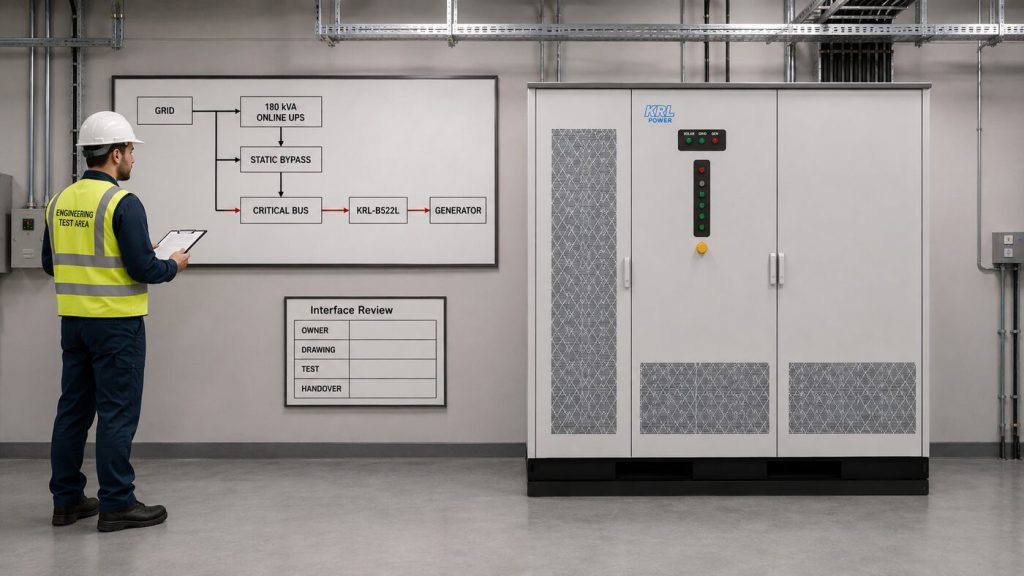
The B522L supports the energy-storage and PCS functions. An online UPS maintains uninterrupted, conditioned power on the airport critical bus. Static bypass and maintenance bypass equipment create safe fault and maintenance paths. The design should identify the function and responsibility of every device and assign a named owner to each handover point between the KRL cabinet and the UPS lineup.
| Equipment boundary | Required project decision | Required proof before shipment |
|---|---|---|
| KRL-B522L to UPS input | Connection method, isolation arrangement, rated cable, protective device and controls | Approved one-line diagram and cable schedule |
| Online UPS to critical bus | UPS model, kVA rating, overload curve, output breaker and critical-load allocation | UPS datasheet and protected-load schedule |
| Static and maintenance bypass | Interlock scheme, labels, operation authority and maintenance procedure | Bypass sequence and witnessed functional-test sheet |
| Generator interface | Start signal, load-transfer order, generator acceptance and return-to-normal sequence | Sequence-of-operations drawing and site test record |
| Monitoring handover | Alarm points, protocol, recipients, event export and access owner | Point list and communication test record |
KRL's BMS, PCS and EMS information describes the relevant control layers. The project engineering package should add the actual I/O schedule, communication protocol, alarm mapping and control authority for the selected equipment.
h2 Fit the KRL-B522L Into the Airport Indoor Room
The KRL-B522L measures approximately 2,480 mm long, 1,400 mm deep, and 2,050 mm high, with an approximate weight of 4,900 kg. The indoor electrical-room design needs to accommodate this cabinet, the 180 kVA UPS lineup, bypass equipment, and protected-load panels in one serviceable arrangement. The cabinet is vertical; KRL should confirm the detailed modular configuration, service side, and final cable-entry layout for the offered configuration.
- Show the cabinet footprint, front and rear service access, and the UPS/bypass service zone on the general arrangement drawing.
- Confirm delivery route, door width, corridor turns, lifting plan, floor load and plinth design for the 4,900 kg cabinet.
- Define cooling air path, room HVAC duty, detection, fire-protection equipment and emergency-stop locations.
- Show cable tray routes, power-cable separation, earthing conductors, bypass conductors and monitoring cabling.
- Keep the critical-power room under controlled technical access with equipment labels and operational signage.
KRL's public B522L data identifies liquid cooling, an IP65 battery enclosure, PCS smart cooling, and a fire-protection system. The public page does not state airport electrical-room clearance requirements, room heat-rejection figures, or a South African installation drawing. Those items belong in the project-specific engineering deliverables. Use KRL's commercial energy storage design process to connect the product dimensions with the final layout, protection plan, and commissioning sequence.
h2 Put SABS Evidence, Drawings and Product Photographs in the Delivery Scope
SABS compliance evidence is an explicit customer requirement. The public KRL-B522L product page does not list an SABS certificate. The commercial proposal therefore needs a compliance register that ties every certificate, report and drawing to the exact battery cabinet, PCS, online UPS, bypass equipment and enclosure delivered to the airport.
| Required delivery item | Airport buyer uses it to verify | Acceptance condition |
|---|---|---|
| SABS evidence register | Certificate scope, model identity, applicable standard and validity | Every document matches the final bill of materials |
| Electrical one-line diagram | Grid, BESS, UPS, bypass, generator and protected-bus boundaries | Drawing revision matches the installed configuration |
| General arrangement drawing | Room position, service space, cable route, emergency stop and access path | Cabinet dimensions and site conditions are shown |
| Authentic product photographs | Cabinet form factor, KRL marking, access side and equipment configuration | Photos show the offered product and final pre-shipment arrangement |
| Commissioning plan | Power test, UPS transfer, bypass test, alarm test and handover records | Test points, witnesses and pass criteria are stated |
The product-photo pack should include front, side, rear, and service views, together with KRL model-identification details, cable-entry direction, cooling equipment, fire-protection interfaces, nameplate format, packaging, and loading method. That evidence lets the EPC compare the final layout against the physical cabinet before dispatch.
h2 Write the One-Year Warranty Around the Entire Critical-Power System
The requested one-year warranty must extend to all supplied components in the airport package. The warranty matrix must assign responsibility for the UPS, bypass, control, and commissioning interfaces. Place every item in one matrix and give the airport a single escalation path.
| Package element | Required warranty scope | Required handover record |
|---|---|---|
| KRL-B522L cabinet | Battery, PCS, BMS, EMS, cooling and fire-protection equipment within the offered scope | Model data, serial numbers, settings and service instructions |
| 180 kVA online UPS | Rectifier, inverter, static bypass, controls and monitoring | UPS test report, bypass test and settings backup |
| Bypass and distribution equipment | Switchgear, breakers, interlocks, meters, cabling and labels in the supplied scope | Protection settings and as-built drawings |
| Controls and communications | Alarm mapping, point list, protocol gateway and access configuration | Point-to-point communication test record |
| Commissioning and service response | Functional tests, training, fault notification, diagnosis and corrective-action route | Signed acceptance, training and escalation records |
The warranty schedule should state its start date, approved operating conditions, capacity-test method, response-time commitment, parts route, travel responsibility, alarm-data access, and escalation contacts. KRL's commercial energy storage selection guidance can support the final comparison of warranty boundary, runtime commitment, site layout, and system responsibility.
h2 Commission the Airport Package Against Measured Results
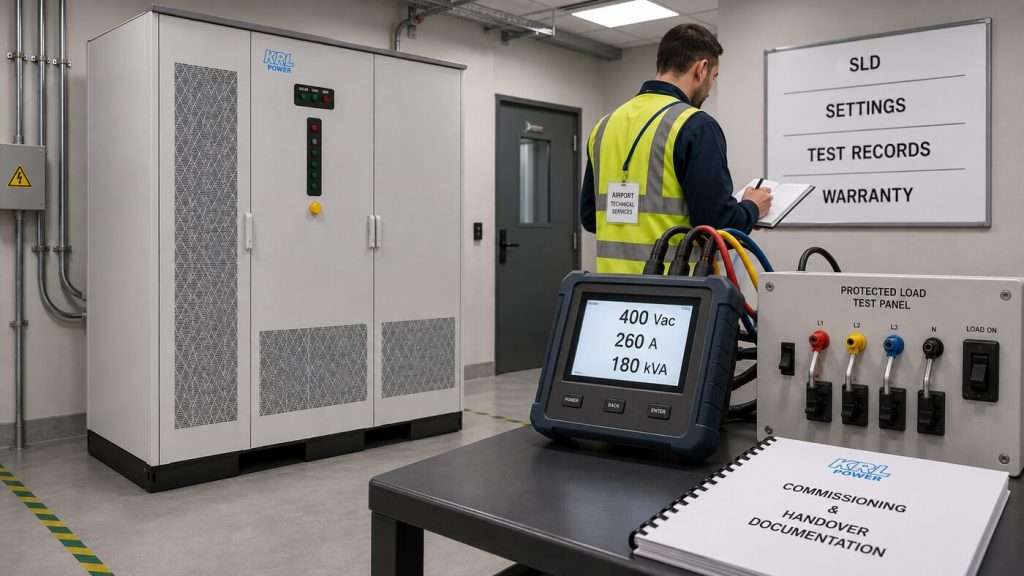
The commissioning team should test the actual airport load or a documented equivalent load bank. The test record needs to show 400 Vac operating data, current, kW, kVA, power factor, UPS output quality, BESS operating state, bypass function, alarms, generator sequence, and completed backup duration. A signed handover package establishes the offered system as an operating asset with traceable responsibility.
- Signed one-line diagram and final general arrangement drawing.
- KRL-B522L model record, serial numbers and pre-shipment product photographs.
- UPS, static bypass and maintenance bypass functional-test records.
- Battery-runtime test with starting condition, measured load, duration and end condition.
- Protection settings, controller settings, firmware versions and communication point list.
- SABS evidence register tied to the final supplied equipment.
- One-year whole-system warranty matrix, service contacts and escalation route.
For a complete C&I storage package discussion, the buyer can reference KRL Power C&I energy storage systems and submit the airport's required configuration through KRL Power's technical enquiry channel.
h2 FAQ
V&A
Which KRL product is proposed for the 180 kVA airport UPS project?
The proposed KRL storage and PCS platform is the KRL-B522L, which KRL publishes as a 250 kW / 522 kWh liquid-cooled all-in-one system. The airport package also needs a named 180 kVA online UPS and bypass equipment.
Can one KRL-B522L support a 180 kVA airport load?
KRL publishes a 250 kW AC rating and 375 A maximum AC current for the B522L. A 180 kVA load equals 144–180 kW across power factors from 0.80 to 1.00, so the stated load falls within the B522L's published 250 kW AC rating. The final design must verify load steps, overload duty, and protection coordination.
Does the KRL-B522L match a 380–415 Vac three-phase supply?
KRL publishes 400/230 Vac and 50/60 Hz for the B522L. The final airport design should state nominal voltage, permitted tolerance, breaker ratings, cable sizing, earthing arrangement and the selected UPS model.
How much backup time can 522 kWh provide for an airport UPS load?
At 162 kW, 60 minutes at the AC bus requires 162 kWh before conversion and operating allowances. The commercial offer must state a guaranteed AC-delivered runtime after PCS and UPS losses, auxiliary load, operating window, and capacity allowance.
Why does the project need an online UPS as well as the KRL-B522L?
The KRL-B522L provides the energy-storage and PCS layer. A named online UPS provides continuous conditioned output to sensitive airport circuits. Static and maintenance bypass equipment provide controlled fault and maintenance paths.
Does KRL publish a switching figure for the B522L?
KRL's public B522L information lists switching of less than 10 ms. The airport critical bus should use a selected online UPS where the load requires continuous, zero-break conditioned output.
Does the public KRL-B522L page provide an SABS certificate?
No SABS certificate is listed on the public KRL-B522L page. The quotation should include a certificate and test-document register that identifies the exact BESS, UPS, bypass equipment and final bill of materials supplied to the airport.
What indoor-room information applies to the KRL-B522L?
KRL publishes approximate dimensions of 2,480 × 1,400 × 2,050 mm and a weight of approximately 4,900 kg. The project drawing should show service space, access route, floor loading, HVAC, cable route, detection, fire protection and emergency-stop positions.
Does the proposed system meet the vertical modular-design requirement?
The B522L is a vertical cabinet product. KRL should confirm the detailed modular build, service side, cable entry and final cabinet arrangement for the offered airport configuration in the engineering drawings.
What should the one-year whole-system warranty cover?
It should identify warranty responsibility for the BESS, PCS, BMS, EMS, cooling, fire protection, online UPS, static bypass, maintenance bypass, distribution equipment, controls, commissioning and fault escalation.
Why should the EPC request authentic KRL product photographs?
Current product photos allow the EPC to check cabinet form factor, KRL model identification, service side, cable entry, cooling equipment, lifting method and room fit before dispatch. The final pack should include pre-shipment photographs of the offered configuration.
Can the KRL-B522L connect with an airport generator?
KRL lists a generator interface for the B522L. The airport package should define generator start command, load-transfer order, synchronization method, protective settings and return-to-normal sequence.
Which records should the airport receive at commissioning?
Handover should include as-built drawings, serial numbers, settings backups, protection-test records, UPS and bypass tests, runtime test data, alarms, communication-test records, product photographs, the SABS evidence register, and the warranty matrix.
What is industrial UPS battery backup for an airport in South Africa?
Industrial UPS battery backup combines energy storage, power conversion, online UPS equipment, bypass equipment and controls to keep approved airport critical loads supplied during a grid event. For this project, the electrical design starts from a 180 kVA three-phase load and a 380–415 Vac supply.
How should a buyer select battery storage for a 180 kVA airport UPS?
Select a system based on continuous kW, UPS kVA, required AC-delivered runtime, voltage, current, room dimensions, cooling, protection coordination, the evidence package, warranty ownership, and commissioning acceptance. KRL-B522L provides a published 250 kW / 522 kWh starting product class for the stated airport load.
Which SABS documents belong in an airport UPS battery-storage proposal?
The proposal should include a compliance register that identifies the applicable standard, issuing body, validity and exact models covered. The register must align with the final KRL BESS, online UPS, bypass equipment, enclosure and bill of materials delivered to the airport.