 Slaan oor na inhoud

Industrial battery storage makes sense when a South African factory has a defined time-based power or energy problem and a clear utility interface. Short demand peaks, a signed backup window, usable PV surplus or diesel support can justify a BESS. Continuous upstream overload cannot. KRL Krag equipment should be screened only after the plant duty and Eskom-or-municipal connection route are known.
The purchase question is which bus needs support, for how long, through which PCC, and under whose grid-connection rules. The KRL C&I energy storage range becomes useful after those answers are stable.

Start With the Plant Problem, Not the Cabinet
Battery storage fits time-bounded problems that can be covered by controlled charge and discharge. South African factories commonly reach that point through a repeatable import peak, a protected production bus that must ride through supply interruptions, daytime PV surplus, or a diesel set that should not carry every short event.
That logic does not fit every electrical constraint. The transformer already above its rating under continuous production has a permanent capacity problem. Battery discharge can reduce a short peak seen by the transformer, but it does not increase transformer nameplate kVA.
| Plant condition | BESS project decision | Next engineering path |
|---|---|---|
| Repeatable import peak lasts for a defined period | Good candidate | Measure peak kW, duration and tariff window |
| Signed critical bus must stay live through a defined interruption | Good candidate | Lock protected kW, restart sequence and required support window |
| Daytime PV repeatedly exceeds plant demand | Good candidate | Measure actual surplus kW/kWh and later load |
| Diesel covers short events or inefficient low-load periods | Good candidate | Define battery ride-through, reserve and generator control owner |
| Continuous plant demand is already above transformer or supply capacity | Do not size the battery first | Resolve the upstream electrical constraint |
| No interval data or signed critical-load list exists | Product selection is premature | Measure the site before choosing a KRL model |
Historical outage patterns should not replace this screen. Published load-shedding blocks, old stage assumptions or generic “four hours of backup” lines do not identify the bus that actually has to survive. The protected load may need only the transfer and generator-start interval, or it may need several hours with the generator intentionally offline. Those are different BESS duties even at the same factory.
The South African Connection Route Comes Before Equipment
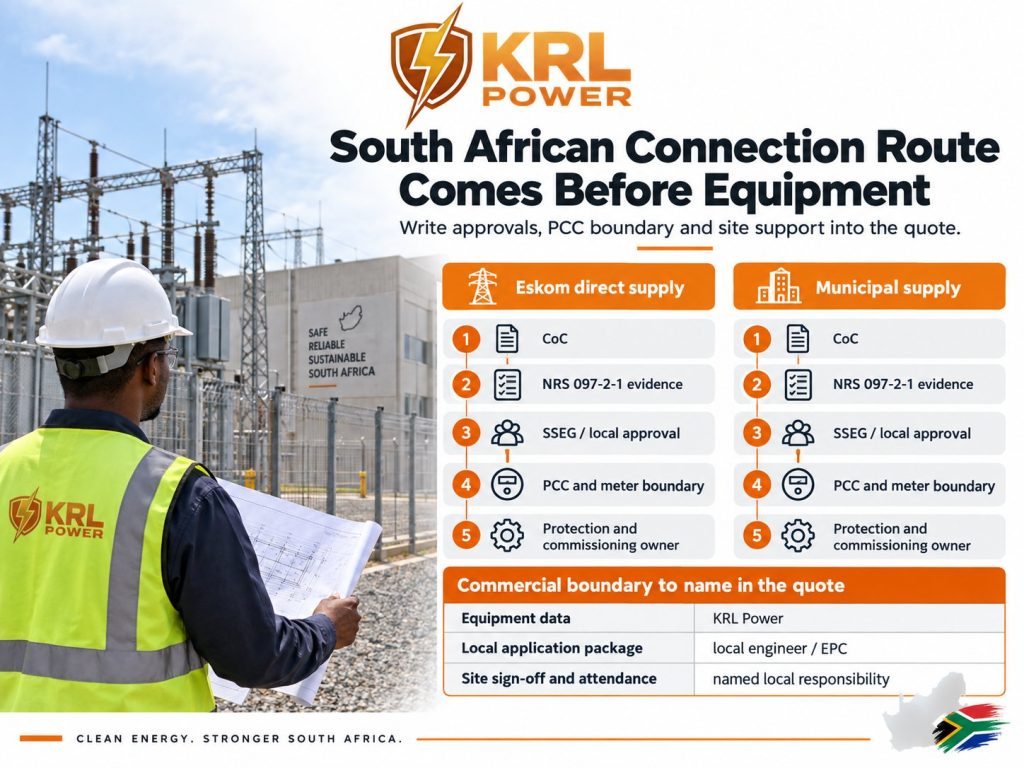
Write one line near the top of the design basis: Eskom direct supply of municipal supply. The application route, metering, permission-to-operate steps and accepted evidence can differ, so the equipment quote should not treat “South Africa” as one approval process.
an Eskom-supplied site, the current Eskom SSEG process requires grid-parallel embedded generation to be registered and asks for compliance evidence including a valid electrical Certificate of Compliance, NRS 097-2-1 inverter type-test evidence and an Embedded Generator Installation report. Eskom also publishes a separate registration path for larger systems and network-connection work. See the current Eskom SSEG requirements before assuming a cabinet can operate in parallel with the network.
Municipal customers follow the local distributor's process. Cape Town, for example, publishes its own embedded-generation authorisation route, approved inverter/equipment list, technical requirements and Permission to Install process. Its current application page warns that PTI can take months. See the City of Cape Town embedded-generation application page for the current municipal example.
The procurement boundary is important: a KRL product page proves the published product rating; it does not by itself prove that the exact inverter configuration has been accepted by Eskom or a municipality for that site.
Before the order is released, the quote should state who supplies the NRS 097-2-1 evidence, who submits the distributor application, who issues the SANS 10142 CoC/installation sign-off, who completes commissioning records and who owns any export-limiting or metering requirement.
One Primary Duty Must Control the Sizing Logic
Industrial battery storage can perform several duties, but one operating objective needs to lead the control strategy. That priority decides how much energy remains reserved, when discharge is permitted and which mode wins when two objectives compete for the same state of charge.
| Primary duty | Battery job | Main design evidence |
|---|---|---|
| Outage-first | Preserve energy for the signed critical bus | Protected kW, support hours, reserve kWh, restart sequence |
| Bill-first | Discharge during a defined demand or tariff window | Peak kW, event duration, tariff structure, recharge opportunity |
| PV-first | Move measured daytime surplus into a later load window | Surplus PV kW/kWh, later demand, charging power, export boundary |
| Diesel-support-first | Carry short events and reduce unnecessary generator runtime | Generator rating, start time, outage pattern, reserve, start/stop logic |
An 80 kW protected load held for two hours and a 160 kW one-hour peak both equal 160 kWh on paper. Their EMS logic is completely different. An outage-first plant protects a reserve; a bill-first plant spends more of the battery during the tariff window.
South African factories should also separate ride-through from long-duration backup. Plants with a generator may need the BESS to hold one signed bus only through transfer and the 10–30 seconds needed for the generator to become stable. Another plant may deliberately keep the generator off for two hours. Changing load-shedding stages does not automatically change the primary duty; the signed bus, generator strategy and allowed recharge window do.
Sites that want one cabinet to perform both bill reduction and outage backup should use the dedicated peak-shaving and backup duty page for the detailed reserve logic instead of assuming both jobs have their own private battery capacity.
Power, Energy and Current Reject Equipment for Different Reasons
Industrial battery storage cannot be sized from kWh alone. Power in kW, energy in kWh and AC current each reject equipment for a different reason.
| Design quantity | What it answers | Typical plant evidence |
|---|---|---|
| kW | How much real power must the PCS deliver at one time? | Running load, peak-reduction target, simultaneous equipment |
| kWh | How long must the assigned duty continue? | Backup hours, peak duration, PV-shifting window |
| A / kVA | Can the converter, switchboard and feeder carry the duty? | Voltage, power factor, motor overlap, breaker and cable ratings |
Converter power follows the largest simultaneous duty, not the factory's daily energy consumption. Plants averaging 90 kW through a shift can still require a higher power class during overlapping motors or a poor-power-factor event.
Energy sets the duration. Signed 80 kW critical load for two hours starts at 160 kWh of AC duty. Rated battery energy still has to accommodate the agreed SOC window, conversion losses, auxiliaries, reserve policy and any end-of-life requirement. The 261 kWh or 522 kWh nameplate is not a promise of the same number of AC kilowatt-hours at the factory bus.
Current can reject a model after kW and kWh have already passed. Low power factor and simultaneous starts raise current without a matching rise in real power. That is why the site record should keep kW, kVA, power factor and current visible as separate fields.
Anonymous 400 V Factory Screen: B261L Can Fail on Current
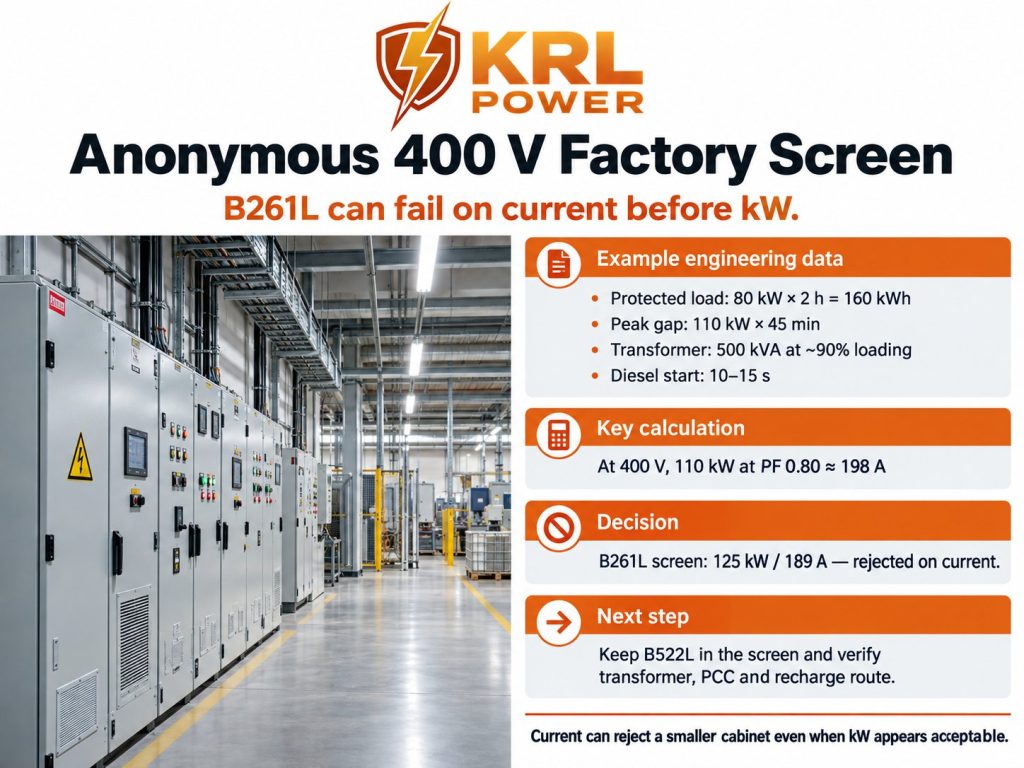
Illustrative screening example , not a KRL Power project. Consider a 400 V three-phase factory with an 80 kW protected bus for two hours, a repeatable 110 kW peak gap lasting 45 minutes, a 500 kVA transformer already running near 90% during the intended recharge period, and a diesel generator that takes about 10–15 seconds to start and stabilise.
Four Limits Appear in the Same 400 V Example
The hand calculation exposes four separate limits:
| Check | Simple screen | What it says |
|---|---|---|
| Backup energy | 80 kW × 2 h = 160 kWh | B261L has enough rated energy to stay in the first comparison, but delivered AC energy still needs SOC/loss/reserve allowances |
| Peak-shaving energy | 110 kW × 0.75 h = 82.5 kWh | Energy alone does not force a larger cabinet |
| AC current at 400 V, PF 0.80 | 110,000 ÷ (√3 × 400 × 0.80) ≈ 198 A | B261L is rejected by its 189 A published current limit even though 110 kW is below 125 kW |
| Transformer recharge headroom | 500 kVA × 10% ≈ 50 kVA spare at that operating point | Full-rate grid charging of a 125 kW-class PCS does not fit this window; charge must be capped, moved or supplied from another valid source |
That site moves KRL-B522L into the next comparison because its published maximum AC current is 375 A. That does not make B522L automatically necessary: power factor correction, motor sequencing or a different protected-bus definition can change the current case. The 750 kW / 1 MW plant-class route is rejected by the stated duty unless another measured plant requirement exists.
The diesel timing is a separate line. KRL publishes on/off-grid switching under 10 ms on the relevant cabinet pages; a generator taking 10–15 seconds to become stable is still a 10–15 second generator event. The protected bus must ride through both the transfer and the generator-start interval.
Primary duty (outage / bill / PV / diesel); protected kW and hours or peak target kW and duration; PCC voltage, transformer nameplate + measured loading, switchboard/feeder current; measured PV surplus or diesel-control owner. KRL Power can return the first equipment boundary: whether B261L is rejected by current, whether B522L is necessary to compare, and whether the plant-class route should be ruled out.
Transformer and PCC Limits Can Reject the Charging Plan
The incoming transformer, main switchboard and PCC determine how the BESS can charge, discharge and interact with the utility. Grid charging often exposes a limit that a discharge-only calculation misses.
Write the electrical boundary before the order is frozen:
- PCC location and nominal voltage
- transformer nameplate and measured loading
- main switchboard and feeder current ratings
- breaker and protection arrangement
- grid-charging headroom
- critical-load bus
- CT and meter locations, including any export-limiting measurement point
One rule prevents a large class of bad purchases: BESS discharge can reduce a temporary peak, but it does not increase transformer nameplate capacity. The dedicated transformer-capacity BESS page carries the detailed charging-versus-islanded screen.
At the South African PCC, the project also needs the distributor's accepted protection and metering arrangement. Zero-export setpoint in the EMS is not the same thing as having the network operator accept the installation. The SLD, CT direction, protection trip path, inverter compliance evidence and commissioning records must agree with the chosen Eskom or municipal route.
PV, Grid and Diesel Need One Control Hierarchy
Grid charging consumes transformer headroom. PV charging can reduce that dependency only when measured surplus exists and the selected product/topology can accept it. Rooftop kWp alone does not prove a charging window.
KRL-B261L publishes up to 120 kW PV input; KRL-B522L publishes up to 240 kW. Compare those interfaces with measured surplus after factory load, not the PV array nameplate.
Diesel adds a different control owner. The quote should state who commands generator start and stop, what bus the battery must hold before the engine is stable, whether the generator may recharge the battery, and how reverse power is blocked. The product's diesel port and <10 ms transfer figure do not define that site sequence.
| Site architecture | South African factory question to close |
|---|---|
| Grid + BESS | Which PCC and distributor process applies, and how much charging headroom exists? |
| PV + BESS | How much measured surplus reaches the battery, and what export rule applies? |
| Grid + PV + BESS | Which meter/CT controls zero-export or permitted export? |
| Grid + diesel + BESS | Who owns generator start, reserve and reverse-power blocking? |
| Grid + PV + diesel + BESS | Which EMS priority is tested at commissioning? |
Product Screening Starts After the Plant Duty Is Fixed
Equipment screening becomes useful after the duty, South African connection route, electrical boundary and recharge source are stable.
| Plant duty class | KRL product path | Published figures to screen first |
|---|---|---|
| 125 kW-class industrial feeder | KRL-B261L | 125 kW / 261 kWh / 189 A / 120 kW PV |
| 250 kW-class industrial feeder | KRL-B522L | 250 kW / 522 kWh / 375 A / 240 kW PV |
| Plant-class duty | KRL-B2M6L route | 750 kW / 1.5 MWh or 1000 kW / 2 MWh configurations |
B261L remains in the comparison only while the signed duty fits both 125 kW and 189 A and the required delivered-energy window can be supported from its 261 kWh rated platform after project allowances. B522L moves the electrical screen to 250 kW and 375 A with 522 kWh rated energy. The larger route belongs on the sheet only after measured plant duty has clearly left the cabinet class.
The table is a product screen, not an SSEG approval statement. The exact South African inverter-compliance evidence and site-connection scope still need to be confirmed for the order configuration.
Put South African Approval and Site Support Into the Commercial Boundary
Product supply and South African site responsibility should appear as separate rows in the commercial offer. Diesel port, liquid cooling or fast transfer figure is a product fact; municipal approval, Eskom paperwork, local electrical sign-off and fault attendance are project-delivery responsibilities.
Name the Owner of Each South African Site Responsibility
The quote should identify the responsible party for each of these items:
| Site responsibility | Name the owner before order release |
|---|---|
| NRS 097-2-1 type-test / inverter compliance evidence | KRL, appointed local EPC, or another documented supplier |
| Eskom or municipal SSEG / embedded-generation application | Local owner/EPC/consultant as contractually agreed |
| Export limit and metering scheme | Local electrical designer + network service provider approval |
| SANS 10142 CoC / installation sign-off | Registered local electrical person within the applicable scope |
| Commissioning / EGI / PTI evidence | Party named in the distributor process and project contract |
| Johannesburg / Cape Town / other-city fault attendance | Named local service party and response commitment, if included |
Do not imply a South African installation track record, local office or on-site service capability unless KRL can document it for the specific offer. Stronger quotations state the boundary plainly: what KRL supplies, what the local EPC supplies, what the network service provider approves, and who signs the plant back into service.
Some Plants Need Electrical Work Before a BESS Order
Some industrial storage reviews should end with a delayed purchase. Continuous demand above the supply or transformer rating, missing interval data, an unsigned critical-load list, unresolved motor-start duty or an unknown distributor-connection route can all make a battery quote look more certain than the engineering actually is.
The same pause is justified when generator control ownership remains undefined, PV capacity is still moving, the main switchboard current path has not been checked, the intended PCC is disputed, or the NRS/CoC/commissioning responsibility has not been allocated.
These are not reasons to reject storage permanently. They are reasons to stop the equipment order from getting ahead of the site design.
Detailed Design Starts After the Operating Boundaries Stabilise
South African factory can move into detailed engineering after the primary duty, measured load, support window, PCC, transformer/switchboard limits, PV/diesel strategy, network-service-provider route and preliminary equipment class are stable.
The design stage should then lock the SLD, protection philosophy, CT and metering arrangement, EMS priority, export control, cable/breaker scope, communications, local compliance evidence and commissioning plan. The KRL commercial BESS design page is the appropriate internal route after the screening decision is complete.
Buy Around a Defined South African Plant Duty
Industrial battery storage should be purchased against a duty that the factory, EPC and equipment supplier can read the same way: a named protected bus or peak target, a duration, a PCC, a measured electrical limit, a recharge source and an agreed South African grid-connection path.
That basis is more useful than broad statements such as “South Africa needs backup” or “the plant has 500 kWp of solar.” It tells the buyer why B261L stays in the comparison, why its 189 A limit can reject it, when B522L becomes relevant and when a plant-class system is plainly too large for the measured job.
Send the same four-part duty pack: primary duty; protected kW/hours or peak kW/duration; PCC + transformer + board/feeder current; PV surplus or diesel-control owner. The reply should state the first rejecting boundary for B261L, whether B522L needs to stay on the comparison sheet, whether plant-class storage is out, and which South African approval/site-scope items remain with the local project team.
