

A remote Egyptian water plant can lose its RO shutdown sequence the moment a high-pressure pump trips on power failure. The price of that failure is measured in disrupted water service and uncontrolled process recovery, not in a battery nameplate. Put KRL B2M6L 750 kW / 1.5 MWh on the shortlist for a qualified protected bus; move to 1 MW / 2 MWh when its verified power demand exceeds 750 kW. Build solar, diesel and water-storage autonomy around that duty.
A quotation that leads with MWh but ignores the flush pump has missed the most important load. The KRL B2M6L plant-class ratings establish the first converter and energy limits. The 750 kW / 1 MW equipment boundary shows where smaller cabinets cease to be a sensible first purchase. A multi-MW desalination facility still needs its own 24-hour power balance, generator strategy and signed RO process sequence.
The EPC still owns the outage if no one has specified what the pumps, valves and generator will do.
A Power Trip Can Become a Water-Quality and Hydraulic Failure
The water-plant consequences are concrete: a tripped VFD, an interrupted valve stroke, a stalled flushing sequence. EPC teams that specify only battery autonomy leave the most expensive process obligations without an electrical owner.
Keep RO Shutdown Controls Alive When the Source Trips
Reverse-osmosis trains operate with tightly managed feed pressure, concentrate flow and permeate conditions. Unexpected loss of control power can interrupt the prescribed flushing and valve sequence. FilmTec RO/NF shutdown guidance from DuPont addresses low-pressure flushing, vacuum prevention and permeate backpressure; its limit of 0.3 bar (5 psi) static permeate backpressure applies to the specified FilmTec conditions. The installed membrane supplier's manual controls the project.
Seconds of lost supply do not by themselves prove membrane damage. The procurement failure is leaving the prescribed shutdown sequence without a verified power source. Identify the PLC/SCADA, actuated valves, flushing equipment, instruments and any drives that must remain live until the process reaches its approved safe state.
KRL B2M6L becomes a credible equipment choice when that safe-stop list is translated into protected kW, AC current and delivery time. Its 750 kW or 1,000 kW rated off-grid PCS output, 1,130 A or 1,500 A maximum AC current, en on/off-grid switching below 10 ms give the electrical team defined ratings to test against. They do not certify uninterrupted operation at every RO terminal. Controls with tighter ride-through limits need their own approved UPS/DC arrangement.
The Pump Must Survive the Electrical and Hydraulic Test
Stopping a large pump changes flow velocity. Check-valve closure, pipe length, wave speed and surge equipment determine whether the result is a damaging pressure rise, sub-atmospheric pressure or reverse-flow event. The familiar screening relation Δp = ρaΔv shows why the speed of flow change matters; the real water network needs a hydraulic transient study.
Buying another megawatt-hour does not fix a check valve that closes at the wrong moment. Demand the VFD transfer test, approved pump deceleration and hydraulic restart limits before anyone signs off the power package. KRL's electrical protection and transfer checklist belongs in the same approval package as the hydraulic surge analysis.
Stop Sizing a 5 MW Water Plant as a 120 MWh Battery Order
A desalination plant carrying 5 MW continuously for 24 hours consumes 120 MWh per day. That 120 MWh belongs in the full-day generation and fuel model. It says nothing about the battery power needed to protect the signed process bus.
Separate the site into operating duties before fixing a battery rating:
| Water-plant duty | What must happen during a source failure | Equipment decision |
|---|---|---|
| Full RO production | Meet the approved production schedule over the day | Size the overall PV, diesel and other generation supply against the daily load profile |
| Protected process bus | Hold specified pumps/VFDs and critical auxiliaries during transfer | Sets KRL B2M6L PCS kW, AC current and protected-load connection |
| Safe-shutdown bus | Keep controls, valves, instruments and flushing active until safe stop | Sets minimum delivered AC energy and the control-power architecture |
| Flexible treatment and transfer | Pause or reduce output within approved tank/quality limits | Allows water storage to reduce electrical backup duty |
| Restarted process | Bring selected pumps and trains back in the permitted sequence | Sets starting-current, frequency, breaker and hydraulic acceptance tests |
Die KRL commercial storage design process can support the converter, battery and interface screening. The plant's hydraulic engineer must still sign which RO trains may stop, and for how long.
Do not let a 5 MW nameplate push the tender into a 5 MW BESS purchase before anyone has defined the critical bus. The expensive version of this mistake is a bigger battery connected to the wrong bus.
Buy KRL B2M6L Against the Critical Bus, Not the Plant Nameplate
KRL offers two published B2M6L configurations with a common 400/230 Vac three-phase AC interface and separate converter and PV ratings. The critical bus gives the first three numbers to check: simultaneous kW, AC current and delivered AC kWh. The container plan follows.
| KRL configuration | Rated on/off-grid PCS | Gegradueerde batterye-energie | Max AC current | Integrated PV input ceiling |
|---|---|---|---|---|
| **KRL-B1M5L-750H3S-720M6-HX1** | **750 kW** | **1.5 MWh** | **1,130 A** | **720 kW** |
| **KRL-B2ML-1MH3S-960M8-HX1** | **1,000 kW** | **2 MWh** | **1,500 A** | **960 kW** |
650 kW critical bus: lead with the 750 kW / 1.5 MWh configuration
For a protected pump-and-control duty of 650 kW over a required 45-minute bridge, the initial load-side energy calculation is 650 × 0.75 = 487.5 kWh AC. KRL's 750 kW / 1.5 MWh configuration passes the first steady-power screen with 100 kW of nameplate headroom. For the stated 650 kW bridge, the 750 kW class is the disciplined first purchase screen.
Do not turn that first calculation into a guaranteed runtime. Confirm usable SOC window, conversion losses, auxiliaries, ageing, temperature, protection reserve and actual AC delivered energy. Check power factor and 1,130 A against the AC switchboard. A motor restart can overturn a steady-power pass.
At 880 kW, Reject the Undersized 750 kW Converter
When protected simultaneous demand rises to 880 kW, the 750 kW converter is 130 kW short. At 880 kW, the smaller converter misses the steady-power requirement by 130 kW. The battery energy figure cannot overturn that rejection. Move the equipment review directly to KRL's 1 MW / 2 MWh configuration and its 1,500 A AC-current limit.
By 880 kW for one hour, the load-side requirement begins at 880 kWh AC, before reserve and losses. The 2 MWh rated battery must still pass a delivered-energy calculation. Either option requires VFD transition and protection testing; <10 ms switching is not a zero-break UPS guarantee for the RO plant.
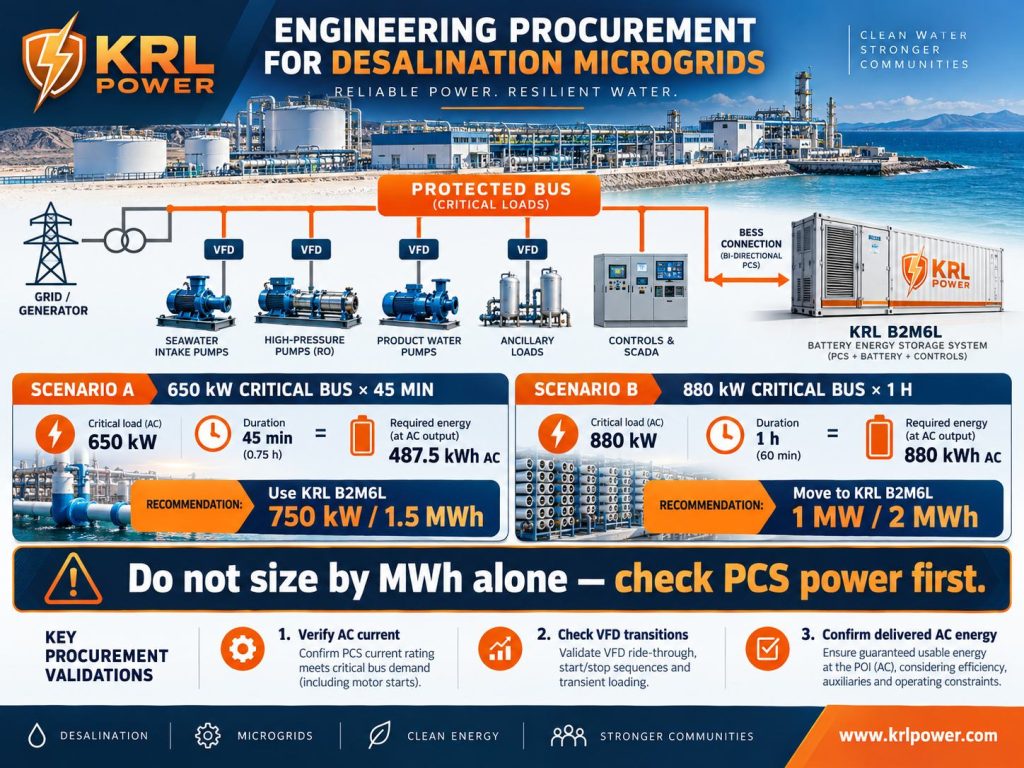
Complete the current, motor-transfer, protection and delivered-energy tests before committing to the chosen converter class. The KRL ESS class-selection reference keeps smaller feeders out of an unnecessarily large purchase while identifying the point at which plant-class equipment becomes relevant.
Above 1 MW of common protected demand, multiple electrical blocks, transformers, synchronisation, controls and fault protection need a project design. One product table does not establish a certified multi-container parallel scheme. Do not multiply the single-unit ratings and call that a tested microgrid.
Keep the Water Flowing When the RO Trains Cannot Run
Treated-water storage can sustain municipal deliveries during an authorised RO production pause. That changes how much electrical load the battery must support. If a treated-water reservoir can carry demand while the RO trains stop safely, the EPC can protect a smaller electrical block without abandoning municipal service obligations.
Consider 3,000 m³ of usable water above the approved minimum and net consumer demand of 1,000 m³/h after RO production stops:
3,000 m³ ÷ 1,000 m³/h = 3 hours of water-service autonomy.
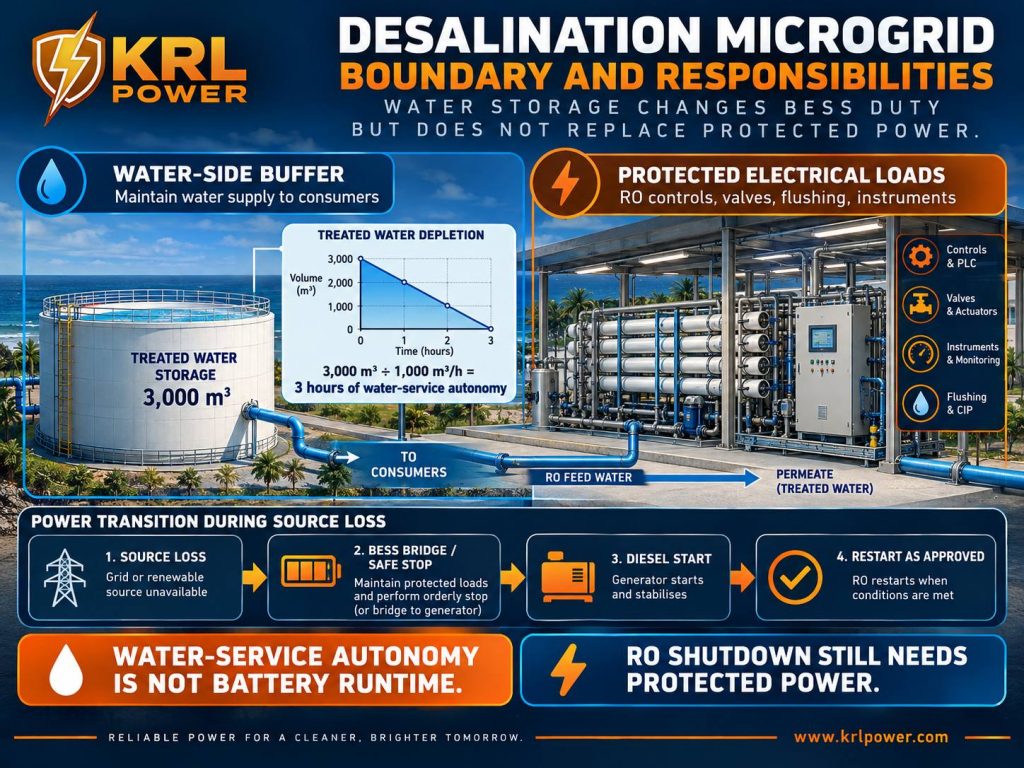
The stated flow case gives three hours of consumer supply; the membranes, instruments, controls and flushing equipment still need their contracted safe-stop power. A higher demand peak, required fire reserve or lower usable level cuts the buffer; continuing inflow may increase it.
The water engineer sets the latest acceptable production restart. The electrical package must protect the controls and safe-stop loads until then. Use KRL B2M6L for the verified protected electrical block. Do not buy battery kWh to duplicate a hydraulic reserve the site already owns.
Die KRL remote water-pumping application deals with the related off-grid pumping duty. An RO desalination tender adds membrane shutdown, pressure sequencing and water-quality acceptance to that baseline.
Solar Cuts the Diesel Workload; BESS Handles the Hard Transitions
Diesel dependency reaches beyond fuel price. Transport, site stock, generator servicing and missed deliveries all feed the operating budget. Fuel purchase, transport, handling, servicing, overhaul intervals and contingency stock all affect operating cost. A generator left running at the wrong load also creates an operating inefficiency problem. On a remote project, a missed fuel delivery can become a water-supply emergency.
KRL B2M6L gives EPC buyers a measurable route to a hybrid plant: up to 720 kW integrated PV input with the 750 kW configuration, or up to 960 kW with the 1 MW configuration; battery liquid cooling; on/off-grid PCS ratings; and a diesel-generator interface. KRL B2M6L offers rated storage and PCS capacity for specified transition and dispatch duties. Diesel remains the long-duration backstop when the project energy balance demands it.
Put a Number on Diesel Energy Before Selling the Savings
If measured PV surplus and operating demand allow 500 kW of diesel-generator electrical output to be displaced for four hours on each of 300 days, the gross substitution opportunity is:
500 kW × 4 h/day × 300 days = 600,000 kWh/year (600 MWh/year).
The 600 MWh figure describes the stated dispatch calculation; it is not a measured project result or a guaranteed reduction in generator output. Account for actual PV availability, energy delivered at the bus, curtailment, generator minimum loading, BESS losses and dispatch priorities. The resulting reduction in diesel litres depends on the generator's tested fuel-consumption curve and the operating load points.
A twenty-year project comparison should evaluate upfront PV/BESS and switchgear, replacement and augmentation requirements, annual fuel and maintenance costs, transport, degradation, discount rate and delivered water/energy service. With no site load profile, fuel price, capital quotation or measured diesel curve, a claim that Solar+BESS is “40–60% cheaper” cannot be defended. A 40–60% cost-saving claim without site fuel consumption, PV yield and capital pricing is just an unpriced sales promise.
The costly diesel mistake is buying emergency power and then paying to operate it as the only daily power source. A properly defined hybrid dispatch may reduce that burden while maintaining a generator path for prolonged renewable deficits.
Prove 24/7 Water Service Through Five Operating Modes
Keep the water-service obligation at 24/7; engineer the electrical loads by what must stay live. Whether every pump must receive uninterrupted electrical power is a different question and must be answered by the process design. A remote microgrid needs a full-day, low-solar and source-failure operating schedule that the water operator can sign.
| Bedryfsvoorwaarde | Power and process response | KRL B2M6L’s specified duty |
|---|---|---|
| Strong daytime PV | PV supplies permitted process demand; surplus can recharge storage | Manage the assigned battery charge/discharge duty within configured PV and AC ratings |
| Evening and night | Diesel and/or storage supplies approved critical loads; water tanks allow flexible train scheduling | Hold the signed critical load for the calculated interval, preserving emergency SOC |
| Consecutive low-solar periods | Dispatch available diesel and reduce deferrable RO production inside water-service limits | Reserve battery power for fast transitions and approved shutdown; do not promise multi-day autonomy from rated MWh |
| Sudden source loss | Protected electrical bus survives or completes the approved safe-stop sequence; generator starts under defined authority | Execute the installed and tested transfer mode; validate PLC/VFD ride-through and generator handover |
| Generator fails to start | Alarm, retain essential controls, use remaining water storage and initiate approved load shedding or shutdown | Protect the specifically contracted safe-stop loads and energy reserve, not an undefined whole-plant demand |
A 5 MW continuously loaded site requires 120 MWh/day regardless of the fact that one B2M6L is rated 750 kW / 1.5 MWh or 1 MW / 2 MWh. The wider energy model must include other PV fields, appropriately sized generation, electrical distribution and any project-specific multiple-storage topology. B2M6L's 720/960 kW PV ceilings are integrated input ratings for each listed unit, not a cap on independently engineered site-wide solar capacity.
At source loss, the sequence either calls the right generator, closes the right breaker and preserves the right SOC reserve—or the plant trips. The source-loss sequence must name the commander of the diesel start, the owner of the islanding breaker, the SOC reserve controller, the RO safe-stop authority and the reset/restart permissives. The KRL BMS, PCS and EMS coordination framework provides the component roles; the plant integrator must validate actual control integration and operating modes.
KRL's published <10 ms on/off-grid switching value alone cannot certify grid-forming, black start, seamless islanding, generator synchronisation or motor-start performance for the assembled installation. Contract those functions separately when the project requires them. Write those functions into tests where the water-service obligation depends on them.
Win the Technical Evaluation With Evidence, Not an ESG Slogan
Government agencies and development-financed water projects buy years of service, not just switchgear. An SDG slogan offers no evidence of how the RO train survives a fault. Voltage limits, water-buffer autonomy and witnessed shutdown tests do.
World Bank-financed international procurement uses project-specific rated criteria for many contracts, covering factors such as methodology, quality, risk management and sustainability alongside price and lifecycle value. That does nie mean a diesel-based bid automatically fails. The specific tender controls the pass/fail criteria, scoring weights and admissible evidence.
The proposal should put these questions and their acceptance evidence next to each other:
| What the evaluator or water operator asks | Evidence the proposal should contain |
|---|---|
| Will critical RO processes survive a source change? | Protected-load schedule, transfer voltage/frequency limits and witnessed PLC/VFD/flush sequence |
| Can water supply continue through a production pause? | Usable reservoir volume, net draw, minimum level and production-recovery deadline |
| Will Solar+BESS materially reduce diesel dependence? | Hourly dispatch simulation, measured generator fuel curve, renewable-energy contribution and sensitivity cases |
| Who owns abnormal-mode failures? | Diesel-start authority, generator-failure sequence, protection settings and escalation responsibilities |
| How can the purchaser compare lifecycle value? | Transparent capital, maintenance, fuel, replacement, ageing and discount assumptions |
| Is the system safe to install and operate? | Site-specific fire, grounding, isolation, thermal and commissioning plans plus required certificates |
An EPC that offers only a “green microgrid” slogan gives evaluators no evidence of process protection. A witnessed source-loss test gives them something they can score and the water operator can demand at handover. KRL's equipment ratings can anchor the storage section, while the EPC keeps functional specifications open, auditable and consistent with applicable public-procurement rules.
Egypt’s 2026 activity confirms water and power are being developed together. The EPC still needs a site-specific answer: coastal grid connection, weak grid or remote island. On 23 June 2026, Egypt's State Information Service reported Scatec's plan to invest up to US$5 billion across several sectors, including renewable-powered desalination and BESS. That figure covers a wider portfolio, not a desalination-only budget. On the same date, Egyptian officials discussed renewable-powered treatment of moderately saline drainage water. On 25 September 2026, ministers examined using existing coastal power-plant infrastructure for seawater desalination. These are different project contexts: a remote islanded plant needs its own source architecture; an established coastal grid connection needs a different interface.
Desert Heat, Coastal Salt and Dust Can Destroy a Weak Equipment Specification
A remote Egyptian water site may combine high ambient temperature, dusty air and limited maintenance access; coastal desalination also introduces salt-laden exposure. In the desert or on the coast, a cheap battery enclosure becomes expensive the moment corrosion, derating or access requires redesign.
The KRL B2M6L ratings provide a defensible starting point: liquid battery cooling; -10°C to 55°C published operating temperature; IP65 for the battery subsystem; fire-protection system listed; and approximately 15,000 kg or 19,500 kg equipment weight for the two configurations. The listed container size for both is 6,058 × 2,438 × 2,896 mm. Those details affect the thermal study, crane plan, pad design and battery protection requirements.
Operating to 55°C is not the same claim as delivering full rated output without derating at 55°C. Nor does IP65(Battery) establish whole-container IP55, or prove a C5 coastal coating. Before releasing the purchase order, require the applicable derating curve, cooling auxiliaries, ventilation layout, corrosion-protection specification, fire strategy and site access design.
An MV desalination distribution board cannot accept a B2M6L's 400/230 Vac output without a properly engineered transformer, switchgear, grounding and protection interface. The KRL protection coordination scope is a useful starting document for this part of the EPC review. The approval remains project-specific.
KRL gives the EPC published electrical and mechanical starting points: KRL places published PCS power, battery energy, PV inputs and cooling data on the table early enough for the EPC to design around them. Missing corrosion, derating and site-test requirements can then be resolved before a container is shipped, when corrections are less expensive.
Put the Microgrid Tender Boundaries on Paper Before Releasing the PO
A bid price without a protected-bus duty and source-loss test cannot establish what the EPC is purchasing. Without the following boundaries, two BESS bids with the same MWh figure may deliver entirely different water-plant performance.
| Required tender boundary | What must be signed or tested before award |
|---|---|
| Process and water-service commitment | RO train schedule, water-quality conditions, minimum production and permitted interruption |
| Critical bus and safe-stop loads | Connected/simultaneous kW, kVA, power factor, essential control loads, duration and available SOC |
| Pump and membrane protection | Largest VFD, start/restart sequence, surge-analysis limit, flushing and valve logic |
| Solar and long-duration generation | 24-hour and low-solar cases, PV collection design, diesel power/fuel curve and replenishment strategy |
| Electrical interface | AC/MV one-line, transformers, islanding point, earthing, fault levels, breaker grading and anti-backfeed |
| Thermal and environmental package | Ambient, salt/dust exposure, cooling auxiliaries, corrosion system, access and derating proof |
| Contract tests | FAT/SAT for source loss, critical-bus transfer, RO safe stop, generator failure, restart and measured AC energy |
This is the section of a government water project where KRL can be evaluated on actual plant-class merits. The KRL ESS equipment-selection path supports the first hardware comparison, but an auditable tender must assign those cross-system duties to named engineering packages.
Name the owner of the diesel start, breaker permissive and failed-start response in the contract. Commissioning is too late to discover an orphaned command.
Water Security Is Energy Security—Specify the Right KRL Power Block
A remote municipal water project can live with a carefully scheduled RO production pause if the hydraulic reserve and water-quality rules allow it. It cannot live with an uncontrolled source failure, an unpowered membrane shutdown or a backup specification that ignores the pump and generator interfaces.
For a verified 650 kW critical block, lead with KRL B2M6L 750 kW / 1.5 MWh. At 880 kW, reject the undersized 750 kW converter and move to the 1 MW / 2 MWh configuration. Expand into a complete multi-MW microgrid only through a site-specific generation, distribution, control and protection study. Use water storage to protect service autonomy and solar to reduce the routine diesel workload where the measured operating cases support it.
Specify the water-service duty first. Make every kilowatt of purchased storage answer to it.