
Egypt's 2026 battery-storage rules move the purchase decision upstream. Before comparing cabinets, a factory must know what storage project it is building. Do not start with battery kWh. Start with project classification, connection voltage, grid-service scope and the single-line diagram. Order the battery first and the project can spend the rest of its schedule paying for that shortcut.
KRL Krag can screen B261L, B522L or a plant-class route only after those boundaries are clear.
A 522 kWh cabinet can be technically suitable and still enter the wrong approval route, while a 1.5 MWh plant-class system can look cheaper per kWh and create a different regulatory discussion. The KRL C&I BESS class-selection table settles equipment class; the ontwerp van kommersiële energiestoorstelsel stage settles how that equipment belongs on the site.
The most dangerous shortcut is to hear “below 1 MWh” and read it as “no licence required.” That shortcut can turn a fast purchase into a slow approval problem. EgyptERA Circular No. 5 of 2026 says something much narrower.
Egypt Has Put Battery Storage Inside a Formal Licensing Framework
EgyptERA's Circular No. 5 of 2026 sets permit and licensing requirements for battery-storage-system installation. The rule separates storage projects according to how they are connected and what they are allowed to do.
A solar or wind project with BESS is handled as an integrated generation-plus-storage project for licensing-fee purposes. A stand-alone BESS providing services to the grid is treated as an independent storage station. A smaller Micro BESS directly connected to a final consumer such as a building or factory can enter a different fee-exemption route when it stays within the conditions set by the Circular.
Those labels determine the regulatory route and should be fixed before equipment is priced.
Purchasing should stop issuing an enquiry that says only:
“Need 500 kWh battery for factory.”
That sentence says nothing about whether the system is behind the meter, whether it will export, whether it will provide commercial grid services or which network company owns the connection. The same battery can sit inside a very different project depending on those answers.
Stop Asking for kWh Before You Know What Type of BESS You Are Building
Two factories can order the same 522 kWh cabinet and still face different regulatory routes.
| Project configuration | First regulatory question |
|---|---|
| Factory solar + BESS | Is storage part of an integrated renewable-energy project? |
| Stand-alone BESS | Will the system operate as an independent storage station and provide grid services? |
| End-user Micro BESS | Is it directly connected to the final consumer, within the qualifying energy boundary and outside commercial grid-service activity? |
Classification follows the cabinet's electrical relationship with the site and grid, not the product label.
Weak procurement often runs in the opposite direction: ask for 500 kWh, ask for 250 kW, compare prices, then discover that nobody defined export rights, PCC, service scope or connection voltage.
The useful order is:
project classification → connection boundary → signed duty → power → energy → equipment
Die commercial energy storage selection guide becomes useful after the regulatory and electrical boundary is known. Product selection cannot repair a project whose basic role is still undefined.
The 1 MWh Boundary Is a Fee-Exemption Test, Not a Free Pass
The purchasing file needs one rule in plain language:
≤1 MWh does not automatically mean “no licence.”
A 900 kWh nameplate is not an exemption stamp. If the project fails the end-user, service-scope or approval conditions, the headline number will not rescue it.
Circular No. 5 identifies a Micro BESS category for small storage systems directly connected to the final consumer, including buildings and factories, with storage capacity not exceeding 1 MWh en not providing commercial services to the grid. Projects meeting the relevant conditions may apply for exemption from licensing fees.
The exemption is not automatic. The investor submits a request with supporting justification, the regulator reviews the technical, financial and legal aspects, and the final decision follows EgyptERA's approval process.
Purchasing should not be told:
“It is only 900 kWh, so regulation does not matter.”
A defensible procurement statement is:
“The project is below 1 MWh and may fit the Micro BESS fee-exemption route, subject to direct end-user connection, no commercial grid services and EgyptERA approval.”
The 1 MWh number is only one test in the exemption route.
The threshold becomes concrete as soon as equipment is counted. One KRL-B522L is rated at 522 kWh. Two units total:
522 kWh × 2 = 1.044 MWh
On simple nameplate arithmetic, the second cabinet moves combined rated energy above the 1 MWh Micro BESS condition. That single arithmetic line can change the regulatory conversation before a cable is pulled. Before the second unit is ordered, the regulatory route needs to be confirmed again; the original fee-exemption assumption may no longer fit.
Connection Voltage Decides Who Enters the Review

EgyptERA's Circular states that projects connected at high voltage are reviewed in coordination with the Egyptian Electricity Transmission Company, while medium- and low-voltage connections are coordinated with the relevant distribution company.
| Connection level | Coordination route |
|---|---|
| High voltage | Egyptian Electricity Transmission Company |
| Medium voltage | Relevant distribution company |
| Low voltage | Relevant distribution company |
Connection level belongs on the purchase-release checklist, not in a later EPC clarification.
Even a correct 180 kW duty can fail at project level if transformer, switchgear, protection, metering or network-owner assumptions are wrong.
The PCC is a network boundary, not a cabinet feature.
The engineering discussion starts with site voltage, transformer, PCC, protection and the SLD—not with a battery render.
A Missing Single-Line Diagram Turns the BESS Quote Into Guesswork
EgyptERA includes the Single Line Diagram among the technical information required for the permit or licence application. The same application framework also calls for storage power and energy, battery type and technology, protection and safety systems, operation and maintenance planning, applicable environmental and economic studies, preliminary grid-owner approval and a recognised safety certificate from the Egyptian Organization for Standardization and Quality or an equivalent accepted body.
The SLD has to exist before the hardware order because it defines what the cabinet is actually being asked to connect to. Without it, every downstream quotation is carrying electrical assumptions the buyer has not signed.
| RFQ-invoer | What it prevents |
|---|---|
| Site voltage | Wrong PCS or transformer interface |
| Connection voltage level | Wrong network-owner assumption |
| SLD | Wrong PCC and protection boundary |
| Required kW | Undersized converter |
| Required kWh | Wrong energy class |
| Transformer rating | Hidden import/export bottleneck |
| PV topology | Incorrect solar integration |
| Diesel control | Generator-control conflict |
| Grid-service intent | Wrong project classification |
| Protection concept | Breaker/selectivity failure |
| Energy above or below 1 MWh | Missed Micro BESS boundary |
KRL se BESS protection coordination checklist belongs in this stage. Correct kW and kWh are useless if breaker logic is wrong, the island boundary is undefined or nobody owns the generator-start sequence.
If the one-line diagram cannot explain the power path, the quotation is not ready.
110 kW Duty? Buy the 125 kW Class, Not a 250 kW Oversize
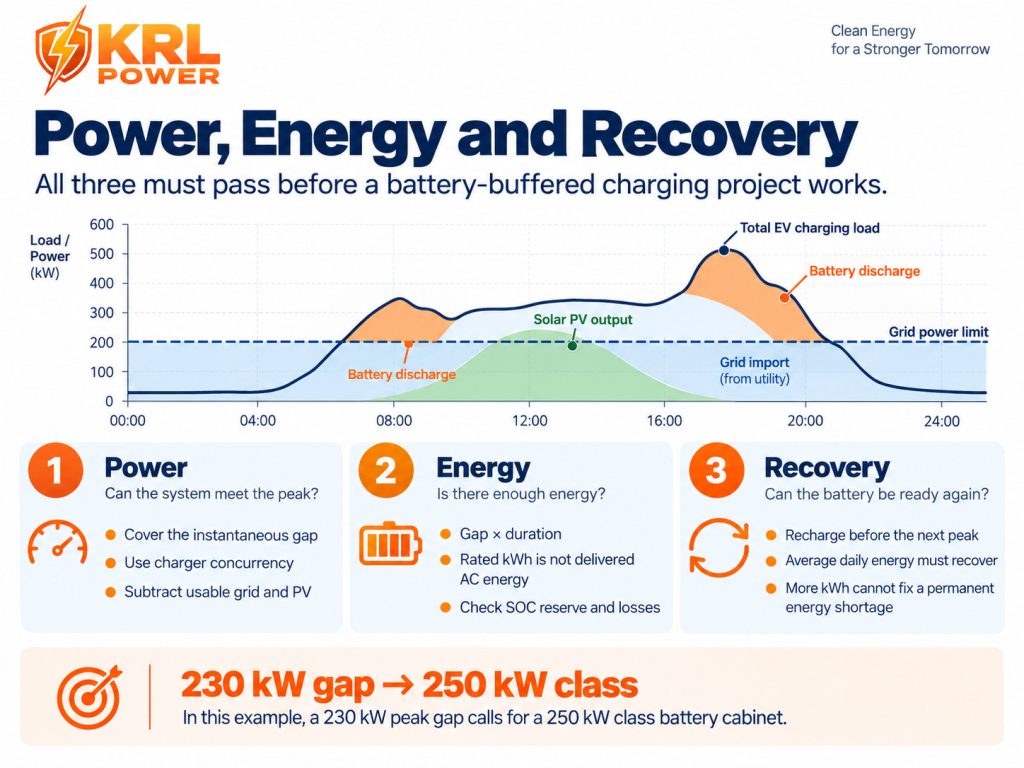
Take a factory that has already fixed its regulatory route and needs approximately:
110 kW / 240–250 kWh
This is a 125 kW-class duty. Start with KRL-B261L.
| B261L item | Geopenbaarde waarde |
|---|---|
| Gegradueerde AC-krag | 125 kW |
| Gegradueerde batterye-energie | 261 kWh |
| Maximum wisselstroom | 189 A |
| Maximum PV input | 120 kW |
| AC output | 400/230 Vac, three-phase |
| Dieselgeneratorhawe | Ja |
| Rooster-/buitenrooster-skakeling | <10 ms |
A 110 kW duty does not need a 250 kW converter just because Egypt is announcing GWh-scale storage projects. Do not pay for a 250 kW converter to solve a 110 kW problem. The measured 110 kW requirement sets the first equipment class.
B261L's 261 kWh rated energy is well below 1 MWh, but the product itself does not carry a regulatory exemption. Direct end-user connection, grid-service scope and EgyptERA's decision still control that question.
180 kW Duty? B261L Is Out—Move to KRL-B522L
Now raise the duty to:
180 kW / approximately 500 kWh
B261L is no longer in the required power class. The first single-cabinet screen moves to KRL-B522L.
| B522L item | Geopenbaarde waarde |
|---|---|
| Gegradueerde AC-krag | 250 kW |
| Gegradueerde batterye-energie | 522 kWh |
| Maximum wisselstroom | 375 A |
| Maximum PV input | 240 kW |
| MPPT-kanale | 2 |
| AC output | 400/230 Vac, three-phase |
| Dieselgeneratorhawe | Ja |
| Rooster-/buitenrooster-skakeling | <10 ms |
180 kW belongs in the 250 kW class. Start with B522L.
Once the plant asks for 180 kW, B261L is out. The price sheet does not get a veto over the load.
B522L's 522 kWh rated energy sits below the 1 MWh energy threshold. That makes it relevant to a project evaluating the Micro BESS route; it does not make the project automatically exempt from licensing fees.
Equipment rating supports the application; it does not decide the regulatory treatment.
Crossing 1 MWh Can Change the Project Before It Changes the Price
KRL's current B2M6L plant-class path starts with 750 kW / 1.5 MWh en 1 MW / 2 MWh public configurations. Both are above the 1 MWh Micro BESS energy condition.
A better headline cost per kWh is not enough reason to jump from 522 kWh to 1.5 MWh. Cheap extra capacity is still expensive when the site never needed it.
Suppose the plant only needs:
220 kW for 2 hours
The first energy calculation is:
220 kW × 2 h = 440 kWh
Final design still has to account for SOC limits, losses, reserve, auxiliaries and operating conditions, but nothing in that first duty proves a 1.5 MWh requirement.
Buying 1.5 MWh before the load curve needs it can increase equipment, civil, protection and regulatory scope at the same time.
Die 750 kW / 1 MW BESS comparison belongs when several feeders, higher current or the energy window have actually pushed the plant beyond the cabinet class.
Do not let $/kWh push the project across a regulatory boundary before the load curve pushes it there.
Egypt's GWh BESS Headlines Are Not Your Factory Sizing Sheet
Egypt's storage market is moving quickly. Nefertiti is a 500 MW / 1,000 MWh stand-alone BESS at Benban. Horus is a 250 MW / 500 MWh stand-alone BESS at Zafarana. The Energy Valley project under appraisal combines 1.95 GWp of solar with 3.9 GWh of battery storage across multiple sites.
Those projects show how quickly storage is moving into Egypt's power system.
Egypt's GWh headlines are proof of market direction, not a factory sizing worksheet. They say nothing about whether a particular factory needs 261 kWh, 522 kWh or 1.5 MWh.
A factory still has to answer:
- What load is the battery carrying?
- For how long?
- At what connection voltage?
- Behind which meter?
- With what grid-service rights?
- Under which regulatory classification?
A national 500 MW project does not turn a 110 kW factory duty into a utility-scale problem.
Copying utility-scale thinking into a factory RFQ skips the load study that should have set the cabinet class.
Buying the BESS Before the Grid Boundary Is Signed Is Backwards
“Buy the cabinet now; the EPC can solve the connection later” is exactly the sequence that creates avoidable redesign.
If the grid owner later requires a different protection arrangement, transformer configuration, PCC treatment, metering architecture or connection study, the buyer owns the mismatch.
EgyptERA's Circular requires the connection route and preliminary grid-owner involvement to be part of the project process. The KRL C&I-energiebergingsreeks gives the buyer multiple equipment classes, but those options should be screened against a signed electrical boundary.
Before release of the BESS PO, the project should be able to answer:
- Which network owns the point of connection?
- What voltage level is the BESS connected at?
- Is the project behind the meter?
- Is export or commercial grid service intended?
- What bus is protected or controlled?
- Which breaker isolates the storage system?
- Who owns the generator start command?
- What does the SLD show during grid loss?
If those answers are still moving between sales, EPC and the factory, the project is not ready to buy hardware. Lock the boundary first. Then make the cabinet solve a job that actually exists.
What Must Be in the First Egypt BESS RFQ
The first RFQ should be specific enough that a generic battery quotation is impossible.
| RFQ field | What the buyer should define |
|---|---|
| Project type | Hybrid, stand-alone or end-user Micro BESS |
| Site voltage | Actual AC system voltage |
| Connection level | HV, MV or LV |
| SLD | Current electrical one-line |
| BESS duty | Peak shaving, backup, PV shifting, grid service or combination |
| Required AC power | kW at the protected or controlled bus |
| Required energy | kWh and operating window |
| PV | Existing/planned kW and coupling architecture |
| Diesel | Generator rating and control sequence |
| Transformer | Rating and present loading |
| PCC | Meter and network-owner boundary |
| Grid-service intent | Yes / No and intended service |
| Storage threshold | ≤1 MWh or >1 MWh |
| Beskerming | Breaker, relay and islanding concept |
Then let the duty select the equipment class.
Inside 125 kW, screen B261L. Above 125 kW and within 250 kW, screen B522L. When power, current or energy has genuinely moved the project into the 750 kW / 1.5 MWh or 1 MW / 2 MWh range, move to the plant-class route.
Equipment class follows the measured site requirement.
Fix the Regulatory Boundary Before You Fix the Battery Size
Egypt's 2026 rules expose weak procurement early, which is useful if the buyer acts on it.
“500 kWh BESS, best price please” is not a complete project brief.
A credible factory project has a classification, a known network owner, a signed connection voltage, an SLD and separate power and energy duties. If the buyer wants to pursue the Micro BESS fee-exemption route, the project also has to fit the actual conditions and pass EgyptERA's approval process.
B261L gives smaller factory projects a 125 kW / 261 kWh starting class. B522L moves the project to 250 kW / 522 kWh. B2M6L takes the site into 750 kW / 1.5 MWh or 1 MW / 2 MWh plant-class storage.
Those ratings speed up product screening; regulatory work still has to be completed on the project itself.
The most expensive BESS is not the cabinet with the highest price. It is the cabinet bought before the project knew what it was allowed to be. Buy after the boundary is signed, and the hardware can spend its life solving the factory's problem instead of becoming part of it.