 Slaan oor na inhoud
Publieke kommentare van inwoners wat naby fabrieke en kommersiële terreine woon, wys op 'n herhalende probleem: dieselgenerators wat deur die nag loop, veroorsaak voortdurende geraasklagtes. Buurmense rapporteer dat hulle nie kan slaap nie en dat hulle klagtes by verhuurders en plaaslike owerhede indien in hierdie wyd gedeelde weergawe. In other cases, residents describe generators running until 4–5 a.m., leading to ongoing conflict as detailed in this resident’s experience. Een wyd gedeelde plasing het 'n buurman beskryf wat 'n generator 12 agtereenvolgende dae sonder ophou laat loop het, wat rus onmoontlik gemaak het volgens hierdie openbare klagte.
Vir fabrieksbestuurders beteken dit nie net spanning in die gemeenskap nie, maar ook werklike operasionele beperkings op nagskofte. Beperkte bedryfsure, bykomende klankisolasievereistes en herhaalde klagtes verhoog almal die koste om die produksie ná donker aan die gang te hou.
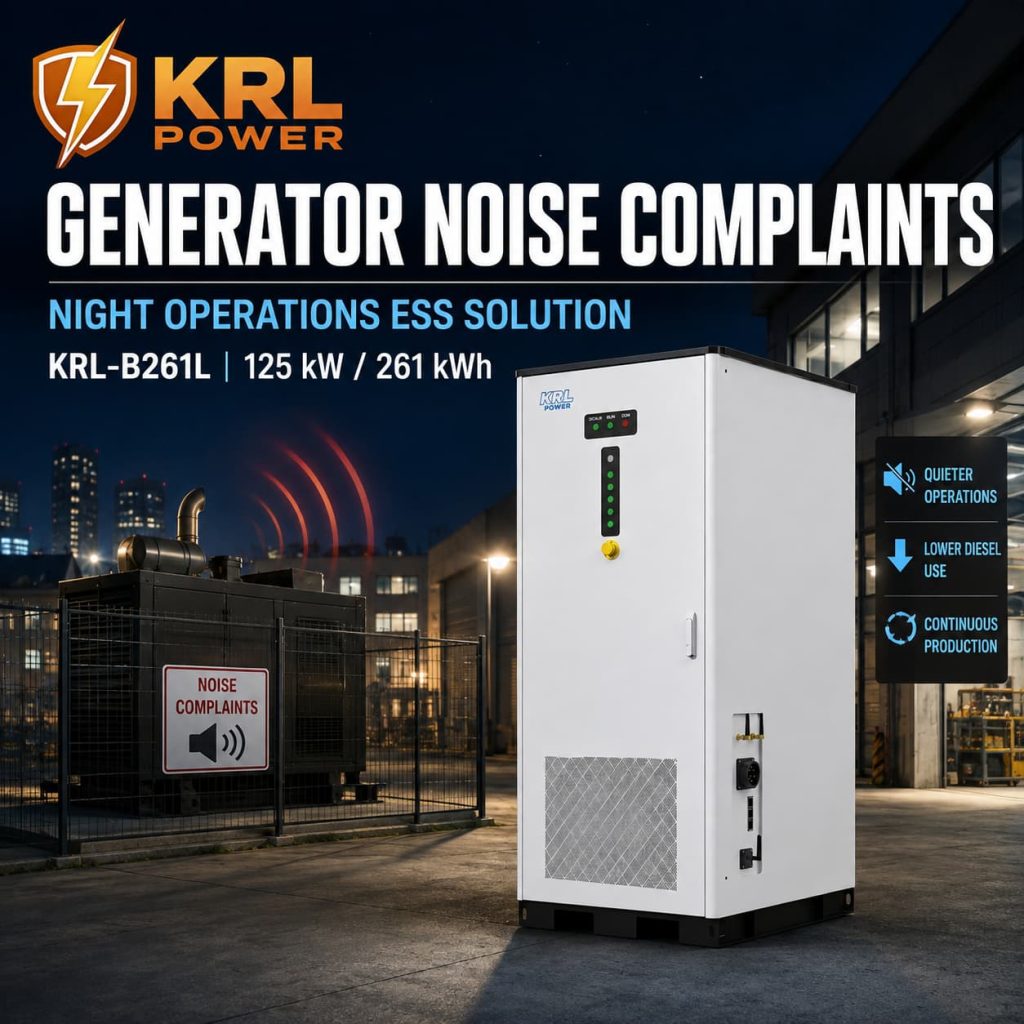
'n fabrieks-voor-geïntegreerde 125 kW / 261 kWh vloeistofgekoelde ESS van KRL Krag adres hierdie druk op vier praktiese maniere:
- Onmiddellike oorbrugging sodat produksielyne aan die gang bly terwyl die diesel aflyn bly of net begin wanneer dit nodig is.
- Gekoördineerde sonkrag en berging wat kritieke laste prioritiseer en die generator se bedryfsure skerp verminder
- Vloeistofkoeling wat stabiele prestasie onder deurlopende belasting handhaaf
- Enkele party se verantwoordelikheid vir stelselprestasie, waarborg en uitbreiding
Die doel is eenvoudig: hou die nagskof aan die gang terwyl die generator die meeste van die tyd stilbly.
| Item | Spesifikasie |
|---|---|
| Aanbevole beginstelsel | 125 kW / 261 kWh vloeistofgekoelde voor-geïntegreerde ESS |
| Hoofgebruikgeval | Fabrieke wat teëkom klagtes oor generatorgeraas en beperkings op nagbedrywigings |
| Sleutelfunksies | Onmiddellike oorbrugging, vermindering van dieselbedryfstyd, son-selfverbruik, piekondersteuning |
| Afkoeling | Vloeistofkoeling |
| Opsionele opgradering | Hibriede vaste-toestand / kwasi-vaste-toestand selle vir terreine met hoër veiligheid |
| Tipiese argitektuur | Rooster + son-PV + ESS + bestaande diesel + kritieke produksieladinge |
Hoe generatorgeraas eintlik nagbedrywighede beperk
Geluidsklaagtes volg gewoonlik 'n duidelike pad:
- Inwoners rapporteer voortdurende generatorgeraas gedurende nagure.
- Plaaslike owerhede of eiendomsbestuur ondersoek
- Bedryfsure is beperk of bykomende klankisolasie word vereis
- Die produksie op die nagskof word beperk of duurder om te onderhou.
Fabrieke wat naby woongebiede, gemengde gebruiksgebiede of digte stedelike nywerheidskluster geleë is, is veral blootgestel. Selfs wanneer die generator tegnies wettig is, kan volgehoue klagtes van bure veranderinge afdwing wat die kapasiteit van die nagskof verminder.
Waarom 'n stiller dieselgenerator alleen selde die probleem oplos
Installing a sound-attenuated or “silent” generator reduces the decibel level, but it does not remove the core issue:
- Die generator loop steeds vir elke kort roostergebeurtenis.
- Kumulatiewe bedryfsure bly hoog
- Brandstof- en onderhoudskoste gaan voort
- Enige oorblywende geraas kan steeds klagtes ontlok tydens stil nagperiodes.
Wat fabrieke nodig het, is 'n stelsel wat die kritieke las van krag voorsien sonder om die generator by elke onderbreking in te skakel.
Matching 125 kW Power and 261 kWh Energy — Is It Enough?
| Parameter | Waarde | Praktiese betekenis |
|---|---|---|
| Gegradueerde krag | 125 kW | Ondersteun tipiese deurlopende produksielading op medium nagskoflyne |
| Gegradueerde energie | 261 kWh | Betekenisvolle brugtyd sodat die diesel tydens kort- en mediumgebeurtenisse aflyn bly. |
| Teoretiese bedryfstyd by 100 kW | ≈ 2.6 hours | Slegs ideale berekening |
| Echt bruikbare uitvoeringstyd | Korter | Beïnvloed deur die SOC-venster, verliese, bykomstighede en reserwebeleid |
Direkte leiding vir fabriekskopers:
- Medium-sized factories with continuous night-shift process load typically 80–120 kW → 125 kW / 261 kWh is a practical starting point for cutting generator hours.
- Larger multi-line night operations → treat this as Phase 1 and plan parallel cabinets once measured load is confirmed.
- Pure battery + diesel (no solar) → energy demand rises; 261 kWh may become tight for multi-hour autonomy.
- Solar already planned or installed → daytime charging supports night bridging and further reduces generator runtime.
Drie eenvoudige kontrole:
- Measured continuous night-shift process load — Below 100–110 kW → 125 kW has healthy margin. Regularly above 130–150 kW → plan parallel units.
- Required bridge time before diesel is allowed to start — Minutes to 30–40 minutes → 261 kWh is normally sufficient. Several hours without diesel → increase energy capacity.
- Solar availability for daytime charging — Yes → 125 kW / 261 kWh works well as the core hybrid block. No → treat it as a short-bridge system and size energy more carefully.
Ingenieursnota: 125 kW is 'n beginkeuse gebaseer op 'n ewewigstoestand kritieke las. Finale bevestiging vereis steeds hersiening van die motorstartvolgorde, gelyktydige motorstarts, VFD/sagstart/DOL-konfigurasie, kragfaktor en die PCS se kortdurende oorlaaivermoë.
Groottebepaling moet begin by die gemeet kritieke prosesbelasting, nie by die battery-naamplaat nie. Oorgrootte belemmer kapitaal. Ondergrootte laat die nagskof blootgestel. Die 125 kW / 261 kWh-eenheid is ontwerp as 'n modulêre boublok binne KRL Power’s C&I energy storage systems.
Aanbevole hibriede argitektuur
Grid → Intelligent EMS → 125 kW / 261 kWh liquid-cooled ESS → Critical night-shift production loads. Existing diesel retained as long-duration backup only. Solar PV sized to daytime charging and process demand.
- Daytime with good solar → PV covers process loads and charges the ESS
- Grid present but expensive → ESS discharges to limit peak demand
- Grid fails at night → ESS bridges instantly so the generator stays silent
- Diesel running → ESS absorbs load steps and shortens generator runtime
Hierdie argitektuur volg dieselfde ontwerpbeginsels wat in groter industriële oplossings soos die gebruik word. KRL 522 kWh sonkrag-opberg-diesel mikro-netkas.
Voordele van fabrieks-voor-geïntegreerde vloeistofgekoelde ontwerp
| Aspek | Multi-verskaffer-bou | Voorgeïntegreerde vloeistofgekoelde stelsel |
|---|---|---|
| Oordragprestasie | Moeilik om te waarborg | Fabrieksgetoets |
| Termiese konsekwentheid | Variabele | Geïntegreerde vloeibare verkoeling |
| Opdragtyd | Langer, meerkantig | Korter, enkele verantwoordelikheid |
| Waarborggrens | Gefragmenteer | Duidelike eenpartyverantwoordelikheid |
| Uitbreiding | Dikwels benodig dit 'n herontwerp. | Modulêre groeipad |
By 'n fabriek wat snags in 'n werkende skof funksioneer, verskyn die koste van koppelvlakfaling as ekstra generatorure, geraasblootstelling en verlore opbrengs eerder as eenvoudige ekstra arbeid. Hierdie voordele is konsekwent oor KRL’s commercial and industrial ESS solutions.
Hoe die stelsel beide geraas en dieselure verminder
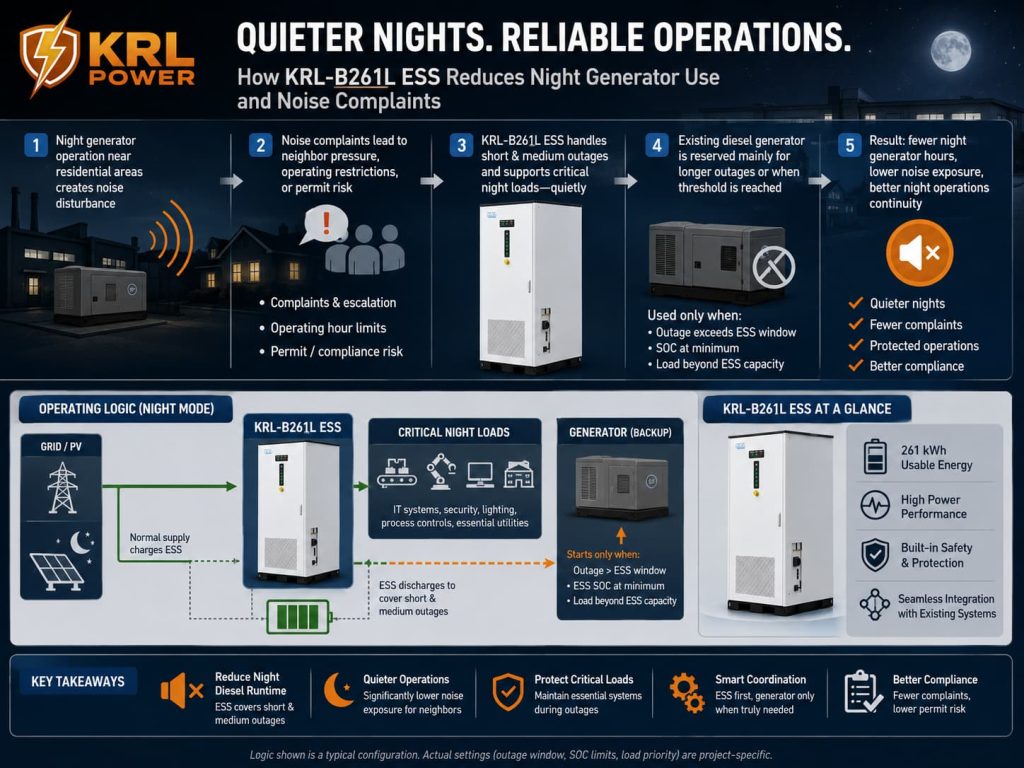
Wanneer sonkrag en berging korrek gekoördineer word, hanteer die ESS die meerderheid van kort- en mediumtermynnetgebeurtenisse. Die dieselgenerator word slegs by langer onderbrekings ingeskakel. Die nagtydse bedryfsure van die generator daal aansienlik, wat beide brandstofkoste en die geraas wat buurteklaagtes ontlok, verminder. Die produksiekontinuïteit word beskerm sonder die deurlopende soniese handtekening van 'n draaiende diesel.
Verder verskyn argitektuurvoorbeelde in die KRL BESS kennisentrum.
Veiligheid en termiese oorwegings
Fabrieke plaas dikwels batterye naby produksieareas of in masjineriekamers met verhoogde temperatuur. Vloeistofafkoeling handhaaf 'n nouer seltemperatuureenvormigheid oor die gepubliseerde bedryfsreeks en ondersteun herhaalde hoë-kragcycli met minder prestasie-afwyking as tipiese luggekoelde ontwerpe.
Vir plekke wat aan hoër ondersoek onderwerp word, is die hibriede vaste-toestand/kwasi-vaste-toestand-opsie beskikbaar deur KRL’s solid-state battery technology kan gekies word as deel van die algehele veiligheidsbeoordeling.
Volledige veiligheidsmodel = Chemie + BMS + Vloeistofafkoeling + Brandbeskerming + Elektriese beskerming + EMS-reserwelogika.
EMS-funksies wat nagskofkontinuïteit beskerm en geraas verminder
- Onmiddellike oorbrugging tydens roostergebeurtenisse
- Gekontroleerde dieselstart en verminderde looptyd
- Spitsvraagbeperking op die netwerkverbinding
- Son-selfverbruiksprioriteit vir produksieladinge
- Konfigureerbare reserve-SOC vir kritieke nagskoflyne
- Gebeurtenislogging vir operasionele en nakomingshersiening
Hierdie beheerfunksies stem ooreen met die benadering wat dwarsdeur beskryf word KRL’s commercial and industrial ESS solutions.
Praktiese beginkonfigurasie
| Komponent | Aanbeveling |
|---|---|
| ESS | 125 kW / 261 kWh vloeistofgekoelde voorgeïntegreerde |
| Battery-opsie | Standaard LFP of hibriede vaste toestand vir terreine met hoër veiligheid |
| Diesel | Bestaande generator word slegs as langdurige rugsteun behou. |
| Sonkrag | Gemaat vir dagtydse laai en prosesseringsvraag |
| Beheer | Intelligente multi-bron EMS |
| Omheining | Buite-gegradeerde of binne-geskikte vloeistofgekoelde kas |
Uitbreiding word bereik deur parallelle kaste by te voeg wanneer die proseslading of outonomievereistes groei. Bykomende projekverwysings verskyn in die KRL Power maatskappyprofiel.
Belangrike inkoopvrae vir fabrieke wat geraasbeperkings in die gesig staar
- Watter bruikbare AC-energie word onder die ooreengekome SOC-venster- en temperatuurtoestande gewaarborg?
- Watter gemeten oordragstyd word bereik vir die kritieke nagskofproduksielading?
- Hoe reageer die stelsel op gelyktydige motorstartopdragte op produksielyne?
- Watter termiese bestuursmetode word gebruik en watter seltemperatuursverskil word onder deurlopende diens gehandhaaf?
- Watter batterychemie en veiligheidstoetsdokumentasie vergesel die kwotasie?
- Kan die stelsel met die bestaande dieselgenerator koördineer sonder handmatige ingryping?
- Wie dra alleenverantwoordelikheid vir stelselvlakprestasie en waarborg?
- Watter fabriekstoetse en terrein-aanvaardingkriteria is ingesluit?
Hierdie vrae weerspieël die ingenieursnorm wat deur die span by KRL Krag.
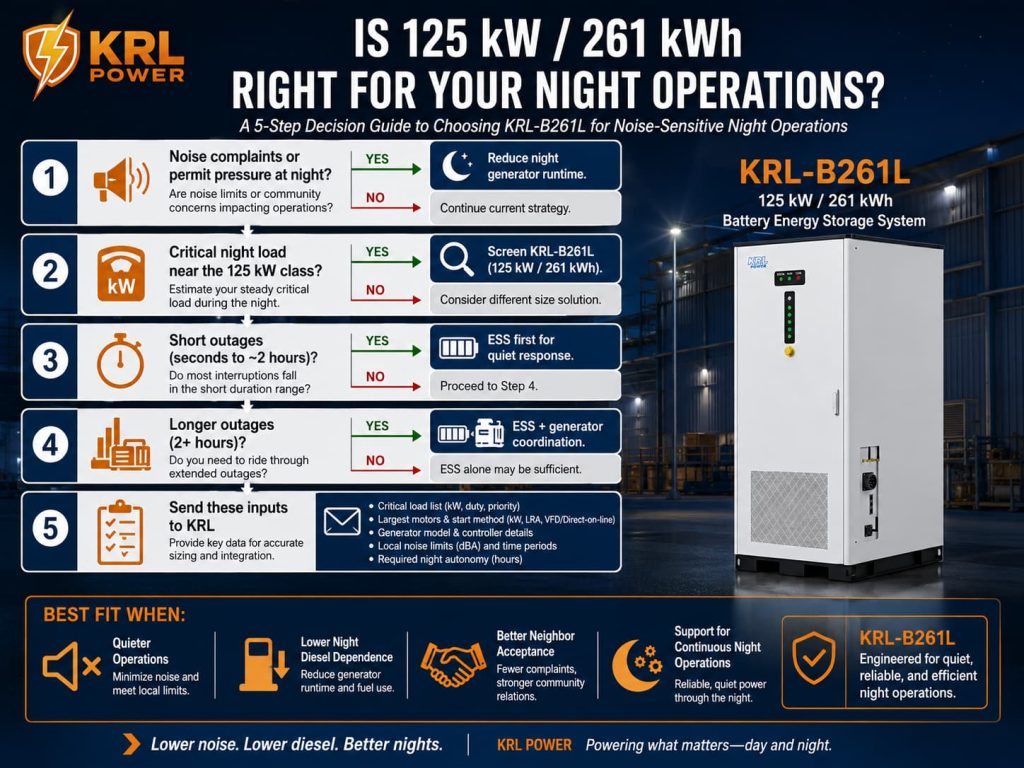
Besluitraamwerk: Toewysing van stelsel aan geraas- en kontinuïteitsrisiko
| Toestand van die terrein | Voorkeurpad | Gevolg van wanpassing |
|---|---|---|
| Frequent short night outages, moderate continuous load (80–120 kW) | 125 kW / 261 kWh vloeistofgekoel | Generator bly snags aan die gang, klagtes bly voortduur |
| Groter multiline-nagbedrywighede of toekomstige uitbreiding | Begin met 125 kW / 261 kWh + beplan parallelle kaste | Duursame herontwerp later |
| Bestaande geraasklagtes of beperkings op bedryfsure | ESS + dieselhibriede beheer + sonkrag | Voortgesette buurkonflik en moontlike verdere beperkings |
| Binnenshuise plasing of hoër veiligheidsondersoek | Hibriede vaste-toestand-opsie | Versekering- of veiligheidsbeoordelingsvertragings |
| Oordag-sonpotensiaal beskikbaar | PV + ESS koördinering | Onderbemiddelde sonenergie en voortgesette hoë naglike dieselverbruik |
Eindaanbeveling
Vir die meeste mediumgrootte fabrieke wat tans beperk word deur klagtes oor generatorgeraas, bied 'n 125 kW/261 kWh vloeistofgekoelde, vooraf geïntegreerde ESS 'n praktiese manier om nagskofte aan die gang te hou terwyl die diesel die meeste van die tyd stilbly. Groter terreine moet dit beskou as die eerste modulêre blok en beplan parallelle uitbreiding op grond van die gemeete las.
Wanneer die battery naby produksieareas geplaas sal word of die veiligheidsbeoordeling groot gewig heg aan termiese gedrag, sluit die hibriede vaste-toestandselopsie in die evaluering in.
Dien in die gemeete kritiese nagskofproseslading, besonderhede van bestaande generator, onlangse dieselbedryfsure, beskikbare ruimte vir sonkrag en enige teiken-outonomie. Die ingenieurspan by KRL Krag sal 'n terreinspesifieke argitektuur teruggee wat daarop gemik is om beide geraasblootstelling en generatorlooptyd te verminder.
V&A
Waarom is 'n 125 kW/261 kWh vloeistofgekoelde ESS 'n praktiese beginpunt vir fabrieke wat klagtes oor generatorgeraas ervaar?
Dit verskaf deurlopende krag vir tipiese produksieladinge, bied betekenisvolle brugenergie sodat die diesel langer aflyn bly, en kom as 'n fabrieksgetoetste vloeistofgekoelde pakket wat die risiko van integrasie op die perseel verminder.
Is 125 kW / 261 kWh genoeg vir my nagskoflyne?
For medium-sized factories with continuous process load around 80–120 kW it is a practical starting point. Larger multi-line night operations should treat it as Phase 1 and plan parallel cabinets. Final confirmation still requires review of motor-start sequence and PCS transient capability.
Hoe moet die bruikbare bedryfstyd uit die 261 kWh-naamplaat bereken word?
Trek SOC-vensterlimiete, omskakelingsverliese, bykomstigheidsverbruik, temperatuur-effekte en die vereiste kritiese reserwe af. Deel die resulterende gelewerde wisselstroomenergie deur die beskermde gemiddelde proseslading.
Watter argitektuur word aanbeveel wanneer 'n dieselgenerator reeds op die perseel bestaan?
Hou die diesel slegs as 'n langdurige rugsteun. Gebruik die ESS vir onmiddellike oorbrugging, lasstapondersteuning en verminderde generatorlooptyd onder gecoördineerde EMS-beheer.
Waarom kies vir fabrieksvoor-geïntegreerde konstruksie vir geraasgevoelige terreine?
Oordragprestasie, termiese ontwerp en beheerkoppelvlakke word voor versending gevalideer, wat inbedryfstelling verkort en die waarborgbesit verduidelik.
Wanneer moet die hibriede vaste-toestand-selopsie geprioritiseer word?
Wanneer die battery naby produksieareas geplaas word of die veiligheidsbeoordeling klem lê op termiese gedrag.
Watter lae vorm die volledige veiligheidsargitektuur?
Selmonitering, intelligente BMS, vloeibare verkoeling, geïntegreerde brandbeskerming, beoordeelde omhulsel, en EMS-bestuurde reserwe- en afskakelingslogika.
Hoe help vloeibare verkoeling onder voortdurende, swaarbelaste nagskoftoestande?
Dit handhaaf 'n nouer seltemperatuur-eenvormigheid oor die gepubliseerde bedryfsreeks en ondersteun herhaalde hoë-krag-siklusse met minder prestasie-afname as tipiese luggekoelde ontwerpe.
Watter EMS-funksies verminder direk generatorgeraas en beskerm die beskikbaarheid van die nagskof?
Onmiddellike oorbrugging, beheerde dieselstart, piekvraagbeperking, sonprioriteit vir produksielading, konfigureerbare kritieke reserwe en gebeurtenislogging.
Watter minimumdata word benodig vir 'n betroubare geraasverminderingvoorstel?
Gemeten kritieke nagskof-prosessladingsprofiel, bestaande generatorgradering en startgedrag, onlangse dieselbedryfsure, beskikbare ruimte vir sonkrag en vereiste outonomie- of reserwebeleid.
Is die 125 kW/261 kWh vloeistofgekoelde platform geskik vir Afrika-fabrieke wat geraasbeperkings op generatoren in die gesig staar?
Ja. Die krag- en energiegraderinge, vloeistofafkoeling en diesel-hibriede vermoë stem ooreen met die deurlopende prosesbelasting en afsluitingspatrone wat gewoonlik by hierdie terreine voorkom.
Watter plaaslike toestande beïnvloed die ESS-spesifikasie vir geraasgevoelige fabrieke die meeste?
Frequent kort nagonderbrekings, hoë deurlopende motorbelasting, nabyheid aan residensiële gebiede en bestaande generatorinfrastruktuur.
Hoe kan 'n fabriek 'n terreinspesifieke voorstel vir geraasvermindering van 125 kW / 261 kWh versoek?
Dien kritieke nagskof-prosessladingdata, generatorbesonderhede, dieselbedryfsure en enige sonmikdoelwit in via die KRL Power-kontakkanaal. Die ingenieurspan lewer 'n op maat gemaakte argitektuur wat daarop gemik is om beide geraasblootstelling en generatorbedryfstyd te verminder.
Wat is die naamplaatkrag- en energiewaardes van die aanbevole vooraf-geïntegreerde ESS?
125 kW deurlopende AC-uitset en 261 kWh beoordeelde energie in 'n fabrieksgeassembleerde vloeistofgekoelde kas.
Watter hoër-veiligheidselchemie word as 'n opsionele opgradering aangebied?
Hibriede vaste-toestand / kwasi-vaste-toestand selle.
Watter bedryfsmodusse word inheems deur die aanbevole argitektuur ondersteun?
Roostergekoppelde piekvermindering, onmiddellike oorbrugging by roosteronderbreking, diesel-hibriede ondersteuning, prioriteit vir son-eigenverbruik en konfigureerbare kritieke-lasreserwe onder 'n enkele EMS.
