1. Customer Background: EV Charging Infrastructure Challenge in Nigeria
Based on the project requirement from Nigeria, the customer is developing a commercial EV charging station and requires a reliable energy supply solution.
The project requirement includes:
The project requirement includes:
- Commercial EV charging application
- Solar integration possibility
- Local power supply uncertainty
- Energy storage system configuration
- Potential diesel generator backup
- Long-term charging operation stability
For EV charging operators, the biggest challenge is not only installing chargers.
The real challenge is:
The real challenge is:
How to guarantee charging availability while controlling electricity cost and protecting investment return?
Customer Pain Points Analysis
1. Grid Reliability Challenge
Many commercial areas in Nigeria experience:
- Grid instability
- Voltage fluctuation
- Unexpected outages
- Limited available power capacity
For EV charging stations, a sudden power interruption means:
- Charging interruption
- Customer complaints
- Revenue loss
- Reduced station utilization
2. High Peak Demand Cost
EV charging creates concentrated power demand.
Without energy storage:
Without energy storage:
- Charging load directly impacts grid demand
- Electricity cost increases during peak periods
- Additional grid expansion may be required
3. Renewable Energy Integration Difficulty
Many charging operators want to combine:
- Solar PV
- Battery storage
- Grid power
- Diesel backup
However, without an intelligent energy management system, different power sources cannot operate efficiently.
2. KRL Power Recommended Solution
Based on the project requirements,KRL Power recommends:
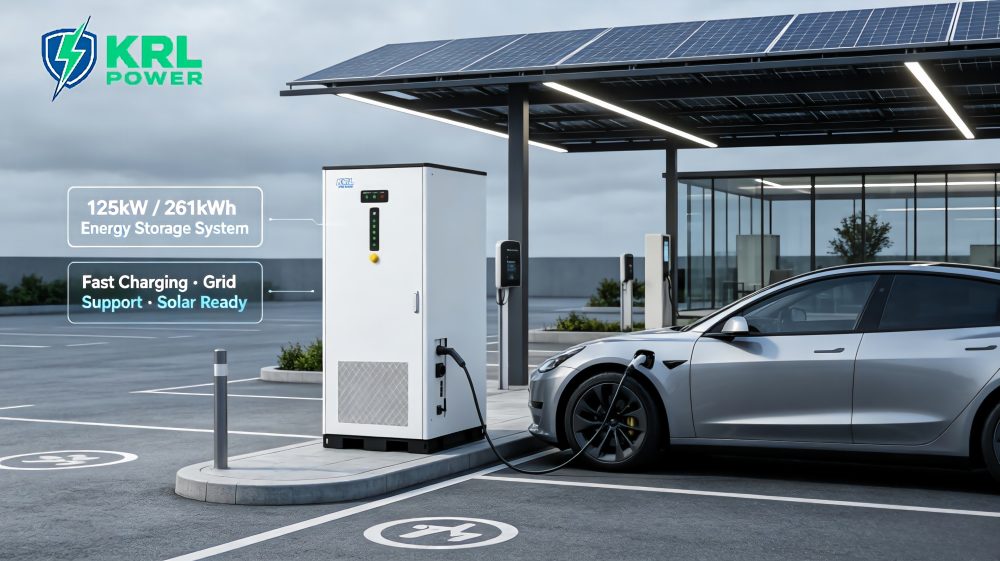
125kW / 261kWh Liquid-Cooled C&I Energy Storage System,
Designed for:
- EV charging stations
- Commercial facilities
- Industrial applications
- Solar + storage microgrids
3. System Architecture: Solar + ESS + EV Charging + Optional Diesel Backup
Nigeria EV Charging Station Microgrid Architecture
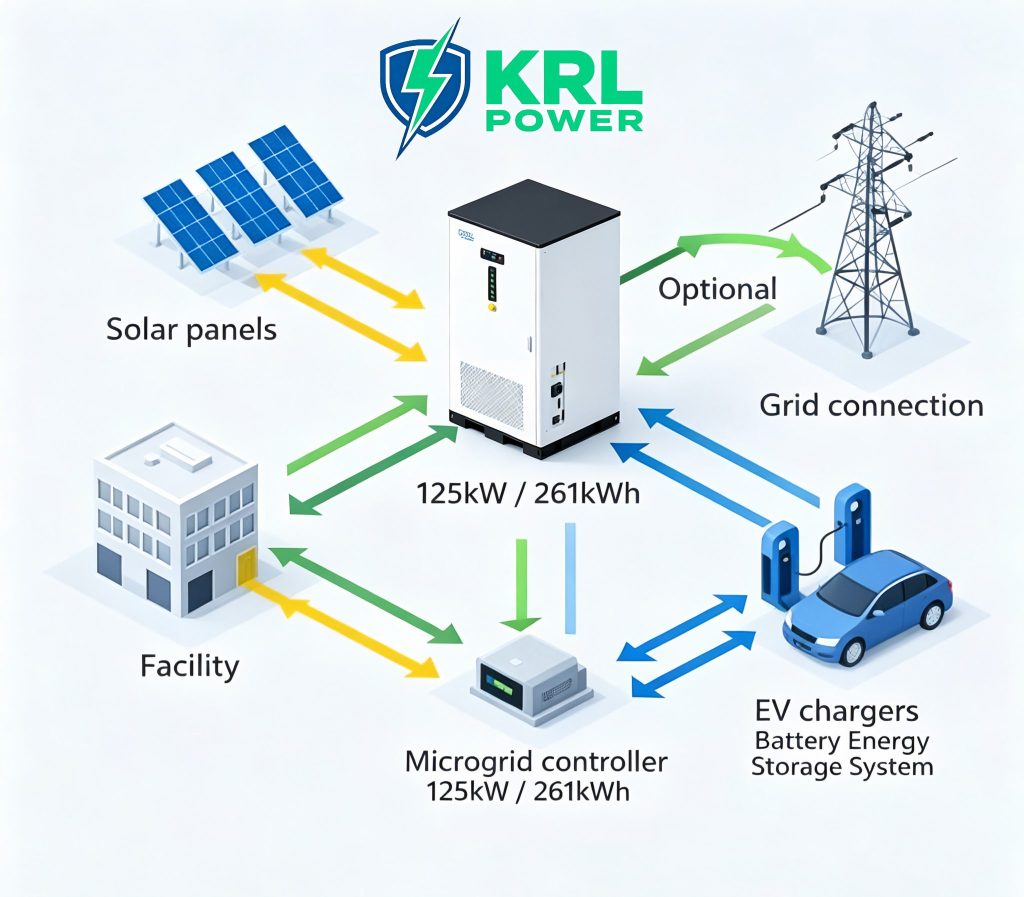
System Components:Solar PV System
Provides:
- Renewable electricity generation
- Daytime charging support
- Reduced grid consumption
KRL 125kW/261kWh Liquid-Cooled ESS
Core functions:
- Energy buffering
- Peak shaving
- Charging load balancing
- Backup power support
EV Chargers
ESS supports:
- Fast charging load stabilization
- Multiple charger operation
- Demand management
Optional Diesel Generator
For areas with unstable grid:
- Emergency backup
- Extended outage support
- Hybrid microgrid operation
4. Why 261kWh ESS is Suitable for Commercial EV Charging Stations
1. Reduce Grid Impact
During high charging demand:
ESS provides additional power output.
Benefits:
ESS provides additional power output.
Benefits:
- Avoid grid overload
- Reduce peak demand pressure
- Improve charging availability
2. Increase Solar Utilization
Solar energy can be:
Daytime:
PV → EV Charging + Battery Charging
Night:
Battery → EV Charging
This improves renewable energy utilization.
3. Improve Charging Reliability
The ESS acts as an energy buffer:
Grid interruption:
Battery instantly supports charging loads
Continuous charging service
5. KRL C&I ESS Technical Advantages
Liquid Cooling Thermal Management
Compared with traditional air cooling:
Advantages:
- Better temperature uniformity
- Improved battery lifetime
- Stable operation in hot climates
Suitable for Nigeria's high-temperature environment.
Intelligent BMS Protection
KRL ESS integrates:
- Cell monitoring
- Temperature protection
- Voltage protection
- Fault diagnosis
Self-developed EMS Energy Optimization
The EMS enables:
Peak Shaving
Reduce expensive peak electricity consumption.
Smart Dispatch
Automatically manages:
- PV
- Battery
- Grid
- Diesel
Remote Monitoring
Operators can monitor:
- SOC
- Charging status
- System alarms
- Energy performance
6. Recommended Configuration for Nigeria EV Charging Station
Option 1: Standard Commercial Charging Station
Recommended:
- ESS:
125kW / 261kWh - PV:
100–200kWp - EV Charger:
According to charging demand - Grid:
Existing supply
Suitable for:
- Shopping centers
- Commercial parking areas
- Fleet charging
Option 2: Hybrid Charging Microgrid
Configuration:
- PV
- 261kWh ESS
- Diesel generator
- EMS controller
Suitable for:
- Remote charging stations
- Logistics fleet charging
- Weak-grid locations
7. Why Choose KRL Power ESS?
Proven C&I Energy Storage Expertise
KRL Power is one of the emerging high-performance energy storage companies in China, focusing on commercial and industrial ESS solutions.
The company has gained recognition through:
The company has gained recognition through:
- Energy storage technology innovation
- Global market expansion
- High-quality ESS manufacturing capability
KRL Core Advantages: Extreme Safety Architecture
Including:
- High-quality LiFePO4 battery cells
- Intelligent BMS
- Liquid cooling system
- Multi-layer fire protection
Cost Optimization Capability
Powered by KRL EMS:
- Peak shaving
- Valley filling
- Dynamic energy scheduling
- ROI optimization
Integrated Smart Design
All-in-One architecture:
- Battery system
- PCS
- EMS
- Thermal management
Supporting:
- Faster installation
- Easier maintenance
- Flexible expansion
8. Installation Considerations for Nigeria
Before deployment, KRL recommends evaluating:
Environmental Conditions
Including:
- Temperature range
- Humidity
- Dust protection
- Installation location
Electrical Compatibility
Confirm:
- Grid voltage
- Frequency
- EV charger capacity
- Communication protocol
Future Expansion
Modular ESS design allows:
261kWh
522kWh
1MWh+
expansion according to charging demand growth.
9. Project Implementation Process
Step 1
Charging load analysis
Step 2
PV and ESS capacity calculation
Step 3
Electrical system design
Step 4
Factory configuration testing
Step 5
Installation and commissioning
Step 6
EMS optimization
FAQ
Q1: Why does an EV charging station need an ESS?
An ESS reduces grid pressure, supports peak charging demand, improves charging reliability and enables solar energy utilization.
Q2: Is 261kWh enough for a commercial EV charging station?
For small and medium commercial charging stations, 261kWh is an effective starting configuration. Larger stations can expand through modular ESS deployment.
Q3: Can KRL ESS work with solar PV?
Yes. KRL C&I ESS supports PV integration and intelligent energy management.
Q4: Does the system require a diesel generator?
Not always. Diesel is optional and mainly recommended for areas with unstable grid conditions.
Q5: Can the ESS operate in hot climates like Nigeria?
Yes. The liquid-cooled thermal management design improves reliability in high-temperature environments.
Q6: How long is the battery lifetime?
KRL ESS uses long-life lithium battery technology designed for frequent commercial cycling applications.
Conclusion
Nigeria's EV charging market requires more than charging equipment.
A successful charging business needs:
A successful charging business needs:
- Reliable electricity supply
- Lower operating cost
- Renewable energy integration
- Intelligent energy management
KRL Power's 125kW/261kWh liquid-cooled C&I ESS solution provides a complete energy platform for commercial EV charging stations.
By integrating:
Solar + Battery Storage + EMS + Optional Diesel Backup
KRL helps charging operators build a more reliable, efficient and scalable energy infrastructure for the future of electric mobility in Nigeria.