1. Customer Background: EV Charging Infrastructure Challenge in Nigeria
The project requirement includes:
- Commercial EV charging application
- Solar integration possibility
- Local power supply uncertainty
- Energy storage system configuration
- Potential diesel generator backup
- Long-term charging operation stability
The real challenge is:
1. Grid Reliability Challenge
- Instabilité du réseau
- Voltage fluctuation
- Unexpected outages
- Limited available power capacity
- Charging interruption
- Customer complaints
- Perte de chiffre d'affaires
- Reduced station utilization
2. High Peak Demand Cost
Sans stockage d'énergie :
- Charging load directly impacts grid demand
- Electricity cost increases during peak periods
- Additional grid expansion may be required
3. Renewable Energy Integration Difficulty
- Énergie solaire photovoltaïque
- Stockage par batterie
- Électricité du réseau
- Diesel backup
2. KRL Power Recommended Solution
- Bornes de recharge pour véhicules électriques
- Établissements commerciaux
- Applications industrielles
- Solar + storage microgrids
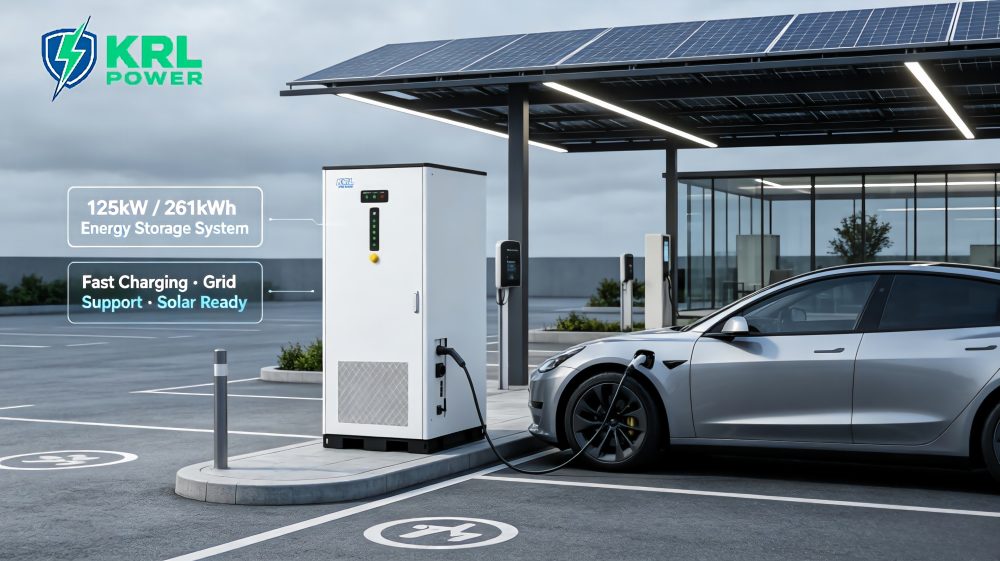
3. System Architecture: Solar + ESS + EV Charging + Optional Diesel Backup
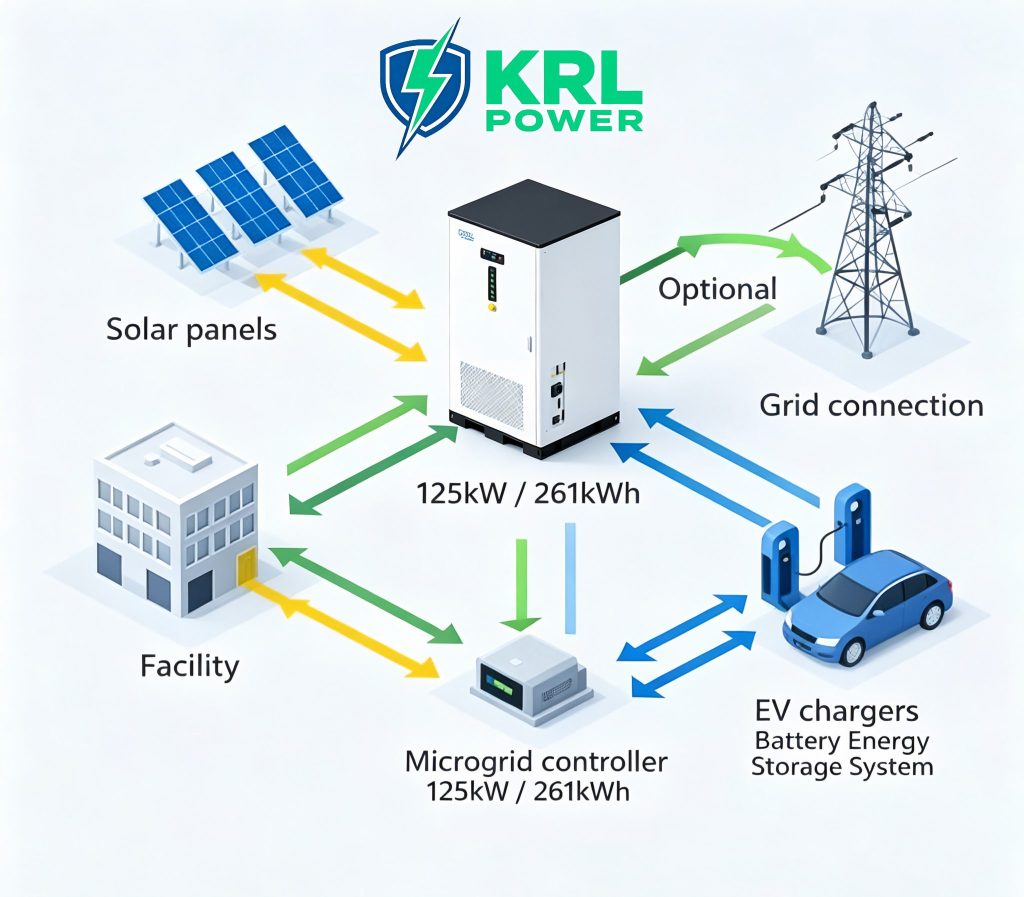
System Components:Solar PV System
- Renewable electricity generation
- Daytime charging support
- Reduced grid consumption
KRL 125kW/261kWh Liquid-Cooled ESS
- Energy buffering
- Égalisation de la charge
- Charging load balancing
- Backup power support
EV Chargers
- Fast charging load stabilization
- Multiple charger operation
- Gestion de la demande
Optional Diesel Generator
- Emergency backup
- Extended outage support
- Hybrid microgrid operation
4. Why 261kWh ESS is Suitable for Commercial EV Charging Stations
1. Reduce Grid Impact
ESS provides additional power output.
Avantages :
- Avoid grid overload
- Reduce peak demand pressure
- Improve charging availability
2. Increase Solar Utilization
Solar energy can be:
En journée :
PV → EV Charging + Battery Charging
Nuit :
Battery → EV Charging
This improves renewable energy utilization.
3. Improve Charging Reliability
The ESS acts as an energy buffer:
Grid interruption:
Battery instantly supports charging loads
Continuous charging service
5. KRL C&I ESS Technical Advantages
Gestion thermique par refroidissement liquide
- Better temperature uniformity
- Amélioration de l'autonomie de la batterie
- Stable operation in hot climates
Protection intelligente du système de gestion de batterie (BMS)
- Surveillance cellulaire
- Temperature protection
- Voltage protection
- Diagnostic des pannes
Self-developed EMS Energy Optimization
The EMS enables:
Réduction des pics de consommation
Reduce expensive peak electricity consumption.
Smart Dispatch
Automatically manages:
- PV
- Batterie
- Grid
- Diesel
Surveillance à distance
Operators can monitor:
- SOC
- Charging status
- System alarms
- Performance énergétique
6. Recommended Configuration for Nigeria EV Charging Station
Option 1: Standard Commercial Charging Station
Recommandé :
- ESS:
125kW / 261kWh - PV:
100–200kWp - EV Charger:
According to charging demand - Grid:
Existing supply
Convient pour :
- Shopping centers
- Commercial parking areas
- Fleet charging
Option 2: Hybrid Charging Microgrid
- PV
- Système de stockage d'énergie (ESS) de 261 kWh
- Générateur diesel
- EMS controller
- Remote charging stations
- Logistics fleet charging
- Weak-grid locations
7. Why Choose KRL Power ESS?
Proven C&I Energy Storage Expertise
The company has gained recognition through:
- Energy storage technology innovation
- Global market expansion
- High-quality ESS manufacturing capability
KRL Core Advantages: Extreme Safety Architecture
- Cellules de batterie LiFePO4 de haute qualité
- Système de gestion de batterie intelligent (BMS)
- Système de refroidissement par liquide
- Protection incendie multicouche
Cost Optimization Capability
- Égalisation de la charge
- Remblayage de la vallée
- Dynamic energy scheduling
- ROI optimization
Conception intelligente intégrée
- Système de batterie
- PCS
- EMS
- Gestion thermique
- Installation plus rapide
- Un entretien plus facile
- Extension flexible
8. Installation Considerations for Nigeria
Environmental Conditions
- Temperature range
- Humidité
- Dust protection
- Installation location
Electrical Compatibility
- Grid voltage
- Fréquence
- EV charger capacity
- Communication protocol
Développement futur
Modular ESS design allows:
261 kWh
522 kWh
1 MWh et plus
expansion according to charging demand growth.
9. Project Implementation Process
Step 1
Charging load analysis
Step 2
PV and ESS capacity calculation
Step 3
Electrical system design
Step 4
Factory configuration testing
Step 5
Installation and commissioning
Step 6
Optimisation des services médicaux d'urgence
FAQ
Q1: Why does an EV charging station need an ESS?
Q2: Is 261kWh enough for a commercial EV charging station?
Q3: Can KRL ESS work with solar PV?
Q4: Does the system require a diesel generator?
Q5: Can the ESS operate in hot climates like Nigeria?
Q6: How long is the battery lifetime?
Conclusion
A successful charging business needs:
- Reliable electricity supply
- Lower operating cost
- Intégration des énergies renouvelables
- Gestion intelligente de l'énergie