

A South African hospital has asked for an outdoor commercial and industrial energy storage system that can work with its existing photovoltaic array and distribution equipment. The proposed procurement is deliberately phased: install 261 kWh first, then expand the site to approximately 1 MWh. The customer also requires an integrated power conversion system, LiFePO4 batteries, an EXW quotation and defined battery and PCS warranty terms.
This is not simply a request for a larger battery. It is a microgrid integration project in which solar generation, battery storage, the grid, the existing diesel generator and hospital load priorities must follow one approved control and protection philosophy.
For this application, KRL Power's KRL-B261L 125 kW / 261 kWh is the proposed building block. It combines the LiFePO4 battery, 125 kW bidirectional PCS, 120 kW PV MPPT, EMS/BMS functions and generator interface in one outdoor cabinet. That integrated architecture removes the need to specify a separate external PCS or PV inverter for the proposed direct-DC PV connection, subject to confirmation of the existing PV string data.
The enquiry translated into engineering decisions
The buyer's requirements can be converted into a clear design and quotation checklist.
Why the KRL-B261L is a solar-storage-diesel all-in-one system
The KRL-B261L is not a battery cabinet that depends on a separately selected inverter. Its public model specification integrates the functions needed for a compact C&I microgrid building block.
| Published item | KRL-B261L value | Relevance to this project |
|---|---|---|
| Battery chemistry | LiFePO4 | Established chemistry for stationary C&I storage |
| Rated energy | 261 kWh | Matches the requested first procurement stage |
| On-grid / off-grid AC power | 125 kW / 125 kW | Defines cabinet power, separate from its energy capacity |
| Integrated PV input | Up to 120 kW | Allows compatible PV strings to feed the cabinet’s MPPT directly |
| MPPT range | 250-850 Vdc | Must be checked against the existing PV string design |
| Maximum PV voltage | 950 Vdc | A hard design boundary requiring cold-condition Voc review |
| Diesel generator port | Yes | Supports coordinated solar-storage-diesel operation |
| Switching time | Less than 10 ms, published value | Must be validated at the project interface; it is not a blanket medical UPS guarantee |
| Battery enclosure | IP65 | Relevant to an outdoor installation, subject to complete site design |
| Battery cooling | Liquid cooling | The correct cooling description for this model |
| Public parallel quantity | Up to 10 units | Four-unit expansion remains subject to project engineering approval |
The proposed architecture therefore connects compatible PV strings to the cabinet's integrated MPPT, connects the cabinet's bidirectional PCS to the hospital AC bus, and coordinates the diesel generator through the designated generator interface. The EMS/BMS then manages energy flows according to the approved priorities.
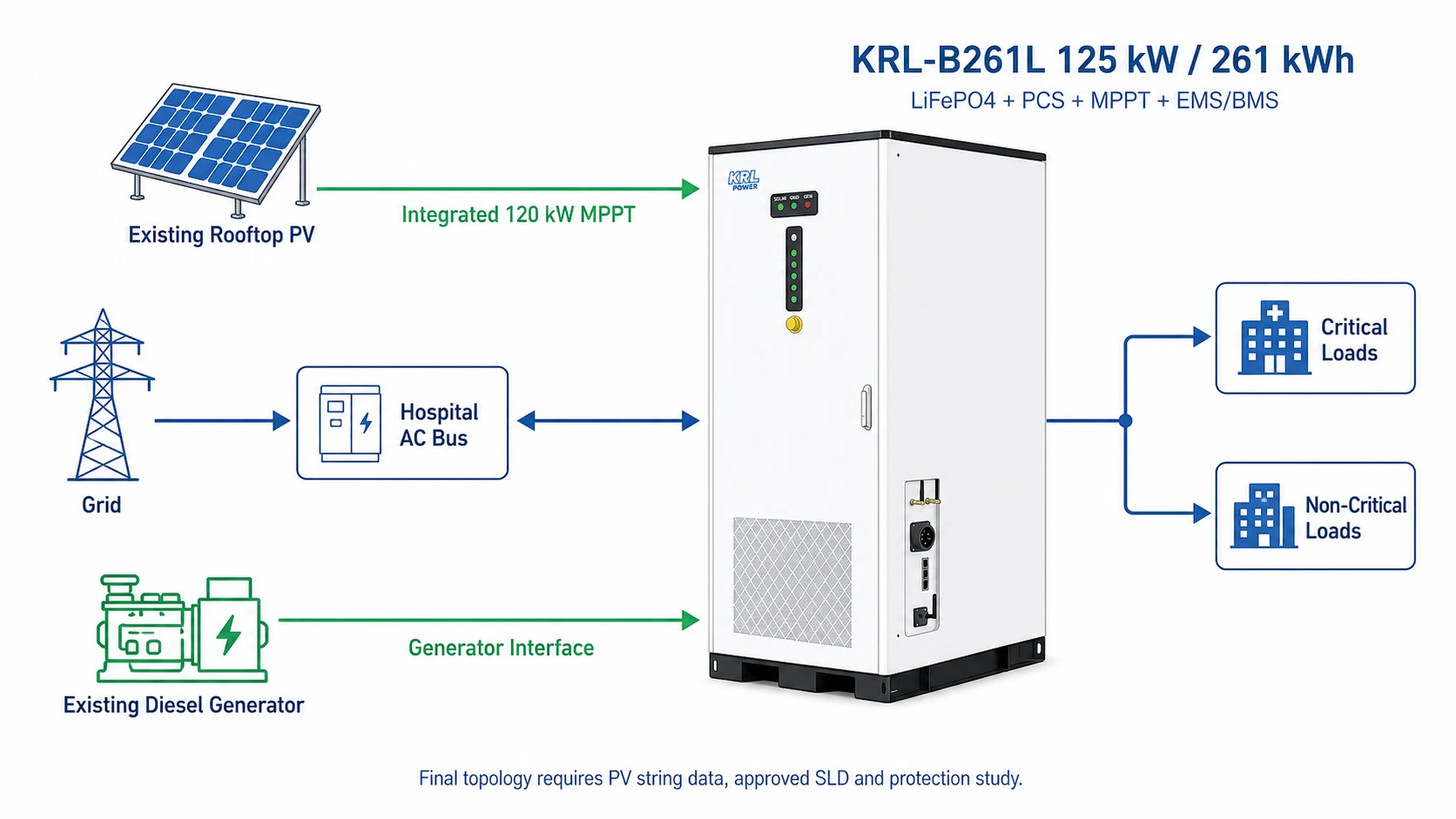
The final single-line diagram must still define breakers, isolators, earthing, metering, anti-islanding, changeover logic, generator controls, cable ratings, fault levels and protection coordination. If the existing solar installation already uses AC PV inverters, the project engineer must decide whether those inverters remain on the AC bus or whether selected PV strings are migrated to the KRL-B261L MPPT. Existing hardware should not be rewired until its electrical compatibility and warranty implications have been reviewed.
Phase 1: install one 125 kW / 261 kWh cabinet
The first procurement phase uses one KRL-B261L. Its nominal ratings are 125 kW of AC power and 261 kWh of battery energy. Those two values answer different questions:
- 125 kW is the cabinet's continuous rated on-grid/off-grid AC power published for the model.
- 261 kWh is its nominal stored energy.
- Backup duration depends on the protected load, usable state-of-charge window, conversion losses, auxiliary consumption, temperature, degradation allowance and required reserve.
A preliminary planning expression is:
For example, dividing nominal energy by a load would overstate the contractual result because nominal battery energy is not the same as guaranteed usable AC energy at the hospital bus. KRL Power should receive the critical-load curve before any runtime is stated in a proposal.
The hospital should also separate loads by continuity requirement. Existing medical UPS equipment should remain responsible for loads that cannot tolerate any interruption unless the approved electrical design explicitly changes that responsibility. The BESS can support an essential-load bus, solar self-consumption, generator coordination and controlled backup, but a published transfer time alone does not certify every connected medical load.
Phase 2: expand to approximately 1 MWh
The customer has now confirmed that the final target is 1 MWh of energy, not 1 MW of power. With the same cabinet model, the practical nominal total is four cabinets:
- Four cabinets x 261 kWh = 1,044 kWh, or 1.044 MWh nominal energy.
- Four cabinets x 125 kW = 500 kW nominal AC power.
- The final four-cabinet count includes the first cabinet, so phase two adds three cabinets.
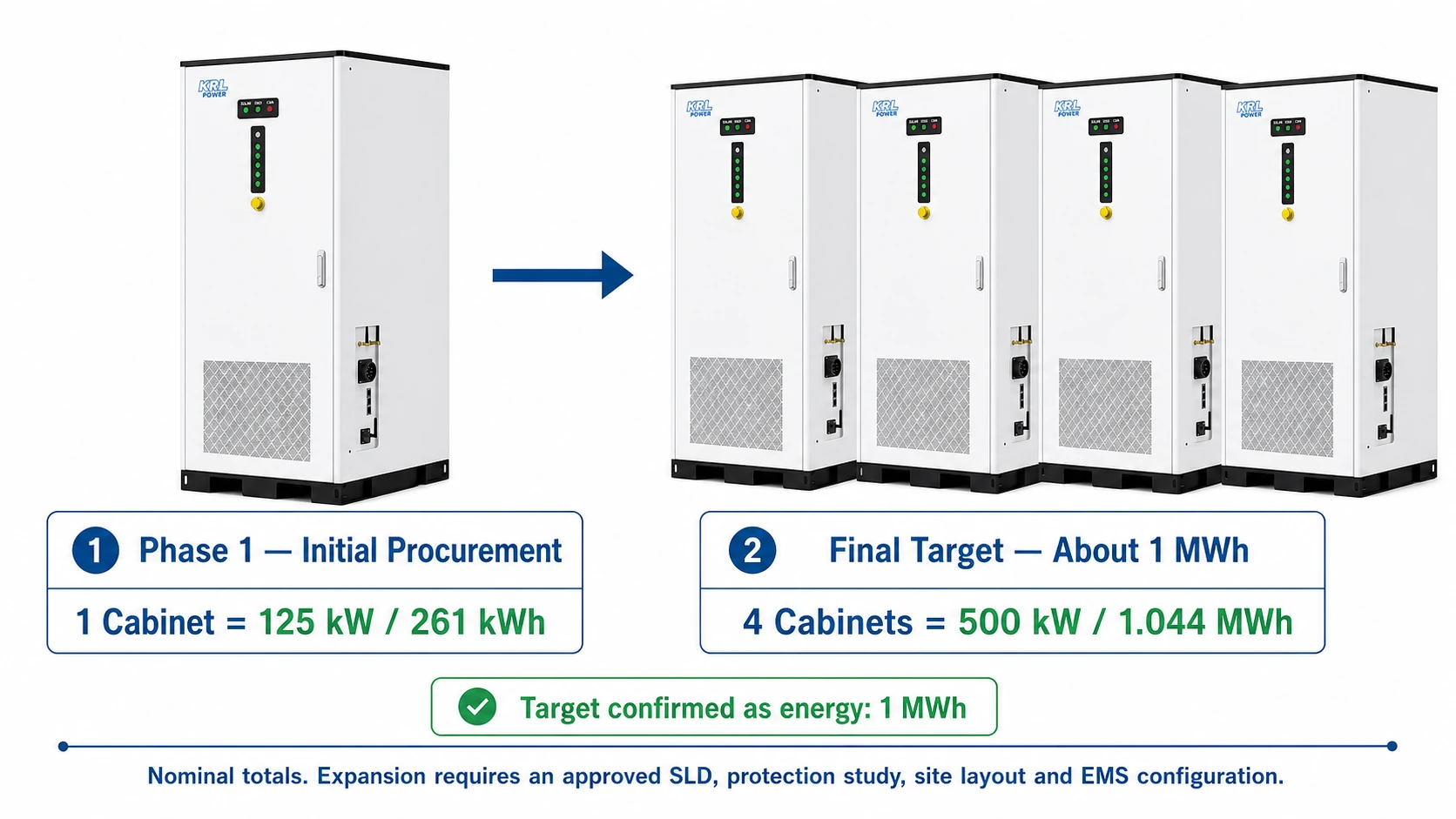
The expansion design should be established during phase one. Reserve switchboard ways, cable routes, communication addressing, equipment pads, access clearances, fire separation and EMS capacity before installing the first cabinet. This avoids treating the later three cabinets as an improvised add-on.
The four-cabinet aggregate power of 500 kW may be higher or lower than the hospital's actual protected demand. That is not automatically a problem, but it must be checked against the load profile, transformer, switchgear, generator, export limits and grid-connection agreement. Energy capacity and power capacity should both appear on the approved SLD and procurement schedule.
Existing PV integration: verify the strings before connection
The integrated 120 kW MPPT is a key reason to use the KRL-B261L as a solar-storage-diesel all-in-one unit. It can reduce interfaces and simplify the proposed direct-DC architecture. However, “existing PV” is not enough information for a final connection design.
Amandla e-KRL needs:
- PV module manufacturer, model and datasheet;
- number of modules per string and number of parallel strings;
- string open-circuit voltage at the site's minimum design temperature;
- operating voltage and current under expected conditions;
- total installed PV capacity and present operating topology;
- DC cable, combiner, isolator and surge-protection details;
- existing monitoring and shutdown requirements; and
- installation photos and the current PV single-line diagram.
For each cabinet, the proposed PV connection must remain within the published 250-850 Vdc MPPT range, 950 Vdc maximum PV voltage and 200 A maximum PV input current. These are equipment-selection boundaries, not permission to connect unverified strings.
Why liquid cooling is recommended instead of the requested air cooling
The enquiry mentions air cooling, but the current KRL-B261L battery system is liquid cooled. The proposal should state this openly rather than relabel the product.
Liquid cooling is recommended for this hospital project because it provides more controlled heat transfer across the battery system and is well suited to an outdoor C&I cabinet. KRL Power's public page states that the liquid-cooling design is intended to limit battery temperature difference; the actual project performance still depends on ambient conditions, loading, maintenance and the final configuration.
The PCS uses its own intelligent cooling arrangement, while the battery thermal-management system is liquid based. Site maintenance planning must therefore include coolant-system inspection, alarms, service access and the manufacturer's maintenance instructions. If air cooling is a mandatory tender condition rather than a preference, KRL Power must review a different product instead of claiming that KRL-B261L is air cooled.
Diesel generator, grid and hospital load coordination
A hospital microgrid needs an agreed operating sequence, not only connected equipment. The control narrative should define at least the following modes:
- Normal grid operation: PV serves loads and/or charges the battery according to the EMS schedule.
- Grid disturbance or outage: approved loads transfer according to the protection and control design, while no-break loads remain covered by their dedicated UPS architecture.
- Battery support: the BESS supplies the designated bus within its power, energy and reserve limits.
- Generator start and synchronization: the controller starts or accepts the existing diesel generator according to the approved sequence.
- Generator-supported charging: charging power is limited so that hospital loads and generator operating limits remain protected.
- Return to grid: sources transfer back in a controlled sequence, with alarms and event records retained.
Load shedding should distinguish critical, conditional and non-critical circuits. A low state of charge, generator failure, communication loss or cabinet alarm must lead to a defined fallback state. Manual override authority and emergency-stop functions should also be documented.
Outdoor installation and hospital-specific due diligence
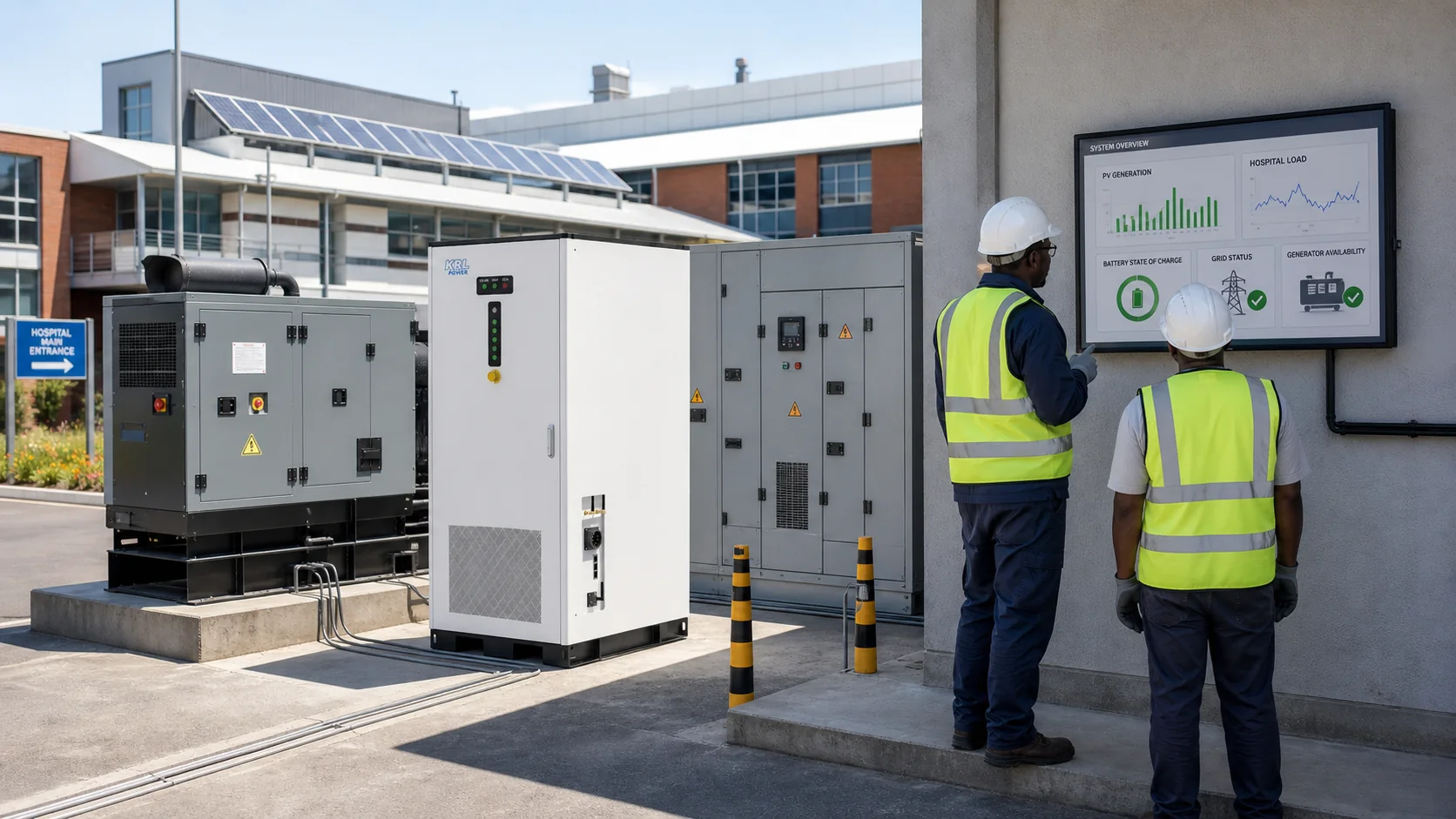
An IP65 battery enclosure does not replace site engineering. The proposed area must be checked for drainage, flood level, direct solar exposure, ventilation, equipment spacing, impact protection, security, noise, cable entry, lifting access and emergency response. The approximate published cabinet dimensions are 980 x 1,300 x 2,320 mm and the approximate weight is 2,600 kg, so the foundation and lifting plan require civil and logistics review.
Before order release, the project team should agree the applicable South African electrical, fire, environmental, occupational-safety and grid-connection requirements. Required certificates must be checked against the exact supplied model and configuration. A factory acceptance test, site acceptance test, commissioning plan, protection test and operator training scope should be included in the commercial package.
EXW price and warranty requirements
The customer requests a complete EXW price, a five-year battery warranty and a three-year PCS warranty. These should be recorded as quotation requirements, not presented as accepted contractual commitments before review.
The final EXW quotation should identify:
- cabinet quantity by phase;
- included PCS, MPPT, EMS/BMS, generator interface, fire-protection and cooling scope;
- parallel-control and communication equipment;
- optional switchgear, transformer, cabling, commissioning and spare parts;
- packaging and dangerous-goods documentation;
- named EXW collection location and quotation validity;
- exclusions, taxes, freight, insurance and destination services; and
- payment, production and acceptance milestones.
The warranty schedule should confirm the covered equipment, start date, duration, operating limits, throughput or cycle conditions, required maintenance, data-recording obligations, exclusions, remedy, labour, travel and freight responsibility. The requested five-year battery and three-year PCS periods must appear in the signed quotation or contract before they are treated as binding.
Information needed for a project-specific proposal
To convert this concept into a technical and commercial offer, send KRL Power:
- at least 7-30 days of interval load data;
- critical-load, conditional-load and non-critical-load schedules in kW;
- required backup duration and reserve philosophy;
- existing PV module/string data and PV SLD;
- hospital main SLD and distribution voltages;
- transformer rating, impedance and available fault data;
- generator rating, controller model and operating sequence;
- existing UPS ratings and the loads they protect;
- site temperature, altitude, photos, layout and installation constraints;
- required grid code, certificates and acceptance tests;
- confirmation that the final target is 1 MWh; and
- requested Incoterm and named EXW collection point.
With those inputs, KRL Power can confirm whether one KRL-B261L is appropriate for phase one, define the four-cabinet 1.044 MWh expansion architecture and issue a traceable quotation.
Imibuzo Ebuzwa Rhoqo
Does a 261 kWh cabinet guarantee a specific hospital backup time?
Is the final target 1 MW or 1 MWh?
Does the KRL-B261L require a separate PV inverter or PCS?
Is the KRL-B261L air cooled?
Can the system replace the hospital existing UPS?
Request a phased 1 MWh hospital microgrid proposal
KRL Power can review the hospital's load curve, PV string data, SLD, generator controls and site constraints, then prepare a phase-one 261 kWh proposal and a planned expansion to 1.044 MWh.
Send the project information to KRL Power and request a technical review plus a complete EXW quotation with the required warranty schedule.