
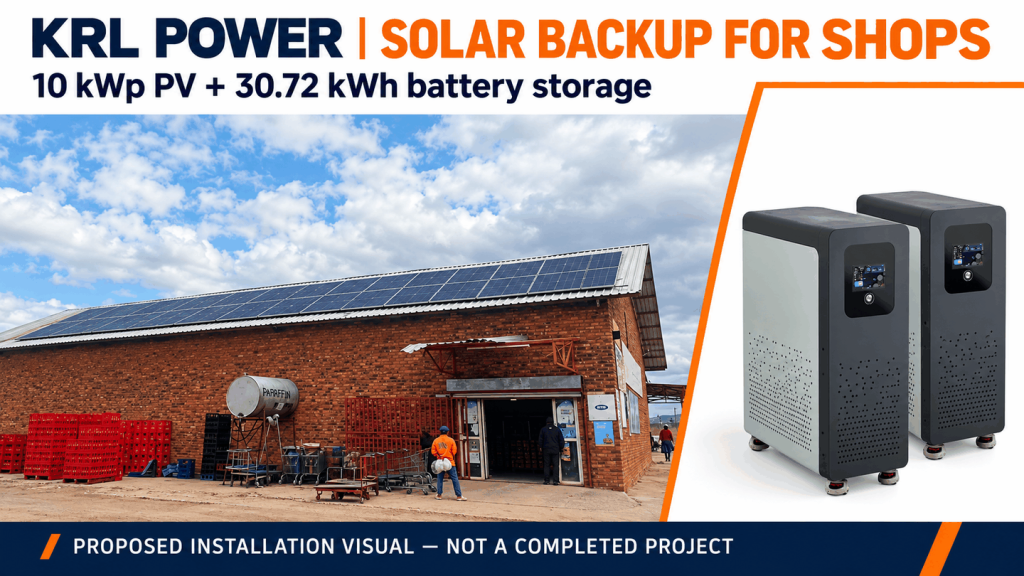
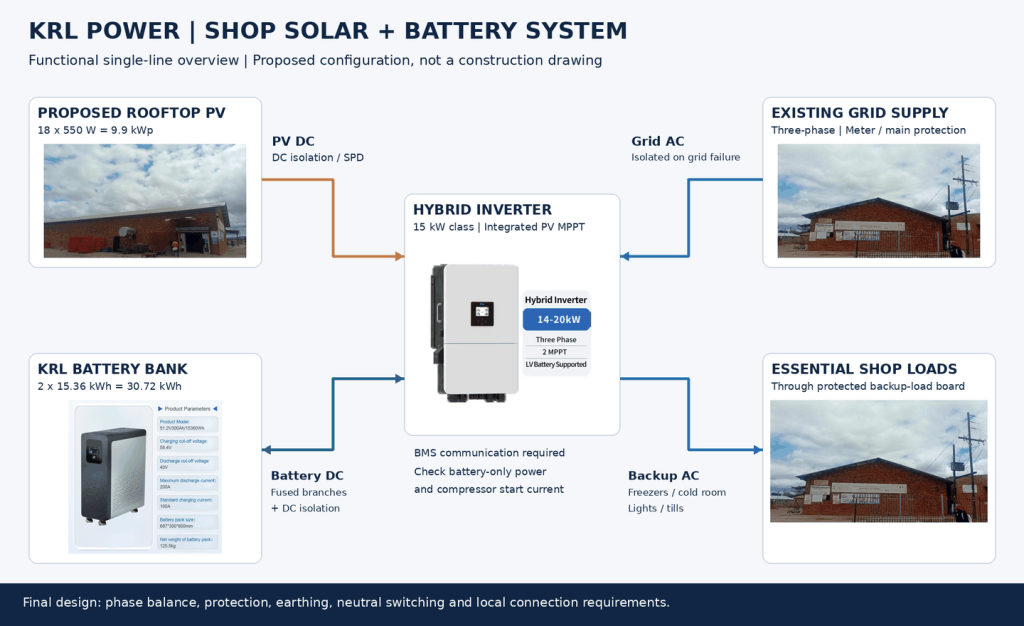
For this enquiry, KRL proposes a 15 kW-class three-phase hybrid inverter, two KRL 15.36 kWh residential batteries and approximately 10 kWp of rooftop solar as a starting configuration. The battery bank totals 30.72 kWh nominal. Final inverter selection depends on measured compressor starting current, phase loading and battery-only output capability.
This is an engineering proposal based on customer information and site photographs. It is not a completed installation or a guaranteed performance case study.
The Customer’s Priority: Protect Refrigerated Stock at an Affordable Cost
The customer operates a South African wholesale shop with a three-phase electricity supply. Reported monthly electricity bills range from ZAR 5,000 to ZAR 10,000. There is no existing solar installation, and the customer reports no ordinary comfort air conditioning.
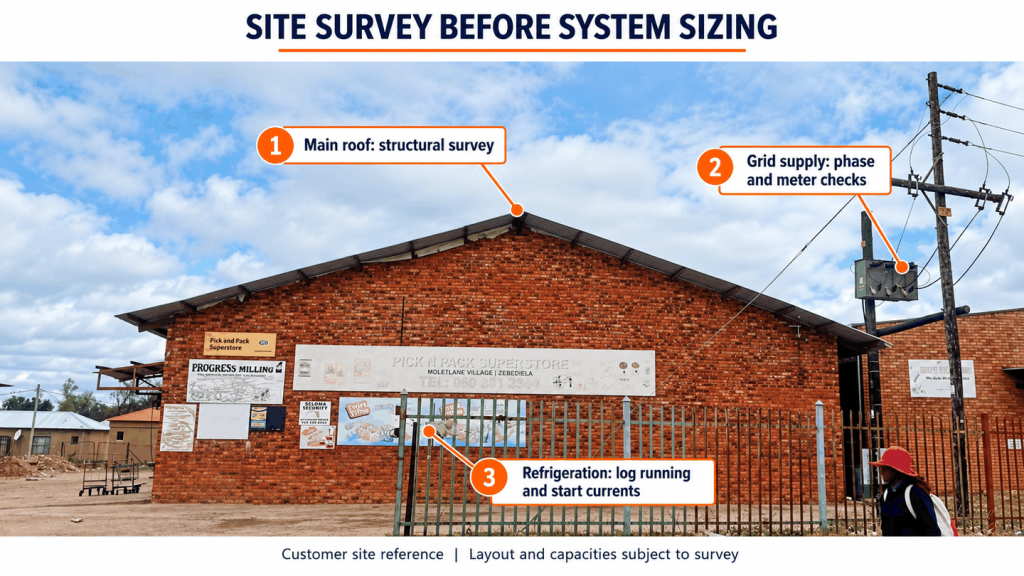
The supplied equipment list includes three deep freezers, three display refrigerators, a cold room operating around minus 10 to minus 15 degrees Celsius, lighting and three tills. The metal roof visible in the photographs offers a possible PV location, subject to structural inspection.
Verify the Refrigeration Load Before Buying Equipment
The preliminary load sheet is useful, but it needs several corrections before it becomes a procurement specification.
| Reported equipment | Ulwazi lomthengi | Engineering interpretation |
|---|---|---|
| Three deep freezers | 230 V, 3.9 A each | Approximately 0.897 kVA each; real kW requires power-factor or meter data |
| Three display refrigerators | 230 V, 3.5 A each | Approximately 0.805 kVA each; not automatically 0.805 kW |
| Cold-room outdoor unit | 2.6 kW stated input | Confirm nameplate, starting current and suitability for the refrigeration duty |
| Cold-room indoor unit | 3.1 kW defrost heater plus fan current | Defrost heating must be distinguished from normal refrigeration operation |
| Lighting and three tills | 1.5 kW estimate | Measure essential circuits and identify loads that can be disconnected |
Multiplying volts by amps gives apparent power. Adding those values to measured kilowatts does not establish an accurate shop demand. Similarly, treating defrost heat as a continuous compressor load can distort both inverter sizing and runtime estimates.
The supplied 8.85 kW average load is therefore a planning scenario, not a measurement. Log real power, energy, phase currents and compressor starts across representative trading and overnight periods. Record door-opening activity and defrost cycles. Monthly spending alone cannot establish backup capacity because tariffs, fixed charges and operating patterns differ.
Recommended KRL Battery and Solar Configuration
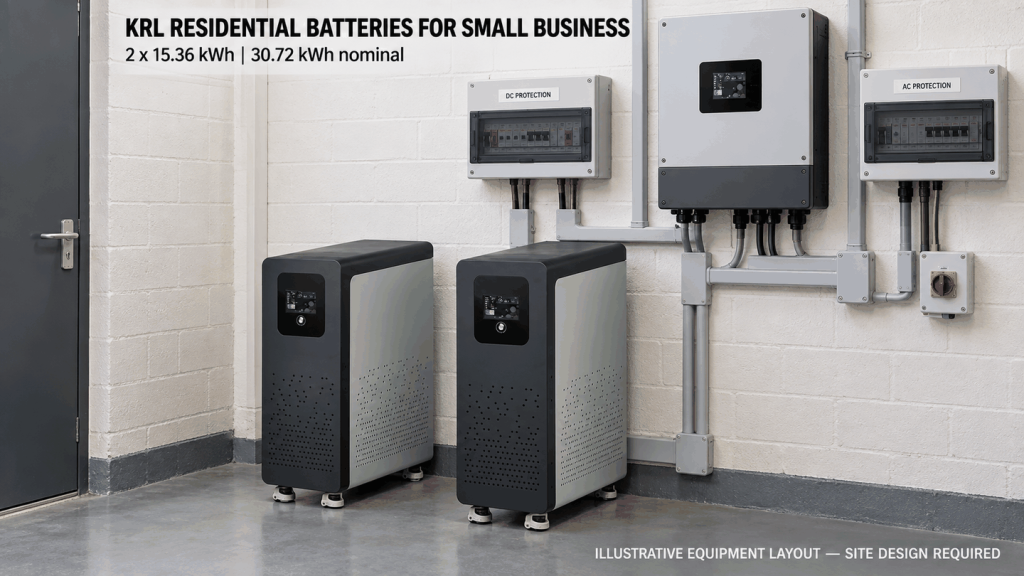
The proposed battery is the KRL-MB-51_2V300Ah-15360Wh, a 51.2 V, 300 Ah LiFePO4 residential storage product. Two units provide 30.72 kWh nominal energy. KRL’s published specification lists 200 A maximum discharge and 100 A standard charging current per unit. Parallel operation and the exact inverter communication protocol must be approved for the supplied units.[1]
| Icandelo | Preliminary selection | Condition before order |
|---|---|---|
| Battery bank | 2 × KRL 15.36 kWh; 30.72 kWh total | Confirm parallel configuration, BMS firmware and commercial application warranty |
| Hybrid inverter | 15 kW-class, three-phase, low-voltage battery model | Verify battery-only power, per-phase limits and compressor start capability |
| Rooftop PV | 18 × 550 W modules; 9.9 kWp example | Final module model, string design, roof survey and shading assessment |
| Battery distribution | Protected parallel branches and enclosed DC distribution | Cable, fuse and isolator ratings coordinated with fault current and BMS |
| Essential-load board | Refrigeration, required lights and tills | Phase balancing, selective protection and staged restart |
| Monitoring | Energy, SOC, alarms and refrigeration temperature | Agree reserve settings and notification responsibilities |
Why a 15 kW Label Does Not Guarantee Every Compressor Start
Deye’s published SUN-15K-SG05LP3-EU-SM2 three-string version lists a 280 A maximum battery discharge current and an off-grid peak-power specification of twice rated power for ten seconds.[2] These figures must be interpreted together with voltage, phase loading and operating conditions.
At nominal 51.2 V, 280 A represents approximately 14.34 kW DC, or about 13.62 kW AC at an illustrative 95% conversion efficiency. At 48 V, the same calculation gives about 12.77 kW AC. These are screening calculations, not a replacement for the manufacturer’s output curves.
Two batteries increase available stored energy and battery-side current capability, but they do not increase the inverter’s own current limit. A heavily loaded phase or a compressor restarting against pressure can still cause a trip.
Ask the installer to test the largest compressor with other essential loads operating. Use manufacturer-approved restart delays and sequencing. If measurements exceed the available margin, consider compatible starting controls, a different inverter platform or a narrower essential-load group. Do not automatically oversize to 30 kW, but do not guarantee that 15 kW is sufficient without testing either.
How Long Can 30.72 kWh Keep the Shop Running?
For comparison, assume a new, fully charged battery bank, a 90% discharge window and 95% DC-to-AC conversion efficiency:
30.72 × 0.90 × 0.95 = 26.27 kWh of estimated AC energy.
| Average essential demand | Calculated battery-only duration |
|---|---|
| 6 kW | About 4.4 hours |
| 8.85 kW | About 3.0 hours |
| 10 kW | About 2.6 hours |
These figures exclude additional site-specific derating and auxiliary consumption. A higher reserve, an incompletely charged bank, battery ageing or temperature restrictions reduces duration. Solar contribution during an outage can extend it but is not assured.
If the measured requirement is five hours at 8.85 kW, the same assumptions require roughly 51.8 kWh nominal. That would justify investigating a larger compatible bank. The preferred budget decision is to measure essential demand before purchasing extra batteries.
Solar Savings and Battery Charging Must Share the Available Power
An example array of eighteen 550 W modules provides 9.9 kWp DC. Module count is illustrative: the installer must check cold-weather string voltage, hot-weather operating voltage and input-current limits against the selected inverter.
Solar first offsets the shop’s daytime demand. Only surplus generation is available for battery charging unless grid charging is enabled. For example, if the array supplies 8 kW while the shop consumes 8.85 kW, there is no solar surplus to refill the batteries. The remaining demand comes from the grid or battery according to the operating mode.
This is why “the battery charges in 3.5 hours” cannot be promised from array capacity alone. Recovery time depends on simultaneous load, sunlight, charging limits and starting SOC. A larger PV array can improve daytime energy availability, but its value requires a site-specific yield and consumption study.
Practical Energy Management for Refrigeration
During normal trading, prioritise solar self-consumption while maintaining the agreed outage reserve. Grid charging can restore that reserve after a long outage or poor-sun period, subject to the electricity tariff and service capacity.
Temperature alarms and low-SOC load reduction should be agreed. Electrical runtime alone does not establish food safety.
During a grid failure, the hybrid system must isolate the backed-up circuits from the utility. Refrigeration receives priority; discretionary loads can be shed. Compressor restarts should follow equipment requirements, while defrost scheduling should be reviewed by a refrigeration technician rather than simply disabled.
Roof, Installation Safety and Acceptance Documents
The photographs show a metal roof, but do not establish its load-bearing capacity. Inspect purlins, trusses, corrosion, roof fasteners, waterproofing and wind resistance. PV fixings must transfer forces into suitable structural members. The lightweight entrance canopy should not be assumed suitable for panels.
Locate batteries in a dry, secure space with the clearances required by their manuals. Keep them away from customer traffic, escape routes, flooding and the fuel-storage area visible in the site photograph. LiFePO4 chemistry does not eliminate electrical or fire risk.
The installer should confirm applicable local connection requirements, protection settings, earthing and documentation with the electricity distributor. Request the exact inverter’s relevant grid-compliance evidence, battery transport test summary and model-specific safety documents. A general catalogue certification claim is not approval for the complete installed system.
Commissioning should include grid-loss operation, staged compressor starts, low-SOC response, alarm delivery, recharge performance and recorded refrigeration temperatures. Keep the as-built drawing and operating instructions on site.
Compare Cost Against Delivered Value
For illustration only, 9.9 kWp multiplied by five equivalent sun-hours and an overall 0.80 yield factor gives 39.6 kWh per day. This is an assumption-based example, not a location-specific forecast. If all of that energy replaced purchased electricity at an assumed ZAR 3/kWh, the gross value would be approximately ZAR 3,564 over thirty days, before additional storage losses, curtailment or operating costs.
Use actual tariffs, seasonal yield and consumption overlap for the financial model. Count each solar kilowatt-hour once; do not count battery discharge again as additional generation. Evaluate stock-loss avoidance separately using the shop’s own history. A payback period needs an installed quotation and cannot be inferred from the monthly bill alone.
Why KRL for This Small-Business Application?
KRL’s residential storage range provides a modular route for smaller sites that do not need a large industrial cabinet.[3] The value of this proposal is the combination of appropriate battery capacity, refrigeration-focused load planning and an installer-supported solar system.
Before purchase, request a written compatibility confirmation for the battery–inverter pairing, permitted parallel configuration, commercial-use warranty and after-sales responsibilities. Remote battery support and local electrical and refrigeration service should be clearly allocated.
Frequently Asked Questions
Can KRL residential batteries supply a wholesale shop?Potentially, yes. Application suitability depends on continuous power, motor starting, approved parallel operation, installation conditions and warranty coverage. “Residential” energy capacity alone does not prove suitability for commercial refrigeration.Is the proposed battery bank 30 kWh or 30.72 kWh?Two 15.36 kWh units total 30.72 kWh nominal. Estimated delivered AC energy is lower; this proposal uses approximately 26.3 kWh under stated discharge and conversion assumptions.Will it provide three hours of backup?Approximately three hours is calculated at an assumed 8.85 kW average load from a full bank. Actual runtime must be established from measured demand, SOC settings, temperature and system losses.Can a 15 kW inverter start the cold room?That remains a commissioning requirement. Check the actual compressor start current, loaded phase, battery-side current and inverter overload conditions. The published peak rating alone is insufficient evidence.Can the shop operate permanently off-grid with 9.9 kWp of solar?This proposal does not establish permanent off-grid capability. An hourly energy balance covering night operation and poor weather is required. The starting design retains the grid for energy support and reserve recovery.Is the existing roof strong enough for PV?The photographs cannot answer that. A competent structural assessment must confirm the roof and fixing system before installation, including corrosion, wind loading and waterproofing.Why not choose only a smaller battery and add solar later?That is possible if the shorter backup window meets the shop’s needs. Compare essential-load runtime and future expansion rules before reducing capacity. Solar adds daytime energy savings but cannot replace assured overnight storage.What should the customer send for a firm quotation?Send the site location, recent electricity bills with kWh and tariffs, outage target, equipment nameplates, phase-load measurements, compressor start data and roof measurements. Include the desired stock-protection priority and installation budget.
Request a Refrigeration-Focused KRL Proposal
Ask KRL to quote a 30.72 kWh residential battery bank, approximately 10 kWp PV and a verified three-phase hybrid inverter configuration. Request a second option only if measured loads show that more storage or inverter capacity is necessary.
The next step is a documented load and roof review, followed by a complete installed scope with an agreed backup target and acceptance test. Contact the KRL engineering team through the official website to begin that review.
Sources and Design Basis
1. KRL 15.36 kWh battery product specification. 2. Deye SUN-14–20K-SG05LP3-EU-SM2, three-string version. Confirm the exact supplied version. 3. KRL home energy storage range.
Customer equipment summary and two site photographs supplied for this proposal. Calculations are engineering estimates; no completed installation results are claimed.