

KRL Power’s public C&I battery energy storage information provides useful reference points for a hotel project in Nigeria seeking a reported 500 kW power capability and approximately 1 MWh of storage. It does not, however, establish an exact ready-made 500 kW / 1 MWh hotel package. For the stated hotel load—20 ducted air-conditioning units rated at 2.5 hp, 45 ducted units rated at 2 hp, plus televisions, laundry equipment and kitchen appliances—the responsible first step is a site load audit and an agreed outage-service plan. Those inputs determine whether the system is intended to support the whole hotel, a managed essential-load board, or selected air-conditioning zones and hotel services.
This distinction matters because power and energy answer different engineering questions. The requested 500 kW inverter figure concerns the rate at which a system must deliver AC power. The 1 MWh figure concerns nominal stored energy. Neither number independently establishes how many hours the hotel can operate during an outage, how many compressors can restart together, or what solar array capacity should be installed. A precise quotation should follow measured electrical data, final equipment selection, a control narrative and defined acceptance conditions.
This is a procurement and engineering planning document rather than a final electrical design. KRL Power publicly presents its business around lithium batteries, custom battery packs, BESS integration and microgrid applications. Its C&I system pages describe integrated battery, PCS, MPPT, EMS/BMS, generator interfaces, fire protection and cooling. Public-page statements must still be matched to the selected model and configuration. The final project should be reviewed by qualified project electrical professionals and against site-specific approval, utility, fire, insurer and installation requirements.
Begin With the Hotel’s Required Service During an Outage
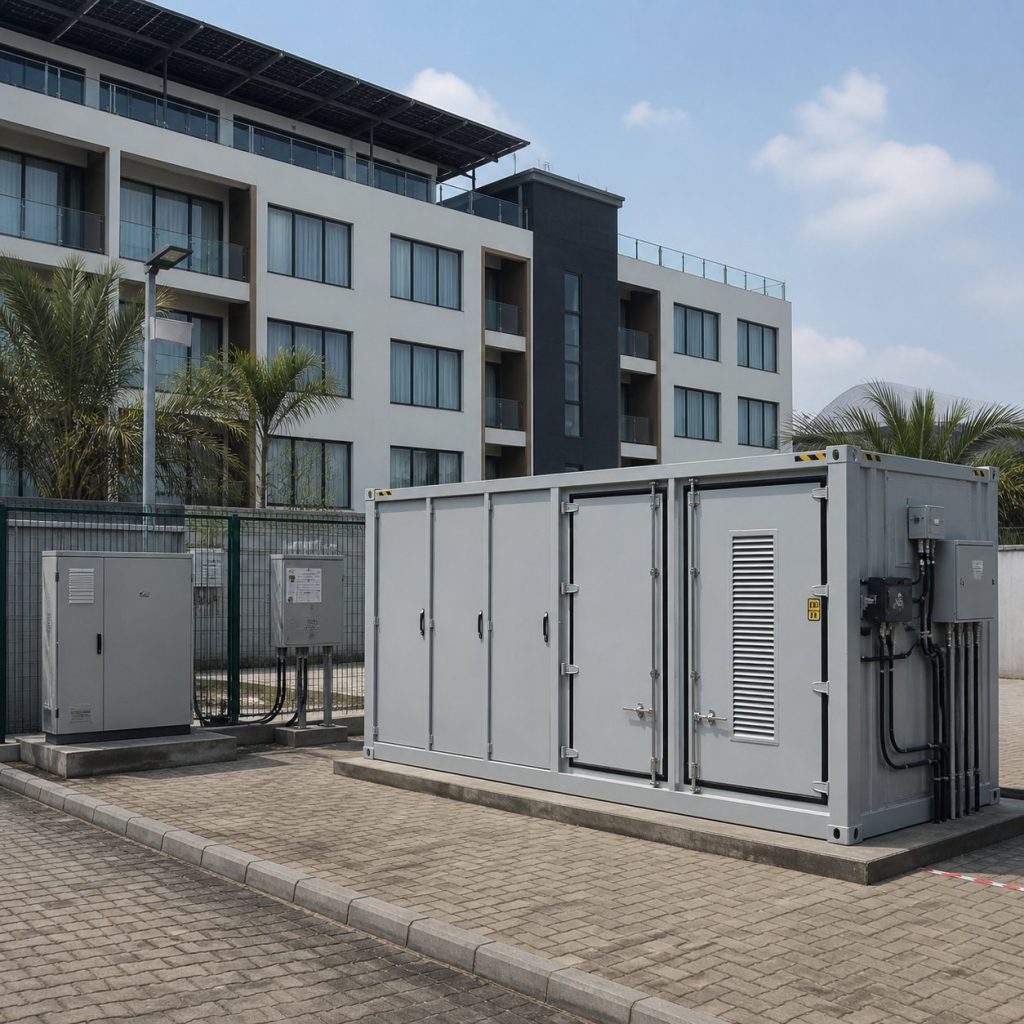
The decision is not simply whether a battery can keep the hotel “on.” Hotel management should define the service level required when the grid is unavailable. Guest-facing services, communications, security, water systems, refrigeration, kitchen circuits, laundry processes and HVAC zones have different priorities. A single undifferentiated 500 kW target can conceal important decisions about what remains energized first, what may wait, and what should be disconnected automatically.
For this project, the load plan should identify at least three operating states. In normal grid-connected operation, the team should state whether the system will reserve energy for outages, support solar self-consumption, reduce selected peaks, or operate with another agreed strategy. During a short interruption, the priority is identifying equipment that cannot tolerate a transfer or restart sequence, such as controls, communications, access systems and selected guest-service loads. During a prolonged outage, the plan must define which areas continue operating after the first minutes, first hour and later stages of the event.
- Uninterrupted or highest-priority loads: List the loads whose operation must be preserved according to the hotel’s service and safety plan.
- Essential managed loads: Identify loads that should remain powered, but can be sequenced or reduced if available energy falls.
- Staged HVAC loads: Divide air-conditioning into zones that may be enabled progressively rather than restarted together.
- Deferrable loads: Identify laundry, kitchen or non-essential guest-area loads that may be postponed or shed during battery operation.
- Excluded loads: State which loads will not be supported by the battery during an outage.
A staged approach is usually easier to test and operate than an assumption that all loads must run at their maximum possible demand. For example, the hotel may choose to maintain reception, security, network equipment, selected water systems, essential guest circuits and defined occupied HVAC areas while managing other zones based on available battery energy and generator status. The exact categories are operational decisions for the hotel and must be documented in the project design basis.
Separate the 500 kW Requirement From the 1 MWh Requirement
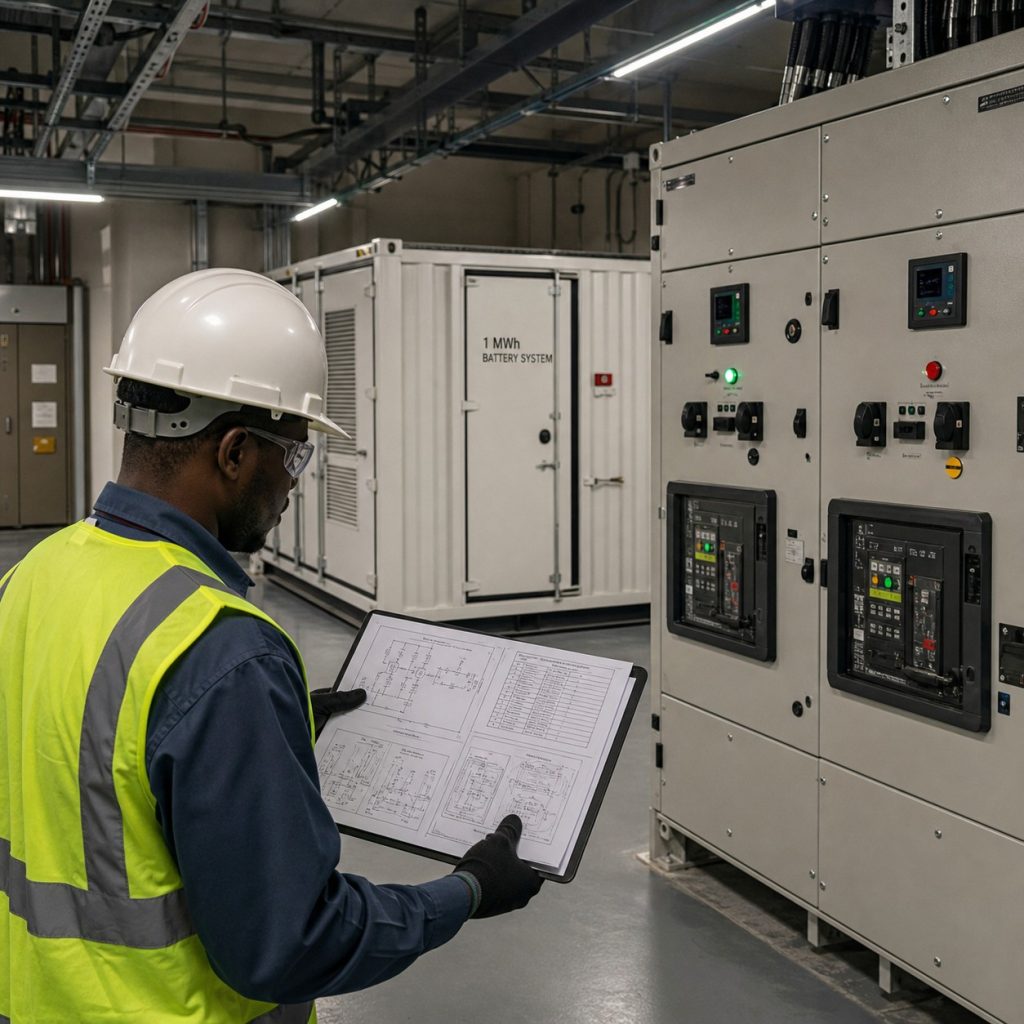
The 500 kW target should be treated as a preliminary AC power requirement at the planned BESS connection point. It must be checked against measured coincident demand, motor starts, current limits, distribution capacity, protection coordination and the selected PCS operating limits. The reported 1 MWh target is nominal energy, not confirmed usable AC energy delivered to hotel loads.
Usable energy can differ from nominal energy because the final operating window, conversion losses, auxiliary consumption, battery temperature, ageing, reserve settings and load profile affect delivered energy. These values must be confirmed for the selected configuration. They should not be assumed from a nominal container or cabinet rating.
A simple calculation explains the commercial risk of confusing these two values. If a hotel were to require 500 kW continuously from a nominal 1,000 kWh battery, dividing 1,000 kWh by 500 kW produces two hours. That is ideal arithmetic only, not a runtime guarantee. It excludes every project-specific factor that affects usable output. If a managed hotel load were reduced to 250 kW, the same arithmetic reference becomes four hours, but that also remains illustrative rather than contractual.
The quotation package should therefore contain both a kW schedule and a kWh schedule. The kW schedule should identify normal running demand, measured peak demand, motor-starting behaviour and the planned sequence for adding or shedding loads. The kWh schedule should use interval consumption data over representative operating days. It should include high occupancy periods, kitchen and laundry schedules, cooling demand and any recorded outage pattern that affects the hotel’s operating objective.
Treat Air Conditioning as a Controlled Electrical Load Group
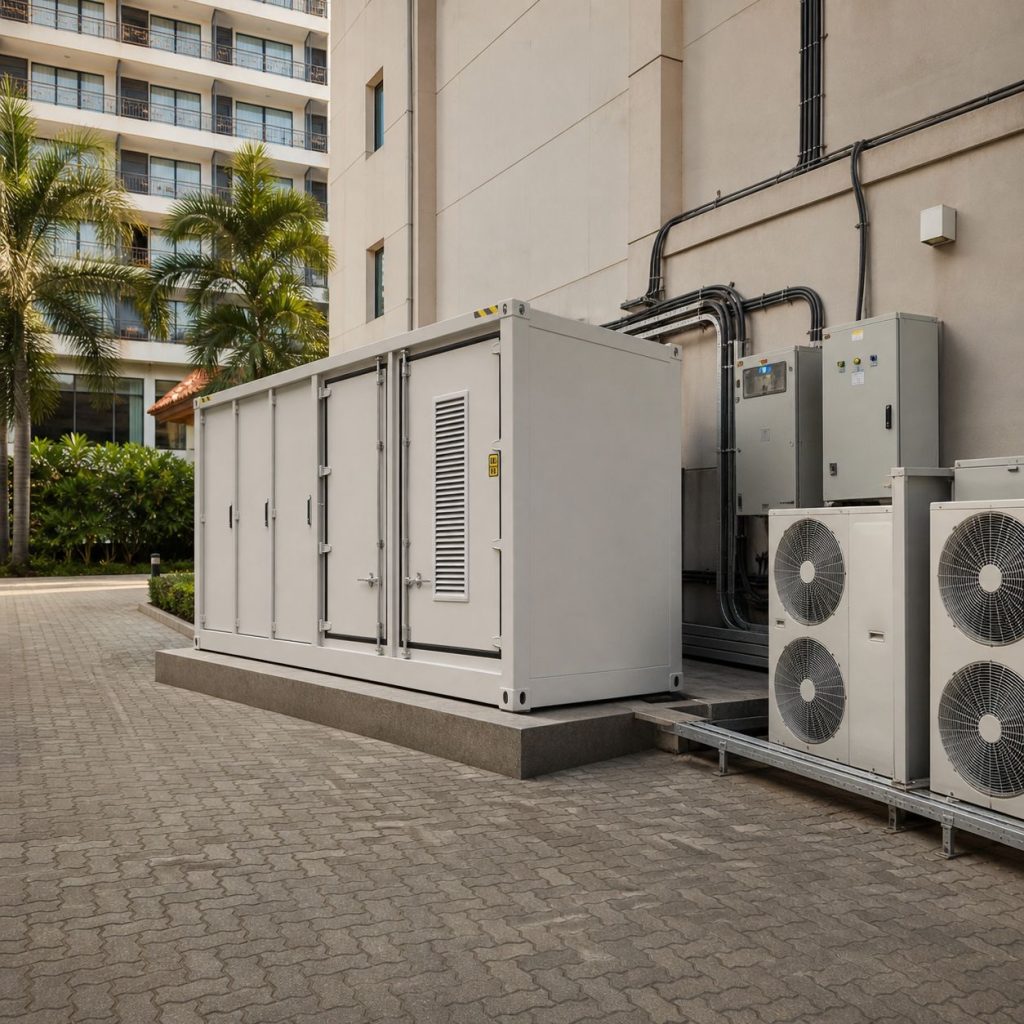
The stated inventory includes 65 ducted air-conditioning units, but their hp labels cannot be converted directly into a final electrical load calculation. The final power demand depends on each unit’s electrical input, compressor type, fan demand, control mode, operating condition, diversity and starting or restart characteristics. Nameplate and measured data are required before assigning a supported number of units to the battery system.
The relevant engineering question is not merely how many air conditioners can run. The question is which HVAC zones may start, run and restart together without exceeding verified AC power, current, overload and control limits for the selected system. Following a blackout, simultaneous compressor restarts can create a substantially different operating condition from normal steady-state demand. The control design may need to sequence HVAC zones, prevent simultaneous restart, prioritize occupied spaces and reduce selected zones when the available energy reserve reaches a defined threshold.
Each unit type should be documented with its rated voltage, phase arrangement, rated current, maximum current, compressor arrangement, fan loads and available manufacturer starting information. Where the hotel has inverter-driven compressors, soft-start equipment or existing building controls, the project team should document how those systems respond after an interruption. A site control narrative should explain the allowed start order and the point at which each load group is shed or restored.
HVAC information required before final sizing
- Equipment schedules for ducted indoor units, outdoor units and associated control circuits.
- Clear nameplate photographs and manufacturer documentation for electrical input values.
- Measured kW and current profiles during representative high-demand operation.
- Starting and restart information for compressor-driven equipment.
- A zone plan for guest rooms, public spaces, kitchen areas, laundry, staff spaces and unoccupied areas.
- A written sequence showing which HVAC groups may start first and which groups may be shed.
KRL Power’s public C&I materials include sub-10 ms switching as a page-level signal for certain system descriptions. That signal is not sufficient evidence that every hotel compressor, control system or sensitive electronic load will ride through a transfer event without interruption. Transfer performance, restart behaviour and load compatibility must be confirmed for the selected model, configuration and connected equipment.
Use Published KRL References Carefully When Reviewing the 500 kW / 1 MWh Concept
KRL Power’s public C&I product matrix lists systems ranging from 30 kW / 65 kWh to 750 kW / 1.5 MWh and 1,000 kW / 2 MWh. These published configurations are useful comparison references, but the reviewed public matrix does not list an exact 500 kW / 1 MWh product. The hotel should not describe an arithmetic combination of reference units as a confirmed solution until KRL Power verifies the complete technical configuration.
The public matrix lists the KRL-B522L with 250 kW AC power, 522 kWh nominal energy, 240 kW maximum PV power, liquid cooling, battery IP65 protection and parallel operation of up to six units. Two nominal KRL-B522L ratings would arithmetically total 500 kW and 1,044 kWh. This may be a useful starting point for an engineering enquiry. It is not a recommendation, runtime promise or quotation because the public material does not establish the final shared AC-bus arrangement, parallel-control conditions, usable AC energy, auxiliary load, protection coordination, derating or site-specific compliance scope.
The KRL-B241 public matrix entry lists 125 kW AC power, 241 kWh nominal energy, 120 kW maximum PV power, industrial air conditioning, IP54 protection and parallel operation of up to 10 units. The KRL-B261L entry lists 125 kW AC power, 261 kWh nominal energy, 120 kW maximum PV power, liquid cooling, battery IP65 protection and parallel operation of up to 10 units. These are published reference values only. They do not establish a particular hotel autonomy period, AC loading arrangement or final installation approval.
The KRL-B2M6L public table lists two citable configurations: 750 kW with 1.5 MWh and 1,000 kW with 2 MWh. Both list LiFePO4 batteries, 400/230 Vac, 50/60 Hz, a diesel generator port, RS485/WiFi communication, battery IP65 protection, fire protection, liquid battery cooling and switching below 10 ms. The public table also lists different maximum PV inputs for those configurations. Those values must remain attached to that larger product reference and must not be transferred to a proposed 1 MWh hotel solution.
Size Solar PV From Measured Hotel Energy, Not From Battery Capacity
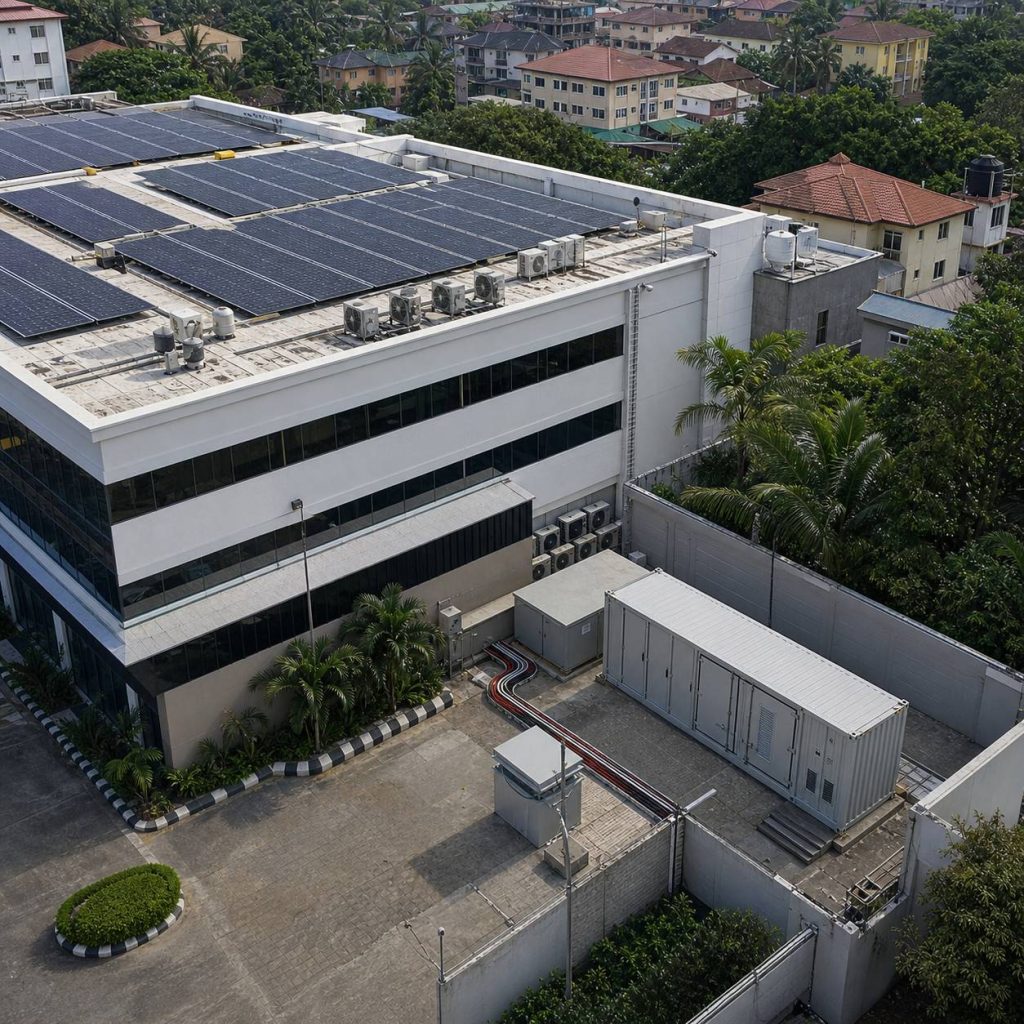
Solar PV may improve the operating value of battery energy storage for a hotel, but battery capacity alone does not determine the correct PV array size. The project needs a solar study covering usable roof or ground area, shading, structural constraints, access, cable routes, module layout, electrical interconnection and the intended energy-dispatch strategy.
The dispatch objective should be stated clearly. Solar may serve daytime hotel demand directly, charge the battery reserve, reduce generator operating time, or support a combination of these aims. For a hotel with substantial daytime cooling demand, the engineering team should compare measured hourly HVAC, kitchen and laundry demand with expected hourly PV generation. If the proposal assumes that solar will recharge battery reserve, it must show when surplus energy is actually available after serving simultaneous hotel demand.
Published KRL maximum PV power values are equipment limits associated with individual models, not recommended PV array capacities for this property. The final PV design must confirm the selected model’s approved PV input parameters, MPPT arrangement and operating limits. It must also account for the hotel’s actual demand pattern. A number representing installed PV capacity without a yield study and dispatch model is not enough to predict hotel autonomy or battery recharge performance.
Define Generator Coordination as an Operating Sequence
KRL’s public C&I information identifies generator interfaces as a common system feature, and the KRL-B2M6L public table lists a diesel generator port. This supports discussion of a hybrid hotel backup architecture, but a generator interface does not by itself define the generator-BESS control philosophy.
The hotel and project team must decide whether the generator will recharge batteries, carry sustained hotel demand after an initial battery period, run while the BESS handles selected transients, or operate under another agreed sequence. Generator minimum-load guidance, step-load response, voltage and frequency behaviour, controller interfaces and protection requirements must be reviewed with the generator documentation and final BESS controls.
A useful project acceptance scenario is a controlled loss of grid supply during a high-demand hotel period. The test procedure should document BESS response, generator start command, permitted load sequence, HVAC restart sequence, state-of-charge thresholds, alarms and the response if the generator does not start. This produces operational evidence that is more meaningful than a generic claim of backup capability.
Plan Outdoor Installation and Evidence Requirements Before Purchase
The customer has indicated an outdoor industrial storage preference and a LiFePO4 battery preference. KRL public product information identifies LiFePO4 in the cited C&I systems. It also distinguishes IP54 protection for the KRL-B241 and battery IP65 protection for the KRL-B261L and KRL-B522L. An enclosure rating is only one part of outdoor project suitability. It does not define the complete civil, electrical, safety or maintenance scope.
The final installation assessment should cover foundation design, drainage, flood exposure, access for delivery and lifting, cable routing, heat rejection, direct sun exposure, dust, humidity, corrosion exposure, security, emergency access and maintenance clearances. The project team must verify the selected equipment’s environmental limits and any resulting derating against actual site conditions. Nigeria-specific approvals and requirements should be determined for the specific site by the appropriate qualified local parties; they should not be assumed from generic regional statements.
Public KRL pages identify fire-protection systems as part of relevant C&I product information. The reviewed public material does not provide enough detail to establish the final detector arrangement, suppression medium, alarm integration, ventilation logic, separation distances or local approval status for a hotel installation. Before purchase, request model-specific drawings, manuals, certificates, installation requirements, maintenance requirements and defined responsibilities for local approvals.
Build the Quotation Request Around Verifiable Inputs
A precise quotation should be based on a documented design basis. The hotel’s initial request identifies the country, load categories and intended scale, but it does not yet fix the exact inverter capacity, battery quantity, PV capacity or commercial scope. A complete enquiry package should contain the following information.
- Interval load records: Provide 15-minute or finer kW, kWh, voltage and power-factor data for representative operating days.
- Critical-load schedule: Classify every connected load as highest priority, essential, staged, discretionary or excluded.
- HVAC documentation: Submit equipment schedules, nameplates, control information, starting data and the required operating priority for all stated air-conditioning units.
- Electrical single-line diagram: Show incoming supply, switchboards, sub-panels, generator equipment, ATS equipment, existing PV and the intended BESS connection point.
- Generator information: Provide generator ratings, controller details, operating history, maintenance status and available communication interfaces.
- PV site information: Supply roof or ground layout drawings, photographs, dimensions, shading observations and known structural constraints.
- Site-condition information: Provide the proposed installation area, access route, elevation, flood risk and relevant environmental exposure.
- Operating priorities: State whether the primary objective is outage continuity, solar use, generator coordination, peak management or a combination.
- Compliance requirements: Identify client, insurer, local authority and fire-safety requirements that must be met before purchase.
- Acceptance criteria: Define the load-support test, runtime test conditions, transfer test, generator interaction test, alarms, reporting and training deliverables.
The recommended next step is therefore a structured feasibility and data-review process. First, establish whether the reported 500 kW represents measured coincident demand, future expansion allowance or the maximum desired critical load. Next, define whether 1 MWh is a nominal-energy target, a required delivered-energy target or a budget reference. Then complete the HVAC, solar and generator operating studies before requesting a model-specific technical-commercial proposal. This creates a transparent basis for comparing commercial energy storage for hotels and avoids treating nominal energy or public reference data as a project guarantee.