Nigeria Rural Electrification Challenge: Providing Reliable Power for 23 Remote Villages
How can we provide stable electricity in areas where the traditional power grid cannot reach?
Recently, a customer from Nigeria approached KRL Power for a rural electrification project covering 23 remote villages.
According to the project requirements, these villages:
- Are located far away from the national grid infrastructure
- Have unstable or no reliable electricity supply
- Need independent power generation capability
- Require long-term low-maintenance operation
- Prefer renewable energy instead of diesel generators
The customer was looking for a complete solution combining:
- Uveliso lwamandla elanga (PV)
- Inkqubo yokugcina amandla ebhetri (BESS)
- Ulawulo olukrelekrele lwe-EMS
- Microgrid operation capability
Why Traditional Diesel Power Is Not the Best Solution for Rural Nigeria
Many remote communities still depend on diesel generators.
However, from our engineering experience, diesel-based power supply creates several long-term problems.
However, from our engineering experience, diesel-based power supply creates several long-term problems.
1. High Operating Cost
Diesel fuel prices continue increasing.
For remote villages, transportation costs can become higher than the fuel itself.
For remote villages, transportation costs can become higher than the fuel itself.
2. Limited Reliability
Diesel generators require:
- Regular maintenance
- Spare parts
- Skilled technicians
- Fuel supply chain
Any interruption can cause power outages.
3. Environmental Impact
Diesel generation produces:
- Ukukhutshwa kwekhabhoni
- Ungcoliseko lwesandi
- High operating expenses
For rural electrification projects, the objective should not only be:
"installing a power source"
but creating:
"installing a power source"
but creating:
a sustainable energy infrastructure that can operate independently for 10-15 years.
KRL Power Solution: Solar + ESS Microgrid for 23 Nigerian Villages
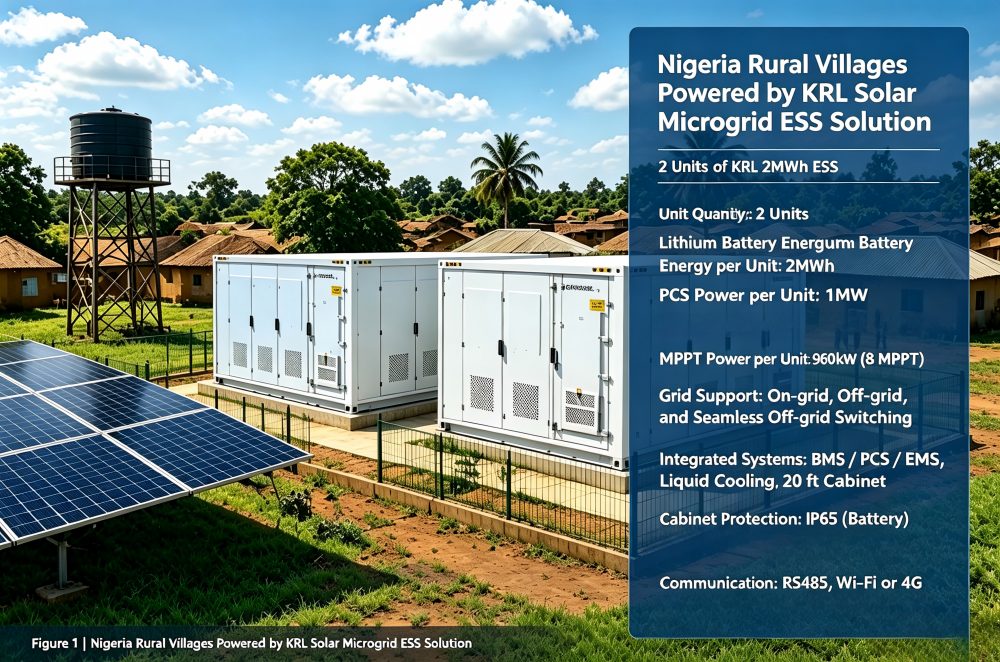
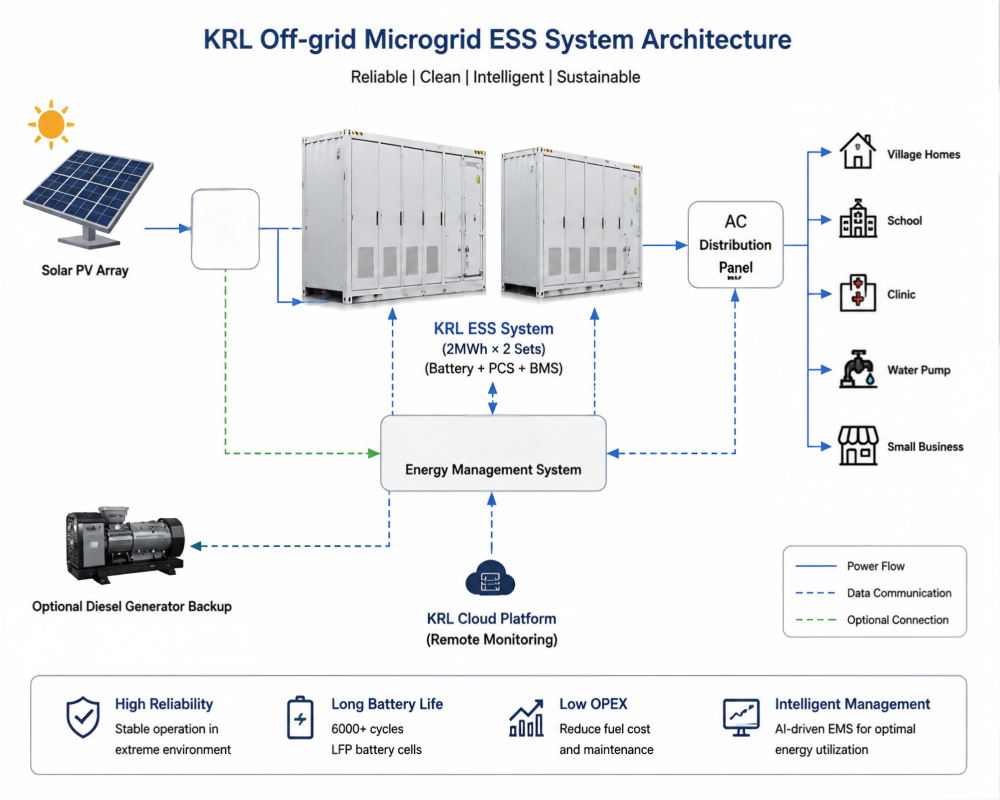
Based on the customer's requirements, Amandla e-KRL designed a scalable C&I ESS microgrid architecture.
The recommended system includes:
The recommended system includes:
Solar PV Generation
Solar panels provide clean electricity during daytime.
Inkqubo yokugcina amandla ebhetri
The ESS stores excess solar energy and supplies electricity:
- Night time
- Cloudy days
- Peak demand periods
Intelligent EMS Platform
KRL self-developed EMS controls:
- Energy dispatch
- Battery charging/discharging
- Load management
- Ukubeka iliso ukude
- System optimization
Recommended KRL ESS Configuration
Based on preliminary estimation:
Project scale:
23 villages
Estimated:
- Daily electricity demand:
2MWh-4MWh/day
Recommended solution:
KRL Modular C&I ESS Microgrid System
| Into | Recommended |
|---|---|
| Umthamo webhetri | 2MWh-4MWh |
| Amandla ePCS | 1MW-2MW |
| Uhlobo lwebhetri | LFP |
| Inkqubo yokupholisa | Ukupholisa okungamanzi |
| Inkonzo yoNyango oluNgxamisekileyo | Intelligent EMS |
| Indlela yokusebenza | Off-grid / Hybrid |
| Ukhuselo | Outdoor Industrial Protection |
| Ukwandisa | Ukwandiswa ngeemodyuli |
Recommended deployment:
2 × 2 MWh ESS units
Why KRL C&I ESS Is Suitable for Nigerian Rural Projects
1. All-in-One Integrated Design
I-KRL ESS idibanisa:
- Inkqubo yebhetri
- PCS
- i-BMS
- Inkonzo yoNyango oluNgxamisekileyo
- Ukhuselo lomlilo
This reduces installation complexity.
For remote projects, fewer components mean:
- Ufakelo olukhawulezayo
- Ulondolozo olulula
- Lower failure risk
2. Advanced Safety Architecture
Safety is the first consideration for rural energy projects.
I-KRL ESS iyamkela:
- Iiseli zebhetri ze-LFP ezikumgangatho ophezulu
- Ujongano olukrelekrele lwe-BMS
- Multi-layer protection
- Ukhuselo lomlilo olusebenzayo
- Itekhnoloji yokupholisa ngamanzi
The system maintains stable operation under:
- High temperature
- Dust environment
- Long continuous operation
3. Intelligent Energy Management
KRL EMS continuously analyzes:
- Solar generation
- Battery SOC
- Load demand
- Weather conditions
It automatically optimizes:
- Charging strategy
- Discharging schedule
- Energy utilization
This helps maximize renewable energy utilization.
Estimated Project Benefits
After implementing KRL ESS microgrid solution:
Inkululeko yamandla
Villages can reduce dependence on unstable grid electricity.
Lower Lifetime Cost
Compared with diesel generators:
- No continuous fuel purchase
- Lower maintenance requirements
- Longer operating lifespan
Better Social Impact
Reliable electricity enables:
- Schools
- Healthcare facilities
- Water supply systems
- Local businesses
Energy storage is not only a power product.
It is an infrastructure investment that improves community development.
Project Implementation Process
KRL Power supports customers through:
Step 1: Load Analysis
Engineering team evaluates:
- Village population
- Electricity demand
- Future growth
Step 2: System Design
Complete design:
- ESS capacity
- PCS rating
- Solar integration
- EMS strategy
Step 3: Manufacturing & Testing
Factory testing includes:
- Battery performance test
- PCS test
- Communication test
- Safety verification
Step 4: Installation & Commissioning
Support:
- Remote commissioning
- Local EPC guidance
- Operation training
Imibuzo Ebuzwa Rhoqo
Q1: Can KRL ESS operate without grid connection?
Yes.
KRL C&I ESS supports:
- Off-grid operation
- Hybrid operation
- Grid-connected operation
It is suitable for remote villages without reliable grid access.
Q2: How much battery capacity is required for 23 villages in Nigeria?
The final capacity depends on:
- Population
- Daily electricity consumption
- Peak load
- Solar resources
For preliminary estimation:
2MWh-4MWh ESS capacity is recommended.
Q3: Can KRL ESS replace diesel generators?
Ewe.
Solar + ESS can significantly reduce diesel consumption.
Diesel generators can remain as backup for extreme conditions.
Solar + ESS can significantly reduce diesel consumption.
Diesel generators can remain as backup for extreme conditions.
Q4: How long is KRL ESS service life?
With LFP battery technology and intelligent thermal management:
The designed lifespan can reach:
10-15 years depending on operating conditions.
The designed lifespan can reach:
10-15 years depending on operating conditions.
Q5: Can the system be expanded in the future?
Yes.
KRL modular architecture supports:
- Additional battery cabinets
- Higher PCS capacity
- Expanded microgrid capacity
Q6: Does KRL support Africa EPC projects?
Yes.
KRL provides:
- Technical proposal design
- ESS configuration
- Factory testing
- Remote commissioning
- After-sales support