

KRL Power presents its commercial and industrial energy-storage offering for backup power, solar integration and microgrid applications. For a hospital, the procurement decision must start elsewhere: energy storage solutions for hospitals should be designed around the electrical loads that need continuity, their interruption tolerance, the intended runtime and the relationship with existing UPS and generator assets. A Hospital BESS can contribute to a layered resilience strategy, but public product information alone cannot establish clinical suitability, project compliance, protected runtime or final system performance.
For a Hospital BESS South Africa project, the most useful first deliverable is a signed-off protected-load schedule. That schedule distinguishes loads that require no-break supply from loads that can accept a controlled transfer, loads that may reconnect only after another source has stabilised, and loads that can be shed. It gives the hospital owner, consulting engineer, electrical contractor and storage supplier the same starting point. It also prevents the common error of selecting a Battery Backup System for Hospital operations from total building consumption instead of the measured demand of the circuits that genuinely require support.
1. Define the continuity objective before selecting storage equipment

The hospital should first state the event it expects the system to manage. A short grid disturbance, a transition while standby generation starts, a longer outage, a planned demand-management event and renewable-energy integration are different duties. They may be addressed by one coordinated design, but they do not automatically require the same inverter power, usable energy, control settings or reserve state of charge.
In practice, critical-power architecture is layered. Dedicated UPS arrangements may protect loads that cannot tolerate an interruption. Generator-backed emergency distribution may support selected essential services for a longer event. Battery storage may be evaluated for controlled transition support, limited-duration supply, solar integration or load management. The allocation of those roles must be agreed by the hospital's clinical, facilities and electrical teams; it should never be inferred from a nominal battery capacity.
- No-break loads: Record the equipment and systems that need a dedicated uninterrupted-power arrangement or another specifically designed solution.
- Essential loads: Identify clinical, life-safety, communications, security, selected pumping, cooling and operational circuits that must remain available for the stated event.
- Conditional loads: Define loads that may operate only after the generator is stable, renewable supply is available or the battery reserve exceeds an approved level.
- Non-essential loads: Agree which circuits may be shed automatically or manually to preserve the defined priorities.
KRL Power describes commercial and industrial energy storage solutions for applications including backup power and solar integration. That is relevant to preliminary hospital discussions, but it does not replace a protected-load schedule or an approved emergency-power philosophy for a particular facility.
2. Build a measured load map and assign restoration priorities

A credible hospital storage brief begins with feeder-level evidence, not a monthly electricity bill. The load map should identify each protected feeder, normal and peak demand, expected simultaneous demand, motor starting duty, restoration priority and the existing source of backup. Where relevant, the project team should record power factor, harmonic sensitivity and the acceptable duration of any interruption. The purpose is not to create unnecessary paperwork; it is to prevent an inverter, feeder or transfer sequence from being selected against incomplete demand information.
Interval data is especially helpful because average demand can conceal short peaks. Pumps, lifts, compressors, cooling equipment and other motor loads can affect the required power capacity and the sequence in which loads should return. The electrical engineer should decide which measurements, starting information and protection data are required for the proposed architecture.
Use consistent terms when reviewing the load map. KRL Power's published Iindidi zeteknoloji yebhetri discuss BBU/UPS concepts while emphasising the need to confirm voltage, runtime, transfer strategy and protocol. Those boundaries are useful for a hospital procurement team: background terminology can guide questions, but it cannot substitute for a configuration-specific electrical study.
Bring the approved load schedule, single-line diagram, UPS information and generator information to the first engineering discussion. A preliminary review should identify missing inputs and decisions before the project moves to a final equipment selection.
3. Calculate power and energy as separate design requirements
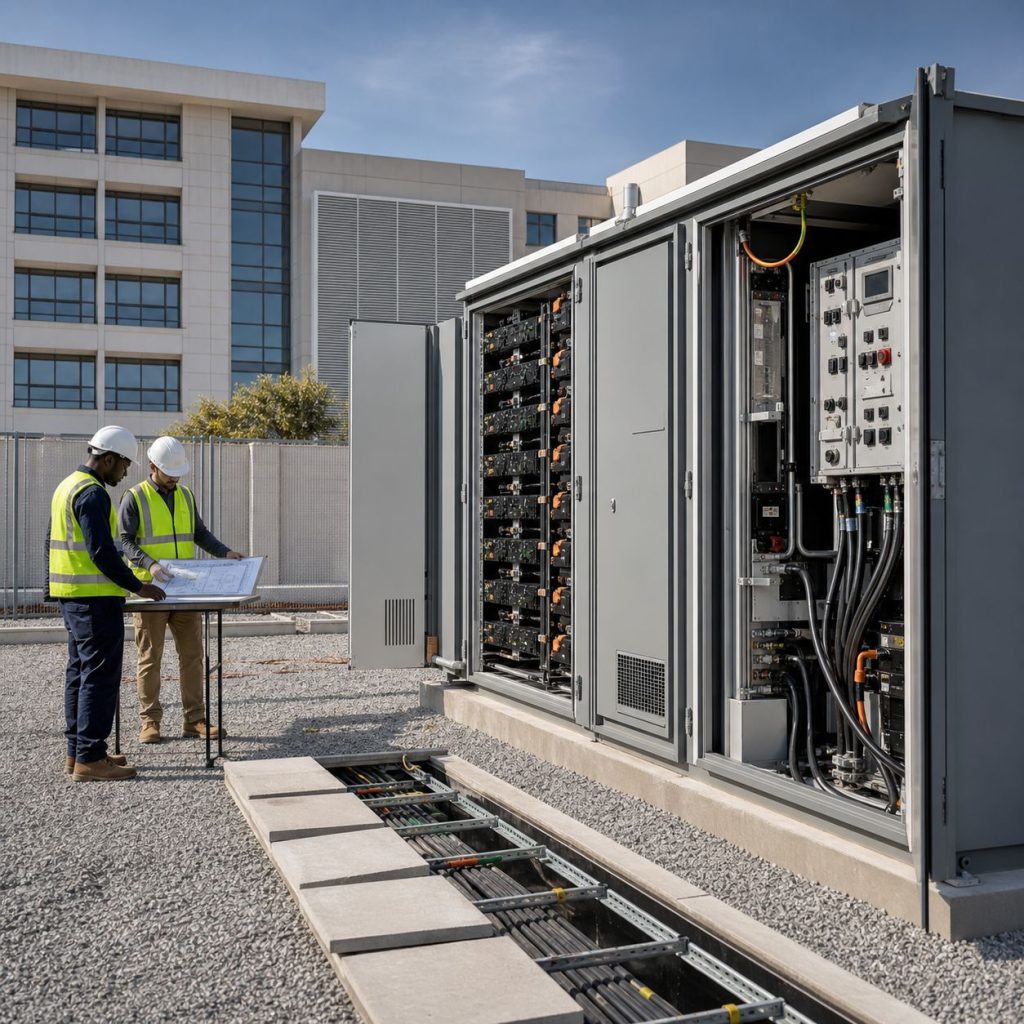
Power and energy are related, but they answer different questions. Power, expressed in kW, concerns the instantaneous demand that the selected inverter and distribution arrangement must carry. Energy, expressed in kWh or MWh, concerns how much electricity is required over the defined duration. A system may have enough nominal energy for an outage scenario yet be unsuitable if it cannot support the required simultaneous demand, starting duty or approved restoration sequence.
A preliminary planning expression is required usable energy = protected load × required runtime. The project team should then assess conversion losses, auxiliary consumption, required reserve, the agreed operating state-of-charge window, temperature effects and degradation planning. This is an illustrative method, not a KRL Power performance commitment. Usable AC energy, auxiliary load and operating limits must be confirmed for the selected configuration and stated test conditions.
Buyers should also state the desired operating priority. If the system is expected to preserve reserve for outage support, that requirement can conflict with routine demand management or solar self-consumption. The control narrative should make the priority explicit rather than leaving it to assumption during commissioning.
4. Coordinate BESS, UPS and generator controls deliberately
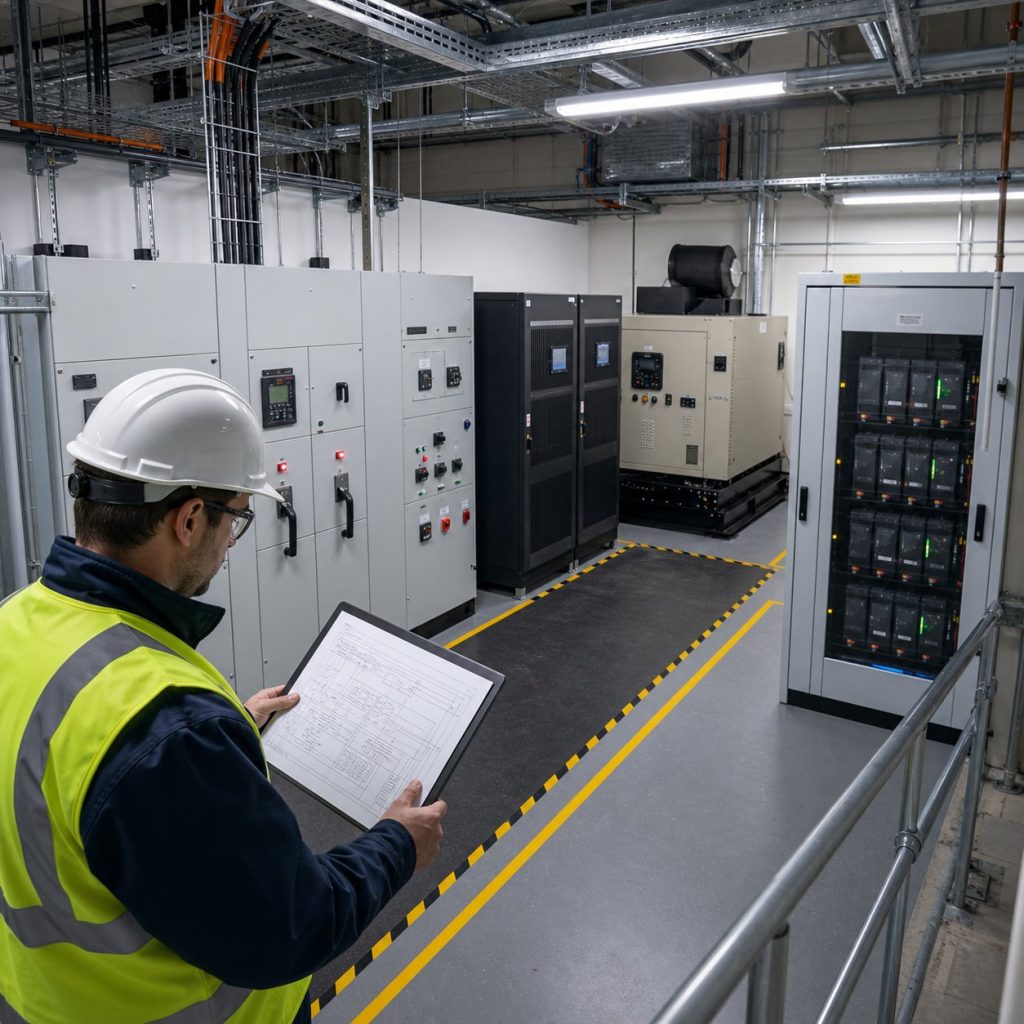
The system architecture should state who detects an outage, which source is permitted to energise each bus, how loads are restored and what occurs if the battery reserve is low or a generator does not start. The goal is a reviewable operating sequence rather than a collection of individually capable assets. The required sequence should be documented for normal operation, supply loss, generator operation, recharging, alarms, manual override and return to normal service.
KRL Power's C&I pages describe integrated battery storage, PCS, MPPT, EMS/BMS, generator interface, fire protection and cooling. The product matrix identifies generator interface and sub-10 ms switching as common page-level signals, while also directing buyers to confirm communications, certifications, usable AC energy, auxiliary load, derating and control limits for the final configuration. Those public signals may support an early discussion; they do not demonstrate no-break performance at every hospital load interface.
Write the control narrative before commercial comparison
A control narrative should explain the intended source priority, outage detection, transfer behaviour, generator start command where applicable, battery discharge limits, recharge approach, solar priority, load-shedding logic, alarm response and manual control. The hospital should also define the safe behaviour when communications are unavailable. This makes it easier to compare proposals on operating outcomes rather than on a headline capacity figure.
Where generator support is proposed, request the supported interface method, start-stop logic, operating limits, control priorities and fault behaviour for the selected project. These questions protect against unintended operation, such as unclear recharge priorities or uncontrolled repeated cycling. They cannot be resolved from generic web-page statements.
5. Use KRL Power's published matrix for screening, not as a hospital guarantee
KRL Power's public C&I matrix lists systems from 30 kW / 65 kWh through listed 750 kW or 1,000 kW configurations with 1.5 MWh or 2 MWh nominal energy. These values can help a buyer determine whether the public range is broadly relevant to a preliminary requirement. They do not establish a hospital's protected runtime, usable AC energy, project compliance, clinical suitability or final installed performance.
Do not add unverified enclosure dimensions, weight, ambient operating range, humidity range, altitude limit, communications detail, port arrangement or certification claim to a hospital specification. If any such item matters to installation, procurement should request the approved drawing, configuration-specific datasheet, contractual scope and supporting evidence. The battery form-factor information is useful background material, but it does not establish the cell choice, lifetime, installation envelope or compliance position of a selected C&I system.
6. Treat South African site integration as a project-specific workstream
Hospital BESS South Africa planning should be based on the real electrical and physical conditions of the site. Record incoming supply characteristics, transformer arrangement, emergency distribution, generator installation, cable routes, indoor or outdoor location, delivery access, security, drainage, noise considerations and emergency-service access. Responsible local professionals should determine the applicable authority requirements, utility conditions, electrical requirements and fire-safety obligations for the particular project.
The public KRL Power material should remain within its evidence boundary. KRL Power positions itself as a lithium-battery and C&I energy-storage source manufacturer focused on custom battery packs, BESS integration and microgrid applications. Its public positioning supports an initial engagement about engineering integration, but company statements and marketing claims do not replace approved project drawings, FAT records, SAT records, certifications or contractual warranties.
The site team should request the final equipment layout before civil and electrical work is committed. That review should cover approved equipment dimensions, lifting requirements, foundation requirements, access clearances, cable entries, maintenance space, emergency isolation and the project fire strategy. A published protection rating, cooling description or nominal capacity cannot by itself validate a proposed location beside a clinical building.
Set a clear boundary for remote monitoring and control
Remote monitoring may be useful for alarms, maintenance and operational visibility, but it also creates governance decisions. Define the approved network architecture, user permissions, authentication approach, remote-command limits, alarm escalation, event-log needs and the local operating mode required if communications are unavailable. KRL Power's public system descriptions refer to EMS/BMS and PCS integration; the supported protocol, object map and access controls must be confirmed for the final configuration.
7. Make safety and protection evidence reviewable
A hospital should evaluate safety through project evidence, not a brochure label. The enquiry package should request a project-specific fire and emergency-response concept, equipment layout, shutdown sequence, thermal-management description, supplied detection or suppression information where applicable, ventilation requirements, hazard communication, maintenance instructions and interfaces with hospital emergency procedures. KRL Power's C&I architecture describes fire protection as a system element, but the final design, approvals, supplied equipment and responsibilities require project confirmation.
Protection coordination is equally important. The project electrical team should review the earthing arrangement, isolation points, breaker and relay coordination, lockout procedures and BESS behaviour during a fault. These are system decisions outside a nominal kW/kWh comparison. They depend on the approved single-line diagram and coordinated information from the equipment suppliers, electrical engineer and facility team.
For background on the public technology scope, the KRL Power technology overview includes category-level statements about LiFePO4, BBU/UPS and smart-battery functions. Those statements should be treated as prompts for verification. The selected system's chemistry, duty-cycle assumptions, warranty conditions and test basis must be confirmed in the project documents.
8. Agree acceptance tests before placing the order
Acceptance tests turn the intended operating sequence into evidence. Agree the test plan before order placement, because it determines the drawings, temporary loads, meters, operational staff, safety controls and access windows needed for commissioning. The hospital should decide which tests can be performed without unacceptable clinical risk and how any limited-duration test will be documented.
- Verify installed equipment identity, labels, isolation points, approved drawings and handover documentation.
- Demonstrate the agreed operating sequence under controlled and approved test conditions.
- Measure transfer behaviour and supply quality at the selected essential-load interface rather than relying only on an equipment-level statement.
- Confirm the agreed protected load and duration through a documented test profile or an agreed calculation method where a full-duration test is impractical.
- Record load shedding, alarm response, manual override, generator interaction, monitoring access and restoration to normal service.
- Deliver as-built drawings, operating instructions, maintenance information, training records, software and parameter backups, plus the agreed warranty documentation.
KRL Power's public C&I energy-storage application information provides a useful starting point for discussing backup and microgrid applications. The acceptance criteria, however, should always be written against the approved hospital architecture and selected configuration.
9. Use a final decision gate before selecting a Hospital BESS
Before requesting a final technical-commercial proposal, the hospital should be able to answer several practical questions: which exact loads are protected, what interruption can each tolerate, how long must they operate, which UPS and generator assets remain active, what operating sequence is approved, where will the system be installed and who has authority over safety, electrical protection, network access and clinical continuity?
If these answers are incomplete, the appropriate next step is preliminary engineering rather than irreversible equipment selection. The available KRL Power public site navigation index shows the breadth of retrieved public content, while the public-source record notes that blocked child sitemap endpoints mean the retrieved material is navigation-complete only for the covered groups, not sitemap-exhaustive. This is a useful reminder that public pages are not a replacement for configuration-specific project evidence.
Prepare a hospital BESS evidence pack before seeking a final proposal. Include the protected-load schedule, interval data, single-line diagrams, UPS and generator information, proposed site layout, continuity objective, safety requirements and acceptance-test expectations. This gives every bidder a clear and comparable basis for response.
The practical result is a more defensible Battery Backup System for Hospital brief. It identifies the protected service, quantifies the duty, assigns control responsibilities and requires evidence for the selected configuration. That is the appropriate basis for evaluating energy storage solutions for hospitals in South Africa or at any site where continuity of electrical supply affects patient care.
For a final cross-check of the public technology context, consult KRL Power's published battery form-factor reference. Use it to frame supplier questions, while keeping the final procurement decision anchored to approved drawings, documented operating requirements and configuration-specific verification.