
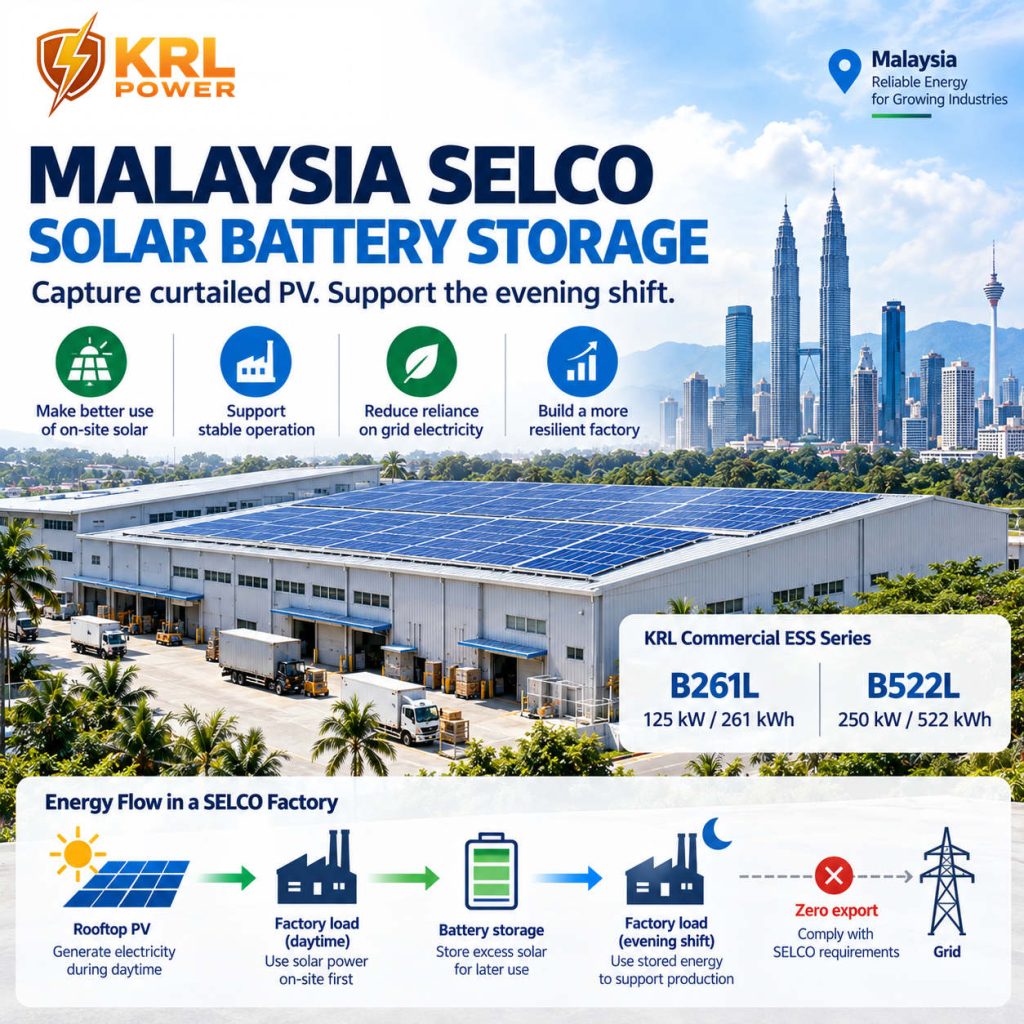
Peninsular Malaysian SELCO factories can lose usable rooftop solar when production slows at midday. Specify KRL-B261L (125 kW / 261 kWh) for a verified 100 kW evening duty; specify KRL-B522L (250 kW / 522 kWh) for one 170 kW feeder. Confirm the charging route and delivered AC energy before either purchase.
I- B261L product specification identifies a 125 kW AC output and a 261 kWh rated battery for the smaller duty. The Iinkcukacha ze-B522L doubles those rated quantities for the 170 kW feeder. Neither model's DC solar-input rating establishes AC charging power from a retained rooftop inverter.
Measure the Solar Electricity the Factory Is Actually Losing
Installed PV capacity does not measure lost electricity. A 900 kWac solar installation may have almost no recoverable output on a busy production day, then curtail heavily on a quiet afternoon. The evidence is an aligned record of available PV power before curtailment, actual inverter production, factory consumption, PCC import/export and the controller's limit command.
For each interval, express available solar and plant consumption as equivalent power at the same AC boundary. With zero permitted export, calculate candidate unused generation as the positive remainder after simultaneous factory consumption and other approved loads. Confirm that the apparent surplus corresponds to a genuine inverter curtailment command or available-generation estimate; weather-driven production loss is not recoverable curtailment. If strings are moved to the cabinet's DC inputs, repeat the energy balance at that new topology and include its conversion limits.
| Same-clock record | Decision it changes |
|---|---|
| Available PV before curtailment and actual inverter output | Amount genuinely constrained by the existing controller |
| Factory load excluding BESS charging and PCC power | Energy available after production’s first claim on PV |
| Length and repetition of the constrained intervals | Maximum candidate AC charging energy, in kWh |
| Evening load and the next morning’s SOC requirement | The useful discharge destination and recovery deadline |
| Permitted SOC, live BMS limit and approved charge-power rating | How much candidate energy a specific configuration can accept |
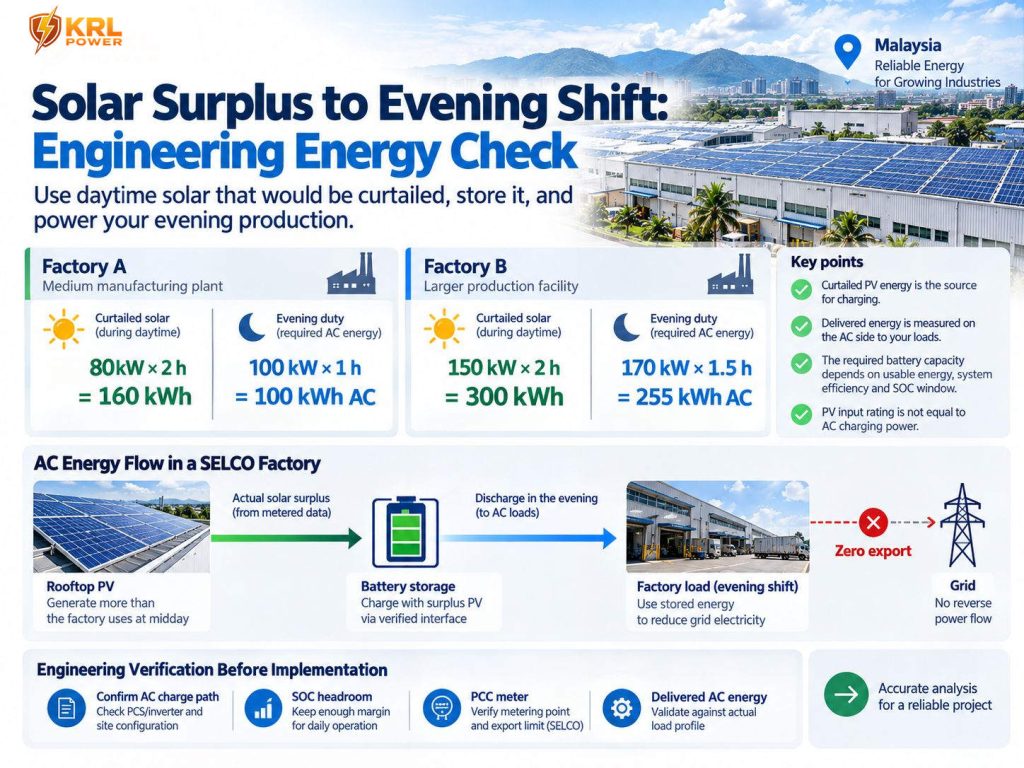
A two-hour event averaging 80 kW of genuinely constrained PV represents 160 kWh of potential AC energy. That quantity is a source-side ceiling, not a battery delivery guarantee or an instruction to buy 160 kWh of usable capacity; the later factory load, charger power, SOC headroom and conversion losses set the useful recovery target. The KRL B522L solar-storage integration guide distinguishes its direct-DC solar input from the AC connection. Purchase acceptance still depends on the ordered model and the site's metered energy boundary.
Match a 100 kW Evening Shift to B261L and a 170 kW Feeder to B522L
Two factory operating profiles below the 1 MWac regulatory trigger lead to different equipment purchases. The first shifts otherwise curtailed power into a short night shift; the second supplies a larger common feeder. All power and energy quantities use the site AC bus as the calculation boundary.
| Purchasing input | Smaller factory | Expanded factory |
|---|---|---|
| Solar installation rated AC capacity | 600 kWac | 900 kWac |
| Candidate curtailed AC surplus | 80 kW for 2 h | 150 kW for 2 h |
| Candidate AC surplus energy | 160 kWh | 300 kWh |
| Required evening battery output | 100 kW for 1 h | 170 kW for 1.5 h |
| Required delivered AC energy | 100 kWh | 255 kWh |
| Initial KRL product class | B261L: 125 kW / 261 kWh | B522L: 250 kW / 522 kWh |
| Published maximum AC current | 189 A | 375 A |
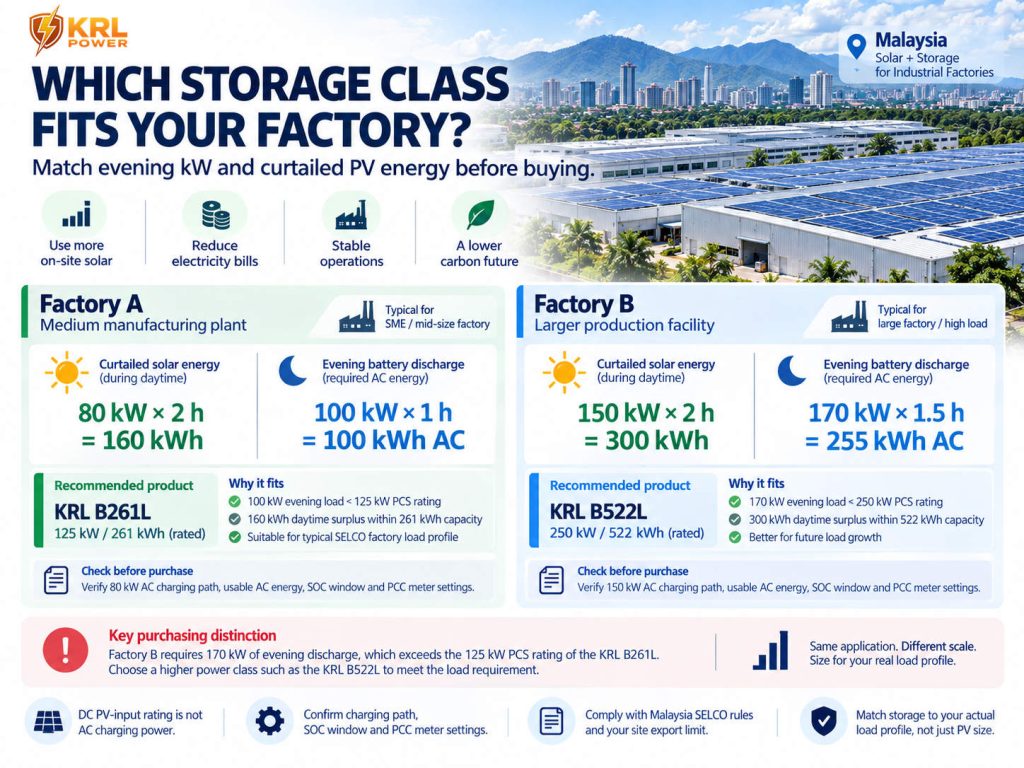
600 kWac factory — specify B261L for the initial engineering design. Its 125 kW rated AC output covers the 100 kW evening contribution on a real-power screen, with 25 kW nominal margin. Buying the 250 kW class solely because the solar installation is 600 kWac does not solve another proven requirement. Confirm feeder current and power factor, the actual 80 kW charging path, and at least 100 kWh delivered AC at the evening meter before ordering.
900 kWac factory — specify B522L as the single-cabinet engineering route. One feeder needs 170 kW during its 90-minute evening window, exceeding B261L's 125 kW rated output by 45 kW. B522L supplies the 250 kW rated class, while its 522 kWh nominal energy is a starting screen for 255 kWh delivered AC. Confirm that this cabinet can accept the planned 150 kW solar surplus through the chosen interface and meet the AC energy obligation after SOC and loss allowances; its nameplate does not guarantee full recovery of 300 kWh.
I- KRL C&I class-selection comparison places these two cabinet duties alongside the plant-scale alternative when a single 250 kW cabinet no longer covers the signed feeder.
At the 400/230 V three-phase interface listed in the manufacturer's sheets, the current limits are 189 A for B261L kwaye 375 A for B522L. A common feeder needing 170 kW must not be described as two independent loads merely to keep a single 125 kW converter on the order. The two-B261L versus one-B522L hardware comparison identifies why identical summed nameplates do not mean identical feeders, controls, PV ports or foundations.
Check the 2026 SELCO Rules Before Treating a Battery as Mandatory
A Peninsular Malaysian factory must first identify the scheme attached to its solar installation. Under self-consumption (SELCO), surplus generation must not be exported to the grid. An export-limiting controller may consequently reduce PV production when the factory load falls below available generation. This creates a commercial reason to store energy for a later shift, provided that energy can actually be captured and used.
The Energy Commission published its June 2026 SELCO guidelines on 24 July 2026. Under paragraph 3.6, the non-domestic BESS trigger is a solar installation exceeding 1 MWac. Solar installations at or below 1 MWac are not subject to that particular BESS requirement. Above the trigger, the rule specifies at least one hour of full solar rating: X MWac requires at least X MWh. Rajah & Tann's analysis dated 29 July 2026 documents the revised threshold, AC measurement and transition provisions. Check the premises, completion/licensing dates and any applicable exemption before treating a retrofit as a new mandatory installation.
A 600 kWac or 900 kWac SELCO plant has a different purchase trigger: repeated lost solar and useful later factory consumption, not a blanket BESS mandate. For a 1.2 MWac installation that actually falls within paragraph 3.6, the minimum stated battery-energy benchmark is 1.2 MWh; one B522L at 522 kWh does not meet that figure. That larger regulatory duty belongs in a plant-scale design with separate power, coupling, metering and utility-acceptance checks.
Solar ATAP is a separate programme. SEDA's eligibility guidance confirms its 1 January 2026 start, permits eligible exports and states that applicants must not already be registered under SELCO or NEM. Do not assign ATAP export credits to the existing SELCO factory or imply that changing programmes is automatically permitted. The purchase examined here is for a verified no-export SELCO connection in Peninsular Malaysia.
Retain the Rooftop Inverter Only with an Approved Charging Path
A factory already operating rooftop PV normally has an inverter feeding its AC switchboard. KRL's published 120 kW PV input on B261L kwaye 240 kW PV input on B522L describe DC solar-input limits. They are not confirmed AC-side battery-charging ratings. Connecting the output of an existing AC solar inverter to a cabinet's DC MPPT terminal is not a permissible shortcut.
| Installation route | Published KRL boundary | Order-release evidence |
|---|---|---|
| Keep the existing PV inverter; add battery on the AC bus | B261L 125 kW or B522L 250 kW rated AC output, with 189 A or 375 A maximum current | Exact ordered model’s bidirectional AC charge rating, wiring, control interoperability and approved protection |
| Reallocate correctly designed DC strings to B261L | Maximum 120 kW DC PV input; 250–850 Vdc MPPT range; 950 Vdc maximum PV voltage | String cold-temperature open-circuit voltage, operating voltage/current and signed PV protection design |
| Design DC strings for B522L | Maximum 240 kW DC PV input; two MPPT channels; 250–850 Vdc operating window | String allocation, per-input current, voltage extremes and protection coordination |
The purchase consequence is substantial. A 125 kW/261 kWh cabinet can fail the intended solar-recovery duty if its ordered AC charging path cannot accept the required 80 kW. The larger 250 kW/522 kWh model's output rating likewise does not establish a 150 kW AC charging capability. Obtain model-specific evidence before presenting either recovery quantity as a deliverable.
Keeping a functioning solar inverter may preserve existing hardware if an AC-coupled retrofit is approved. The KRL retrofit integration checklist sets out the necessary changes to meter mapping, protection, firmware, control authority and cutover records; the installer must demonstrate compatibility of the actual inverter and the selected KRL configuration.
Design the Malaysian Connection Around the Cabinet's Current, Not Only Its Energy
The KRL product tables specify 400/230 V three-phase, 50/60 Hz. The Malaysian factory's actual transformer secondary, switchboard voltage, grounding and feeder current must match an approved design; a nominal label alone does not certify compatibility. Recheck fault levels, protection coordination and reverse-power measures wherever the PV/BESS single-line drawing changes.
The June 2026 SELCO guideline and the applicable utility assessment process govern the solar connection. The connection-review threshold must not be confused with the higher BESS-mandate threshold: a project requiring a connection study does hayi automatically require a battery. Tenaga Nasional Berhad's connection guidelines distinguish supply-voltage planning and distributed-energy-resource connection requirements. Determine the study, licensing and alteration route for the actual existing PV plant, proposed BESS connection and distribution utility before ordering equipment.
Both product pages list liquid cooling for the battery. Their IP65 designation explicitly applies to the battery subsystem; it does not establish an IP65 ingress rating for the complete cabinet or permission to wash down the installation. For an outdoor Malaysian factory, approve the foundation, drainage, flood exposure, heat rejection, maintenance clearance and lifting path. B261L is listed at approximately 2,600 kg, and B522L at approximately 4,900 kg. The larger cabinet changes the civil and handling scope alongside its electrical capability.
Factory motor starting is a separate engineering check. A quiet evening load curve does not establish a converter's transient response or the protection settings of a heavily motorised feeder. The KRL 125 kW converter and motor-start review explains why a normal running-power reading cannot certify a restart sequence.
Give the Export Limit Priority When Clouds Move or the Battery Fills
A battery that charges at a fixed midday setpoint may start drawing from the grid when clouds reduce PV output. It can also fill before the solar crest, leaving the PV controller to curtail generation again. EMS design therefore affects whether the customer receives the solar benefit assumed in the purchase.
The operating sequence is to supply the factory from PV first, measure the remaining surplus at the approved PCC boundary, charge only within verified PCS/BMS/SOC limits and reduce the command as surplus disappears. When the battery approaches its permitted upper SOC or the charge path reaches its limit, the designated PV controller must curtail the remaining generation within the permitted no-export condition. Loss of an authoritative meter or control link needs a tested safe response, not a frozen charging command.
The reserve setting also has an owner. If the factory purchases the cabinet for an approved backup duty as well, energy used after sunset cannot also be counted as untouched outage reserve. The KRL shared peak-shaving and backup duty analysis identifies the reserve conflict. Solar recovery does not itself certify islanding, whole-factory continuity or an approved transfer arrangement.
Commissioning should replay three transitions against time-aligned records: rising PV while storage has room, sudden PV loss while the charger is active, and a full battery during the afternoon solar peak. Record the PCC power sign, accepted battery AC charging kW, curtailment command, starting/ending SOC and delivered AC energy. IEC TS 62933-2-2:2022 defines application and performance testing methods and duty cycles for electrical energy storage systems; use the applicable project test procedure to distinguish accepted AC energy from the nominal battery rating. A successful sequence respects the export agreement and demonstrates real solar recovery; manufacturer nameplates alone cannot prove either result.
Value Recovered Solar at the Factory Meter Before Upsizing
At the site AC boundary, 80 kW × 2 hours gives the smaller factory 160 kWh of candidate surplus; 100 kW × 1 hour defines its 100 kWh evening delivery. For the expanded factory, 150 kW × 2 hours produces 300 kWh of candidate surplus, while 170 kW × 1.5 hours requires 255 kWh delivered AC. The expanded profile therefore needs at least 85% of that entire candidate source energy to reach the evening meter even if all 300 kWh can enter storage. This is a mathematical screening condition, not a stated KRL efficiency. If the approved charge path, SOC headroom and losses cannot meet it, the project must reduce the delivery target or define another permitted energy source; a larger battery nameplate alone does not create missing solar energy.
A defensible project comparison uses energy actually delivered to the specified factory meter multiplied by the applicable avoided-import price, then subtracts charging energy bought from the grid, operating costs and battery usage costs where relevant. SELCO's no-export constraint affects the counterfactual; a Solar ATAP participant needs a different comparison that includes its actual permitted export credit. No published KRL rating establishes tariff savings, return on investment or payback by itself.
Start with the model that meets the proven evening kW. If the actual duty is 100 kW, B261L avoids purchasing the unused 250 kW converter class. If one feeder needs 170 kW, the B522L power class addresses the shortfall that a single B261L cannot cover. Increase energy capacity only when measured, repeatable usable-energy demand justifies it; unused daytime PV on an array nameplate is not enough.
Where a non-domestic SELCO system exceeds 1 MWac and has no applicable exemption, paragraph 3.6 requires at least one hour of battery energy corresponding to its MWac solar rating. A 1.2 MWac example therefore starts at 1.2 MWh, exceeding either single KRL cabinet; this is a different procurement scope. KRL's 750 kW/1 MW versus yard-cabinet comparison opens the plant-scale equipment review; energy, power, regulatory approval and exact ordered-model evidence remain distinct.
Release the Purchase Against One AC Energy Balance
B261L is the initial 600 kWac SELCO-factory purchase path for the 100 kW evening duty, subject to an approved 80 kW charge route and a validated 100 kWh AC delivery window. B522L is the one-cabinet path for the 900 kWac factory's 170 kW evening load, provided its ordered charge configuration and at least 255 kWh delivered AC are demonstrated. Neither decision bypasses the factory's approved SELCO connection.
Write four separate accepted results into the project: candidate curtailed AC solar energy; solar energy actually accepted by storage; energy later delivered at the agreed AC meter; and residual PV curtailment. A successful system moves more of the factory's existing generation into a useful later operating window without buying a larger cabinet simply because the roof looks large.