

Remote sites do not lose money only because diesel is expensive. They lose money because every litre must be purchased, transported, handed over, stored, guarded, measured and finally burned. KRL Power solar + BESS removes much of that stealable fuel flow from routine electricity production and turns energy use into something management can measure remotely in kWh instead of trying to reconcile missing litres.
Replacing diesel generators does not always mean physically removing every genset from the site. The first replacement is operational: solar + BESS takes over routine energy duty, while the generator moves into long-outage backup.
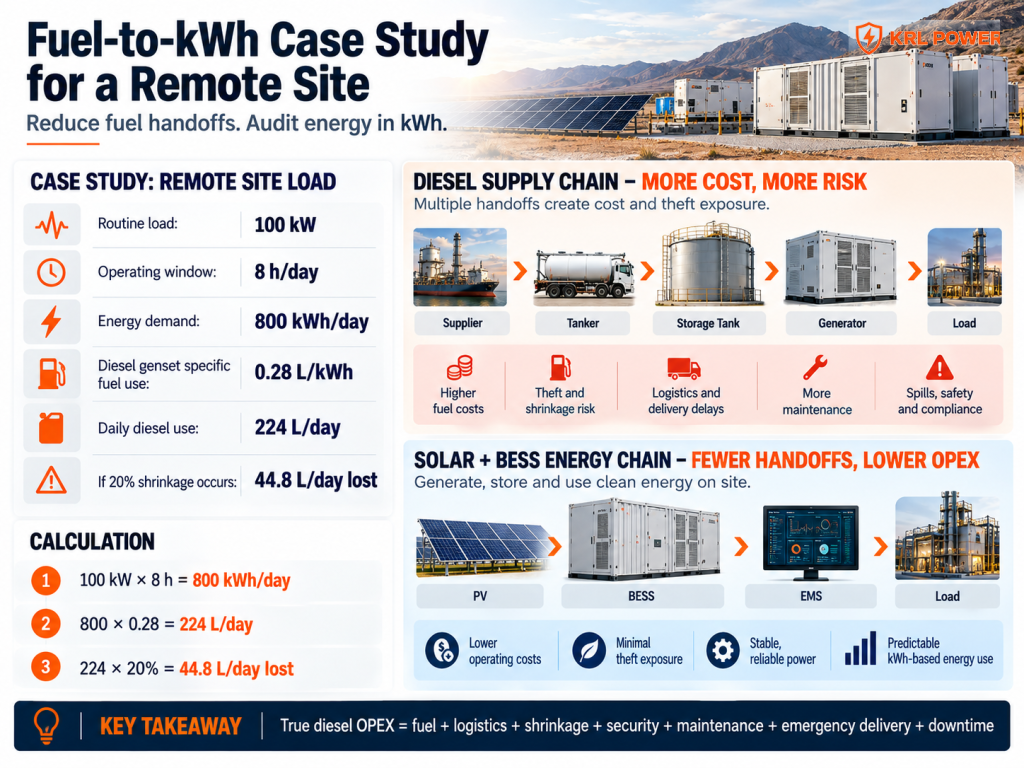
If a remote mine, telecom tower or agricultural site still runs a generator every day, the company is also running a small fuel-distribution operation whether it calls it that or not:
supplier → tanker → driver → site gate → bulk tank → day tank → generator
Every handoff adds cost and another reconciliation point. Any physical litre sitting between the supplier and the engine can disappear before it ever produces electricity.
Where site records show 20–30% shrinkage, the loss is no longer a minor security expense; it is a direct hit to operating profit. Adding another padlock does not change that exposure. Reducing the amount of stealable fuel moving through the business does.
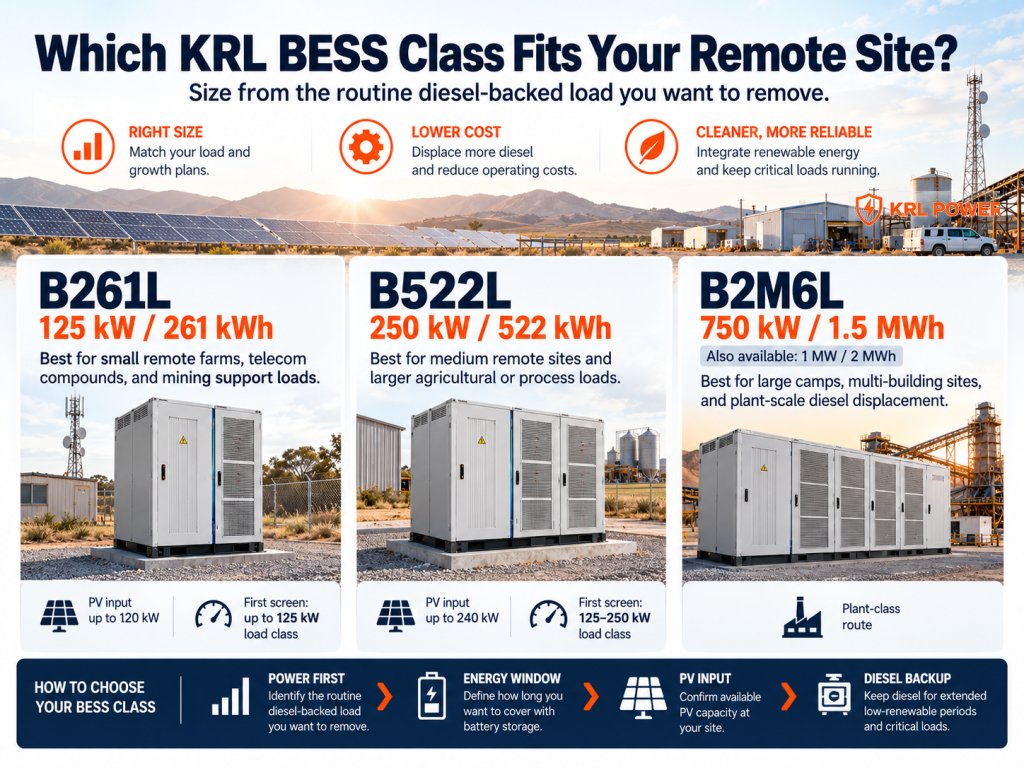
For remote loads inside the 125 kW class, KRL-B261L provides a 125 kW / 261 kWh platform with up to 120 kW PV input and diesel-generator integration.
When the required electrical duty moves beyond 125 kW, KRL-B522L raises the platform to 250 kW / 522 kWh with up to 240 kW PV input.
Large mining camps, agricultural estates and multi-site remote microgrids can move into the KRL-B2M6L plant-class range.
The equipment choice should start with one commercial question: how much routine diesel duty can be taken out of the daily operating chain without weakening power availability?
The "Shrinkage" Epidemic: The True Cost of Diesel Logistics
The Vulnerable Supply Chain
Diesel is expensive, but the bigger control problem is that it remains valuable and portable at every stage of the supply chain.
A tanker leaves the depot, someone confirms how much was loaded, another person drives it hundreds of kilometres, the site receives it, the bulk tank is measured, fuel is transferred again, generator hours are recorded, and someone signs the reconciliation sheet. For a remote asset, that is a long chain of custody with too many places where records and physical inventory can diverge.
The owner may be in Johannesburg, Lagos, London or Nairobi while the fuel sits hundreds of kilometres away. In many remote operations, the same local team receives the tanker, controls tank access and reports the inventory. More paperwork can document that process, but it does not remove the underlying exposure.
That is why the real diesel equation is not:
litres × pump price
Yile:
diesel purchase + transport + storage + security + shrinkage + generator maintenance + emergency delivery + downtime risk
A CFO who models only the supplier invoice is understating the cost of diesel power.
The true cost includes missing litres, tanker logistics, guards, fuel storage, generator overhauls and emergency refills when the recorded inventory turns out to be wrong.
Diesel can look cheap in a procurement spreadsheet while its transport, security, shrinkage and maintenance burden sits elsewhere in the P&L.
The Failure of Traditional Security Measures
The standard response to fuel theft is to surround the fuel with more security.
The usual response is more hardware and more paperwork: stronger locks, flow meters, GPS tracking, CCTV, guards and additional signatures on delivery sheets.
These controls can help, but they do not change the basic fact that the valuable commodity is still physically present on site.
Locks, GPS trackers, flow meters and CCTV all have a role, but each one monitors a physical fuel chain that still depends on honest handoffs and usable records. None of them proves by itself that every purchased litre became useful electricity.
Traditional security tries to defend the fuel chain. Solar + BESS changes the exposure by shrinking that chain in the first place.
If the site stops burning diesel for routine daytime and evening loads, it orders, transports, stores and guards fewer litres. The amount of fuel available to disappear falls with it.
That is a fundamentally stronger control than buying another lock for the same tank.
The BESS Advantage: A Theft-Proof Energy Ecosystem
The Physics of Security: You Can't Steal Electrons
The strongest way to reduce fuel theft is to reduce the fuel flow itself. A solar + BESS microgrid does exactly that for the portion of the load it can carry economically.
With a conventional diesel site:
fuel supplier → truck → storage tank → day tank → generator → electrical load
With solar + BESS:
sunlight → PV → battery / PCS → electrical load
Sunlight does not arrive in a tanker, and stored electrical energy cannot be siphoned into a 20-litre container for roadside resale. That removes the easiest theft mechanism from routine power production.
A BESS site still needs physical security, and cabinets, cables, switchgear and communications remain assets that need protection. What changes is the routine energy commodity.
The site is no longer moving a liquid product with an immediate black-market resale value through multiple human-controlled handoffs.
That is the real anti-theft advantage.
For a remote farm, telecom compound or smaller mining support site with a signed critical load below 125 kW, KRL-B261L should be the first KRL class screened.
The 125 kW rating matters because it defines how much routine diesel generation the site can potentially displace, subject to the load profile and energy window.
If a site currently operates an 80–110 kW routine load on diesel during daylight hours, PV plus B261L can move a large part of that operating period away from the fuel chain.
Each kWh supplied from solar and storage reduces the corresponding diesel energy that would otherwise have to be bought, moved, stored and reconciled.
When the signed load moves past 125 kW, B522L becomes the first larger class to screen. Its 250 kW / 522 kWh platform and larger PV-input class can move a greater share of the site's normal demand away from routine genset operation. Once several buildings, pumps, workshops or process loads are aggregated onto one microgrid, B2M6L becomes relevant because the site is no longer managing one cabinet-sized duty; it is replacing a larger block of distributed diesel generation at plant scale.
The objective is not to buy the largest battery possible. It is to move the economically sensible share of routine generation outside the diesel supply chain while retaining the genset for the periods where long-duration fuel-based backup still adds value.
100% Digital Transparency and Remote Monitoring
Diesel reconciliation follows a physical commodity through several handoffs. A BESS microgrid produces an electrical record instead, which gives head office a different way to audit the site.
EMS can place PV generation, battery charge/discharge, SOC, PCS power, load demand, generator contribution, alarms and operating states on one electrical timeline that can be reviewed remotely.
The CFO no longer has to start every variance review with, “How many litres did the driver say he delivered?” The first check can instead be, “How much energy did this site generate, store and consume?”
That difference is enormous.
Suppose a remote site reports unusually high diesel use. With a manual fuel system, head office may spend hours comparing delivery sheets, tank readings and handwritten generator-hour records before it even knows where the discrepancy started.
With an integrated BESS and EMS, management can compare generator operating hours against electrical load, PV production, battery discharge and site consumption.
The question changes from:
“Where did the fuel go?”
to:
“Why does the electrical energy balance not match the expected operating profile?”
That is a much stronger audit position.
The data should not be described as magically impossible to alter. User permissions, communications, access control and system architecture still matter.
But digital energy monitoring removes one of the worst weaknesses of remote diesel operations:
head office no longer depends entirely on manual fuel reporting from the same remote location that controls the fuel.
For a remote owner, that is less about dashboards and more about management control.
Operational Reliability: Preventing "Empty Tank" Outages
The Silent Sabotage
Fuel shrinkage eventually becomes an uptime problem, not just a finance problem.
The records may show enough fuel on site, yet the generator can run for less time than expected and the critical load can still go dark.
The missing litres have suddenly become operational downtime.
At a telecom site, that can take communications offline.
At a mine, it can stop pumps, ventilation, lighting or process loads.
At an agricultural site, it can stop refrigeration, ventilation, irrigation or water systems.
The danger is that shrinkage can remain hidden until the site actually needs the energy and the recorded reserve is no longer there.
A security report can be investigated tomorrow.
A dead critical load cannot always wait until tomorrow.
Solar + BESS reduces that dependency by storing a measurable electrical reserve on site.
The question is no longer:
“Do we think there is enough fuel?”
It becomes:
“What is the current SOC, what is the signed critical load and how many hours of reserve are available?”
That is a far more useful operating question.
Uninterrupted Autonomy
Battery autonomy is calculated from power and energy, not from a fuel inventory that may be disputed.
Assume a remote site has 100 kW of critical load that must remain available for four hours before long-duration diesel support is required.
The first calculation is simple:
100 kW × 4 h = 400 kWh
That immediately shows why buying by PCS power alone is dangerous.
A system can pass the 100 kW power requirement and still fail the four-hour energy requirement.
The same logic applies to KRL selection.
A protected load below 125 kW brings B261L into the first power screen.
A protected load between 125 kW and 250 kW moves the first screen to B522L.
Larger site-wide loads move toward B2M6L.
Then the energy window has to pass.
Rated battery capacity is not automatically usable AC energy. The final project still needs to account for the approved SOC window, conversion losses, auxiliaries, operating reserve, temperature and battery condition.
That engineering discipline matters because a secure energy system still has to carry the load it was bought to protect.
Diesel operators often ask:
“How much fuel do we think is left?”
A properly monitored BESS allows management to ask:
“How much stored energy is available against the current critical load?”
The second question is materially easier to verify because it is tied to measured load and stored energy rather than a disputed physical inventory.
The ROI Equation: Driven by OPEX Elimination, Not Just Efficiency
Rethinking the Payback Period
Your diesel invoice is not your diesel cost. For a remote-site BESS business case, that is the right place to start.
If the CFO compares BESS CAPEX only against the official price per litre, the spreadsheet is already incomplete.
The real calculation is:
True diesel OPEX = fuel purchase + shrinkage + tanker logistics + fuel storage + security + generator maintenance + lubricants + filters + overhaul allowance + emergency delivery + downtime exposure
Against that, the project should model:
Solar + BESS CAPEX + financing + maintenance + remaining backup-diesel cost

That is the correct commercial fight.
Consider a site purchasing the equivalent of $500,000 of diesel per year.
If site reconciliation shows 20% unexplained shrinkage:
$500,000 × 20% = $100,000
That $100,000 has not produced a single useful kWh.
The same model should include tanker transport, fuel-store security, generator oil and filters, maintenance labour, engine overhauls, emergency deliveries and downtime linked to unexpectedly low fuel inventory.
Once those items are counted, the annual cost can sit well above the supplier invoice.
Now the BESS CAPEX is not being compared with “cheap diesel.”
It is being compared with an entire operating system built around buying, moving, protecting and burning a stealable commodity.
This is why remote-site economics can look very different from a grid-connected C&I project where fuel logistics and shrinkage barely exist.
Do not promise every customer a two-year payback. Calculate it from the site's own records; if the result is 2.4 years, show 2.4 years, and if it is 4.1 years, show 4.1 years.
There is no need to manufacture an aggressive payback claim. The customer's own accounts should do the work.
Ask the CFO for twelve months of diesel purchased and physically received, generator operating hours and metered kWh if available, delivery cost, tanker mileage, security and fuel-storage expense, generator servicing, lubricants and filters, emergency deliveries, unexplained fuel variance, and outages linked to fuel availability.
Then calculate:
Total diesel-system OPEX ÷ useful generator kWh
That is the cost base BESS has to reduce, not the pump price by itself.
A remote company that spends heavily on guards, meters, reconciliation and emergency deliveries is already paying to control fuel theft; the weakness is that the fuel remains available to steal.
Conclusion: Cut the Fuel Line, Secure Your Profits
A remote operation should not also have to run a private fuel-security business simply to keep the lights on.
Every litre used for routine generation has to be ordered, transported, received, stored, guarded, measured, reconciled and finally burned.
Solar + BESS reduces that exposure by removing a large part of the stealable fuel commodity from normal electricity production. It does not make the entire site theft-proof; it removes one of the most persistent theft channels.
KRL-B261L gives smaller remote operations a 125 kW / 261 kWh starting class.
KRL-B522L moves larger remote loads into the 250 kW / 522 kWh class.
KRL-B2M6L extends the same architecture into larger mining, agricultural and remote microgrid projects.
The diesel generator does not have to disappear on day one; its role changes.
Instead of being the machine that runs every day and forces the company to keep feeding a vulnerable fuel chain, it becomes the backup source used when stored energy and solar are no longer enough.
At a remote site, “replacing diesel generators with BESS” should first mean replacing diesel as the routine operating model. Whether the physical genset can later be removed is a second decision based on autonomy, solar resource, seasonal conditions and the site's tolerance for long outages.
For the owner, the useful financial question is not simply, “How much does diesel cost per litre?” It is, “How much are we spending every year to buy, transport, guard and reconcile a fuel supply chain that still shows unexplained losses?”
That is the number worth eliminating.
Send KRL Power the site's monthly diesel consumption, generator rating, operating hours, critical load, site voltage, available PV area and required backup duration. The engineering team can use those inputs to screen B261L, B522L or B2M6L and quantify how much routine diesel duty can realistically be removed.