 Yiya kumxholo
| Into | Iinkcukacha zobuchwepheshe |
|---|---|
| Recommended Starting System | KRL-B261L 125 kW / 261 kWh liquid-cooled pre-integrated ESS |
| Primary Use Case | Tea and coffee processing factories running night shifts |
| Key Functions | Instant bridging, diesel runtime reduction, solar self-consumption, process continuity |
| Ukubandisa | Ukupholisa ngamanzi |
| Optional Upgrade | Hybrid solid-state / quasi-solid-state cells for higher-safety sites |
| Typical Architecture | Grid + Solar PV + ESS + existing diesel + critical process loads |
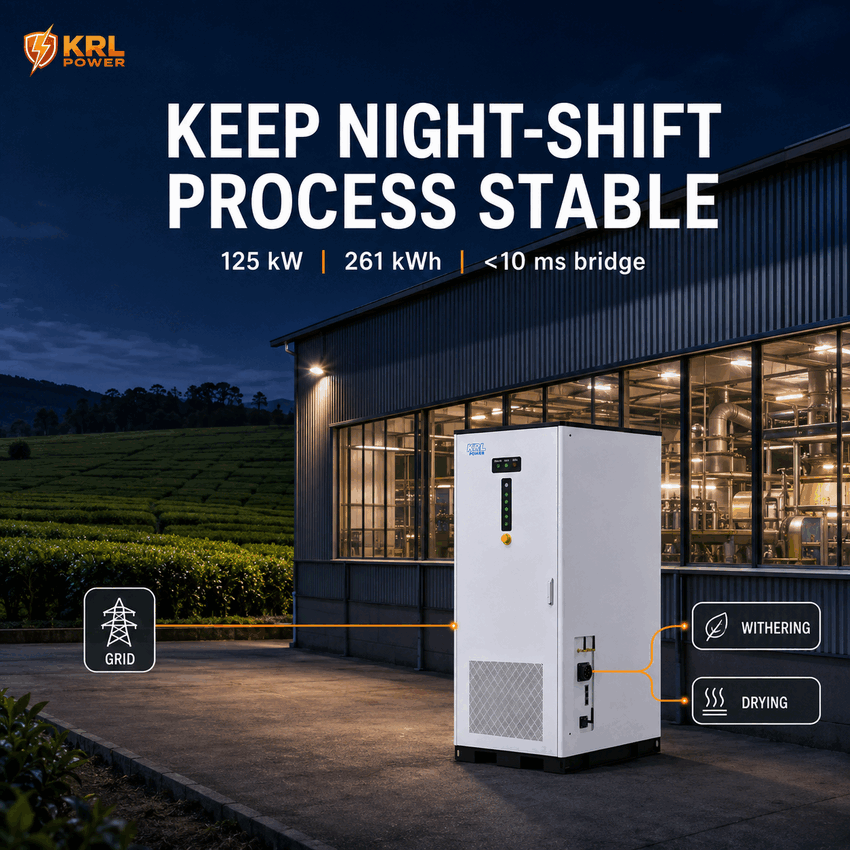
Night-shift power interruptions in Kenyan tea and coffee factories do more than stop machines. They interrupt withering, drying and temperature-sensitive stages that directly affect leaf quality and final grade. Once the process is disrupted, the damage shows up in the cupping score or the auction price, not just on the electricity bill.
A factory-pre-integrated 125 kW / 261 kWh liquid-cooled ESS from Amandla e-KRL is designed to protect that continuity in four practical ways:
- Instant bridging so critical process lines keep running while the diesel starts or stays offline
- Coordinated solar + storage that prioritises withering fans, dryers and sorting equipment
- Liquid cooling that holds performance under continuous high-duty cycles
- Single-party responsibility for system performance, warranty and expansion
The goal is simple: keep the night-shift process stable so grade consistency is not left to chance.
Why Tea and Coffee Processing Is Especially Sensitive to Power Gaps
Tea and coffee factories share several characteristics that make short outages expensive:
- Withering and drying stages need stable temperature and airflow
- Restarting after an interruption often produces uneven moisture or over-dried leaf
- Night shifts are when a large share of processing happens
- Export buyers pay for consistency; grade drops are hard to reverse
Diesel generators are already common. The problem is the transfer delay and the cumulative fuel cost of running them for every short grid event.
Why a Larger Diesel Generator Alone Does Not Protect Grade
Upsizing the diesel usually increases fuel consumption, maintenance frequency and noise during night hours. It does not remove the gap between grid failure and stable power restoration. That gap is exactly when process quality starts to drift.
What these factories need is a system that keeps the critical load powered through the transition so the process never notices the outage.
Matching 125 kW Power and 261 kWh Energy — Is It Enough?
| Ipharamitha | Ixabiso | Practical Meaning |
|---|---|---|
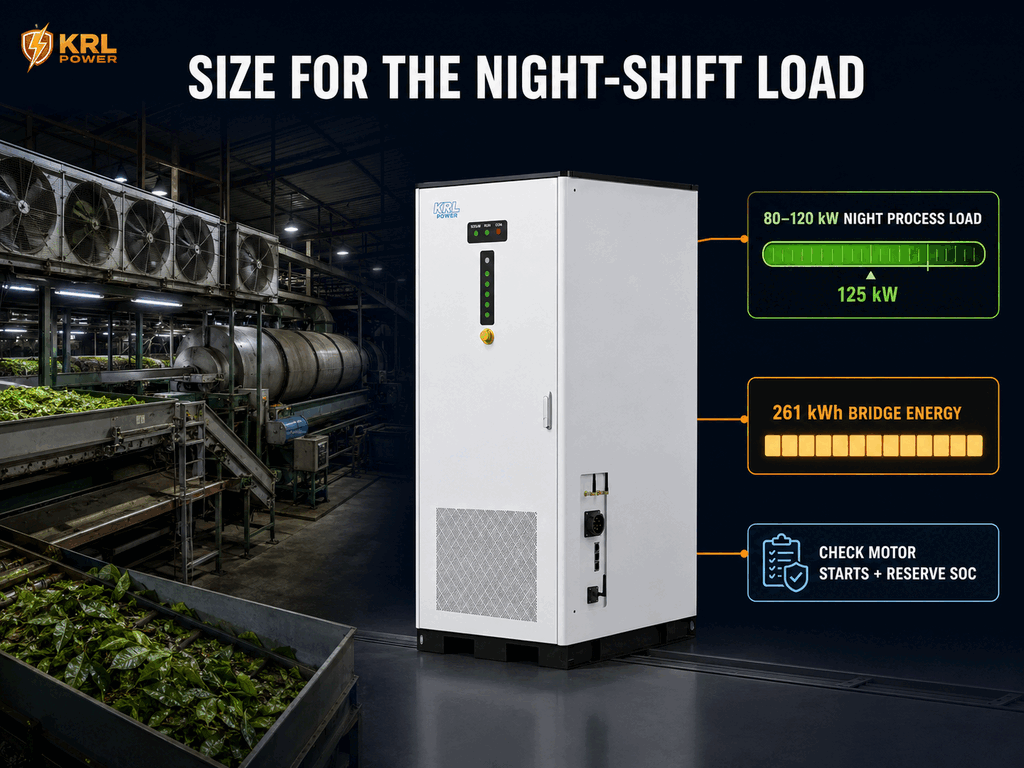
| Amandla alinganisiweyo | 125 kW | Supports typical continuous process loads on medium tea/coffee lines |
| Amandla Alinganisiweyo | 261 kWh | Meaningful bridge time so diesel stays offline during short and medium events |
| Ixesha eliqikelelweyo lokusebenza kwi-100 kW | ≈ 2.6 hours | Simple calculation only (261 ÷ 100) |
| Real usable runtime | Imfutshane | Affected by SOC window, losses, auxiliaries and reserve policy |
Direct guidance:
- Continuous night-shift process load typically 80–120 kW → 125 kW / 261 kWh is a practical starting point.
- Larger multi-line factories → treat this as Phase 1 and plan parallel cabinets once measured load is confirmed.
- No solar → energy demand rises; 261 kWh may become tight for multi-hour autonomy.
- Solar already planned → daytime charging supports night bridging and improves diesel reduction.
Three checks worth doing:
- Measured continuous night-shift process load
- Below 100–110 kW → 125 kW has healthy margin
- Regularly above 130–150 kW → plan parallel units
- Required bridge time before diesel is allowed to start
- Minutes to 30–40 minutes → 261 kWh is normally sufficient
- Several hours without diesel → increase energy capacity
- Solar availability for daytime charging
- Yes → 125 kW / 261 kWh works well as the core hybrid block
- No → treat it as a short-bridge system and size energy more carefully
Engineering note: 125 kW is a starting selection based on steady-state critical load. Final confirmation still requires review of motor-start sequence, simultaneous motor starts, VFD/soft-starter/DOL configuration, power factor, and the PCS short-duration overload capability.
Sizing must start from the measured critical process load, not from the battery nameplate. The 125 kW / 261 kWh unit (KRL-B261L) is designed as a modular building block within KRL Power’s C&I energy storage systems.
→ Submit your continuous night-shift load and motor list for a preliminary check.
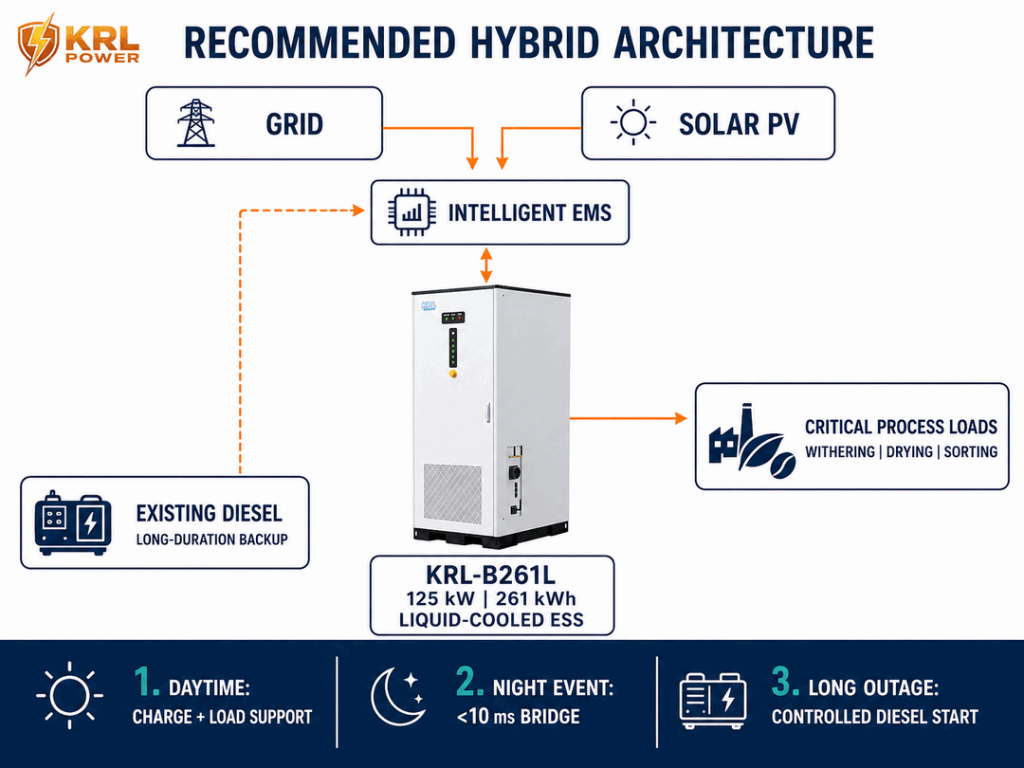
Recommended Hybrid Architecture
Grid → Intelligent EMS → 125 kW / 261 kWh liquid-cooled ESS → Critical process loads (withering, drying, sorting) Existing diesel retained as long-duration backup only Solar PV sized to daytime process demand and battery charging
Typical sequence:
- Daytime with good solar → PV covers process loads and charges the ESS
- Grid present but expensive → ESS discharges to limit peak demand
- Grid fails at night → ESS bridges instantly so the process never stops
- Diesel running → ESS absorbs load steps and shortens generator runtime
This architecture follows the same design principles used in larger industrial solutions such as the KRL 522kWh solar-storage-diesel microgrid cabinet.
Advantages of Factory Pre-Integrated Liquid-Cooled Design
| Inkalo | Multi-supplier Build | Pre-integrated Liquid-cooled System |
|---|---|---|
| Transfer performance | Kunzima ukuqinisekisa | Factory-tested |
| Thermal consistency | Variable | Unified liquid cooling |
| Commissioning time | Longer, multi-party | Shorter, single responsibility |
| Warranty boundary | Fragmented | Clear single-party accountability |
| Ukwandisa | Often requires redesign | Modular growth path |
At a working tea or coffee factory the cost of interface failure appears as grade loss and extra diesel hours rather than simple extra labour. These benefits are consistent across KRL’s full range of C&I ESS solutions.
How the System Protects Night-Shift Grade Consistency
When solar and storage are correctly coordinated, the ESS handles the majority of short and medium grid events. Diesel is called only for longer outages. The process experiences no stop-start cycle, protecting moisture content, temperature profile and final grade. The net result is fewer generator operating hours, lower fuel invoices, and far less quality variation during night shifts.
Further architecture examples appear in the Iziko lolwazi lwe-KRL BESS.
Safety and Thermal Considerations
Factories often place batteries near production areas or in plant rooms with elevated temperature and continuous duty. Liquid cooling maintains tighter cell-temperature uniformity and supports repeated high-power cycles with less performance drift than typical air-cooled designs.
For higher-scrutiny locations, the hybrid solid-state / quasi-solid-state option available through KRL’s solid-state battery technology can be selected as part of the overall safety evaluation.
Complete safety model = Chemistry + BMS + Liquid cooling + Fire protection + Electrical protection + EMS reserve logic.
EMS Functions That Protect Process Continuity
- Instant bridging during grid events
- Controlled diesel start and reduced runtime
- Peak demand limiting on the grid connection
- Solar self-consumption priority for process loads
- Configurable reserve SOC for critical night-shift lines
- Event logging for operational and quality review
These control functions align with the approach used in KRL industrial energy storage applications.
Uqwalaselo oluSebenzisekayo lokuQala
| Icandelo | Recommendation |
|---|---|
| Izifundo ezongezelelweyo | KRL-B261L 125 kW / 261 kWh liquid-cooled pre-integrated |
| Ukhetho lwebhetri | Standard LFP or hybrid solid-state for higher-safety sites |
| Diesel | Existing generator retained as long-duration backup only |
| Solar | Sized to daytime process demand and battery charging |
| Ulawulo | I-EMS ekrelekrele enamagxowa amaninzi |
| Isingxobo | Outdoor-rated or indoor-compatible liquid-cooled cabinet |
Expansion is achieved by adding parallel cabinets when process load or autonomy requirements grow. Additional project references appear in the KRL Power company profile.
Key Procurement Questions for Tea and Coffee Factory Buyers
- What usable AC energy is guaranteed under the agreed SOC window and temperature conditions?
- What measured transfer time is achieved to the critical process load?
- How does the system respond to simultaneous motor starts on withering or drying lines?
- What thermal management method is used and what cell-temperature differential is maintained under continuous duty?
- What battery chemistry and safety test documentation accompany the quotation?
- Can the system coordinate with the existing diesel generator without manual intervention?
- Who holds single-party responsibility for system-level performance and warranty?
- What factory test and site acceptance criteria are included?
These questions reflect the engineering standard applied by the team at KRL Power’s engineering team.
→ Send your continuous night-shift load profile, motor list and current generator behaviour for a site-specific architecture.
Decision Framework: Matching System to Grade-Risk
| Site Condition | Preferred Path | Consequence of Mismatch |
|---|---|---|
| Frequent short night outages, moderate continuous load (80–120 kW) | 125 kW / 261 kWh epholiswa ngulwelo | Repeated process interruptions, grade variation, higher diesel hours |
| Larger multi-line factory or future expansion | Start with 125 kW / 261 kWh + plan parallel cabinets | Uyilo olutsha oluzenza iindleko kamva |
| High diesel hours already recorded on night shifts | ESS + diesel hybrid control + solar | Missed reduction in generator operating hours |
| Indoor placement or higher safety scrutiny | Hybrid solid-state option | Insurance or safety-review delays |
| Daytime solar potential available | PV + ESS coordination | Under-utilised solar and continued high night diesel use |
Isindululo sokugqibela
For most medium-sized Kenyan tea and coffee factories running night shifts, a 125 kW / 261 kWh liquid-cooled pre-integrated ESS (KRL-B261L) offers a practical way to protect process continuity and grade consistency while cutting generator hours. Larger sites should treat it as the first modular block and plan parallel expansion based on measured load.
When the battery will sit near production areas or the safety review places high weight on thermal behaviour, include the hybrid solid-state cell option in the evaluation.
Submit measured critical night-shift process load, existing generator details, recent diesel consumption patterns, available space for solar, and any target autonomy. The engineering team at KRL Power contact channel will return a site-specific architecture focused on protecting night-shift grade consistency.
