

Amandla e-KRL should treat this Iraq Agricultural Irrigation inquiry as a preliminary engineering and quotation brief rather than a final equipment order. The customer-stated concept combines a 100 hp submersible pump, a three-phase sprinkler irrigation system stated at 45 A, approximately 98.5 kW of simultaneous running demand, 14 continuous hours of night operation, a preliminary 2 MWh Battery Storage Solution, and a preliminary 600 kWp solar PV concept. These inputs create a practical starting point for technical review. They do not independently verify actual load, establish usable delivered energy, confirm PV generation, or create commitments for price, delivery, warranty, or after-sales support.
The direct procurement answer is that a preliminary 2 MWh storage concept and 600 kWp PV concept may be suitable for further project engineering. They must be validated through coordinated electrical, hydraulic, solar-resource, controls, protection, civil, and commercial review. Selecting an off-grid system only from nominal MWh and kWp figures can overlook the conditions that determine whether irrigation continues at the intended pump terminals during the required operating period.
For an off-grid project, the procurement question is not simply, “What is the price of a 2 MWh battery?” The more useful question is: what complete system must deliver the agreed irrigation duty at the agreed site, under the agreed operating conditions? That framing directs attention to measured load, motor starting, seasonal energy balance, usable-energy definition, operating reserve, field installation, documentation, and clear supplier responsibility.
1. Separate customer-provided assumptions from verified project evidence
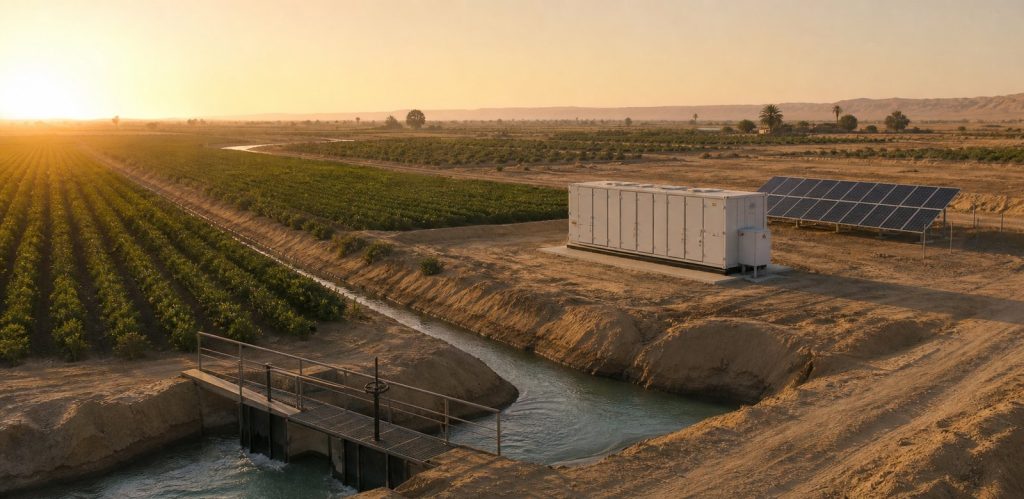
The information currently available is a customer-provided preliminary brief. It should be retained in the project record as assumptions until equipment documentation, site data, and operating evidence are reviewed. This separation is essential for technical traceability and for a fair comparison between supplier proposals. Related engineering references: C&I Energy Storage System.
The stated approximately 98.5 kW figure should be treated as a preliminary running-load assumption, not as a verified system demand. The figure is identified as the customer’s own calculation rather than a KRL Power calculation or product specification. Nameplate motor power does not necessarily equal actual electrical demand at every hydraulic duty point. Likewise, current alone does not establish real power without confirmed voltage, power factor, and operating conditions.
The requested supply scope includes battery energy storage, PV panels, inverter equipment, an EMS, protection equipment, monitoring, and necessary accessories. Before commercial comparison, “turnkey” should be converted into a written scope boundary. Potential items requiring explicit inclusion or exclusion include PV mounting structures, AC distribution, pump-control equipment, field cabling, cable trays or trenches, foundations, drainage, earthing, lightning protection, fencing, transportation, unloading, installation, commissioning, training, spare parts, and ongoing support.
2. Use the night-energy calculation as a screen, not a final battery size
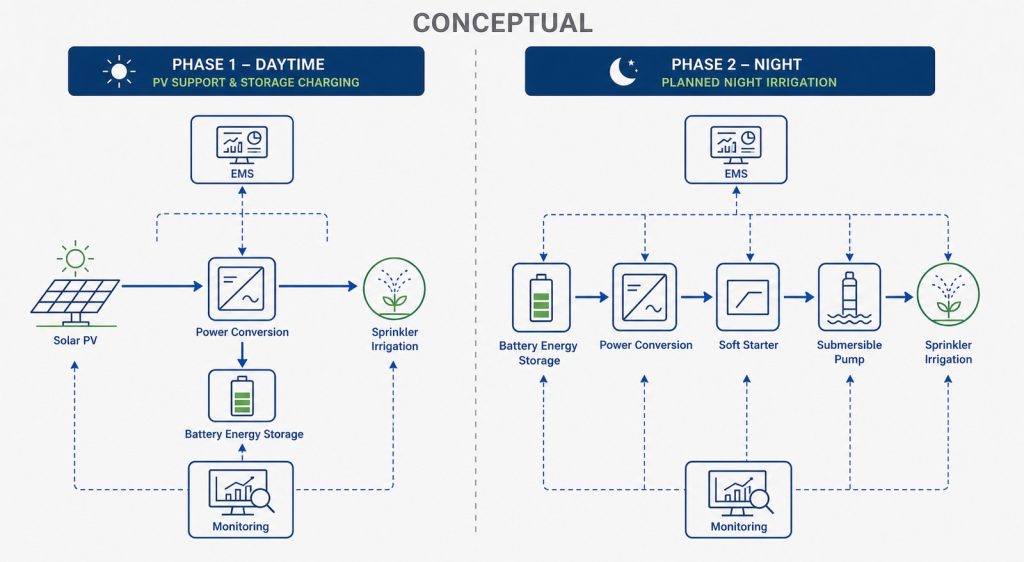
Using the customer-stated approximately 100 kW running-load assumption and the requested 14-hour night schedule gives a simple preliminary energy calculation of approximately 1,400 kWh. In arithmetic terms, approximately 100 kW multiplied by 14 hours equals approximately 1.4 MWh. This explains why the inquiry includes a preliminary 2 MWh Agricultural Battery Storage concept.
However, this is not final battery sizing. The calculation does not define the difference between nominal battery energy and energy delivered to AC loads. It does not include conversion losses, auxiliary consumption, cable losses, actual motor loading, temperature effects, operating reserve, possible load growth, charging strategy, or the selected control sequence. Final nominal storage requirements can change when these project-specific factors are quantified.
A compliant technical proposal should state its energy-delivery boundary. It should make clear whether a capacity figure means nominal battery-side DC energy, an internal usable-energy value under specified conditions, or usable AC energy delivered at a defined electrical point. These are distinct measures and should not be treated as interchangeable. Related engineering references: Amandla e-KRL.
The current KRL Power C&I BESS matrix lists nominal energy. For the relevant 2 MWh concept, usable AC energy for this irrigation duty is not stated publicly. A final proposal should therefore define operating conditions, auxiliary-load treatment, reserve level, and the electrical delivery point before any autonomy claim is accepted.
Reserve is an operating decision as well as an engineering margin. The owner should define whether remaining energy is required for a controlled restart, an irrigation extension, control equipment, alarm functions, or a lower-solar period. The final EMS sequence should identify what happens when available energy is below plan: irrigation may be reduced, shifted, stopped in stages, or supported by a separately approved backup arrangement.
3. Review motor starting separately from steady running demand
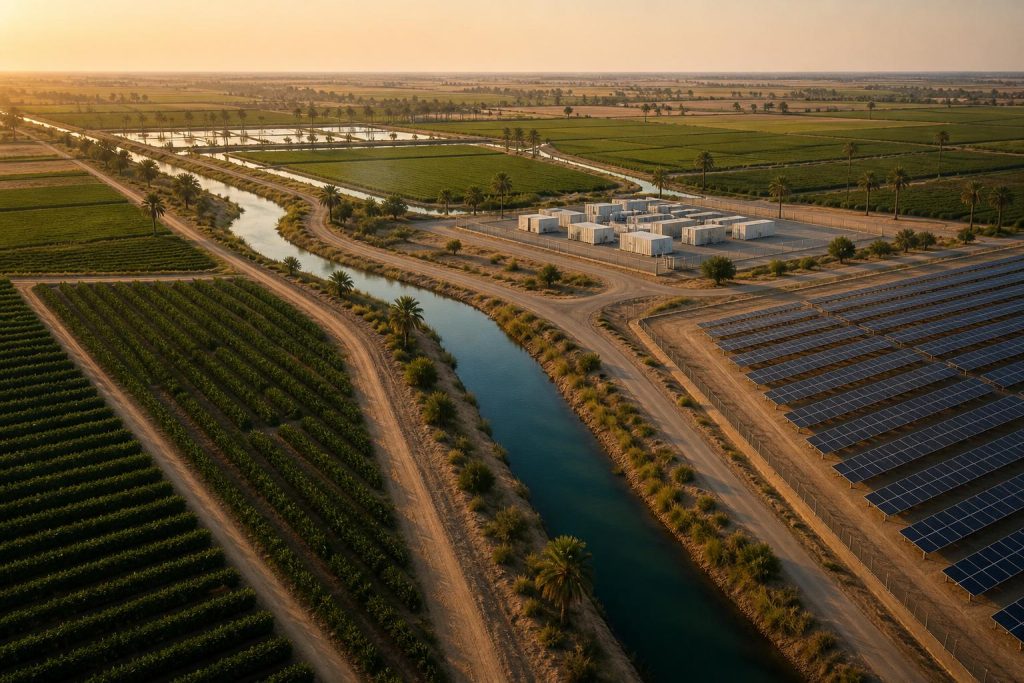
The approximately 98.5 kW preliminary running demand does not replace a motor-starting study. The 100 hp submersible pump is customer-described as an inductive load. The customer also states that direct-on-line starting current may be three to five times rated current and recommends evaluation of a soft starter. This is a project input, not a verified universal motor-performance figure, and it must not be used as the sole basis for selecting power conversion or protection equipment.
A soft starter is a reasonable item to evaluate because it may help manage motor-starting transients. Its suitability must still be confirmed against the actual motor, required starting torque, pump hydraulics, feeder impedance, voltage at the pump terminals, ramp settings, simultaneous loads, and protection coordination. The system must be assessed for successful starts as well as stable operation after the motor reaches normal speed.
Information needed before selecting the starting arrangement
- A legible pump-motor nameplate showing available rated electrical data.
- The motor manufacturer’s starting requirements and permitted starting method.
- The proposed soft-starter data, settings, bypass arrangement where applicable, and control interface.
- Submersible cable length, conductor size, installation method, route, and voltage-drop assessment.
- The pump curve, static head, dynamic head, required flow, and water-level range.
- The operating sequence for the pump, sprinkler equipment, and approved auxiliary loads.
- The required response after a controlled shutdown, low-energy event, alarm, or failed start.
A variable-frequency drive may also be evaluated if the final project requires controlled speed, staged flow, or a different acceleration profile. It should not be presumed from the available brief. Its inclusion would need a project review of control requirements, cooling, output filtering, protection, harmonics considerations, and compatibility with the final electrical architecture. Related engineering references: Sitemap Index.xml.
The engineering objective is not merely to select a high nominal power figure. The selected configuration must demonstrate that the pump can start and run under agreed conditions while the sprinkler system and other approved loads follow the defined sequence. In off-grid Agricultural Irrigation, a failed start can interrupt water delivery even if nominal battery energy remains available.
4. Apply KRL Power product-matrix facts within their stated limits
The KRL Power C&I BESS Product Matrix lists KRL-B2M6L configurations with 1.5 MWh and 2 MWh nominal energy. The matrix lists 750 kW and 1,000 kW AC power respectively; 720 kW and 960 kW maximum PV power respectively; liquid cooling; and battery IP65 protection. These are the relevant verified public matrix facts for reviewing the preliminary 2 MWh Battery Storage Solution concept.
The public matrix does not state usable AC energy, auxiliary consumption, discharge-duration performance, temperature derating, dimensions, weight, detailed communications architecture, project-specific fire-system design, certification status, transport requirements, or final control limits for this use case. These fields should remain “Not stated publicly” until configuration-specific documentation is issued.
The 1,000 kW AC-power listing for the 2 MWh configuration must not be read as automatic proof of submersible-pump starting performance. A final assessment must consider actual motor and feeder conditions. Similarly, the listed maximum PV power does not automatically approve a 600 kWp array; final compatibility depends on the completed architecture, selected PV strings, voltage range, input-current limits, isolation, surge protection, cable design, and agreed controls. Related engineering references: Wall Mounted Lithium Iron Phosphate Battery.
5. Model the 600 kWp PV concept by location and irrigation season
The customer proposes 600 kWp of solar PV to support daytime irrigation and recharge storage for night use. This is a coherent operating objective for an off-grid Agricultural Irrigation system. It is not sufficient evidence to responsibly state an expected daily generation figure.
PV output depends on the exact project location, month-by-month solar resource, selected PV modules, orientation, tilt, shading, soiling, ambient temperature, module temperature, DC losses, AC losses, curtailment logic, availability, and maintenance practice. Until these inputs are available, the appropriate description is a preliminary 600 kWp PV concept, not a guaranteed daily-yield value.
The 960 kW maximum PV-power matrix value for the 2 MWh KRL-B2M6L configuration indicates only that the customer-stated 600 kWp concept is below that published matrix value. It is a preliminary comparison, not project approval. It does not establish string-design compliance or prove that every element of the proposed PV system is compatible with the final selected configuration.
The energy model should examine the irrigation season rather than rely on an annual average. Water demand may change throughout the year. Higher ambient conditions, module temperature, and soiling can affect PV production. The review should compare daytime irrigation demand, required storage-charging energy, defined battery reserve, and planned night load with seasonally resolved solar production. It should also state the agreed response when solar resource is below the planning case. Related engineering references: Portable Battery Energy Storage System.
Useful PV-design inputs include exact coordinates, available land or roof area, topographic and shading information, mounting preference, module selection, string-layout assumptions, cleaning access, site soiling observations, and the electrical single-line concept. A project-specific model can then make assumptions auditable instead of embedding them in an unsupported daily-generation claim.
6. Define EMS and monitoring around irrigation continuity
An EMS should execute an approved operating philosophy. It cannot compensate for insufficient storage, unsuitable motor control, or incomplete protection coordination. For this project, the EMS design should convert the verified irrigation schedule into transparent charging, discharge, load-priority, alarm, and shutdown rules.
- Daytime load priority: Apply the agreed logic for serving approved irrigation loads while solar production is available.
- Storage recovery: Charge storage within confirmed operating limits while protecting energy required for scheduled night duty.
- Managed starts: Apply the approved pump-start sequence and avoid unnecessary coincident starts.
- Night dispatch: Supply approved loads while maintaining the documented minimum reserve.
- Low-energy action: Generate alarms and apply the approved staged reduction, rescheduling, or shutdown response.
- Event records: Record available operational data for PV production, battery condition, pump runtime, alarms, and trips.
The KRL Power matrix notes common page-level signals including generator interface, RS485/WiFi, fire protection, and sub-10 ms switching. These are common page-level signals, not model-specific or project-specific commitments for this Iraq inquiry. The final proposal must explicitly confirm any generator interface, communications method, monitoring hardware, transfer behaviour, fire-protection boundary, remote access, alarm handling, and control sequence included in the selected configuration.
Monitoring should define data ownership, account permissions, remote-access roles, alarm recipients, escalation steps, and local response responsibilities. Monitoring becomes useful only when the project identifies who can safely act on an alarm and what on-site support is available. The quotation scope should state whether communications hardware, platform setup, commissioning, recurring communications service, and ongoing monitoring support are included or excluded.
7. Treat field conditions as part of the Battery Storage Solution
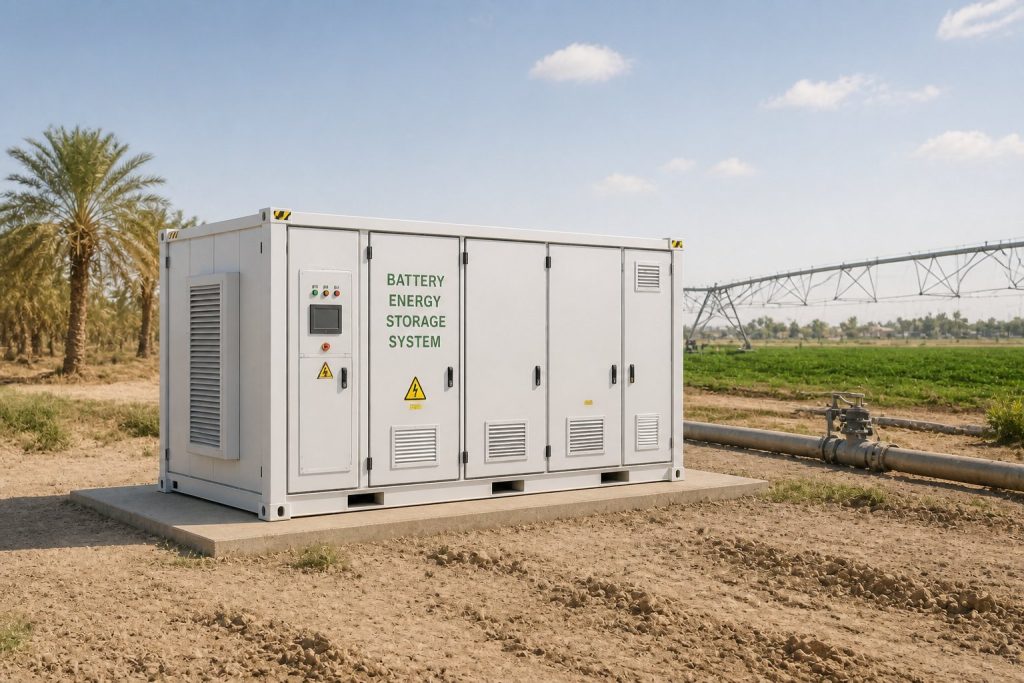
Agricultural Battery Storage installations can face dust, heat, solar exposure, uneven ground, long feeder routes, water around irrigation infrastructure, and limited maintenance access. The matrix statement of battery IP65 protection applies to the listed battery protection classification. It does not demonstrate that every field junction box, motor-control enclosure, cable entry, foundation, drainage arrangement, or site interface is appropriate without project engineering. Related engineering references: Standard Off The Shelf Battery.
The site review should document the proposed foundation or concrete pad, drainage, potential flood exposure, equipment clearances, fencing, access route, lifting route, maintenance space, cable trenches, mechanical cable protection, earthing arrangement, and lightning-protection approach. It should also document expected ambient conditions, dust-management practice, cleaning access, and availability of qualified local maintenance resources.
Where the project is close to boreholes, pipelines, or active sprinkler zones, the design should identify foreseeable water exposure and maintain suitable separation between irrigation infrastructure and electrical equipment. Field motor-control equipment requires its own environmental evaluation. Reliability depends on the entire installed system: equipment placement, cable routes, field connections, drainage, access, protection settings, and the ability to conduct planned maintenance safely.
8. Convert protection and accessories into a defined engineering scope
The inquiry includes protection devices, monitoring, and all necessary accessories. These terms should become a documented single-line diagram, protection philosophy, equipment schedule, and responsibility matrix. Without this documentation, responsibilities can remain unclear between PV equipment, battery storage, power conversion, pump control, AC distribution, and civil works.
- PV-side isolation, overcurrent protection, and surge-protection requirements.
- Battery and power-conversion protection boundaries for the approved configuration.
- AC distribution and feeder protection for the pump and sprinkler system.
- Motor overload, short-circuit, restart-control, and lockout requirements.
- Earthing, bonding, lightning protection, and field cable-routing requirements.
- Emergency-stop locations, access control, alarm annunciation, and safe maintenance procedures.
- Drainage, weather protection, and mechanical protection for outdoor interfaces.
Protection coordination should be assessed for normal running, motor starting, fault clearing, controlled shutdown, and restart. The operating philosophy should also define the intended response if PV production is lower than planned, storage reaches its agreed reserve, the motor fails to start repeatedly, or monitoring communications are interrupted. This converts a component list into a coherent off-grid operating system.
9. Request commercial terms after defining the technical boundary
KRL Power presents itself publicly as a lithium battery and C&I energy-storage source manufacturer focused on custom battery packs, BESS integration, and microgrid applications. This public positioning is relevant to an off-grid irrigation inquiry, but it does not replace a configuration-specific proposal. Related engineering references: Krl B2m6l 1 2mw 2 6mwh.
The available material does not state project-specific price, delivery time to Baghdad or Basra, warranty coverage, local service scope, acceptance criteria, installation responsibility, or final included accessories. These matters need a configuration-specific technical and commercial review. They should not be estimated from nominal capacity, prior projects, or general product-page statements.
Before requesting a final quotation, the buyer, EPC, or integrator should provide exact site coordinates; delivery point; local grid status and electrical standard; measured load data or detailed operating schedule; motor nameplates; pump curve and hydraulic-duty data; starter information; cable details; available PV area; shading constraints; civil information; autonomy requirement; minimum reserve; and the approved response during lower-solar periods.
10. Use a controlled path from concept to approved proposal
The preliminary 2 MWh storage concept and 600 kWp PV concept should remain in the inquiry because they express the operating objective: support daytime irrigation and charge storage for scheduled night irrigation. The next task is to test those concepts against evidence that may change final equipment selection.
- Confirm actual concurrent electrical demand and the 14-hour night operating requirement.
- Complete the motor-starting, feeder-voltage-drop, and protection-coordination review.
- Build a seasonal PV model using the confirmed Iraq site and selected array assumptions.
- Define the usable-energy boundary, operating reserve, and lower-solar operating plan.
- Prepare the single-line diagram, EMS sequence, monitoring requirement, and protection philosophy.
- Review civil, environmental, access, transport, lifting, installation, and maintenance conditions.
- Issue a configuration-specific technical proposal with commercial scope, delivery review, warranty terms, support boundary, and acceptance plan.
Final Thoughts
An Iraq Agricultural Irrigation system should be selected through verified load, motor-starting, seasonal PV, usable-energy, and site-condition evidence rather than nominal capacity alone. The approximately 100 kW assumption, 14-hour duty, 2 MWh storage concept, and 600 kWp PV concept form a useful preliminary brief. Final generation, configuration, delivery, price, warranty, and support remain subject to project-specific confirmation.