

A factory can purchase approximately 1 MWh of batteries and still receive the wrong converter arrangement. This Italian enquiry illustrates the risk: the customer requested a complete 200 kW PCS / 1 MWh LFP system, while the proposed modular configuration uses four 125 kW / 261 kWh KRL cabinets. Those are not the same power specification.
The decision is whether the customer accepts additional installed converter capacity under a verified site-level power limit—not whether the quotation can relabel 500 kW as 200 kW.
Quick Answer: Four Cabinets Provide 1.044 MWh, Not a 200 kW PCS
The preliminary recommendation is four KRL-B261L all-in-one units plus one 400 V parallel/grid-connection cabinet. Their arithmetic totals are 1,044 kWh nominal battery energy and 500 kW installed PCS power. If the customer requires 200 kW operation, propose an aggregate EMS limit subject to KRL validation, distributor acceptance and written customer approval.
Keep the existing 220 kWp PV array and two 100 kW Growatt inverters AC-coupled. Connect storage behind the factory's existing MV/LV transformer, assuming its secondary is confirmed as 400 V. The 20 kV Areti connection is not the storage cabinet terminal voltage. Final selection requires the load profile, approved single-line diagram, transformer data and clarification of the reported 155.8 kW import figure.
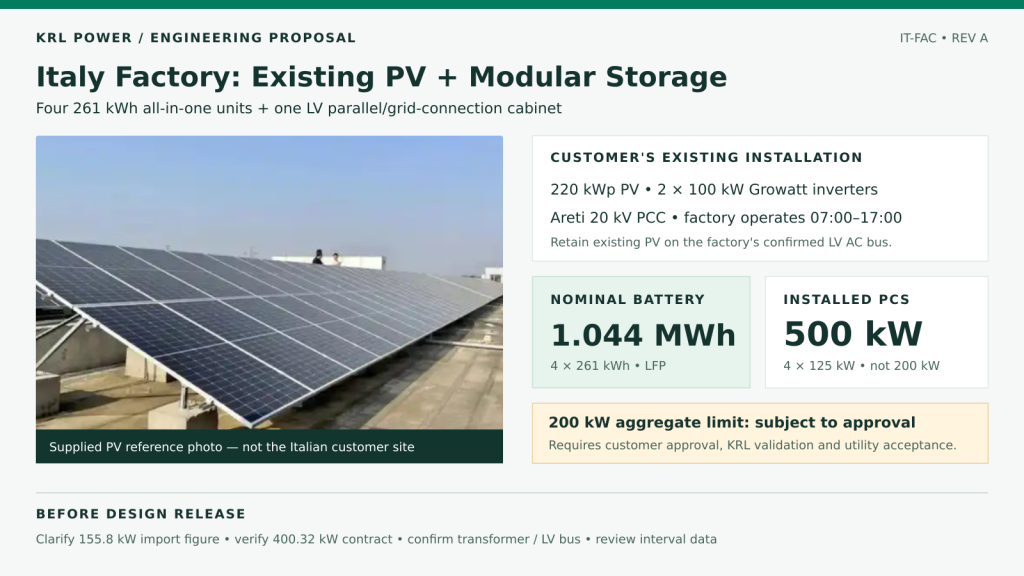
What the Customer Has—and What Still Needs Confirmation
| Customer information | Engineering interpretation | Required confirmation |
|---|---|---|
| Factory operates 07:00–17:00 | Daytime PV and production overlap | Interval load and PV records, including weekends |
| 220 kWp PV; also described as 200 kW panels | Use 220 kWp as the preliminary DC array figure | Module schedule and approved as-built documents |
| Two 100 kW Growatt inverters | Approximately 200 kW existing nominal PV AC conversion | Exact models, settings and communications |
| Areti connection at 20 kV | MV-connected site with internal LV distribution | Transformer secondary voltage and connection agreement |
| Maximum grid import 155.8 kW | May be historical demand or a binding limit | Original bill, measurement period or contractual wording |
| Contracted/available power 400.32 kW | Commercial connection figure, not transformer capacity | Import/export limits and applicable tariff |
| Requested 200 kW PCS / 1 MWh LFP | Energy target aligns with four 261 kWh units | Acceptance of 500 kW installed PCS with restricted dispatch |
This is a configuration proposal, not evidence of a commissioned Italian project. KRL defines the storage package and control interfaces; the local EPC and authorized electrical designer verify site works, protection, permitting and the Areti submission.
Separate Peak-Shaving Power from Stored Energy
Peak shaving starts with the factory's net demand: factory load minus available PV. Battery discharge supplies only the portion above the agreed import target, within converter, SOC, temperature and protection limits. If 155.8 kW is simply a previously recorded maximum, it should not automatically become the control setpoint.
The required energy is the accumulated power deficit over the target period. For example, a hypothetical 100 kW reduction sustained for three hours requires 300 kWh delivered at the agreed AC measurement boundary. That example is not a measured duty for this factory.
The proposed battery total is:
4 × 261 kWh = 1,044 kWh nominal energy.
At 200 kW, its nominal energy-to-power ratio is 5.22 hours; at 500 kW, it is 2.09 hours. Neither figure is a guaranteed discharge duration. The permitted SOC window, conversion losses, auxiliaries, reserve and aging reduce deliverable energy. The quotation must define usable AC energy and its test boundary separately.
A ten-hour production day does not imply ten hours of full battery discharge. Conversely, 1.044 MWh cannot automatically support the entire factory for ten hours. Interval data determines whether this energy class is appropriate or oversized for the actual peak-shaving opportunity.
Recommended Architecture: Preserve Existing PV on the AC Bus
The preliminary power path is Areti 20 kV → existing MV switchgear and transformer → factory LV bus. Four protected storage feeders connect through the new parallel/grid-connection cabinet to that same LV bus. Existing Growatt PV and factory loads retain their own protected connections.
Le KRL-B261L product platform integrates battery storage and bidirectional PCS, with PV MPPT and generator interfaces. For this retrofit, retain the existing PV conversion path. Integrated MPPT inputs remain unused unless a separately approved PV expansion or DC retrofit is designed; do not connect the same PV strings to both arrangements.
Site-level control needs a verified measurement of total grid exchange at the actual PCC. An LV-side control meter may be practical, but its location and transformation/loss treatment must match the approved design. A meter measuring only the storage feeder cannot regulate the whole factory's import or export.
The new cabinet is LV AC combining equipment, not a 20 kV cabinet. Select its busbars, short-circuit withstand, protection, isolation and communications for the project. MV protection and utility metering remain separate unless explicitly included.
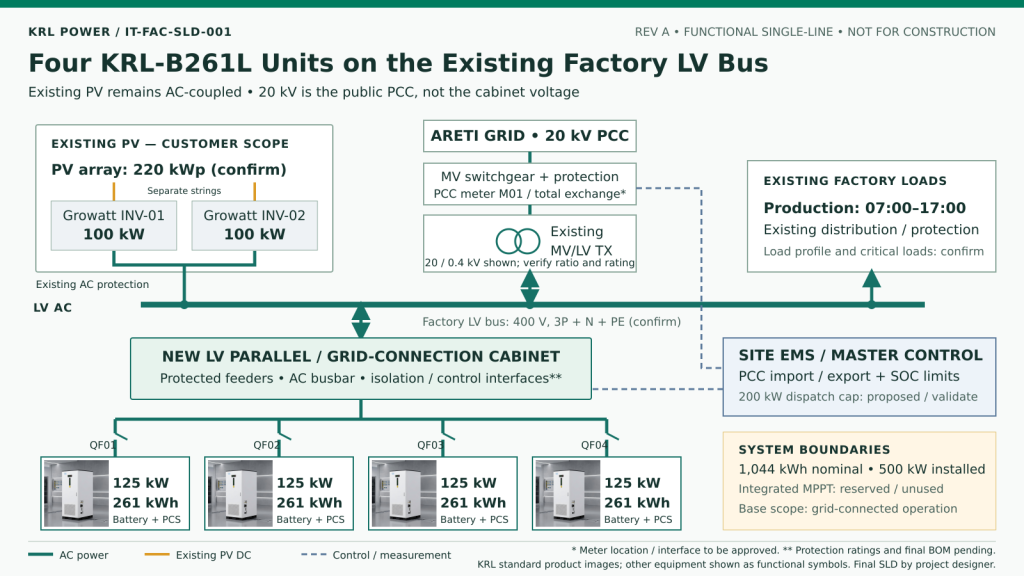
KRL Configuration and Verified Product Boundaries
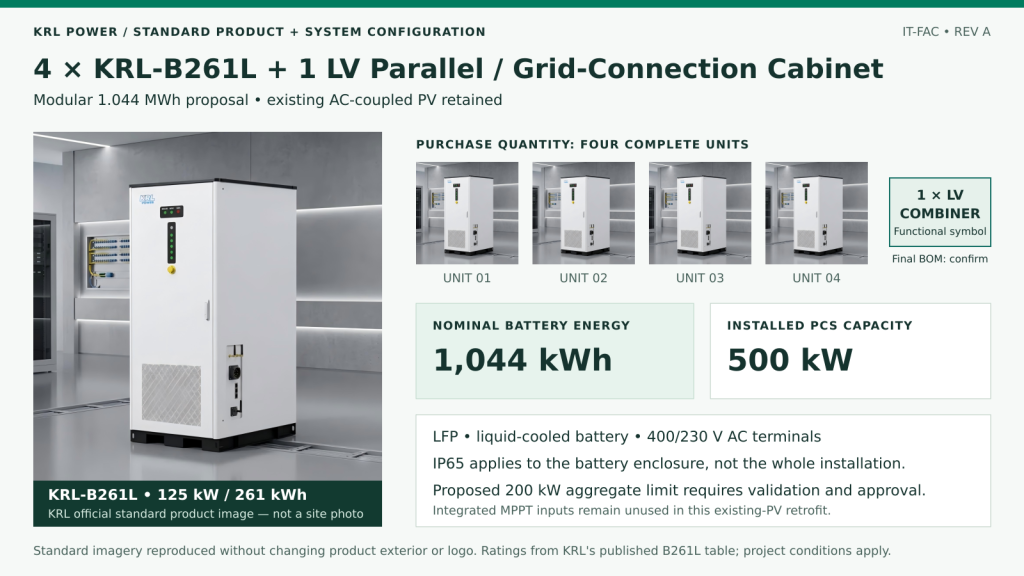
| Article | Preliminary selection | Boundary |
|---|---|---|
| Storage units | 4 × KRL-B261L, 125 kW / 261 kWh each | Complete all-in-one units, not bare battery enclosures |
| Batterie | 1,044 kWh nominal, LiFePO4 | Delivered energy separately specified |
| PCS | 500 kW installed total | Proposed aggregate operating limit requires validation |
| AC terminals | 400/230 V, L1/L2/L3/N/PE | Confirm factory LV voltage and earthing |
| Maximum published AC current | 189 A per unit | Feeder and cabinet selection needs full design review |
| Battery thermal control | Refroidissement par liquide | Ambient conditions and derating assessed for the site |
| Boîtier de batterie | IP65 | Not a rating for the complete yard or LV cabinet |
| Published operating range | −10°C to 55°C | Check project-specific operating/derating conditions |
| PV interface | Up to 120 kW per unit | Unused in the proposed existing-PV AC retrofit |
| Published parallel quantity | Up to 10 units | Four-unit coordination still requires approval |
| Unit size / mass | 980 × 1,300 × 2,320 mm; approximately 2,600 kg | Verify delivered revision, foundation and lifting plan |
| LV combining equipment | 1 parallel/grid-connection cabinet | Final BOM and protection functions project-defined |
| Supervisory control | Site EMS with PCC measurement | Coordinate four units, existing PV and grid limits |
Four units weigh approximately 10.4 tonnes before other equipment. Verify foundations, lifting access, drainage, cable routes and service clearances against installation drawings. The C&I storage selection hub provides context for alternative package sizes.
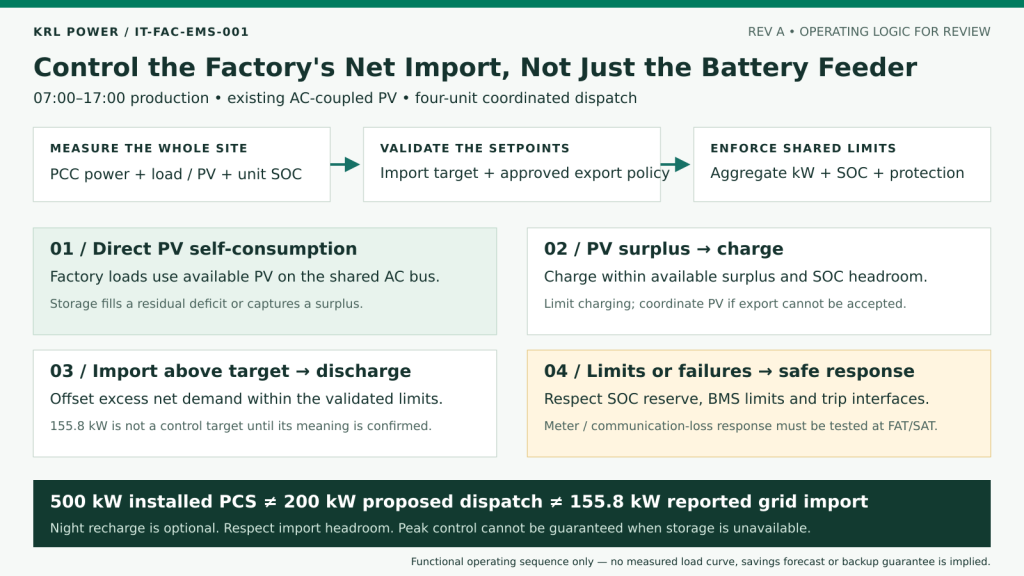
EMS Operation for a 07:00–17:00 Factory
Prioritize direct PV consumption by factory loads. When measured PV production exceeds demand, the EMS can request battery charging through the shared AC bus, subject to permitted charging power and SOC headroom. At high net demand, discharge offsets import above the agreed target.
If 200 kW is the accepted dispatch limit, enforce it across all four units—not independently per unit. Charging and discharging limits should be documented separately. SOC-aware sharing avoids commanding an unavailable cabinet and records each unit's contribution.
Export control is a separate constraint. Zero-export or export-limited operation must follow the approved connection terms; it is not created merely by writing “self-consumption” on the proposal. The EPC must verify control response, PV coordination, trip interfaces and the safe response to loss of PCC metering or communications.
Night charging is optional, not automatic. It only makes commercial sense after checking tariff differences, losses, degradation and remaining import headroom. Do not schedule all available converters at full charge power against a potentially lower site limit.
Italian Grid Review and Acceptance Before Release
Because the reported public-grid connection is MV, review the project against current CEI 0-16 requirements and Areti's connection process. Internal 400 V equipment does not turn the public connection into an LV application. CEI publishes the standard, amendments and controller annexes; Areti provides connection and modification procedures for existing sites.
Ask the local designer to assess interface protection, disconnection, metering, declared generating/storage power, and whether CCI/controller or communication obligations apply to the revised installation. Recent ARERA measures and subsequent changes make this a current-document check, not a blanket compliance statement. A software power limit alone does not prove how Areti will classify installed equipment.
Before procurement, confirm the SLD, utility acceptance and scope split. Verify control sequences, protection and FAT records before shipment. SAT must test aggregate limits, PV charging, import/export control, meter polarity, SOC boundaries and communication-failure behavior against agreed thresholds and conditions.
Information Needed for a Comparable Quotation
Provide load/PV interval data, twelve months of bills, the Areti agreement, and clarification of 155.8 kW and 400.32 kW. Add transformer data, LV ratings, fault levels, earthing, cable distances and Growatt models.
Confirm import/export policy, charging/discharging limits, reserve SOC and critical loads. Include site photos, ambient conditions, installation area, delivery location, schedule and ownership of civil works, MV equipment, permitting and commissioning.
Frequently Asked Questions
Request a Four-Cabinet Interface Review
Send the SLD, transformer data, load/PV records and original grid-limit documents to KRL's engineering team. Request a four-unit 1.044 MWh proposal with one LV parallel/grid-connection cabinet, an explicitly declared PCS operating limit and a responsibility matrix for Italian interconnection. The next deliverable should be a reviewed configuration and scope—not an unsupported savings promise.
Primary Sources and Related Engineering Reading
Technical and regulatory references checked on 30 September 2026. Final projects require current revisions and site-specific approval.