 Aller au contenu

Analyse technique par Liu, directeur de la R&D chez KRL Power — 20 ans d’expérience en ingénierie du stockage d’énergie pour les secteurs commercial et industriel, anciennement au sein du département R&D de Huawei.
A hotel in Cameroon needs reliable power for guest services, refrigeration, water systems, communications, safety equipment and selected air-conditioning loads during extended grid outages. The confirmed project target is to support a 60 kW average critical load for 12 hours, while accommodating a reported short-duration peak of 250 kW.
Based on these requirements, KRL Power recommends one BAT-B1ML-500H3S-480M4-HX1R6 all-in-one energy-storage system. It combines a 1 MWh lithium battery, 500 kW bidirectional PCS, 480 kW integrated MPPT with four input routes, BMS and EMS in one liquid-cooled 20-foot container.
The recommendation is technically reasonable, but only when the 60 kW figure represents the measured average of the loads that must remain powered during an outage. The available battery-energy margin is narrow, so a professional proposal must also define battery ageing, reserve state of charge, solar availability, generator support and permitted load shedding. This article is a preliminary engineering proposal rather than a completed installation case study.
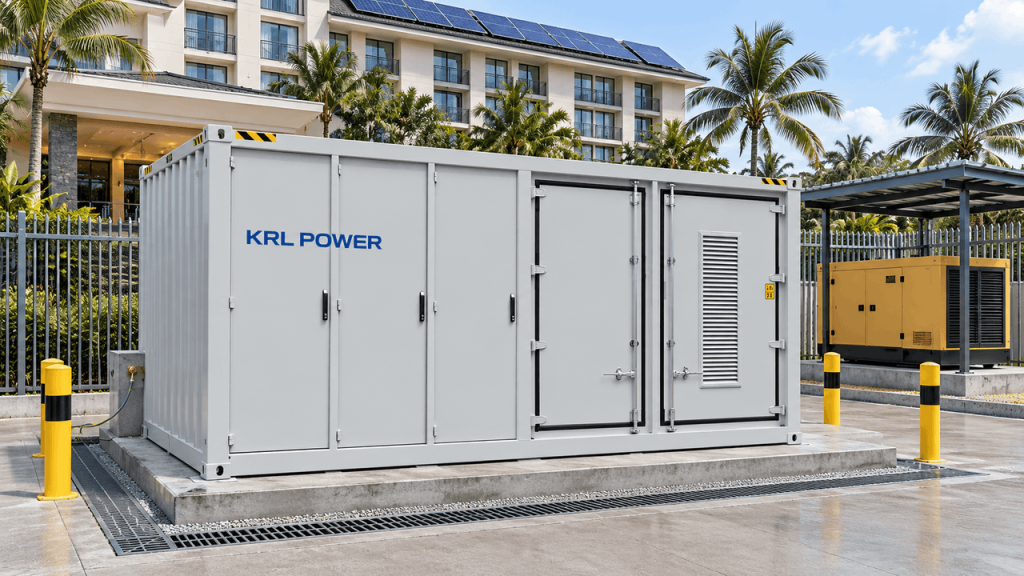
Executive Recommendation
One KRL 1 MWh system is the appropriate phase-one configuration when all three of the following conditions are accepted:
- The 60 kW value is the average critical-load demand rather than the hotel’s entire unrestricted load.
- The 12-hour requirement is assessed at beginning of life or as a hybrid guarantee supported by available PV and diesel generation.
- The reported 250 kW demand is a short-duration peak and not a continuous 12-hour load.
The system should not be presented as providing a guaranteed 12 hours from the battery alone at end of life. It would also be incorrectly sized if the hotel consumes 250 kW continuously during the outage. One 1 MWh system avoids unnecessary initial equipment while meeting the stated beginning-of-life requirement, but the operating agreement must retain PV, generator support and intelligent load management.
Confirmed Requirements and Items Still to Be Verified
| Design item | Current project basis | Decision significance |
|---|---|---|
| Project location | Cameroon hotel | Determines grid, climate and installation requirements |
| Average critical load | 60 kW | Controls the 12-hour energy calculation |
| Reported peak | 250 kW | Controls PCS, motor-start and transient verification |
| Required continuity | 12 hours | Requires 720 kWh at the supported AC bus |
| Recommended storage | One KRL 1 MWh system | No multi-unit parallel connection is required |
| Energy sources | Grid, PV, battery and diesel | Provides resilience beyond battery-only runtime |
| Large motor information | Not yet confirmed | Needed for lifts, pumps, chillers and compressors |
| Generator specification | Not yet confirmed | Needed for synchronization and charging control |
| Site solar yield | Not yet confirmed | Needed before finalizing PV capacity |
The design therefore separates confirmed customer data from preliminary planning assumptions. Final runtime, protection settings, PV strings and financial returns remain conditional on measured site data.
Is One 1 MWh Battery Really Enough for 12 Hours?
The hotel’s required AC energy is 60 kW × 12 hours = 720 kWh AC.
A 1 MWh nameplate battery cannot be treated as 1,000 kWh of usable AC energy. Battery operating limits, conversion losses and container auxiliary consumption must be included. For preliminary screening, KRL uses an 80% operating depth of discharge, 94% battery-to-AC discharge-chain efficiency and a 3% allowance for cooling, controls and auxiliary consumption. These are transparent planning factors rather than product-warranty values.
The estimated beginning-of-life energy delivered to the supported AC bus is 1,000 kWh × 0.80 × 0.94 × 0.97 = 729.44 kWh AC.
| Energy calculation | Résultat |
|---|---|
| Required energy for 12 hours | 720 kWh AC |
| Estimated usable AC energy | 729.44 kWh AC |
| Preliminary energy margin | 9.44 kWh AC |
| Calculated runtime at 60 kW | 12.16 hours |
| Runtime margin | Approximately 9 minutes |
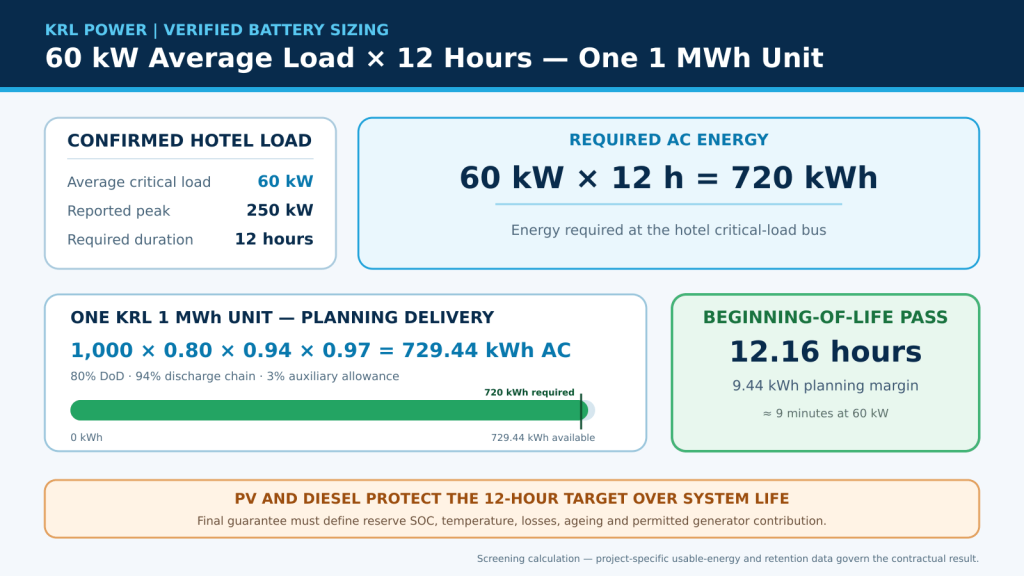
The calculation supports the single-unit recommendation, but the approximately nine-minute margin is too small to absorb significant load growth, poor operating conditions or long-term battery degradation. KRL therefore recommends a hybrid operating guarantee rather than presenting 12.16 hours as an unconditional lifetime performance promise.
Beginning-of-Life Runtime Is Not an End-of-Life Guarantee
If battery capacity retention eventually falls to an illustrative 80%, and the same operating and efficiency assumptions are retained, estimated AC energy becomes 1,000 kWh × 0.80 capacity retention × 0.80 DoD × 0.94 × 0.97 = 583.55 kWh AC. At a constant 60 kW, that corresponds to approximately 9.7 hours of battery-only operation.
| Required performance | Can one 1 MWh unit meet it? |
|---|---|
| 12 hours at 60 kW at beginning of life | Yes, based on the stated assumptions |
| 12 hours using battery plus available PV | Yes, subject to solar conditions and controls |
| 12 hours using battery, PV and diesel backup | Yes, subject to generator availability |
| 12 hours battery-only at illustrative end of life | No, not under the same calculation assumptions |
| 12 hours at a continuous 250 kW load | No; that would require 3,000 kWh before losses |
For this hotel, the commercially balanced choice is one 1 MWh system with an agreed minimum SOC reserve, automatic generator start and a prioritized critical-load schedule. The contract must define whether the autonomy requirement applies at beginning or end of battery life.
Why the 500 kW PCS Is Suitable for the Reported 250 kW Peak
The integrated PCS is rated at 500 kW, giving a 2:1 nominal power ratio relative to the reported 250 kW peak. This provides adequate steady-state power capacity and useful headroom for changing hotel loads. However, a kW rating alone cannot verify motor-start performance. Lifts, chilled-water pumps, compressors and air-conditioning equipment may draw several times their normal current when starting.
Before final approval, KRL should receive:
- Peak kW and kVA measurements.
- Power factor and phase-current data.
- Motor nameplate ratings and starting methods.
- Allowed voltage and frequency deviation.
- Required starting sequence.
- Existing soft-starter or variable-frequency-drive information.
If necessary, the EMS can sequence large loads, while VFDs or soft starters can reduce starting current. The final protection study must also check fault current, breaker coordination and phase imbalance.
Recommended KRL 1 MWh All-in-One System
| Product parameter | Recommended specification |
|---|---|
| Modèle | BAT-B1ML-500H3S-480M4-HX1R6 |
| Énergie de la batterie | 1 MWh |
| PCS bidirectionnel | 500 kW |
| MPPT intégré | 480 kW, four routes |
| Modes de fonctionnement | Raccordement au réseau, fonctionnement hors réseau et basculement transparent |
| Commandes intégrées | BMS, PCS et EMS |
| Gestion thermique | Refroidissement par liquide |
| Enclosure | 20-foot container |
| Battery-compartment protection | IP65 |
| Communications | RS485, Wi-Fi ou 4G |
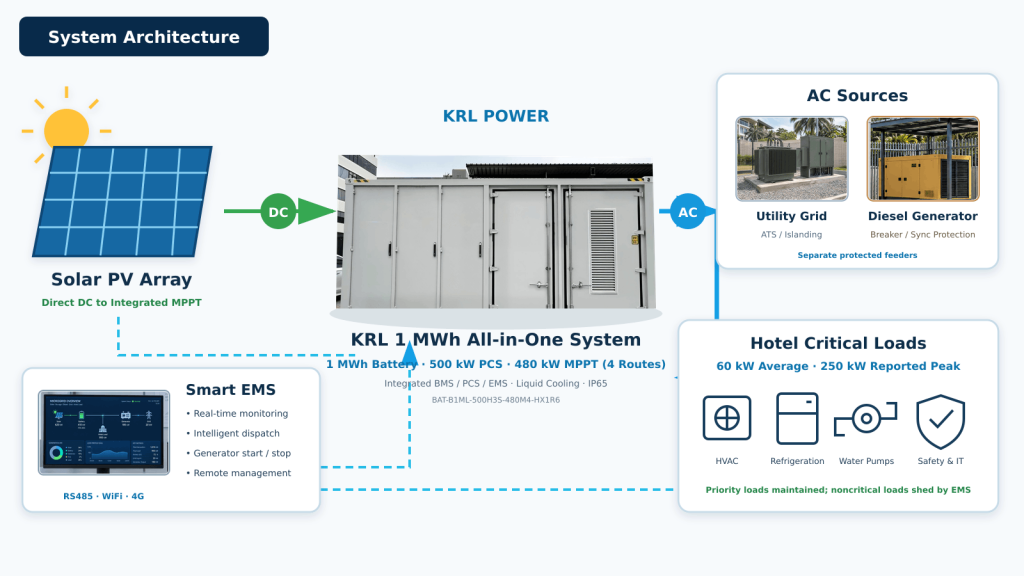
Because the PCS, MPPT, BMS and EMS are already integrated, the project does not require a separate PV inverter, external MPPT cabinet or storage-unit AC combiner. External project equipment is still required, including correctly rated switchgear, ATS or islanding equipment, protection, metering, transformer interfaces where applicable, AC and DC cabling, earthing and generator controls.
Correct Electrical Architecture
PV strings connect directly to the four integrated MPPT routes on the DC side. The final string design must verify module open-circuit voltage at minimum temperature, operating voltage, string current, cable loss and the allowable input range of each MPPT route.
The integrated 500 kW PCS connects to the hotel critical-load bus through a dedicated protected AC interface. As the project uses one storage container, no multi-unit AC combiner is needed.
The utility supply enters through an ATS or approved grid-islanding arrangement. The diesel generator is separate from the KRL container and connects through its own breaker, synchronization protection, reverse-power protection and start/stop interface.
The KRL EMS supervises grid availability, solar priority, battery charge and discharge, reserve SOC, generator start and stop, load shedding, alarms and operating-data recording.
Preliminary Solar Capacity
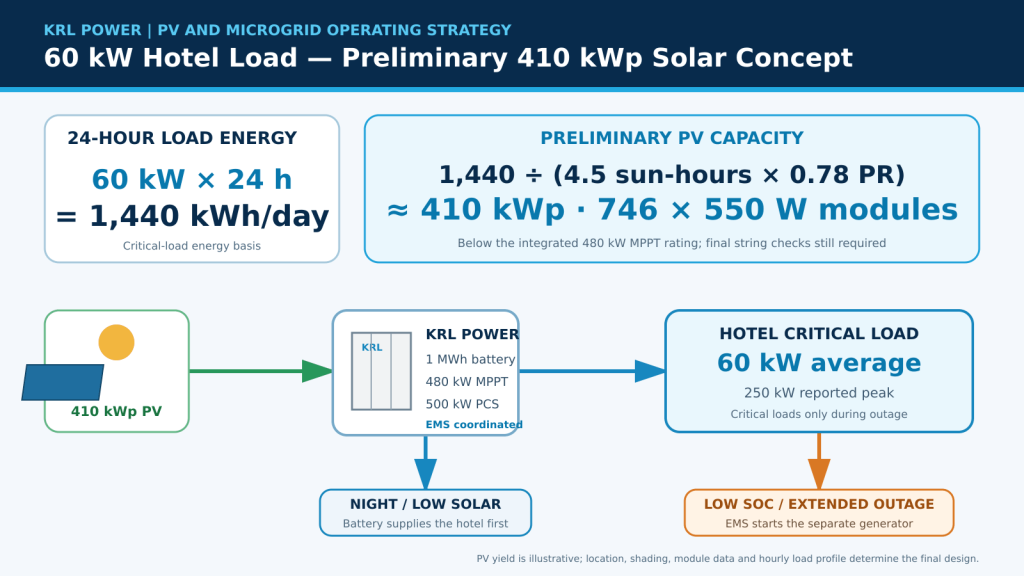
A 60 kW average load operating for 24 hours consumes 60 kW × 24 hours = 1,440 kWh per day. Using a preliminary assumption of 4.5 peak-sun-hours and a 0.78 overall PV performance ratio gives 1,440 kWh ÷ (4.5 hours × 0.78) ≈ 410 kWp.
With 550 W modules, the preliminary quantity is 410 kWp ÷ 0.55 kW ≈ 746 modules. A 410 kWp PV array remains below the system’s 480 kW integrated MPPT rating and is suitable as an initial concept when PV is expected to support daytime demand and restore battery SOC after an outage.
This is not a final PV design. Module quantity and string allocation must be recalculated using the Cameroon site coordinates, shading survey, module datasheet, roof or ground area, orientation, temperature conditions and seasonal irradiation.
How the System Operates
Normal Grid Conditions
PV supplies the hotel first. Surplus solar energy charges the battery, while the EMS maintains the configured backup reserve. If local tariffs justify it, the battery can also reduce demand peaks without compromising outage readiness.
Daytime Grid Outage
The grid-islanding device separates the supported bus. PV continues through the integrated MPPT, directly reducing the battery discharge rate. When PV generation exceeds the critical load, the surplus can recharge the battery.
Night-Time or Low-Solar Outage
The battery supplies the supported hotel loads. When SOC reaches the configured generator-start threshold, the EMS starts the diesel generator before the battery reaches its minimum operating limit.
Extended Outage
The generator supports the critical bus and may recharge the battery at a controlled rate. Generator loading, minimum operating load, fuel efficiency and battery charging power should be coordinated to avoid inefficient short cycling.
Grid Restoration
The system confirms voltage, frequency, phase and protection conditions before restoring grid operation. Seamless transfer performance must be verified during site commissioning with the actual ATS, generator controls and hotel loads.
Which Hotel Loads Should Remain on the Critical Bus?
The 60 kW average must refer to a controlled critical-load group. Typical priority loads include:
- Reception, access control and communications.
- Emergency and essential lighting.
- Fire alarm and safety systems.
- Refrigeration and cold storage.
- Water and fire pumps.
- Selected ventilation and air-conditioning.
- Selected lifts where operationally necessary.
- IT, security and payment systems.
Electric water heating, laundry heating, decorative lighting, nonessential kitchen equipment and unrestricted air-conditioning should be placed in lower-priority load groups unless the measured 60 kW profile already includes them. A three-level load-shedding plan allows the EMS to protect runtime without interrupting the hotel’s most important services.
Installation and Safety Requirements
The 20-foot system requires an engineered concrete foundation, drainage, cable trenches, earthing, service clearances, vehicle-impact protection and unobstructed thermal-management airflow. IP65 protection of the battery compartment does not mean the container can be installed in a flood zone or without site engineering.
- Confirm the highest recorded flood level and finished foundation elevation.
- Check ambient temperature, solar exposure and corrosion conditions.
- Provide fire-service access and clearly identified emergency isolation.
- Maintain safe distance from occupied buildings and required service clearance.
- Protect and separate AC, DC and communication cables.
- Verify local grid, building and fire requirements before construction.
Commissioning should test grid-loss detection, island formation, load steps, motor starting, MPPT operation, generator start and stop, reverse-power protection, SOC thresholds, emergency stop, fire alarms, communications and safe grid restoration.
Commercial Value and Payback Assessment
The business case can come from avoided room-service interruption and guest relocation, lower diesel fuel and generator-maintenance costs, increased use of solar energy and peak-demand reduction where the local tariff supports it.
A credible ROI should not use a generic payback claim. It should be calculated from the hotel’s actual data: annual net benefit = avoided fuel cost + avoided outage loss + demand-charge savings + additional solar value − annual operating cost. Simple payback is the installed project cost divided by the annual net benefit.
The final commercial model requires grid tariffs, outage frequency, diesel litres per hour, fuel price, generator maintenance, solar yield, hotel occupancy impact and installed project cost.
Customer Decision Checklist
The customer can proceed with one KRL 1 MWh unit when:
- Seven days of interval data confirm approximately 60 kW average critical demand.
- The 250 kW figure is confirmed as a short-duration peak.
- Major motor starting is verified.
- The customer accepts a beginning-of-life or hybrid 12-hour guarantee.
- PV and diesel support remain available.
- Automatic load shedding is permitted.
- The installation site meets foundation, drainage and safety requirements.
KRL should not issue a final runtime guarantee until these conditions have been documented.
Conclusion technique
One KRL BAT-B1ML-500H3S-480M4-HX1R6 is the technically and commercially appropriate recommendation for the current Cameroon hotel requirement. At a 60 kW average critical load, the hotel needs 720 kWh for 12 hours. Under the stated preliminary assumptions, the KRL system can deliver approximately 729.44 kWh AC at beginning of life, corresponding to 12.16 hours.
The 500 kW PCS is appropriately rated for the reported 250 kW peak, subject to verification of motor starting, kVA demand and protection coordination. A preliminary 410 kWp PV array can support the hotel’s 24-hour average energy demand and remains within the integrated 480 kW MPPT rating, pending final solar and string-level design.
The decisive point is not simply whether the container has a 1 MWh nameplate. It is whether the customer accepts the defined critical-load boundary, lifecycle runtime basis and hybrid operating strategy. With those conditions documented, one integrated KRL system provides a practical balance between resilience, solar utilization, diesel reduction and initial investment.
Consultez le Portefeuille de solutions ESS commerciales et industrielles de KRL, le KRL C&I energy-storage solutions and KRL’s guide to commercial battery backup for power outages. For a final proposal, Contacter KRL Power with the hotel load profile, generator information, grid single-line diagram and PV site data.
