 Skip to content
Top 10 Solid State Battery Companies in 2026: A Buyer's Guide for Commercial Energy Storage and ESS Projects
Introduction
As the R&D Director of KRL Power, I have spent nearly two decades designing battery systems for commercial and industrial energy storage projects across Europe, North America, Africa, the Middle East, and Southeast Asia.
One question has become increasingly common among EPC contractors, renewable energy developers, utility operators, and energy storage investors:
One question has become increasingly common among EPC contractors, renewable energy developers, utility operators, and energy storage investors:
"Which solid-state battery manufacturer should we trust for our next energy storage project?"
The growing interest in solid-state batteries is understandable. Compared with conventional lithium-ion technologies, solid-state batteries promise higher energy density, improved safety, longer service life, and greater thermal stability.
However, the reality is that not every company claiming to offer solid-state battery technology is ready for large-scale commercial deployment.
This article reviews ten influential solid-state battery companies in 2026 while providing practical procurement guidance based on real-world ESS project requirements.
However, the reality is that not every company claiming to offer solid-state battery technology is ready for large-scale commercial deployment.
This article reviews ten influential solid-state battery companies in 2026 while providing practical procurement guidance based on real-world ESS project requirements.
Why Solid-State Batteries Are Attracting Global Attention
Traditional lithium-ion batteries rely on liquid electrolytes and polymer separators. While these technologies have powered electric vehicles and energy storage systems successfully for years, they also face inherent limitations:
Key Challenges of Conventional Lithium Batteries
- Thermal runaway risks
- Electrolyte leakage
- Reduced safety under mechanical damage
- Limited energy density
- Capacity degradation over long operating periods
Solid-state batteries replace liquid electrolytes with solid electrolyte materials, offering significant advantages:
Advantages of Solid-State Battery Technology
- Higher energy density
- Enhanced fire safety
- Better thermal stability
- Longer cycle life
- Wider operating temperature range
- Reduced maintenance requirements
- Improved system reliability for ESS applications
For utility-scale and commercial energy storage projects, these benefits translate directly into lower lifecycle costs and higher project returns.
Why Solid-State Batteries Are Attracting Global Attention
1. CATL
Headquartered in China, CATL remains the world's largest battery manufacturer.
Strengths:
Strengths:
- Massive manufacturing capacity
- Strong global supply chain
- Significant investment in next-generation battery chemistry
- Extensive ESS deployment experience
CATL continues to advance semi-solid and all-solid-state battery research while maintaining leadership in utility-scale energy storage markets.
2. BYD
BYD has evolved from a battery manufacturer into one of the world's largest integrated energy technology companies.
Key strengths include:
Key strengths include:
- Vertical integration
- Strong EV ecosystem
- Utility-scale battery deployment
- Global market presence
BYD's continued investment in solid-state battery technology positions the company for future growth.
3. LG Energy Solution
Formerly part of LG Chem, LG Energy Solution remains one of the most technologically advanced battery manufacturers worldwide.
Advantages:
Advantages:
- Strong R&D capabilities
- Automotive-grade quality systems
- Global manufacturing footprint
- Strategic partnerships with major automakers
4. Panasonic
Panasonic has decades of experience in rechargeable battery technology.
Key advantages:
Key advantages:
- Advanced cell engineering
- High manufacturing consistency
- Extensive automotive battery expertise
- Continuous investment in next-generation battery development
5. KRL Power
Founded in 2005, KRL Power focuses on delivering complete battery and energy storage solutions for global B2B customers.
Unlike many companies that only manufacture cells, KRL controls the entire process from cell selection to complete ESS integration.
Unlike many companies that only manufacture cells, KRL controls the entire process from cell selection to complete ESS integration.
Advanced Solid-State Battery Portfolio
Available technologies include:
- Solid-state pouch cells
- Quasi-solid prismatic batteries
- 314Ah solid-state ESS cells
What Makes KRL Different?
Most suppliers sell batteries.
KRL delivers complete energy storage solutions.
Our engineering team evaluates project requirements, local regulations, operating environments, and financial objectives before recommending the most suitable battery chemistry.
For many customers, the best solution is not simply the newest battery technology—it is the technology that provides the highest project ROI.
Our engineering team evaluates project requirements, local regulations, operating environments, and financial objectives before recommending the most suitable battery chemistry.
For many customers, the best solution is not simply the newest battery technology—it is the technology that provides the highest project ROI.
6. MegSolid
MegSolid is among China's early commercial producers of hybrid solid-state batteries.
Its portfolio includes:
Its portfolio includes:
- Portable energy storage
- Residential ESS
- Commercial ESS
- Containerized energy storage systems
MegSolid has established itself as a growing player in the residential and distributed energy storage sectors.
7. QuantumScape
QuantumScape is one of the most recognized solid-state battery innovators globally.
Backed by Volkswagen, the company focuses primarily on lithium-metal solid-state battery technology for electric vehicles.
Key strengths:
Backed by Volkswagen, the company focuses primarily on lithium-metal solid-state battery technology for electric vehicles.
Key strengths:
- Advanced electrolyte technology
- Strong patent portfolio
- Significant automotive investment
8. Ampcera
Ampcera specializes in solid-state electrolyte materials rather than complete battery systems.
The company focuses on:
The company focuses on:
- Sulfide electrolytes
- Ceramic electrolyte technologies
- Lithium metal compatibility
Its technology supports numerous battery developers worldwide.
9. Toyota
Toyota remains one of the world's largest investors in solid-state battery R&D.
The company continues to pursue breakthroughs in:
The company continues to pursue breakthroughs in:
- Fast charging
- High energy density
- Automotive-grade commercialization
Many industry analysts view Toyota as a future leader in all-solid-state vehicle batteries.
10. Samsung SDI
Samsung SDI continues investing heavily in next-generation battery platforms.
Its solid-state roadmap focuses on:
Its solid-state roadmap focuses on:
- Enhanced safety
- Increased energy density
- Premium EV applications
The company's strong manufacturing capabilities position it as a major future supplier.
How to Choose the Right Solid-State Battery Supplier
Many buyers focus solely on battery specifications.
Experienced project developers focus on total project success.
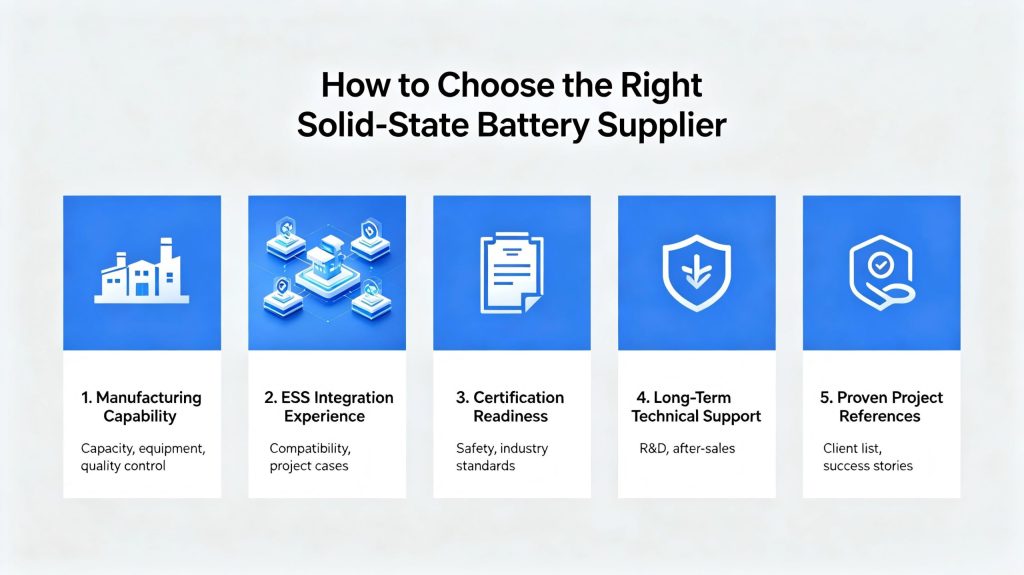
When evaluating suppliers, consider the following:
Experienced project developers focus on total project success.
When evaluating suppliers, consider the following:
1. Manufacturing Capability
- Does the company own its production facilities?
- What is annual production capacity?
- Can it support long-term supply agreements?
2. ESS Integration Experience
A battery cell alone does not create a successful project.
Look for suppliers with experience in:
Look for suppliers with experience in:
- PCS integration
- EMS development
- Thermal management
- Fire protection systems
3. Certification Readiness
Ensure products comply with:
- UL9540
- IEC62619
- CE
- UN38.3
4. Long-Term Technical Support
The battery supplier should provide:
- Remote monitoring
- Warranty support
- Engineering consultation
- Spare parts management
5. Proven Project References
Request evidence of:
- Commercial ESS installations
- Utility-scale deployments
- Industrial applications
Real-world operating data is more valuable than laboratory claims.
The Future of Solid-State Batteries in Energy Storage
By 2030, analysts expect solid-state technologies to capture a significant portion of the global energy storage market.
However, widespread adoption will depend on:
However, widespread adoption will depend on:
- Manufacturing scale
- Cost reduction
- Supply chain maturity
- Regulatory approval
In the near term, hybrid solid-state and quasi-solid-state batteries are likely to dominate commercial ESS applications because they offer an optimal balance between safety, performance, and cost.
Final Thoughts from KRL Power's R&D Director
After twenty years in battery engineering, one lesson remains consistent:
The best battery is not necessarily the one with the highest energy density.
The best battery is the one that delivers reliable performance, strong safety margins, predictable lifecycle costs, and dependable long-term support.
When evaluating solid-state battery suppliers, look beyond marketing claims and focus on engineering capability, manufacturing experience, certification readiness, and real-world project success.
The best battery is not necessarily the one with the highest energy density.
The best battery is the one that delivers reliable performance, strong safety margins, predictable lifecycle costs, and dependable long-term support.
When evaluating solid-state battery suppliers, look beyond marketing claims and focus on engineering capability, manufacturing experience, certification readiness, and real-world project success.
At KRL Power, our mission is simple:
Help customers deploy safer, smarter, and more profitable energy storage systems that create long-term value for their businesses.
Whether you are developing a microgrid, industrial ESS project, renewable energy plant, or utility-scale battery installation, selecting the right battery partner today will determine your project's success for the next decade.
Help customers deploy safer, smarter, and more profitable energy storage systems that create long-term value for their businesses.
Whether you are developing a microgrid, industrial ESS project, renewable energy plant, or utility-scale battery installation, selecting the right battery partner today will determine your project's success for the next decade.
FAQ
Q1. Are solid-state batteries already commercially available?
Yes. Hybrid solid-state and quasi-solid-state batteries are already entering commercial ESS and EV markets. Fully solid-state batteries are still scaling toward mass production.
Q2. Are solid-state batteries safer than LiFePO4 batteries?
Both technologies offer strong safety performance. Solid-state batteries provide additional thermal stability and reduced fire risk because they eliminate most flammable liquid electrolytes.
Q3. What is the biggest challenge facing solid-state battery adoption?
Manufacturing cost and large-scale production capacity remain the primary challenges.
Q4. Are solid-state batteries suitable for commercial energy storage systems?
Yes. Hybrid solid-state batteries are increasingly being deployed in C&I ESS, microgrids, renewable integration projects, and backup power systems.
Q5. How long can a solid-state ESS battery last?
Depending on chemistry and operating conditions, many systems are designed for 6,000–12,000+ cycles with service lives exceeding 15 years.
Q6. What should buyers prioritize when selecting a solid-state battery supplier?
Buyers should evaluate manufacturing capability, certification status, ESS integration experience, warranty support, and proven project references rather than focusing solely on battery specifications.
