 Skip to content
By the KRL Power Industrial Mobility & Robotics Engineering Team · Last reviewed: November 2026
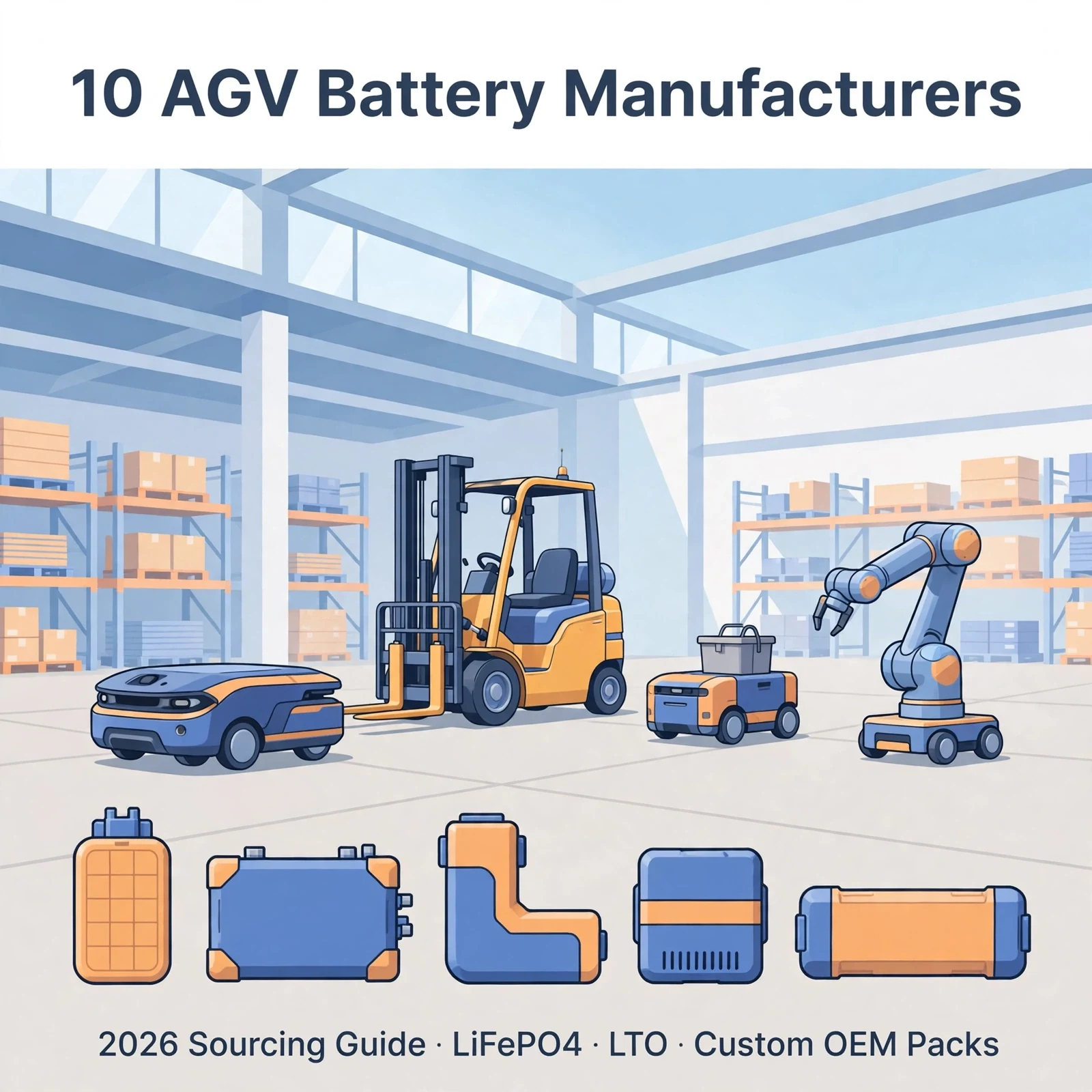
Selecting an AGV battery manufacturer in 2026 requires evaluating far more than nominal amp-hours. As warehouse automation expands across low-profile under-ride autonomous mobile robots (AMRs), rail-guided vehicles (RGVs), collaborative robots and autonomous forklifts, procurement and engineering teams must vet suppliers on opportunity-charging capability, mechanical enclosure fit, RS485 and CAN bus communication, regional safety compliance and UN 38.3 transport testing requirements.
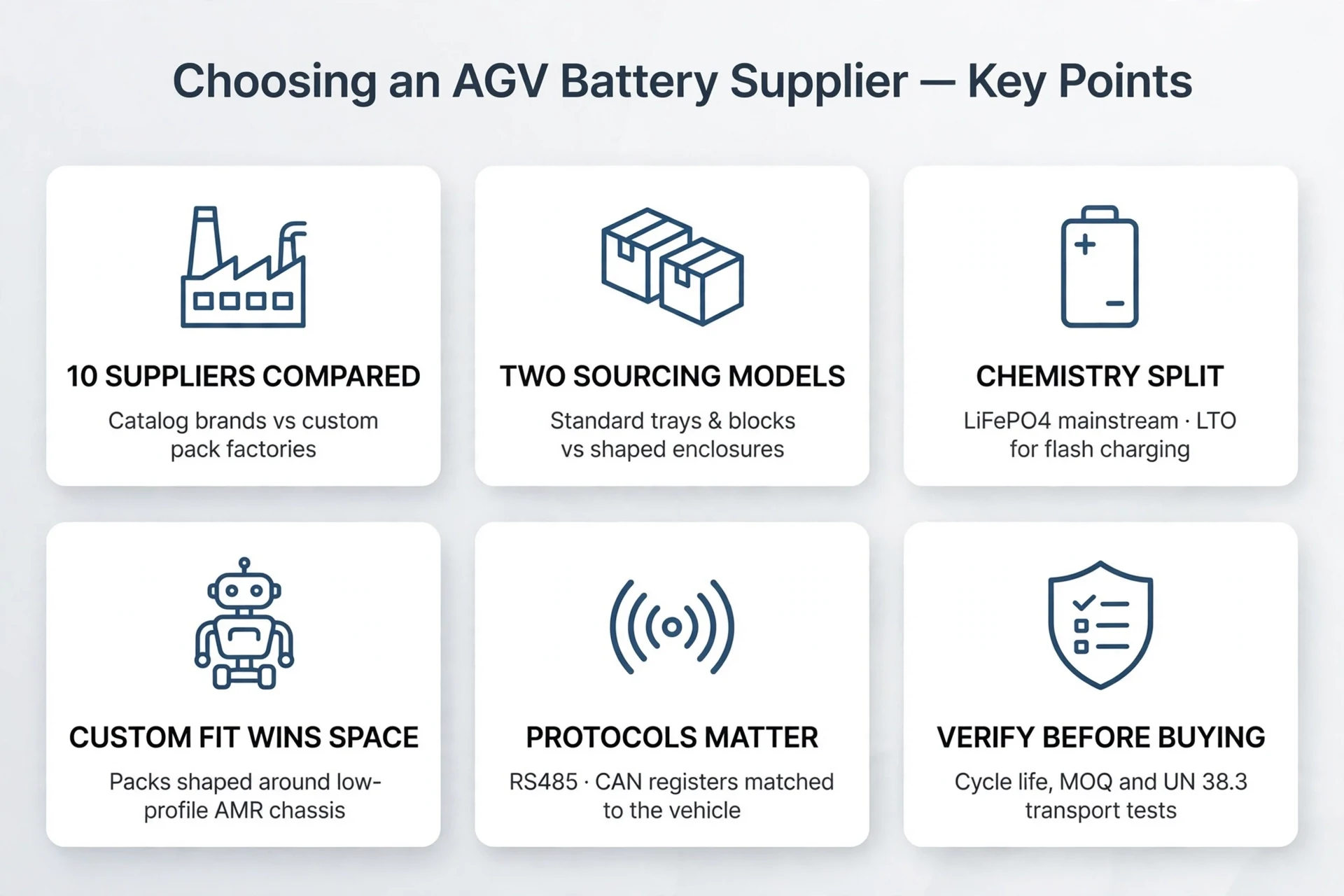
Global catalog battery brands often focus on standardized form factors for high-volume vehicle platforms, whereas specialized custom pack manufacturers focus on dimensional flexibility, protocol adaptation and lower minimum order quantities (MOQs). Rather than assigning an arbitrary ranking, this guide compares 10 established industrial robot battery suppliers in 2026 by their primary product focus, core chemistry, customization model and typical OEM fit based on publicly available product lines.
1. Quick Comparison: 10 AGV & Industrial Robot Battery Suppliers (2026 Overview)
Note: Specifications such as charge rates, cycle life and MOQs vary by specific model, cell selection and project agreement. Always verify project-specific datasheets directly with each manufacturer.
| Manufacturer & Origin | Core Chemistry | Primary Application Focus | Customization & Sourcing Model |
|---|---|---|---|
| Inventus Power (USA) | LiFePO4 / NMC | OEMs using standardized U1, GC2 & modular commercial packs | Standard catalog modules plus enterprise custom programs |
| Flux Power (USA) | LiFePO4 | North American Class I–III electric forklifts & heavy AGVs | Focused on counterbalance & standard forklift battery trays |
| Valence / Lithion (USA / UK) | LiFePO4 | Medical carts, hospital AGVs & modular commercial systems | Built around fixed modular voltage blocks |
| KRL Power (China, Direct Factory) | LiFePO4 (custom options available) | Custom AGV/AMR enclosures, RS485/CAN protocol adaptation & OEM/ODM supply | Flexible MOQs, 3D mechanical design & in-house BMS development |
| EnerSys / NexSys iON (USA) | TPPL / Li-ion | Enterprise warehouse fleets & heavy material handling | Turnkey battery-and-charger fleet packages |
| EcoTree Lithium (UK / Europe) | LiFePO4 | European regional industrial & material-handling replacements | Regional pack integration & replacement focus |
| Toshiba SCiB (Japan) | LTO (Lithium Titanate) | Cold-chain shuttles & high-frequency flash-charge loops | Supplied primarily as LTO cells and standard modules |
| Triathlon Batterien (Germany) | Li-ion / LiFePO4 / Lead-Acid | DACH & European intralogistics and heavy AGV fleets | Focused on European industrial truck trays |
| RoyPow (China / USA) | LiFePO4 | Low-speed utility vehicles, floor scrubbers & material handling | Focused on standardized motive-power case sizes |
| Alexander Battery Technologies (UK) | NMC / LiFePO4 | UK & European custom pack assembly for compact robotics | Custom pack engineering and UK assembly |
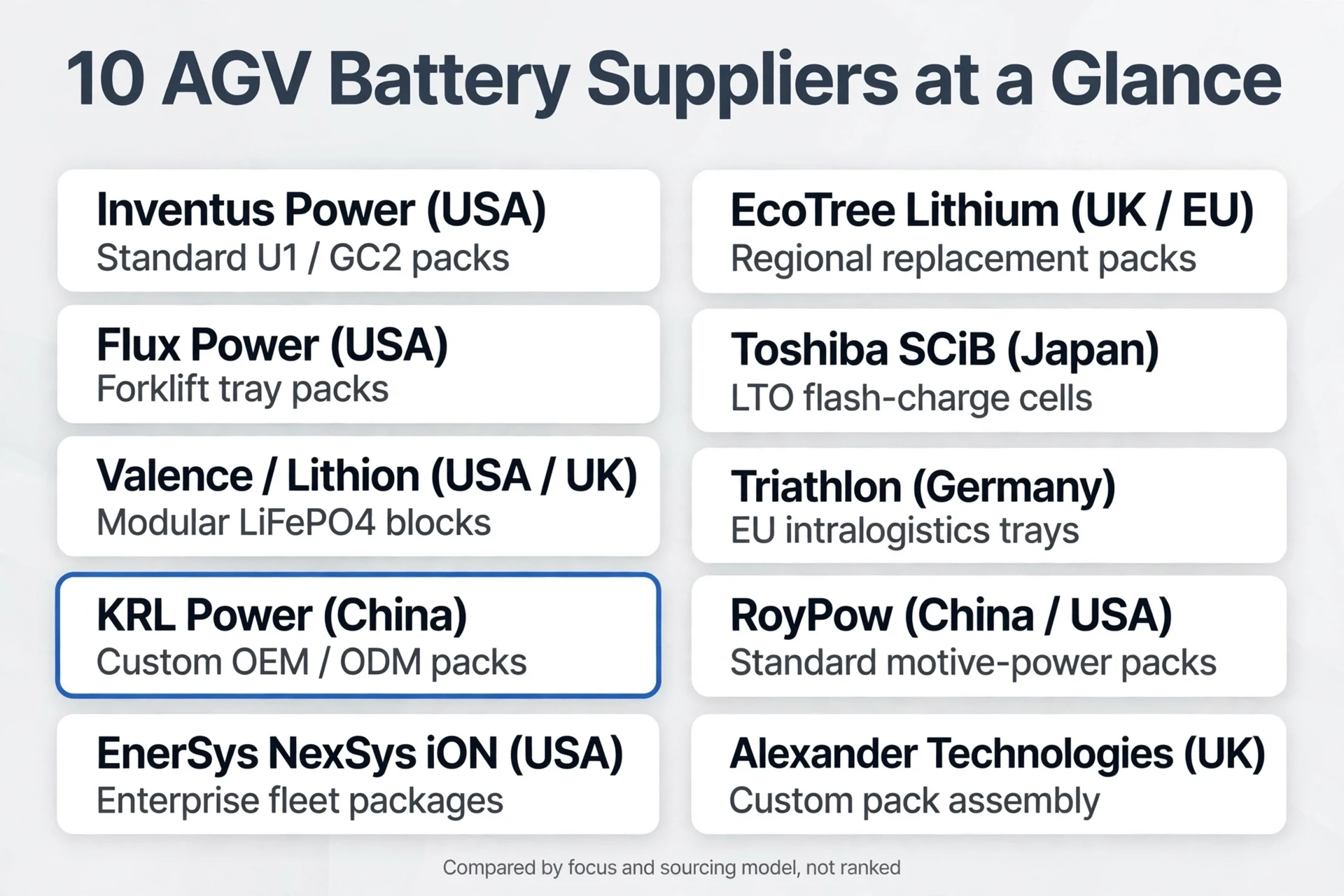
2. Supplier Profiles: Comparing Forklift and AGV Lithium Battery Companies
1. Inventus Power (PROVerge & U1 Series): Standardized Commercial & Medical Pack Supplier
- Public product focus: With experience across medical, military and commercial battery systems, Inventus Power offers standardized 24V and 48V commercial battery modules (such as U1 and GC2 drop-in sizes) alongside enterprise custom engineering.
- Evaluation considerations for OEMs: When sourcing for compact under-ride AMRs that cannot accommodate standard U1/GC2 footprints, procurement teams should clarify non-recurring engineering (NRE) tooling costs, minimum annual volume commitments and lead times for custom mechanical enclosures or firmware register changes during the RFQ stage.
2. Flux Power: North American Counterbalance Forklift & Heavy AGV Specialist
- Public product focus: Flux Power designs lithium-ion battery packs tailored to Class I, II and III electric forklifts, walkie pallet jacks and airport ground support equipment in the North American market.
- Evaluation considerations for OEMs: Because Flux Power's core lineup centers on steel-tray forklift packs designed to match lead-acid battery compartments, robotics builders developing compact warehouse sorting bots, slim RGV shuttles or lightweight AMRs should assess whether standard forklift tray dimensions and weight budgets fit their chassis architecture.
3. Valence (Lithion Battery): Modular LiFePO4 Systems
- Public product focus: Part of Lithion, Valence is known for modular 12V, 24V and 48V LiFePO4 building blocks with master-slave BMS architectures used in hospital AGVs, commercial cleaning machines and autonomous tuggers.
- Evaluation considerations for OEMs: Modular block architectures simplify multi-series/parallel scaling, but require mechanical engineers to design the vehicle's battery bay around fixed plastic module dimensions rather than shaping a single enclosure around irregular chassis cavities.
4. KRL Power: Factory-Direct Partner for Custom Dimensional & Protocol-Matched AGV/AMR Packs
- Core positioning: KRL Power operates as a direct industrial manufacturer providing OEM/ODM custom battery solutions for robotics and automated material-handling equipment. Rather than limiting buyers to fixed catalog cases, KRL engineers LiFePO4 battery systems around the specific mechanical envelope, voltage platform and communication requirements of AGVs, RGVs, collaborative robot battery packs and industrial vehicles.
- Key capabilities for robotics OEMs:
- — Custom enclosures and voltage platforms: Alongside standard 24V lithium battery platforms (such as 25.6V 60Ah LiFePO4 AGV packs) and 48V lithium battery platforms (48.0V / 51.2V), KRL designs custom battery enclosures to fit low-clearance AMR bays, RGV side cavities and heavy AGV compartments, rated for ≥3,000 cycles at 80% DoD (room temperature) on its AGV battery line.
- — Application-specific RS485 and CAN communication: KRL's BMS development team supports RS485 and CAN communication and can adapt protocol registers to report pack voltage, current, SOC, temperature and fault status to the host vehicle controller or PLC.
- — Project-configurable charging and interface design: Charge rates and BMS protection parameters can be engineered per project based on cell selection and thermal budget. Where automatic docking stations require specific charger-to-BMS handshakes or pre-charge circuit arrangements, custom hardware and control logic can be evaluated and designed according to confirmed project specifications.
- — Custom cold-storage and ingress-protected builds: Through its custom robot battery solutions program, KRL offers optional low-temperature preheating / self-heating configurations and optional enclosure sealing up to IP67 for chilled or humid environments, built to meet UN 38.3 transport requirements and applicable IEC standards.
- — Low MOQ flexibility and 3D design support: Robotics OEMs can collaborate directly with KRL's engineering team on 3D structural layout and BMS development with flexible MOQs from initial pilot runs to volume production.
Need a battery pack tailored to your robot's chassis cavity and communication bus? Explore KRL Power's dedicated AGV lithium battery solutions to review standard and customizable specifications or request an engineering evaluation.
5. EnerSys (NexSys iON): Enterprise Fleet Electrification Supplier
- Public product focus: EnerSys provides Thin Plate Pure Lead (TPPL) and NexSys iON lithium-ion systems backed by global field service for large material-handling and logistics fleets.
- Evaluation considerations for OEMs: EnerSys typically supplies integrated battery-and-charger fleet solutions for enterprise end users; third-party AMR OEMs building custom docking stations should verify charger compatibility and unbundled OEM component pricing early in the sourcing process.
6. EcoTree Lithium: European Industrial Replacement Supplier
- Public product focus: EcoTree supplies LiFePO4 battery packs for European material-handling equipment and regional industrial equipment retrofits.
- Evaluation considerations for OEMs: Often evaluated for regional fleet replacements and European support; global robotics OEMs should compare unit BOM economics and firmware customization scope against factory-direct cell-to-pack manufacturers.
7. Toshiba (SCiB): LTO Cell & Module Specialist
- Public product focus: Toshiba's SCiB Lithium Titanate (LTO) technology uses a spinel Li₄Ti₅O₁₂ anode designed for rapid flash charging, high cycle life and low-temperature operation at the cell and module level.
- Evaluation considerations for OEMs: Because LTO cells operate at a lower nominal voltage (2.40V/cell) and lower gravimetric energy density than LiFePO4, they require a larger weight and installation space budget alongside higher upfront CAPEX. OEMs typically reserve LTO for extreme flash-charge or sub-zero duty cycles where high-rate LiFePO4 cannot meet the takt time.
8. Triathlon Batterien: European Intralogistics & Heavy AGV Supplier
- Public product focus: Headquartered in Germany, Triathlon manufactures industrial lithium-ion and lead-acid traction batteries for European electric forklifts and heavy automated guided vehicles.
- Evaluation considerations for OEMs: Well aligned with heavy DIN-tray industrial trucks in European logistics hubs; builders of compact, lightweight AMRs may require more compact custom form factors.
9. RoyPow: Standardized Motive Power & Material Handling Packs
- Public product focus: Known for low-speed vehicle and floor-scrubber lithium packs, RoyPow offers standardized 24V, 36V, 48V and 80V LiFePO4 batteries for aerial work platforms and material-handling equipment.
- Evaluation considerations for OEMs: Best suited when a vehicle chassis can accommodate existing catalog case dimensions; custom mechanical footprints or non-standard vehicle bus protocols should be confirmed case by case.
10. Alexander Battery Technologies (ABT): UK Custom Pack Assembler
- Public product focus: ABT designs and assembles custom NMC and LiFePO4 battery packs in the UK for medical devices, robotics and industrial electronics.
- Evaluation considerations for OEMs: Provides local UK/European engineering collaboration for custom packs; buyers should compare European assembly costs and cell import lead times against direct Asian manufacturing options.
3. When to Choose a Custom Robotics Battery Pack Manufacturer Over Catalog Packs
Selecting between an off-the-shelf catalog battery and a custom-engineered pack depends on three technical constraints in your vehicle program:
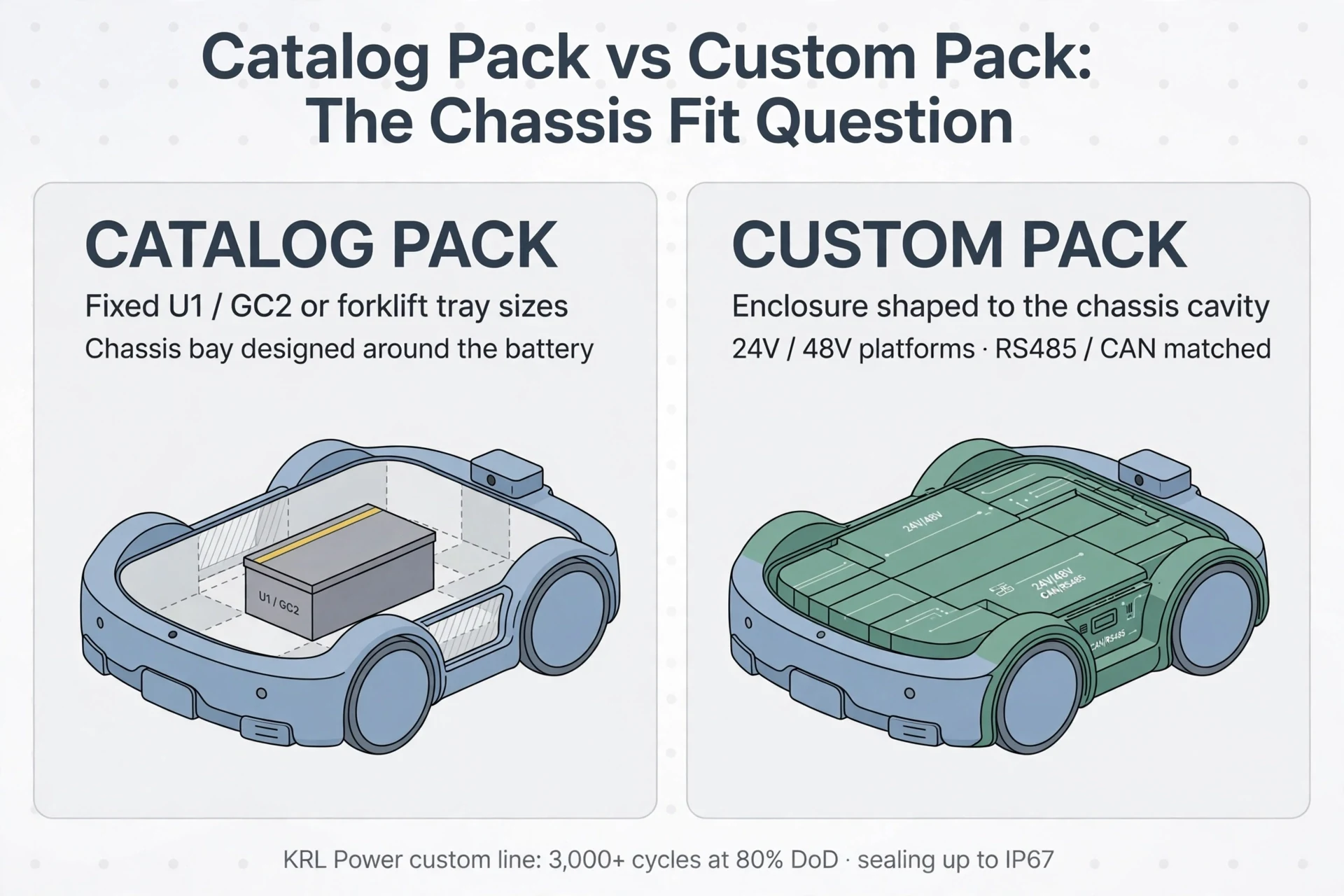
3.1 Maximizing energy density inside low-profile AMR chassis
Standard catalog batteries use rectangular enclosures sized for telecom racks, solar storage or golf carts. Working directly with a custom robotics battery pack manufacturer allows mechanical engineers to shape the enclosure around wheel wells, lift mechanisms and sensor bays. (When evaluating 48.0V 15S versus 51.2V 16S voltage architectures during chassis layout, refer to our 48V 13S/15S/16S lithium battery voltage chart.)
3.2 Aligning BMS communication and charging control with the vehicle
Generic backup BMS boards are not always configured for automated docking stations or host robot controllers. Through custom BMS development, engineers can match RS485 or CAN register maps to the vehicle's main controller and coordinate charging current limits and docking safety logic with the charger manufacturer.
3.3 Managing BOM cost across prototype and production stages
Partnering with a direct manufacturer that offers both standard voltage platforms and flexible-MOQ custom design lets robotics startups validate initial pilot vehicles without excessive tooling barriers, then scale into mass production on the same hardware architecture.
FAQ
How to choose a reliable custom AGV battery manufacturer?
What is the difference between a catalog AGV battery pack and a custom AGV battery pack?
Which battery chemistry is commonly used in industrial AGVs and AMRs?
When should an AGV manufacturer consider an LTO battery instead of LiFePO4?
What information should an OEM provide when requesting a custom AGV battery pack?
Can an AGV battery supplier customize RS485 or CAN communication?
What should engineers check before choosing an AGV battery charging system?
Why does battery enclosure fit matter for low-profile AMRs?
What battery safety and transport documents should an AGV buyer request?
What should buyers compare when evaluating AGV battery manufacturers?
5. Conclusion & Direct Factory Engineering Consultation
If your vehicle platform is built around standard drop-in forklift trays or fixed modular blocks, catalog suppliers such as Inventus Power, Flux Power or EnerSys offer established regional options.
If your robotics program requires custom battery enclosures, application-specific RS485 or CAN communication, project-matched charging design, or optional low-temperature preheating and IP67 protection with flexible MOQs, connect with KRL Power's engineering team via our AGV lithium battery solutions page. Share your available compartment dimensions (L×W×H), nominal voltage (24V / 48V / custom), continuous and peak current profile, and target regulatory requirements to receive a tailored technical proposal.
