

At a remote quarry, a 315 kW jaw crusher starting on a weak feeder can cause a voltage dip at the motor terminals. Downstream conveyors or controls may trip, stopping the line.
A quarry energy storage system can share short bursts of active and reactive power with the utility feeder or genset. Size it against the crusher start, concurrent loads and allowable voltage dip.
A crusher motor inrush battery system also needs a dust and vibration plan. Keep motor stall and jam protection in service.
Power Challenges at Quarries
Start with the motor and feeder. The largest motor start can govern inverter and generator sizing, even when average site load is much lower.
Aggregate plants impose transient electrical and airborne dust stresses far harsher than indoor factories. Commercial storage cabinets sized solely for slow peak shaving encounter two immediate engineering boundaries on a quarry pad: transient surge sharing and abrasive mineral dust.
Motor Starts and Torque Surges
Induction motors driving primary jaw crushers, secondary cone crushers, and ball mills create demanding transient profiles:
- Direct-on-line (DOL): A high-inertia flywheel can draw 6–7 times rated current on starting. A 5–15 second ramp and 0.25–0.35 starting power factor are screening assumptions; confirm the motor and loaded acceleration curve.
- Soft-Start vs. VFD Path: Reduced-voltage soft starters balance current caps (often 3.0x to 4.0x on heavy crushers) against breakaway torque, while VFDs regulate torque separately from utility-side rectifier sizing.
- Momentary Torque Surges vs. Mechanical Stall: Hard basalt entering the chamber produces sharp 1-to-5-second torque swings above running load. BESS voltage support operates alongside dedicated motor overload, stall, and jam relays. Persistent mechanical blockage triggers coordinated fault clearing and inspection procedures.
Weak Feeders and Low Genset Load
Remote quarries face distinct electrical bottlenecks depending on whether they connect to utility lines or operate on diesel generation:
- Weak Utility Feeders and Voltage Sags: Long radial 11 kV or 33 kV spurs carry limited short-circuit strength. Under high feeder impedance and DOL starting conditions, illustrative terminal voltage dips reach 15% to 25% and trip downstream screening deck VFDs and PLC racks.
- Voltage Sags vs. Billing Demand Windows: Transient voltage support targets brief motor dips separately from monthly demand billing. In a 15-minute utility window (900 seconds), an extra 1,000 kW pulse lasting 10 seconds adds roughly 11.1 kW to the billing average. Sustained crushing production shapes monthly demand charges.
- Dual-diesel example: Two 600–800 kVA prime-rated sets represent 960–1,280 kW combined at 0.8 power factor. At a 220 kW site average, that is about 17–23% of installed capacity if both run and share load.
- Low-load operation: Sustained operation at low load can increase wet-stacking risk. Check the generator manufacturer’s minimum-load guidance and duty limits.
Dust and Blasting Shock
Quarry crushing circuits continuously suspend crystalline silica and fine stone grit around equipment pads. Abrasive mineral dust clogs open intake filters and restricts heat dissipation.
Combined with moisture or condensation, accumulated grit raises insulation leakage risk while daily bench blasting transmits ground shock into enclosures and busbars.
Size BESS for Crusher Starts
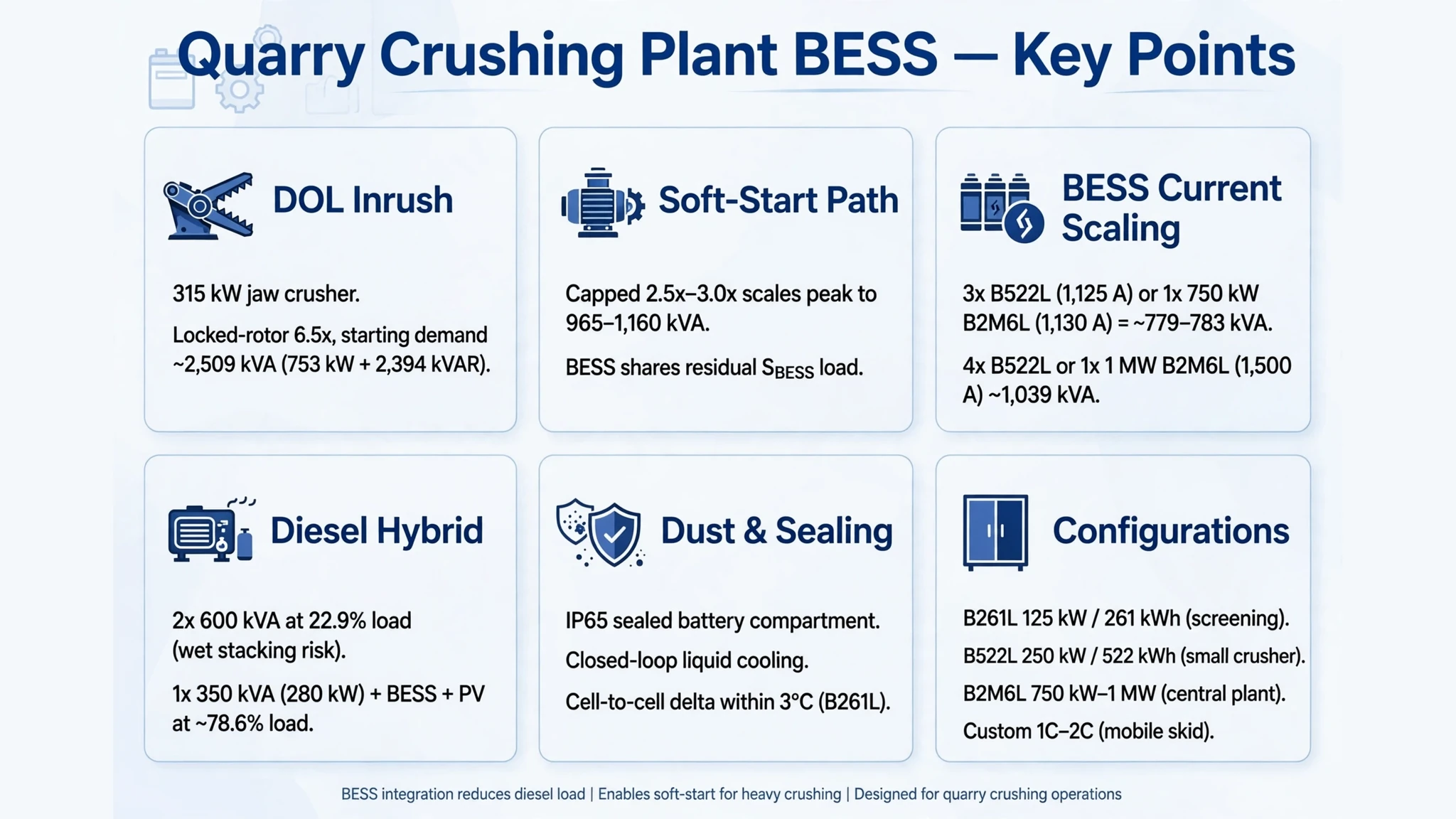
Size for the remaining kW and kVAR. In the example below, a 315 kW motor can draw about 2,509 kVA at direct-on-line start. The BESS shares the portion the feeder or generator cannot carry.
Effective jaw crusher voltage sag mitigation sizes energy storage around residual active power (P_BESS, kW), reactive power (Q_BESS, kVAR), apparent power (S_BESS, kVA), and verified PCS overload duration alongside motor-start coordination.
315 kW Jaw Crusher Example
Under illustrative motor assumptions (315 kW shaft output, 400V three-phase, 96% efficiency, 0.85 power factor), continuous electrical demand is 328.1 kW active, 386.0 kVA apparent, and 557.2A line current. Actual site motors vary by frame and efficiency:
- Direct-On-Line Start (locked-rotor current = 6.5 × rated full-load current; starting PF = 0.30): Apparent starting demand reaches ~2,509 kVA (~753 kW active plus ~2,394 kVAR reactive power). This surge exceeds single-unit 250 kW commercial inverter limits.
- Controlled Soft-Start vs. VFD Path: Verified flywheel breakaway torque under a soft starter capped at an illustrative 2.5x to 3.0x limit scales peak demand to 965 kVA–1,160 kVA. Heavy crushers frequently require higher caps such as 400%. VFDs regulate motor torque separately from utility-side rectifier sizing.
- Momentary Torque Overload Boundary: Near rated speed, a 200% torque event corresponds to ~630 kW shaft power, or ~656 kW electrical input at 96% efficiency. During real chamber jams, speed, efficiency, and power factor shift dynamically, leaving full stall trips enforced by motor protection relays.
- Candidate BESS currents at 400 V: Three B522L cabinets total 1,125 A (about 779 kVA); the 750 kW B2M6L series option lists 1,130 A (about 783 kVA). Four B522L cabinets or the 1 MW container option total 1,500 A (about 1,039 kVA).
- These kVA figures are calculated from listed maximum AC current at nominal voltage. Verify the PCS short-term P/Q envelope, current limiting at the minimum bus voltage and approved load sharing with the feeder or generator.
- Calculate the required apparent power from the BESS share of active and reactive power: S = √(P² + Q²). Include concurrent loads and compare the full starting duration against the PCS limits.
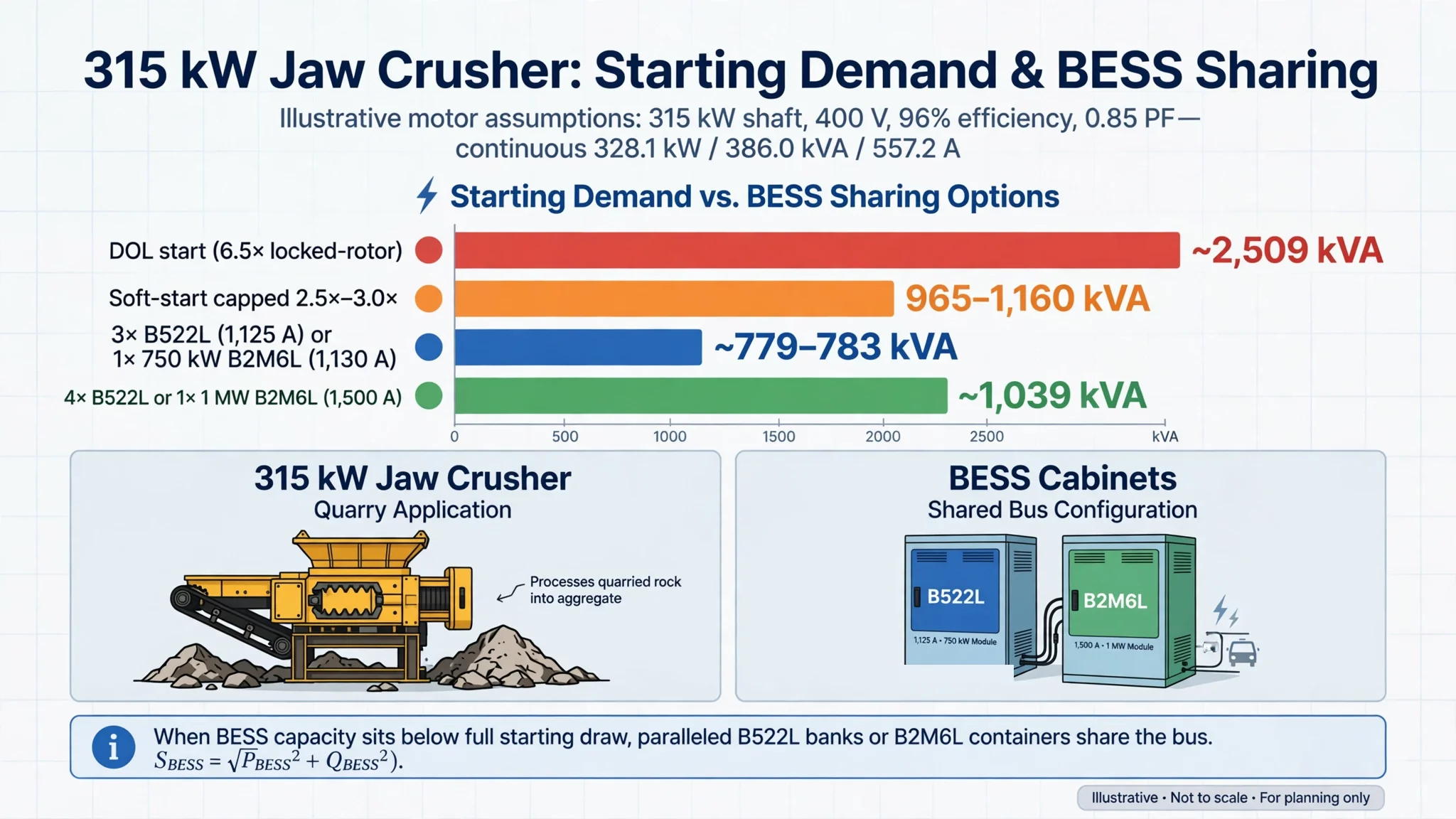
The 750 kW B522L example in the figure represents three 250 kW cabinets. It is a separate option from the container, and the current figures are sizing checks.
Diesel Hybrid Sizing
In a diesel generator hybrid bess quarry retrofit, matching generator capacity to average plant duty cycles reduces low-load runtime while retaining peak support:
- Legacy Dual-Genset Baseline: Two 600 kVA generators (960 kW combined prime rating at 0.8 PF) carrying 220 kW average crushing demand run at 22.9% load factor, risking wet stacking and high idle burn.
- Hybrid screening case: A 350 kVA / 280 kW prime genset plus BESS and PV gives a reference ratio of 220 ÷ 280 = 78.6%. Actual generator loading varies with PV production, battery dispatch and recharge.
- Running power gap: The fully loaded crusher motor draws 328.1 kW, or 48.1 kW more than the 280 kW genset before conveyors, auxiliaries and reserve. Check reactive power and starting demand separately.
- Mandatory SOC Recovery and Cost Modeling: Generator dispatch, PV output, and recharge schedules must restore required SOC ahead of the next crushing cycle, covering conversion losses, chiller power, and sustained motor loads. Fuel and engine overhaul savings are modeled separately per site from engine L/h curves, duty histograms, and PV yield.
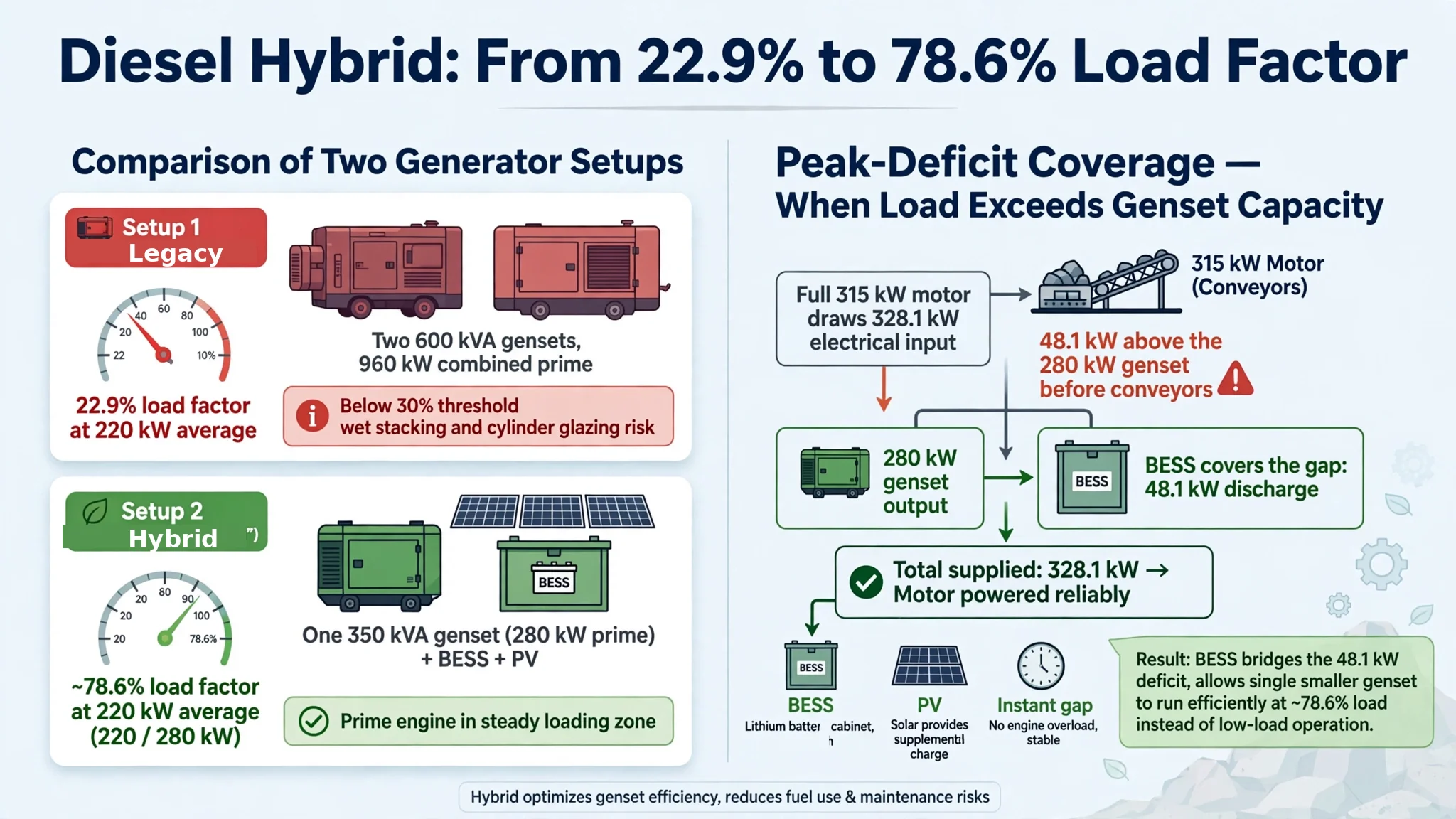
The figure compares load ratios at a fixed 220 kW reference. Its 315 kW motor is the jaw crusher; conveyor power is additional.
Compare Three Power Setups
| Check | Generic BESS | Dual diesel | Motor-matched BESS |
|---|---|---|---|
| Motor start | Verify P/Q and overload | Verify start kVA | Match the residual kVA |
| Voltage sag | Check PCS response | Check transient dip | Test the shared bus |
| Dust control | Check intake filters | Service engine filters | IP65 battery compartment |
| Running cost | Model losses and wear | Use fuel curves | Model site dispatch |
Dust, Cooling and Vibration
IP65 applies to the battery compartment. Plan separate dust protection and servicing for the PCS and external heat exchanger.
Specifying a mining heavy machinery bess goes far beyond inverter power sizing; enclosure integrity and thermal stability decide whether equipment runs reliably beside primary crushers.
Protect the Battery Compartment
Standard indoor or light commercial cabinets pull outside ambient air directly over power electronics and battery racks. Along crushing haul roads, airborne mineral dust clogs mesh filters, traps heat, and coats insulating surfaces in moisture-retentive grit.
On KRL's liquid-cooled lineup, including the 125 kW / 261 kWh KRL-B261L all-in-one ESS cabinet and 250 kW / 522 kWh KRL-B522L industrial BESS unit, cells stay inside IP65 sealed compartments. Closed-loop liquid cold plates replace open airflow across the battery modules.
Choose Battery Power and C-Rate
Stationary KRL C&I units (B261L, B522L, and containerized B2M6L) carry a standard power-to-energy ratio near 0.5P using long-life LiFePO4 battery technology.
On fixed substation pads, paralleling units scales active kW headroom (up to 6 units on B522L for 1.5 MW / 3.13 MWh, or up to 10 units on B261L for 1.25 MW / 2.61 MWh).
Mobile tracked crushers and compact skids face tight weight limits and often need a high overload industrial bess 2c battery profile. KRL engineers dedicated high-rate packs for those frames via our custom industrial battery assemblies team.
KRL publishes a cell-to-cell temperature delta within 3°C on the B261L, stabilizing cell health across repetitive surge duty.
Specify Skid and Vibration Limits
Remote aggregate operations advance bench faces every few years. Containerized and skid-ready BESS assemblies relocate cleanly alongside mobile crushing spreads in place of permanent substation concrete.
Tender specifications define vibration, shock, and skid-mounting criteria (referencing standards such as IEC 60068) alongside bolted busbar locking and generator reverse-power protection (ANSI 32). Site plans also define dust filtration and washdown service intervals for PCS bays and liquid-to-air heat exchangers.
Ready to stabilize crusher motor starts and streamline diesel generator fleets? Explore KRL Power's high-overload industrial and C&I BESS units with IP65 battery protection for mining and quarries.
KRL Quarry BESS Options
Review controls before delivery. Check the motor start curve, the generator interface and the PV inputs for the ordered configuration.
Megawatt-class mining microgrids succeed when power electronics, solar arrays, diesel gensets, and crusher motor starters are coordinated in engineering review before shipping to site.
Coordinate Controls Before Delivery
Before factory dispatch, KRL engineers review the site's largest motor kW rating, starting topology (DOL, soft starter, or VFD), feeder short-circuit strength, and genset specifications. Verifying P/Q setpoints alongside concurrent conveyor loads avoids remote ridge commissioning delays.
The B261L and B522L list generator ports and maximum PV input of 120 kW and 240 kW respectively. Confirm automatic start/stop, minimum run time and recharge controls in the project design.
Scale to a Central Plant
Central aggregate plants often run primary, secondary, and tertiary crushing circuits concurrently with overland conveyors.
For multi-motor hubs, the KRL-B2M6L containerized BESS series lists 750 kW / 1.5 MWh and 1 MW / 2 MWh configurations. They list maximum AC currents of 1,130 A and 1,500 A at 400 V, and maximum PV input of 720 kW and 960 kW respectively. Verify the exact order code, grid-forming controls and transfer behavior under the intended crusher load.
Compare KRL Configurations
| Duty | KRL option | Rated power / energy |
|---|---|---|
| Screens, pumps, auxiliaries | B261L | 125 kW / 261 kWh |
| Small crusher with soft start | B522L | 250 kW / 522 kWh |
| Central plant | B2M6L series | 750 kW / 1.5 MWh |
| Central plant | B2M6L series | 1 MW / 2 MWh |
| Mobile crusher or skid | Custom LFP pack | Project-specific 1C–2C |
Plan Your Quarry BESS
Every hour of belt-line stoppage from weak rural feeders or low-load generator maintenance erodes quarry output per ton. Matching residual BESS apparent power headroom, IP65 battery protection alongside PCS/chiller dust servicing, and starter ramp coordination protects crushing uptime across demanding sites.
Planning an off-grid quarry microgrid or weak-feeder retrofit? Contact KRL Power's Heavy Industrial Engineering Team with your motor kW rating, starting method (DOL, soft starter, or VFD), concurrent loads, and transformer or genset specs.
The KRL Power engineering team can review PCS headroom, enclosure protection and generator fuel estimates using that site data.