Nigeria Industrial Facility Requires a Reliable Off-Grid Energy Solution
1. Customer Background: Industrial Power Challenge in Nigeria
Based on the customer's project requirements from Nigeria, this application represents a typical industrial off-grid energy scenario.
The customer operates an industrial facility without access to a stable utility grid.
The customer operates an industrial facility without access to a stable utility grid.
Existing Power System:
- Diesel Generator #1:
- 150kVA
- Diesel Generator #2:
- 100kVA
Total available backup capacity:
250kVA diesel generation system
Main Industrial Loads:
The facility operates multiple production loads:
- Industrial ovens
- AC mixers
- Water pumps
- Auxiliary equipment
Daily operation:
- 12–15 hours/day
Current Energy Challenges:
1. High Diesel Consumption
The factory depends completely on diesel generators.
Problems:
Problems:
- High fuel cost
- Frequent fuel supply requirements
- Increased operating expenses
2. Poor Energy Efficiency
Diesel generators often operate inefficiently when:
- Load changes frequently
- Production demand fluctuates
- Equipment starts/stops
3. No Renewable Energy Integration
The customer wants to evaluate:
- Solar PV integration
- Battery energy storage
- Diesel optimization
to build a more economical microgrid.
2. Engineering Analysis From KRL Power Perspective
From 20 years of ESS engineering experience, this project is not simply a backup power application.
It is a:
It is a:
Industrial Hybrid Microgrid Optimization Project
The objective is:
PV + ESS + Diesel Generator = Lower Fuel Consumption + Higher Power Reliability
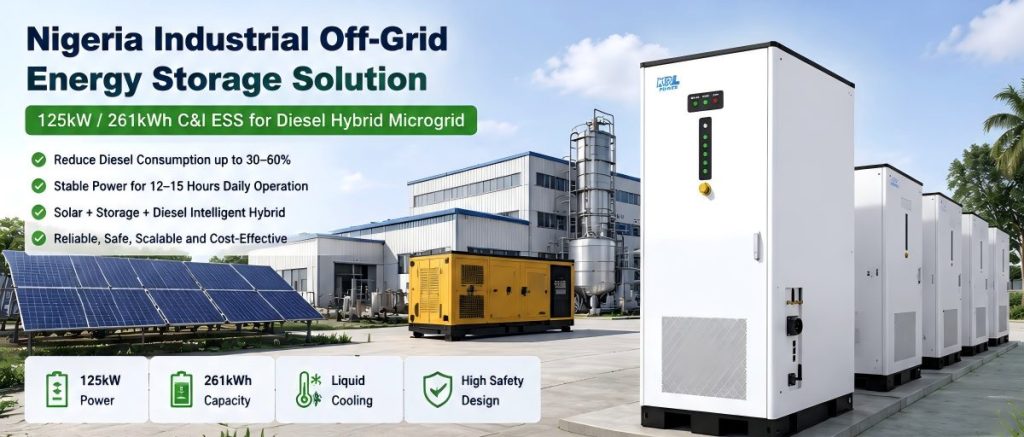
3. Recommended KRL Solution
125kW / 261kWh Liquid-Cooled C&I Energy Storage System
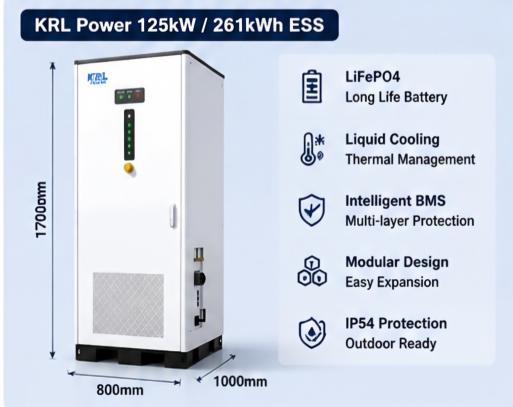
The KRL Power C&I ESS integrates:
- Battery system
- PCS
- EMS
- Intelligent BMS
- Thermal management system
Providing a complete industrial energy management solution.
4. Recommended Industrial Microgrid Architecture
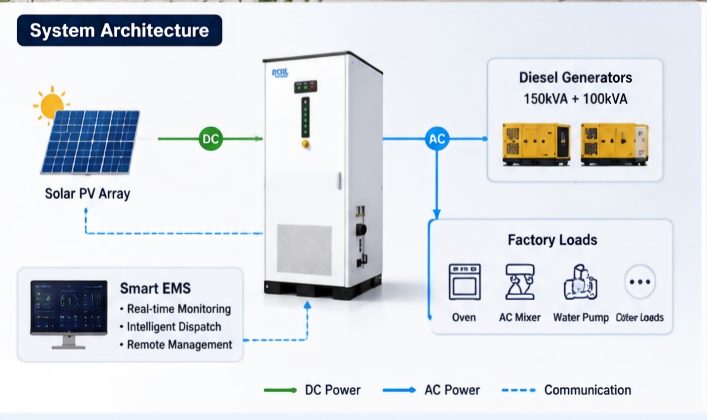
Energy Flow:Daytime Operation
Solar PV →
Factory Load
↓
Excess Solar →
Battery Charging
High Load Period
PV + ESS →
Industrial Equipment
Reducing diesel generator output.
Night / Low Solar Period
Battery →
Factory Loads
Diesel generator operates only when required.
5. Why 261kWh ESS is Suitable for This Project
For the current factory load:
Existing diesel capacity:
250kVA
Daily operation:
12–15 hours
The purpose of ESS is not to completely replace diesel immediately.
The optimized strategy is:
Existing diesel capacity:
250kVA
Daily operation:
12–15 hours
The purpose of ESS is not to completely replace diesel immediately.
The optimized strategy is:
Peak Load Support + Diesel Fuel Reduction
Energy Storage Functions:
1. Reduce Diesel Running Hours
Instead of:
Diesel generator:
12–15 hours/day
Optimized:
PV + ESS:
Most daytime operation
Diesel:
Backup only
2. Improve Generator Efficiency
Diesel generators perform best under stable loading.
ESS can:
- Absorb load fluctuations
- Reduce frequent generator adjustment
- Improve fuel efficiency
3. Protect Production Continuity
ESS provides:
- Fast power response
- Stable voltage
- Reduced interruption risk
6. KRL C&I ESS Technical Advantages
Liquid Cooling Thermal Management
Industrial environments require stable temperature control.
KRL liquid cooling provides:
KRL liquid cooling provides:
- Better thermal balance
- Longer battery lifetime
- Higher safety performance
Intelligent BMS Protection
Including:
- Cell monitoring
- Temperature management
- Over-voltage protection
- Fault diagnosis
Intelligent BMS Protection
Including:
- Cell monitoring
- Temperature management
- Over-voltage protection
- Fault diagnosis
Smart EMS Energy Management
KRL EMS automatically controls:
- PV priority
- Battery charging/discharging
- Diesel generator operation
- Load optimization
7. Recommended Configuration
Initial Configuration
Energy Storage System
KRL:
125kW / 261kWh Liquid-Cooled ESS
KRL:
125kW / 261kWh Liquid-Cooled ESS
Solar PV
Recommended:
150–250kWp
(depending on available installation area)
150–250kWp
(depending on available installation area)
Diesel Generator
Existing:
150kVA + 100kVA
Continue using as backup.
150kVA + 100kVA
Continue using as backup.
Future Expansion
Modular expansion:
261kWh
↓
522kWh
↓
1MWh+
according to factory production growth.
8. Expected Project Benefits
Fuel Cost Reduction
Potential diesel saving:
30%–60%
depending on PV capacity and load profile.
Improved Production Reliability
Benefits:
- Stable factory operation
- Reduced downtime
- Better equipment protection
Lower Long-Term Operating Cost
Compared with diesel-only operation:
- Lower fuel expenses
- Reduced maintenance
- Better energy efficiency
9. Installation Considerations for Nigeria
Before installation, KRL recommends:
Environmental Assessment
Confirm:
- Temperature
- Humidity
- Dust condition
- Outdoor/indoor location
Electrical Design Confirmation
Need to verify:
- Generator voltage
- Frequency
- Load power
- Protection settings
Communication Integration
EMS supports:
- Remote monitoring
- Alarm notification
- Performance analysis
10. Why Choose KRL Power
KRL Power is one of the emerging high-performance energy storage companies in China, focusing on commercial and industrial ESS solutions.
KRL has developed global ESS solutions based on:
KRL has developed global ESS solutions based on:
- Advanced battery technology
- Intelligent energy management
- Integrated system design
KRL Competitive Advantages
Extreme Safety Architecture
- Long-life LiFePO4 cells
- Liquid cooling technology
- Intelligent BMS
- Multi-layer fire protection
Superior Cost Optimization
Self-developed EMS enables:
- Peak shaving
- Valley filling
- Diesel optimization
- ROI improvement
Integrated Smart Design
All-in-One architecture:
- Faster deployment
- Easier maintenance
- Flexible expansion
FAQ
Q1: Can KRL ESS replace diesel generators completely?
For industrial off-grid applications, diesel is usually retained as backup. ESS mainly reduces diesel consumption and improves system efficiency.
Q2: Why not install a larger battery directly?
Battery sizing should match actual load profile and ROI. Starting with 261kWh allows optimized investment and future expansion.
Q3: Can existing 150kVA and 100kVA generators work with KRL ESS?
Yes. KRL ESS can integrate with existing diesel generators through AC coupling and EMS control.
Q4: Is solar required?
Solar is recommended because it significantly improves fuel-saving performance, but the ESS can also operate with diesel and grid sources.
Q5: Can this system operate in harsh Nigerian environments?
Yes. The liquid-cooled ESS design improves reliability under high-temperature industrial conditions.
Q6: Can the system expand in the future?
Yes. KRL modular C&I ESS architecture supports expansion from hundreds of kWh to MWh-level systems.
Conclusion
For Nigerian industrial facilities without grid access, relying only on diesel generators creates long-term operational pressure.
The optimized solution is not simply replacing diesel, but building a smarter hybrid microgrid.
The optimized solution is not simply replacing diesel, but building a smarter hybrid microgrid.
KRL Power's:
125kW / 261kWh Liquid-Cooled C&I ESS
combined with:
Solar PV + Existing Diesel Generators + Intelligent EMS
creates a reliable and economical industrial energy solution.
It helps factories achieve:
It helps factories achieve:
- Lower diesel consumption
- Stable production power
- Renewable energy integration
- Future scalable expansion
KRL Power provides industrial customers with a practical pathway toward energy independence in Nigeria and other emerging markets.