
Consider an illustrative day-ahead curve with −€80/MWh at 13:00 and +€240/MWh at 19:00. A KRL C&I battery can shift energy between those windows when the site’s tariff, usable capacity and dispatch limits support a positive margin.
A qualifying German PV system can lose EEG support during negative settlement intervals. The value of exports and evening imports depends on the site’s electricity contracts.
Deploying negative electricity prices battery storage closes that gap. Commercial BESS systems that schedule against the next day's 15-minute prices charge during low-price or sub-zero wholesale windows and discharge into the evening peak, turning European price volatility into a measurable revenue line.
- Use quarter-hour prices and the actual site tariff.
- Subtract wear and conversion costs before trading.
- Keep enough SOC for contracted demand limits.
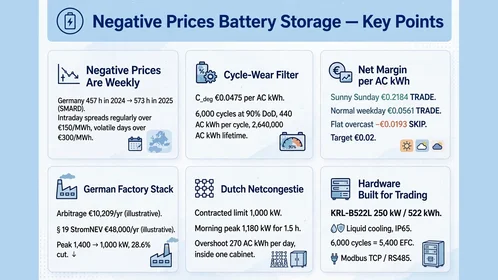
This guide shows German and Dutch energy managers, VPP aggregators and C&I solar EPCs how automated dispatch works. You also see how to model net margins on a unified AC basis after battery wear, then stack spot trading with German grid fee savings and Dutch capacity relief.
Why European Power Prices Go Negative
Germany hit 573 negative-price hours in 2025 while EEG § 51 cuts PV support during sub-zero quarter-hours. Check the next day’s prices and reserve adequate headroom for the charge and discharge windows.
Wind and solar build-out has turned negative wholesale prices from a rare anomaly into a recurring operating condition in Northwest Europe.
When Negative Prices Occur
SMARD reports 457 negative-price hours in 2024 and 573 in 2025 for Germany. Evaluate the actual bidding zone rather than applying German price history to the Netherlands, Belgium or the Nordics. SMARD 2025 market review
Negative prices cluster in two windows:
- Sunny midday hours (roughly 11:00 to 15:00), when PV output exceeds demand and inflexible generation keeps running.
- Windy nights and holiday weekends, when wind output peaks against low industrial demand.
Evening hours after sunset, and calm winter periods with little wind or sun (Dunkelflaute), push prices the other way. Intraday spreads between the cheapest and most expensive quarter-hours regularly exceed €150/MWh and on volatile days pass €300/MWh.
Check EEG and SDE++ Terms
For covered installations, Germany’s EEG § 51 reduces the applicable subsidy value to zero in negative-price periods. EEG § 51
For PV plants commissioned from 25 February 2025 under the Solarspitzengesetz, feed-in support suspends during every negative day-ahead quarter-hour. Systems under 100 kW retain transitional exemptions until the end of the calendar year in which the smart metering system is installed.
EEG § 51a governs the support-period extension and includes PV-specific conversion rules. Review transitional rules for older installations by commissioning date and capacity. EEG § 51a
That policy shift makes eeg negative price solar curtailment bess essential for plant margins. By absorbing midday surplus into storage and serving evening factory demand, operators protect green output from inverter throttling and negative spot settlement.
Dutch SDE++ negative-price treatment depends on the award round, generation type and capacity. Check the award terms alongside the import and export contracts. RVO negative-price guidance
Replace Fixed Schedules
Many entry-level storage cabinets rely on fixed time-of-use clocks: charge at 02:00, discharge at 18:00. While that schedule fits regulated night tariffs, it mismatches renewable-driven European wholesale markets.
In Germany and the Netherlands, the lowest prices on sunny days cluster around 13:00, while calm winter nights stay expensive. Fixed timers therefore charge at high night tariffs and discharge into weaker afternoons, whereas profitable dispatch aligns daily with published exchange curves.
How Day-Ahead Dispatch Works
Dispatching across 15-minute SDAC prices yields €0.2184/AC kWh on -€50 to +€220/MWh spreads after €0.0475/AC kWh wear. Built-in spread filtering keeps low-margin cycles idle to protect asset life.
Every day-ahead market energy storage system builds its daily schedule from published exchange prices ahead of fixed timers.
Build the Daily Schedule
Single Day-Ahead Coupling (SDAC) auctions close at 12:00 CET, with EPEX SPOT and Nord Pool publishing results around 12:45 to 13:00 CET.
SDAC transitioned to 15-minute market time units (MTU) with first delivery on 1 October 2025 (first traded 30 September 2025). Standard delivery days hold 96 intervals, while Daylight Saving Time transition days hold 92 or 100 timestamp-indexed intervals. EPEX SPOT implementation notice
For epex spot nord pool battery trading, a project-configured EMS layer executes four afternoon steps:
- Timestamped price import: The EMS gateway downloads the next day's 15-minute zone prices (such as DE-LU or NL) from the exchange feed, ENTSO-E API, or supplier feed. Indexing by UTC/CET timestamp handles 92-, 96- and 100-MTU DST days cleanly.
- PV and load forecast: Local irradiance data estimates tomorrow's rooftop PV curve, and the factory's 15-minute load profile (Lastgang) forecasts demand by shift.
- Priority constraint allocation: The optimizer reserves state of charge for peak-shaving targets, contracted capacity caps and backup reserves before assigning remaining headroom to arbitrage.
- Wear filter and setpoint dispatch: Candidate windows pass a cycle-wear threshold check, and accepted trades translate into PCS active-power setpoints.
KRL's built-in EMS executes peak shaving, load shifting and PV self-consumption locally. Day-ahead price optimization runs either through a project-level EMS configuration or via a third-party optimizer or VPP writing setpoints through a verified local interface or gateway.
Set a Cycle-Wear Budget
Every charge-discharge cycle consumes part of a battery's operational budget. A simplified cycle-wear filter budgets replacement cell and pack capital across expected AC throughput (kept distinct from full project LCOS models that also include financing, fixed O&M and calendar aging).
Consider one KRL-B522L unit (522 kWh nominal) modeled with an illustrative €240/nominal kWh replacement valuation (€125,280 total). The model assumes 6,000 cycles at 90% DoD and 440 AC kWh delivered per cycle, for 2,640,000 AC kWh of lifetime throughput.
C_deg = (€240 × 522) ÷ (6,000 × 440) ≈ €0.0475 per AC kWh
Use 6,000 cycles for this example. Check warranted throughput, DoD and end-of-life criteria for the exact model.
Net margin per AC kWh delivered to the facility load:
Net margin = P_peak − (P_charge ÷ η_RT) − C_deg − F_loss
Here η_RT represents AC round-trip efficiency (0.88 assumed; verify on the project datasheet) and F_loss covers volumetric grid fees and levies paid on conversion losses. At €0.08/kWh in volumetric charges, F_loss = €0.08 × (1 ÷ 0.88 − 1) ≈ €0.0109 per AC kWh.
Trade or Skip Each Price Window
This calculation covers grid-to-load arbitrage when volumetric grid fees and levies match between charge and displaced evening consumption; supplier markups, capacity-charge shifts and site-specific taxes are assessed separately. Charging from surplus rooftop PV is valued separately against lost export tariff or curtailment avoidance.
Because a 250kW cabinet moves at most 62.5 kWh per 15-minute MTU, importing 500 AC kWh (at 88% efficiency) requires 2.0 hours across eight charge intervals. Delivering 440 AC kWh at 250 kW requires 1.76 hours, spanning eight 15-minute settlement intervals with partial dispatch in the final interval.
Use energy-weighted averages over the active blocks. Convert P_charge and P_peak from €/MWh to €/kWh for the formula. The table applies the displayed rounded cost inputs.
| Day | Charge €/MWh | Peak €/MWh | Margin €/AC kWh |
|---|---|---|---|
| Sunny Sunday | −50 | +220 | +0.2184 · Trade |
| Wide weekday spread | +40 | +160 | +0.0561 · Trade |
| Flat weekday spread | +80 | +130 | −0.0193 · Skip |
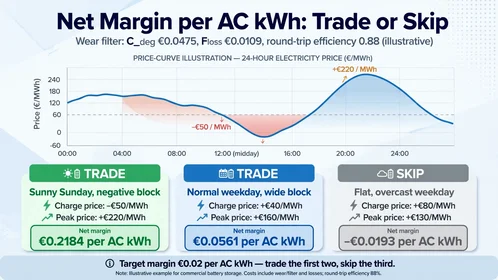
With a target margin of €0.02/AC kWh, the dispatch logic trades the first two profiles and skips the third, saving battery cycles for profitable spreads.
Compare Control Options
| Check | Fixed timer | Add-on gateway | Project EMS |
|---|---|---|---|
| Price source | Confirm imports | Map the API | Zone price feed |
| Timing | Verify 15-min steps | Check polling lag | Timestamped intervals |
| PV and export | Check PV controls | Test the handshake | Enforce site limits |
| Wear budget | Check filter support | Check SOC and SOH | Set a margin hurdle |
| Local commands | Check registers | Map PCS setpoints | Verify write access |
German and Dutch Factory Examples
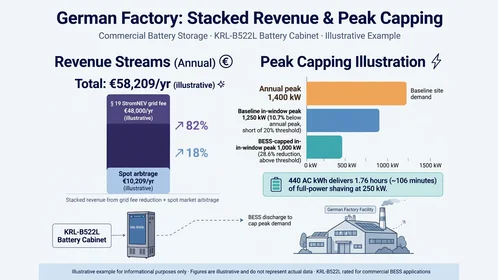
Stacking spot arbitrage (€10,209 illustrative annual contribution) with German § 19 StromNEV peak capping (€48,000 illustrative fee reduction) or Dutch netcongestie headroom can add value when both services fit the operating schedule.
Europe commercial bess arbitrage delivers stronger returns when daily price shifting stacks alongside regulatory grid-fee savings or grid-capacity relief.
Start with the Supply Contract
Spot arbitrage reaches the P&L through an electricity contract linked to 15-minute wholesale prices on an interval meter (RLM in Germany). A dynamic tariff commercial battery germany netherlands deployment verifies wholesale pass-through terms, supplier service fees, and balancing settlement rules before hardware sizing begins.
German Factory Peak Capping
Site assumptions: medium-voltage connection, 1,400 kW annual peak load, 600 kWp rooftop PV, spot-indexed supply, one 250kW / 522kWh KRL-B522L liquid-cooled C&I BESS cabinet delivering ~440 AC kWh per full 90%-DoD cycle.
Revenue line 1, illustrative annual arbitrage contribution after modeled cycle wear, before fixed operating costs (co-simulated on the same SOC timeline alongside peak-shaving reservations and prior to PV self-consumption gains):
- 60 negative-block days × 440 AC kWh × €0.2184 = €5,766
- 180 wide-block days × 440 AC kWh × €0.0561 = €4,443
- Annual arbitrage contribution ≈ €10,209 using energy-weighted block averages (counting shared peak-shaving/arbitrage discharges once while adding any extra shaving-only throughput to the wear budget)
Revenue line 2, § 19 Abs. 2 Satz 1 StromNEV atypical grid use (subject to formal eligibility and agreement):
German distribution operators publish high-load time windows (Hochlastzeitfenster) by season, voltage tier and year. When a factory keeps its in-window peak sufficiently below its annual peak, it can apply for an individual network tariff based on the lower in-window peak.
This medium-voltage example uses a 20% in-window materiality threshold. Confirm the applicable threshold, minimum load shift and minimum fee savings with the network operator. The individual fee under § 19(2), sentence 1 remains at least 20% of the published network fee. StromNEV § 19
- Baseline profile: 1,250 kW in-window peak, sitting 10.7% below the 1,400 kW annual peak and short of the 20% threshold.
- BESS-capped profile: discharging 250 kW holds the in-window peak at 1,000 kW, achieving a 28.6% reduction above the materiality threshold.
- Illustrative annual saving at €120/kW/year (contingent on formal grid-operator agreement and year-round meter compliance): (1,400 − 1,000) kW × €120 = €48,000 per year.
At 250 kW output, the cabinet's 440 AC kWh delivers 1.76 hours (~106 minutes) of continuous full-power shaving.
Engineers verify on the site's 15-minute Lastgang that cumulative overshoot energy above 1,000 kW in each window stays within 440 AC kWh (minus backup reserve). The EMS reserves sufficient SOC before every applicable high-load window published by the local network operator.
For models extending beyond 2028, separate the existing StromNEV case from the proposed AgNes tariff structure. The regulator’s consultation describes a transition from 2029. Confirm the final decision and any applicable transition terms when pricing the project. Bundesnetzagentur AgNes proceeding
Separate pre-2029 StromNEV savings from post-2029 transition scenarios in 10-year models, and reserve the separate 10 GWh / 7,000-hour band-load route under Satz 2 for qualifying large industrial loads.
Dutch Logistics Import Cap
Grid congestion (netcongestie) leaves many Dutch business parks waiting into the 2030s for transformer upgrades. On-site storage lets operations expand within existing contracted transport capacity (gecontracteerd transportvermogen).
Site assumptions: 1,000 kW contracted limit with morning peaks reaching 1,180 kW for 1.5 hours when truck chargers and cold-store compressors run together.
- Peak overshoot energy: 180 kW × 1.5 h = 270 AC kWh daily, well within one 250kW / 522kWh cabinet.
- Dispatching any available balance from the remaining 170 AC kWh (plus midday recharges) for spot trading or TenneT imbalance response stays inside the site's 1,000 kW import limit. Operations also follow the site's separately agreed export limit while holding required backup SOC.
Check which flexible transport rights are available for the connection. ACM distinguishes time-duration rights on the transmission system from time-block rights on distribution networks. Use the signed transport agreement to set dispatch limits. ACM grid-congestion measures
Ready to turn sub-zero wholesale prices and German grid fees into a revenue line? Explore KRL Power's AI-EMS integrated commercial battery storage cabinets, built for peak shaving, PV self-consumption and open-protocol dispatch.
Cabinets, Controls and Grid Codes
Dual-cycle spot trading requires closed-loop liquid cooling, transparent EFC accounting (5,400 EFC at 6,000 cycles/90% DoD), applicable DSO certificates, and a verified local control interface to retain aggregator choice.
Daily trading cycles place sustained thermal and mechanical demands on cells and power electronics. System durability and compliance determine long-term bankability.
Track Cooling and Cycle Throughput
Active trading strategies often run morning wind-to-peak shifts followed by midday solar-to-evening shifts, totaling 500 to 650 partial or full cycles annually.
Both the KRL-B261L 125kW / 261kWh all-in-one ESS cabinet and the KRL-B522L use liquid cooling and feature IP65-rated battery protection; KRL publishes a cell-to-cell temperature difference within 3°C for the B261L.
Counting cycles consistently matters: 6,000 cycles at 90% DoD represent 5,400 equivalent full cycles (EFC) of nominal capacity throughput (6,000 × 0.90 = 5,400 EFC). Running 600 cycles annually at 90% DoD spans roughly 10 years of that simplified throughput budget, whereas 600 full EFC per year corresponds to 9 years of budget.
Both cabinets rely on LiFePO4 battery technology; verify rated cycle life, end-of-life SOH and warranty throughput on the exact model datasheet prior to financial close.
Check Grid Code and Test Evidence
German and Dutch distribution operators verify compliance per PCS model and firmware version before grid energization. Confirm the project dossier includes:
- VDE-AR-N 4105 for German low-voltage connections.
- VDE-AR-N 4110 for German medium-voltage installations (unit certificate and plant-level certification workflow).
- Applicable national energy storage grid-connection codes and DSO requirements, including EN 50549 where adopted for EU storage installations.
- IEC 62619 industrial lithium battery safety reports, alongside UL 9540A thermal propagation test data where requested by the insurer or relevant authority.
Verify the Local Control Interface
Many turnkey energy platforms bind hardware to proprietary cloud dispatch in exchange for recurring revenue splits. Keeping local control open preserves flexibility if an owner switches aggregators over the 10-year asset life.
The B522L product table lists RS485 and Wi-Fi. For Modbus TCP, Modbus RTU or another VPP interface, obtain the exact register map, write permissions and gateway configuration for the ordered equipment. Test telemetry and setpoint control before accepting the integration. KRL-B522L product specifications
Scaling to multi-megawatt distribution feeders or logistics hubs? Evaluate the 750kW to 1MW KRL-B2M6L containerized battery energy storage system with 400Vac grid-forming capability and sub-10ms transfer.
Choose a Cabinet or Container
| Site | KRL model | Rated power / energy |
|---|---|---|
| Workshop or farm | KRL-B100 | 50 kW / 100 kWh |
| Factory or cold store | KRL-B261L | 125 kW / 261 kWh |
| Industrial load | KRL-B522L | 250 kW / 522 kWh |
| Logistics park | KRL-B2M6L | 750 kW / 1.5 MWh or 1 MW / 2 MWh |
Verify PV input and configuration by order code. The options discussed here are 100 kW for B100, 240 kW for B522L and 720 or 960 kW for the two listed B2M6L configurations. Check the approved parallel design for up to ten B261L or six B522L units.
Request a Project Assessment
Leaving rooftop PV exposed to sub-zero quarter-hours and unbuffered grid peaks erodes C&I plant margins across Northwest Europe. Pairing daily market dispatch with compliant BESS hardware turns price volatility into a recurring factory asset.
Planning a C&I storage deployment in Germany, the Netherlands, Belgium or the Nordics? Contact KRL Power's European engineering support team with your bidding zone (such as DE-LU or NL), a 12-month 15-minute Lastgang CSV load file and your rooftop PV rating.
Submit your project inputs for a custom BESS sizing, arbitrage and grid-fee assessment backed by KRL Power's 24-hour engineering team response. Learn more about KRL Power's lithium battery R&D and manufacturing.