 Skip to content

Industrial Production Line Backup Power: Solid-State Battery
For a 24-hour automated production line, a single voltage dip or grid interruption isn't just an inconvenience—it represents hundreds of thousands of Rands in ruined product and hours of baseline recalibration. In regions like South Africa, where load shedding is a structural reality, the conversation for C&I executives has shifted from simple backup power to high-capacity energy arbitrage.
Particularly in the typical energy-intensive commercial and industrial (C&I) scenario of 800–1000kW, factories not only require millisecond-level seamless backup power to keep precision equipment running but also expect to achieve "peak shaving and valley filling" through energy storage system to amortize the initial equipment investment.
This article will break down how to utilize next-generation solid-state battery technology to completely solve power outage pain points while achieving an outstanding Return on Investment (ROI), using a real-world 920kW C&I energy storage case study.
Running the Numbers: A Real-World Case of a 920kW/4.6MWh Energy Storage System in a South African Food Factory
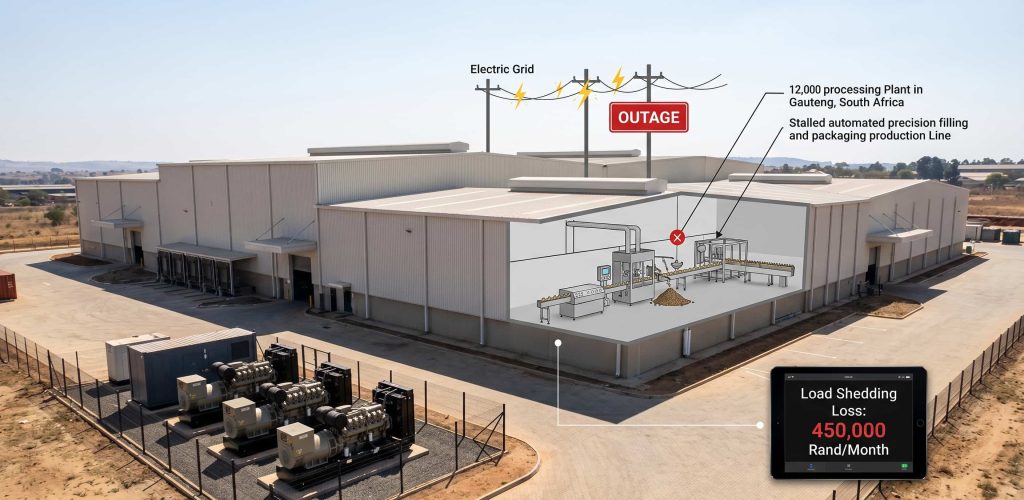
In B2B industrial procurement, data is more convincing than any marketing rhetoric. Take a leading food processing plant in Gauteng, South Africa, as an example. The plant has a production workshop of approximately 12,000 square meters, running precision filling and automated packaging lines 24 hours a day.
Pre-Implementation Pain Points:
- Massive Power Outage Losses: Facing grid load shedding 2–3 times a week, lasting 2–4 hours each time, direct losses from production halts and waste products amounted to about 450,000 Rand per month.
- High Backup Power Costs: The original 4 diesel generators (total capacity 1,200kW) had high fuel consumption and required frequent maintenance, with annual diesel costs exceeding 1.3 million Rand.
- Extreme Environmental Challenges: Summer temperatures in the factory area in South Africa can exceed 45°C. Traditional liquid lithium batteries experience rapid capacity degradation at these high temperatures and pose a significant risk of thermal runaway.
KRL POWER's Solution and Results:
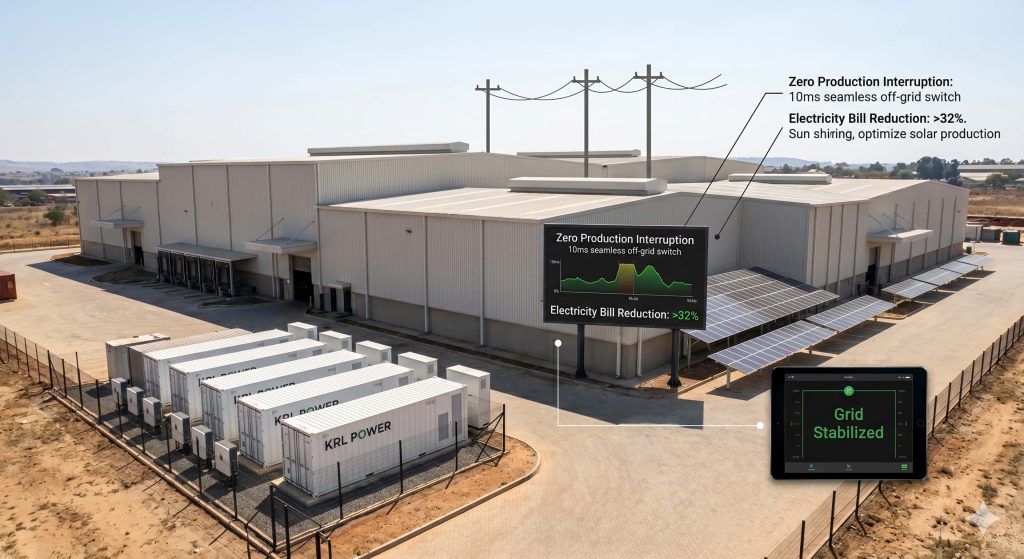
To thoroughly resolve these issues, the factory introduced the KRL Power 920kW/4.6MWh Solid-State Battery System (paired with 9×100kW PCS), integrated with a 1.2MW on-site solar PV system. The financial and operational data post-implementation showed a fundamental reversal:
- Zero Production Interruption: The system supports a 10ms seamless off-grid switch, providing 6–8 hours of continuous power, successfully reducing production halt losses to zero.
- Significant Electricity Bill Reduction: Utilizing the "valley-charging, peak-discharging" peak-valley arbitrage model, monthly electricity bills dropped from 1.18 million Rand to under 800,000 Rand, a drop of over 32%.
- Plummeting Diesel Consumption: Diesel generators were downgraded to extreme-condition backups, slashing diesel consumption by 85% and saving approximately 1.1 million Rand annually.
- Stunning ROI: The total project investment was approximately 21 million Rand, with a payback period of only 3.8 years. Over the estimated 15-year lifecycle of the solid-state batteries, net revenue is projected to exceed 45 million Rand.
Bidding Farewell to Traditional Pain Points: Why are Solid-State Batteries the Optimal Solution for 800kW+ Scenarios?
In the above case, why did the client ultimately abandon traditional liquid lithium batteries in favor of KRL POWER's solid-state battery solution? For precision electronics, data centers, and high-end manufacturing scenarios at the 800–1000kW scale, which demand extreme safety and lifespan, solid-state batteries completely bypass the thermal and degradation limits inherent to liquid lithium chemistries.
Core Technical Parameter Comparison (Traditional Liquid Lithium vs. KRL POWER Solid-State Battery)
| Comparison Dimension | Traditional C&I Liquid Lithium Battery | KRL POWER Solid-State Battery System |
|---|---|---|
| System Safety | Risk of thermal runaway, leakage, and fire | Oxide solid electrolyte, physically flame-retardant and non-leaking |
| Energy Density | Approx. 160–200 Wh/kg | 300 Wh/kg (up to 420 Wh/kg) |
| Cycle Life | Approx. 3,000–4,000 cycles | Exceeds 6,000 cycles |
| Temperature Adaptability | 0°C ~ 40°C (Requires heavy HVAC temp control) | -20°C ~ 85°C |
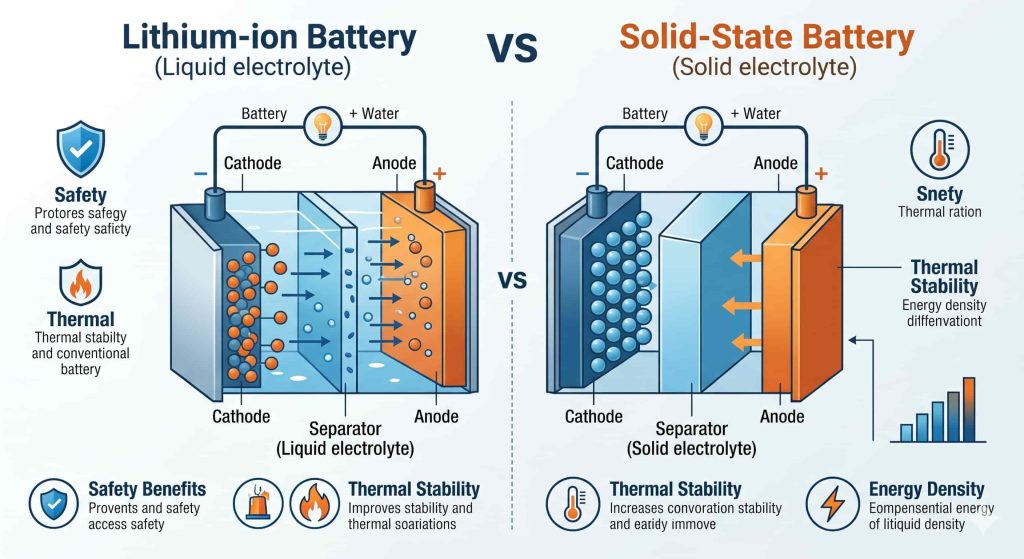
By combining extreme physical safety, a 35% smaller footprint, wide temperature adaptability, and a 15-year lifespan, solid-state batteries deliver significantly reduced lifecycle costs and ultimate operational stability for industrial scenarios.
Beyond the innovation in cell materials, addressing the C&I demand for "high power and unattended operation," KRL POWER has custom-developed a proprietary BMS (Battery Management System). It monitors cell status in real-time, provides fault warnings, and performs equalization management, strictly keeping voltage fluctuations within ±1.5%. This indirectly reduced the failure rate of precision equipment within the factory by 60%.
From Unattainable to Highly Cost-Effective: How Does KRL POWER Ensure Scalable Delivery?
For a long time, the biggest obstacles for solid-state batteries in the B2B market were "high prices" and "difficulties in mass production." However, these barriers are currently being broken.
1. Production Capacity Doubling in 2026, GWh-Scale Cost Reduction
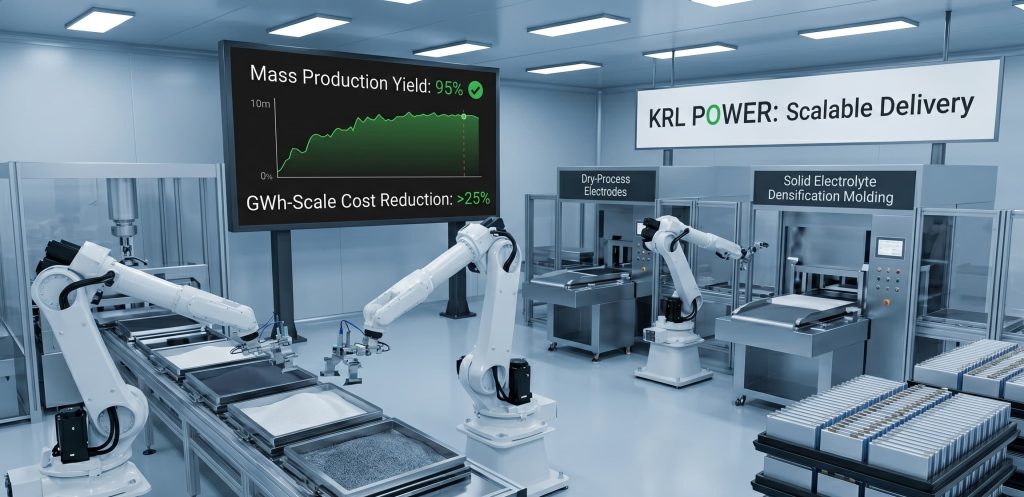
KRL POWER completed the upgrade of its dedicated solid-state battery C&I production line in 2025, with single-line annual capacity leaping to the GWh level. Through scaled production (amortizing R&D and equipment depreciation) and fully automated, unmanned production lines, unit cell production costs have dropped by over 25%. Scale has officially transitioned solid-state batteries from "high-end, high-price" to "highly cost-effective."
2. Core Process Barrier: 95% Mass Production Yield
Relying on 24 years of battery manufacturing experience, KRL POWER has mastered core processes such as fully automated dry-process electrodes and solid electrolyte densification molding. Compared to the industry's general struggle with yield rates, KRL POWER's mass production yield has broken through 95%. This is the foundation for guaranteeing stable, on-time (delivery cycle shortened by 40%) supply of large-volume orders to end customers.
3. Full Industry Chain Closed Loop Ensures Profit Margins
By self-developing oxide solid electrolytes combined with silicon-based anodes, and employing hedging strategies on the raw material end to offset volatility, KRL POWER can provide high-value customers with stable performance and highly cost-effective long-term supply guarantees without participating in low-end price wars.
Conclusion and Next Steps
For C&I enterprises facing high electricity bills, unstable grids, or carbon reduction mandates, an 800–1000kW level backup power supply is no longer just a "bottom-line cost center," but a "profit center" capable of generating real cash flow. KRL POWER's solid-state battery technology, with its intrinsic safety, ultra-long lifespan, and extreme temperature adaptability, has proven its robust profitability and reliability in complex C&I scenarios.
Is your factory facing similar challenges of load shedding, high electricity bills, or the safety hazards of traditional lithium batteries?
Contact the KRL POWER solution expert team to get a customized C&I energy storage ROI calculation sheet tailored to your local electricity pricing policies and factory power load, or schedule a live operational demonstration of the KRL POWER solid-state battery system.
FAQ
Q1.Why are solid-state batteries better than traditional lithium batteries for 800–1000kW industrial backup power?
KRL POWER solid-state batteries offer intrinsic safety with zero thermal runaway and leakage risks, a wide -20°C~85°C temperature range, higher energy density, and 6000+ long cycles. They effectively adapt to South Africa’s high temperatures and frequent load shedding, outperforming traditional liquid lithium batteries in harsh industrial scenarios.
Q2.What actual benefits can a 920kW/4.6MWh solid-state energy storage system bring to South African factories?
It supports 10ms seamless off-grid switching to avoid production downtime during load shedding. It cuts electricity bills by over 32% via peak-valley arbitrage, reduces diesel consumption by 85%, and stabilizes power quality. The system features a short 3.8-year payback period and 15-year long stable revenue.
Q3.Is large-scale solid-state battery energy storage cost-effective for C&I projects?
Yes. KRL POWER’s GWh-scale automated production and 95% high yield cut battery unit costs by over 25%. With lower lifecycle costs, higher safety and longer lifespan than traditional lithium batteries, it delivers outstanding ROI for C&I energy storage projects.
Q4.What scenarios are the 800–1000kW solid-state battery energy storage system suitable for?
It is perfectly suited for 24-hour continuous production factories, food processing plants, precision manufacturing workshops and commercial buildings. It also adapts to solar-storage hybrid systems, solving power instability, high diesel and electricity cost issues for medium and large C&I projects.
