

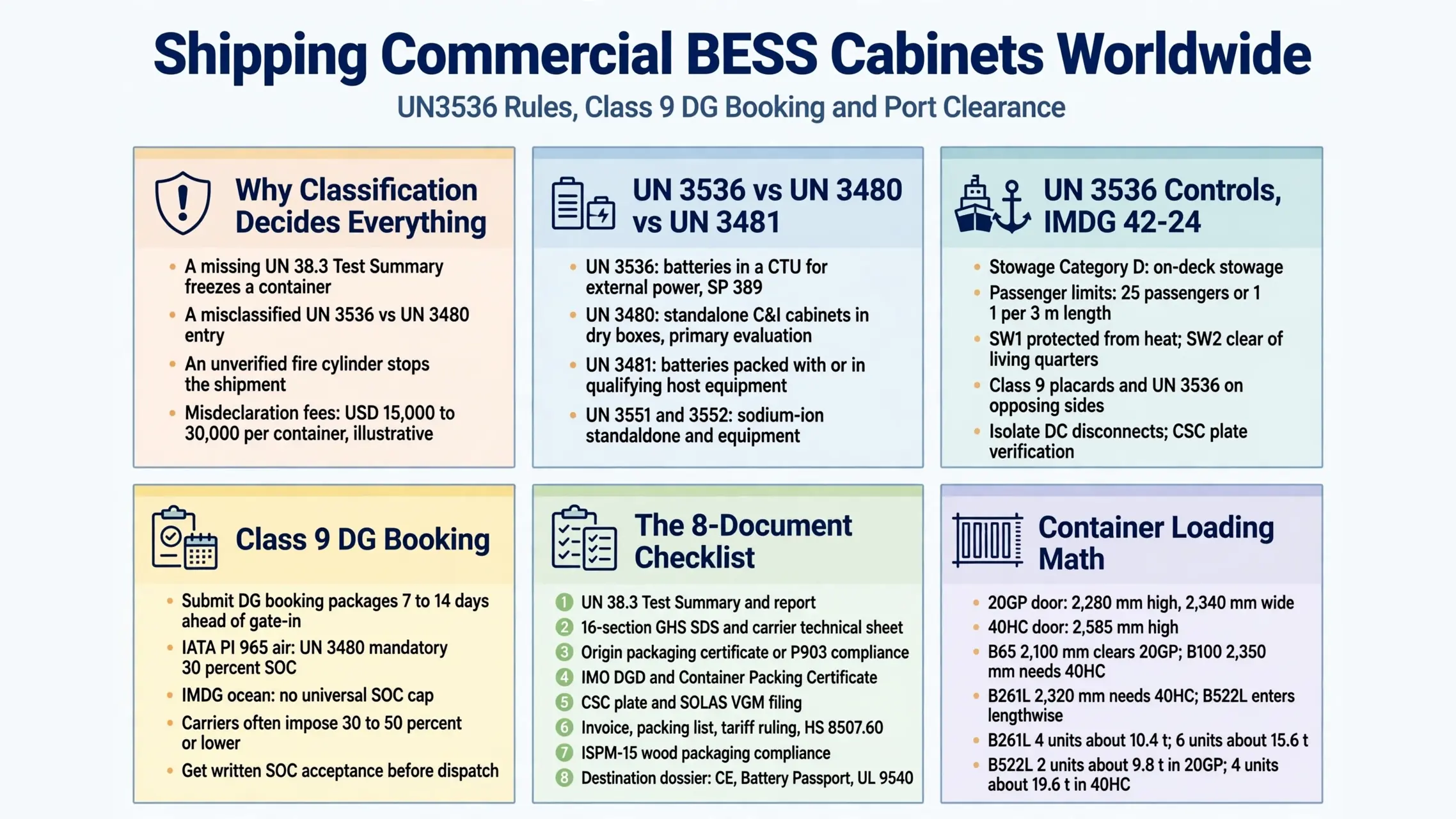
Receiving a carrier hold notice at Rotterdam, Hamburg, Sydney, or Los Angeles turns a profitable storage project into an emergency cash drain for EPCs and plant CFOs. One missing UN 38.3 Test Summary, a misclassified UN 3536 vs. UN 3480/3481 entry, or an unverified fire cylinder can freeze a container on the quay for weeks.
Published carrier misdeclaration fee schedules can reach illustrative levels of USD 15,000 to USD 30,000 per container depending on the shipping line and trade lane. Daily port demurrage and contractual EPC liquidated damages compound that hit rapidly.
Mastering UN3536 battery energy storage shipping under IMDG Code Amendment 42-24 (mandatory from January 1, 2026) protects procurement teams from customs holds and preserves project ROI before the deposit leaves the bank.
UN3536 vs. UN3480 vs. UN3481: Choosing the Exact Maritime Classification
Buyer Takeaway: Qualifying external-power CTUs follow UN 3536 (SP 389), while standalone C&I cabinets in dry boxes require primary UN 3480 evaluation (or UN 3481 for qualifying host equipment).
Correct dangerous goods classification governs carrier acceptance, deck stowage, and origin port packaging certificates. Misapplying UN3536 vs UN3481 BESS cabinet rules remains a leading cause of rejected ocean tenders.
1. UN 3536 and IMDG Code Special Provision 389 for Containerized BESS
UN 3536 (Class 9, EmS F-A, S-I) applies to qualifying lithium-ion or lithium-metal batteries installed within a Cargo Transport Unit (CTU) designed exclusively to provide electrical power external to the CTU.
Under IMDG Code Special Provision 389 (SP 389), the installed lithium batteries must comply with IMDG Code 2.9.4.1 to 2.9.4.7 and include necessary overcharge and over-discharge protection systems.
Batteries must also attach securely to the interior CTU structure with engineered measures preventing short circuits, accidental operation, and significant movement during ocean transit.
Where the CTU is an international freight container subject to the CSC Convention, shippers verify a valid CSC safety approval plate alongside SP 389 compliance and transport documentation.
KRL builds its KRL-B2M6L 20ft containerized BESS series around a 20ft footprint (6058 x 2438 x 2896 mm).
UN 3536 classification applies where the supplied CTU, CSC plate, internal structural restraint, and installed battery system meet all IMDG SP 389 requirements, confirmed against the actual shipment configuration and transport dossier.
Under IMDG Code Amendment 42-24 (mandatory January 1, 2026), UN 3536 shipments follow four strict maritime controls:
- Stowage Category D and Separation: Stowage Category D requires on-deck stowage on cargo ships and on passenger ships within prescribed passenger limits (25 passengers or 1 per 3m overall vessel length, whichever is greater). Carriage on other passenger ships is prohibited, paired with SW1 (protected from heat) and SW2 (clear of living quarters).
- Exterior Hazard Marking: Opposing sides of the CTU must display Class 9 placards and the UN 3536 number per IMDG Code marking rules.
- Operational Equipment Exclusivity: Dangerous goods necessary for safe and proper operation of the CTU (such as properly installed fire-extinguishing and air-conditioning systems) are permitted inside under SP 389, while unrelated dangerous goods are prohibited.
- Prevention of Accidental Operation: SP 389 requires preventing short circuits and accidental operation during transit. Shippers implement this operationally by isolating main DC disconnects and maintenance switches prior to dispatch.
Amendment 42-24 also introduced standalone and equipment-contained organic-electrolyte sodium-ion battery entries (UN 3551 and UN 3552) alongside dedicated battery-powered vehicle codes (UN 3556 lithium-ion, UN 3557 lithium-metal, and UN 3558 sodium-ion vehicles).
The updated code renamed the Class 9 label to cover both lithium and sodium-ion batteries. Stationary BESS containers remain governed by CTU rules (UN 3536 for qualifying lithium CTUs), distinct from UN 3558 vehicle entries.
2. Shipping Standalone C&I Cabinets (65kWh to 522kWh) Inside Standard Dry Containers
Standalone C&I battery assemblies shipped inside a standard dry freight container generally require primary evaluation under UN 3480 (Lithium Ion Batteries). UN 3481 applies when lithium batteries are genuinely packed with or contained in qualifying host equipment under the applicable regulatory definition.
Commercial BESS cabinets primarily function as energy storage and external power-supply units, as emphasized in regulatory guidance such as PHMSA interpretations on battery vs. equipment classification.
Integrating a PCS, EMS, or outer enclosure alongside battery racks therefore keeps the primary evaluation centered on UN 3480 unless qualifying host equipment rules apply.
This dry-container shipping analysis covers KRL's compact models, starting with the KRL-B65 30kW/65kWh compact cabinet.
Mid-sized commercial procurement teams apply the same dry-container workflow to the KRL-B100 50kW/100kWh cabinet.
Larger liquid-cooled enclosures include the KRL-B261L 125kW/261kWh liquid-cooled cabinet.
Heavy industrial sites ship the KRL-B522L 250kW/522kWh high-capacity cabinet under the same classification review.
The following four P903 paragraphs are particularly relevant to commercial BESS shipments (alongside P903(5) for combined packed-with and contained-in equipment configurations):
- P903(1) Packaged Standalone Batteries (UN 3480): Covers lithium-ion cells and modules packed inside UN-specification performance-tested boxes, such as SKD split shipments pairing boxed modules with an empty cabinet shell.
- P903(2) Large Robust Assemblies ≥12 kg (UN 3480): Covers battery assemblies ≥12 kg with strong, impact-resistant outer casings in strong crates, enclosures, or secured pallets per IMDG 4.1.1/4.1.3; protect terminals from short circuits and keep terminals isolated from supporting any superimposed weight.
- P903(3) & P903(4) Batteries Packed With or Contained In Equipment (UN 3481): Evaluated when lithium-ion batteries are packed with qualifying equipment (P903(3)) or installed inside qualifying host equipment providing equivalent mechanical protection (P903(4)).
The shipper must confirm the final UN number, proper shipping name, packing instruction, and origin port maritime/customs packaging verification with a qualified dangerous-goods specialist for the exact supplied configuration.
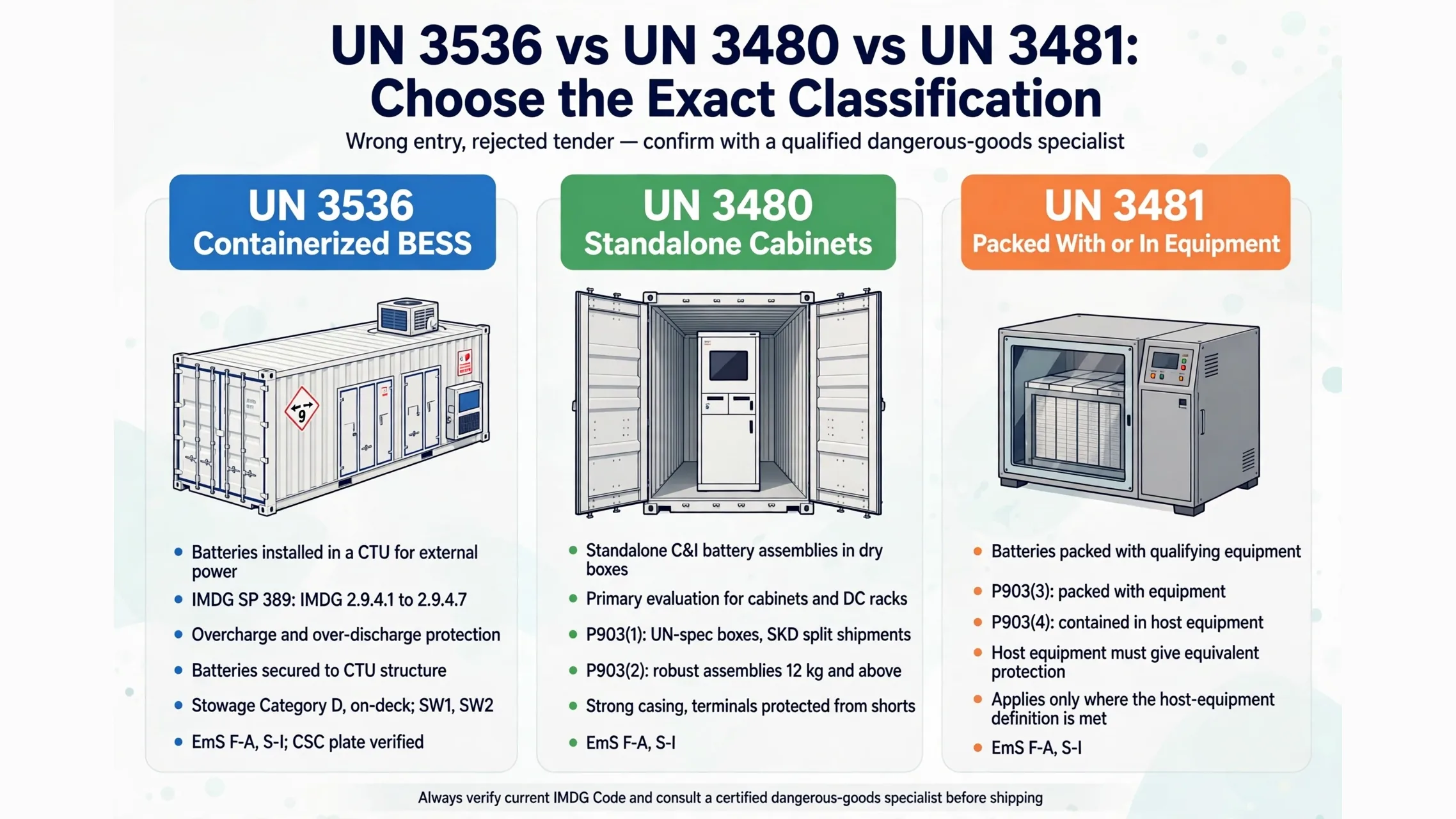
Table 1: IMDG Code Amendment 42-24 (2026) Maritime Classification Matrix
| Shipment Configuration | Primary UN Evaluation | Key IMDG Provision & EmS | Regulatory Classification Scope |
|---|---|---|---|
| Qualifying BESS Installed in CTU | UN 3536 (Class 9) | SP 389 (2.9.4.1–7); Cat. D (SW1, SW2); F-A, S-I | CTU designed for external power (e.g. B2M6L if SP 389 met) |
| Standalone C&I Battery Assembly | UN 3480 (Class 9) | P903(1) UN boxes or P903(2) (≥12kg casing); F-A, S-I | Primary evaluation for standalone C&I cabinets & DC racks |
| Battery Packed With / In Equipment | UN 3481 (Class 9) | P903(3) packed with or P903(4) contained in; F-A, S-I | Applies where qualifying host equipment definition is met |
| Organic-Electrolyte Sodium-Ion | UN 3551 / UN 3552 | IMDG 42-24 (distinct from UN 3558 vehicles) | Standalone (3551) or equipment (3552) Na-ion benchmark |
Mastering Class 9 DG Booking: Carrier Rules, SOC Limits & Internal Cylinders
Buyer Takeaway: Plan Class 9 DG bookings 7 to 14 days ahead, secure written carrier SOC acceptance, and classify internal fire cylinders and refrigerants individually via SDS Section 14.
Correct UN classification solves only part of Class 9 DG booking BESS execution. Ocean carriers enforce internal safety vetting and stowage approvals before issuing dangerous-goods booking confirmations.
1. Recommended Booking Lead Time and Carrier-Specific Transit SOC
As a practical logistics planning benchmark (subject to individual carrier dangerous-goods approval procedures and vessel cutoff schedules), shippers should submit dangerous-goods booking packages 7 to 14 days ahead of gate-in.
Under standard IATA PI 965 air-transport rules, UN 3480 shipments follow a mandatory 30% State of Charge (SOC) limit unless specific written approvals are granted by the state of origin and the state of the operator. The maritime IMDG Code sets no single universal statutory SOC cap across all lithium battery ocean entries.
Instead, individual ocean carriers and specific trade lanes often impose their own transit SOC acceptance conditions, which frequently fall within a 30% to 50% range or lower. Shippers must obtain written SOC acceptance requirements from the selected carrier prior to factory dispatch.
2. Individual Classification of Fire-Suppression Cylinders and HVAC Refrigerants
Commercial BESS cabinets may contain pressurized fire-suppression cylinders and HVAC or liquid-chiller refrigerants.
Shippers determine each item's transport classification individually using cylinder markings, refrigerant identification, gas or mixture UN numbers, charge pressures, SDS Section 14 data, and applicable IMDG special provisions.
Under UN 3536 (SP 389), fire-extinguishing and air-conditioning systems that are necessary for the safe and proper operation of the CTU and properly installed or secured inside are covered by SP 389's operational provision.
Standalone cabinets shipped inside a dry container under UN 3480 or UN 3481 fall outside SP 389's CTU scope.
Dangerous-goods specialists evaluate each installed cylinder or cooling circuit against SDS Section 14 and applicable IMDG provisions, declare regulated secondary hazards on the DGD, or ship cylinders unpressurized or separately where required.
3. Financial and Insurance Risks of Misdeclaring BESS as General Cargo
Declaring commercial battery cabinets as generic solar inverters or electrical switchgear to bypass Class 9 booking checks exposes importers and project CAPEX to severe maritime enforcement. Port X-ray scanners and manifest screening flag high-density battery enclosures quickly.
Carrier misdeclaration charges can reach illustrative levels of USD 15,000 to USD 30,000 per container depending on the carrier and route. Breaches also trigger forced port discharge, customs holds, and potential marine cargo insurance claim disputes or coverage denial under policy compliance clauses.
The 8-Document Port Clearance Checklist for Global BESS Importers
Buyer Takeaway: Verify all eight maritime, customs, biosecurity, and destination compliance files before shipment so EPC commissioning stays on schedule.
Reliable importing commercial BESS customs clearance across Europe, Australia, North America, and Africa relies on aligning eight procurement documents with the bill of lading and serial list:
- UN 38.3 Test Summary (TS) and Report Access: UN Manual of Tests and Criteria 38.3.5 mandates making the UN 38.3 Test Summary available for applicable lithium batteries. Retain the complete UN 38.3 test report to provide upon request by carriers, authorities, or importers.
- Current 16-Section GHS SDS and Carrier Technical Sheet: Supplies standard GHS hazard data and Section 14 transport classification (UN number and Class 9). Supplement the SDS with technical sheets or DGD entries stating nominal Wh ratings and EmS schedules (F-A, S-I) where carriers require them.
- Origin Packaging Certificate or P903 Compliance Documentation: Includes China Customs Outbound Dangerous Goods Packaging Certificates for UN-boxed batteries, or origin authority packaging verification according to P903(2) for qualifying robust battery assemblies or P903(4) for batteries contained in equipment, where applicable.
- IMO Dangerous Goods Declaration (DGD) and Container Packing Certificate (CPC): Signed declarations confirming proper hazard classification, internal cargo securing, and container structural integrity.
- CSC Safety Approval Plate and SOLAS VGM Filing: Verifies valid CSC plate status, tare mass, and maximum permissible payload for international freight containers, paired with Verified Gross Mass (VGM) submission prior to vessel loading where applicable under SOLAS Chapter VI Regulation 2.
- Commercial Invoice, Packing List, and Customs Tariff Ruling: States declared unit weight, gross shipping mass, and origin certificates (CO, Form E, or EUR.1). Lithium-ion accumulators commonly reference HS 8507.60; confirm final 8-to-10-digit headings with your licensed customs broker for integrated PCS cabinets.
- ISPM-15 Wood Packaging Compliance (Australia DAFF, US APHIS, EU): Regulated solid-wood packaging, skids, and dunnage must comply with applicable ISPM 15 treatment methods (such as approved heat treatment HT or methyl bromide fumigation MB) and display valid IPPC markings, or use steel bases and plywood.
- Destination Market Compliance Dossier: Confirms model-specific EU CE files and Regulation (EU) 2023/1542 compliance. Digital Battery Passport rules apply from 18 February 2027 to industrial batteries above 2kWh per Article 77, alongside US UL 9540 / UL 9540A / UL 1973, Australia RCM / IEC 62619, or South Africa NRCS / LOA files.
Looking for engineering support on export documentation? Explore KRL Power's export-ready commercial and industrial ESS solutions.
Check Your Dangerous-Goods Shipping Scope Before Booking. Submit your target KRL model, destination port and shipment configuration to request model-specific UN 38.3/SDS document samples and a preliminary shipping documentation review.
Container Loading Math, Door-Height Limits & Incoterms (FOB / CIF / DDP)
Buyer Takeaway: Check 20GP door height (2,280mm) and width (2,340mm) against exact cabinet dimensions and include pallet height, packaging weight, SOLAS VGM, and floor loading in the final loading plan.
Practical BESS container ocean freight requirements start with container doorway geometry. Standard ISO 20GP dry containers typically provide a 2,280mm door opening height and 2,340mm door width, while 40HC High Cube containers provide a 2,585mm door opening height.
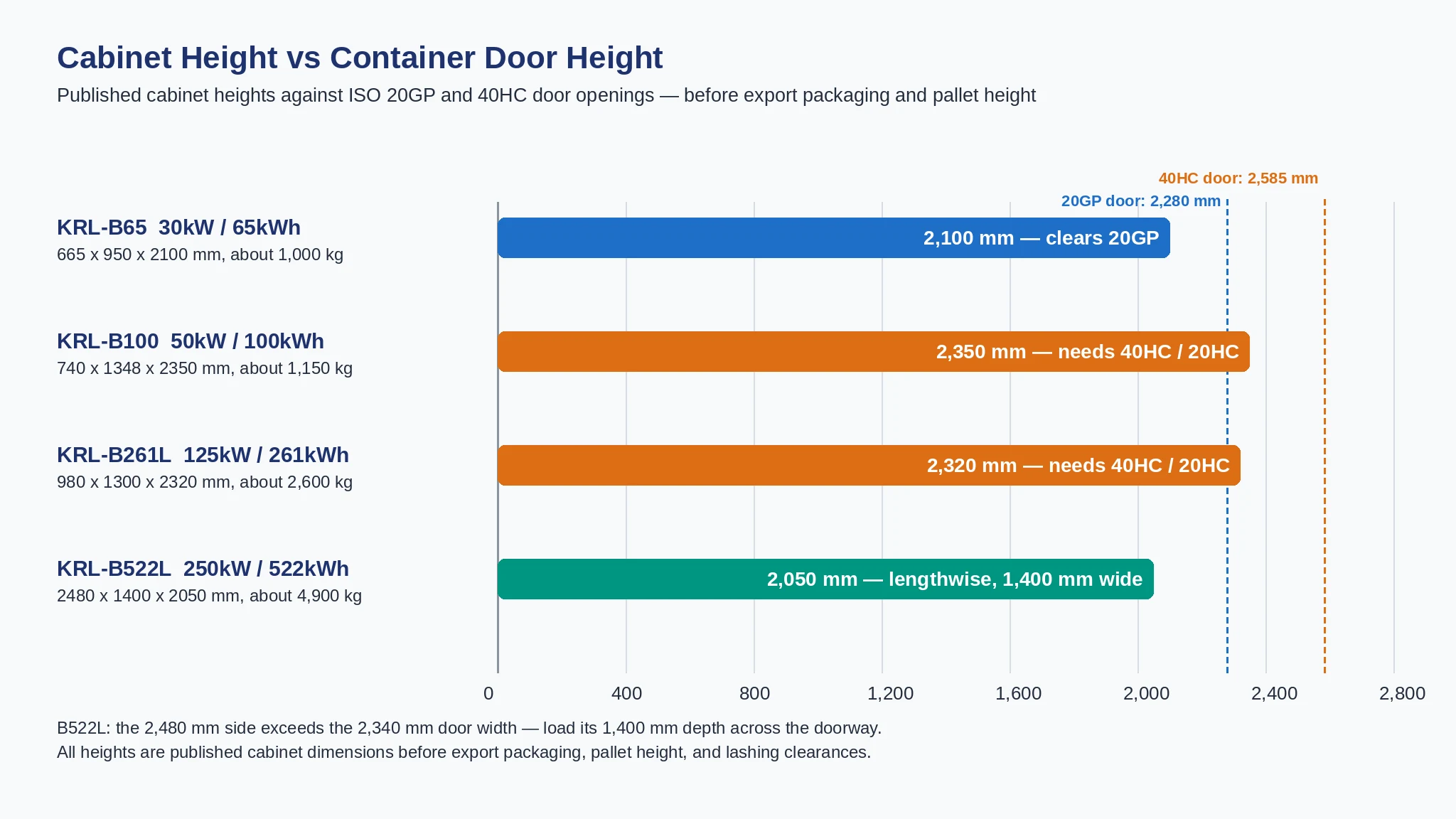
Table 2: Published KRL BESS Dimensions, Published Cabinet Weights & Container Fit
| KRL Model / Config | Published Dimensions (W x D x H) | Approx. Published Unit Weight | Container Doorway & Transport Fit |
|---|---|---|---|
| KRL-B65 (30kW / 65kWh) | 665 x 950 x 2100 mm | ~1,000 kg | Clears 20GP (2,280mm door) & 40HC upright |
| KRL-B100 (50kW / 100kWh) | 740 x 1348 x 2350 mm | ~1,150 kg | 2,350mm height requires 40HC / 20HC upright |
| KRL-B261L (125kW / 261kWh) | 980 x 1300 x 2320 mm | ~2,600 kg | 2,320mm height requires 40HC / 20HC upright |
| KRL-B522L (250kW / 522kWh) | 2480 x 1400 x 2050 mm | ~4,900 kg | Enters lengthwise (1,400mm width x 2,050mm height) |
| KRL-B2M6L (B1M5L / B2ML) | 6058 x 2438 x 2896 mm (20ft) | ~15,000 kg / ~19,500 kg | 20ft containerized BESS (verify CSC & SP 389 scope) |
On the KRL-B522L (2480 x 1400 x 2050 mm, ~4,900 kg cabinet weight before additional export packaging), the 2,480mm side exceeds a 2,340mm container door width.
Load planners orient its 1,400mm depth across the doorway width and 2,050mm height under the 2,280mm 20GP header. Two units total ~9,800 kg published unit weight in a 20GP, while four units total ~19,600 kg published unit weight in a 40HC.
For the KRL-B261L (~2,600 kg cabinet weight before additional export packaging), four cabinets represent an aggregate published unit weight of approximately 10.4 metric tons. Six cabinets total approximately 15.6 metric tons before additional export packaging and lashing materials.
For the 20ft containerized KRL-B2M6L, published unit weights are approximately 15,000 kg for the B1M5L (750kW/1.5MWh) configuration and 19,500 kg for the B2ML (1MW/2MWh) configuration, including the integrated container structure.
All figures in Table 2 represent published unit or cabinet weight before additional export packaging. Verify actual shipping gross mass, tare mass, CSC plate payload ratings, pallet height additions, floor point loading, lashing clearances, and road axle limits against the approved container loading plan.
Where applicable under SOLAS Chapter VI Regulation 2, the shipper must submit the Verified Gross Mass (VGM) before vessel loading.
Marine Lashing and Export Incoterms
Ocean transit preparations include isolated DC disconnects, container desiccant poles, timber or steel floor blocking, rated lashing straps, and optional tilt or impact indicators verified prior to container sealing.
KRL Power supports FOB, CIF (to major ports such as Rotterdam, Hamburg, Felixstowe, Sydney, Los Angeles, Durban, or Jebel Ali), and project-arranged DDP logistics depending on destination customs rules and importer-of-record structure.
Review published cabinet weights, dimensions, and specifications across our KRL Power commercial and industrial BESS cabinets and containers.
FAQ
What does IMDG Special Provision 389 require for a containerized BESS?
What is Stowage Category D for UN 3536 shipments?
Which packing instruction applies to a robust standalone lithium battery cabinet?
When should a commercial BESS dangerous-goods booking be submitted?
How are installed fire-suppression cylinders and HVAC refrigerants classified?
Which documents should an importer prepare before shipment?
Can the KRL-B65 and KRL-B100 fit upright through a standard 20GP container door?
Why is the KRL-B522L loaded lengthwise?
Do published KRL cabinet weights include export packaging?
Can KRL Power arrange FOB, CIF or DDP shipping?
Ship Your Next Commercial BESS Globally on Schedule
Selecting the right battery cabinet is only half the procurement job; landing it through Class 9 maritime vetting and destination customs cleanly protects your EPC commissioning schedule.
Share your target capacity, destination port (such as Rotterdam, Sydney, Los Angeles, or Durban), and preferred Incoterms (FOB, CIF, or DDP inquiry) to request sample UN 38.3/SDS export documentation and ocean freight planning.
KRL Power's engineering and export logistics team provides an initial response within 24 hours. Redacted model-specific export document samples, container loading plans, and ocean freight quotes are prepared according to your confirmed equipment scope and destination port.
Get a Project-Specific Container Loading and Freight Proposal. Share your cabinet quantities, destination port and preferred Incoterms to request a container loading plan, export documentation samples and ocean freight quotation.