

Operators running a neighborhood supermarket, a multi-bay car wash, or a dental clinic face an awkward procurement gap when buying small commercial battery storage.
Residential solar installers frequently propose hanging five or six home wall batteries across a narrow back stockroom. Those multi-pack stacks trigger fire-insurance holds and trip inverters under three-phase compressor starts.
Utility-focused C&I suppliers pitch the opposite extreme. Quoting a 125kW/261kWh industrial factory cabinet triples the budget, overwhelms a shop's 63A or 100A three-phase main breaker, and triggers lengthy grid-upgrade reviews.
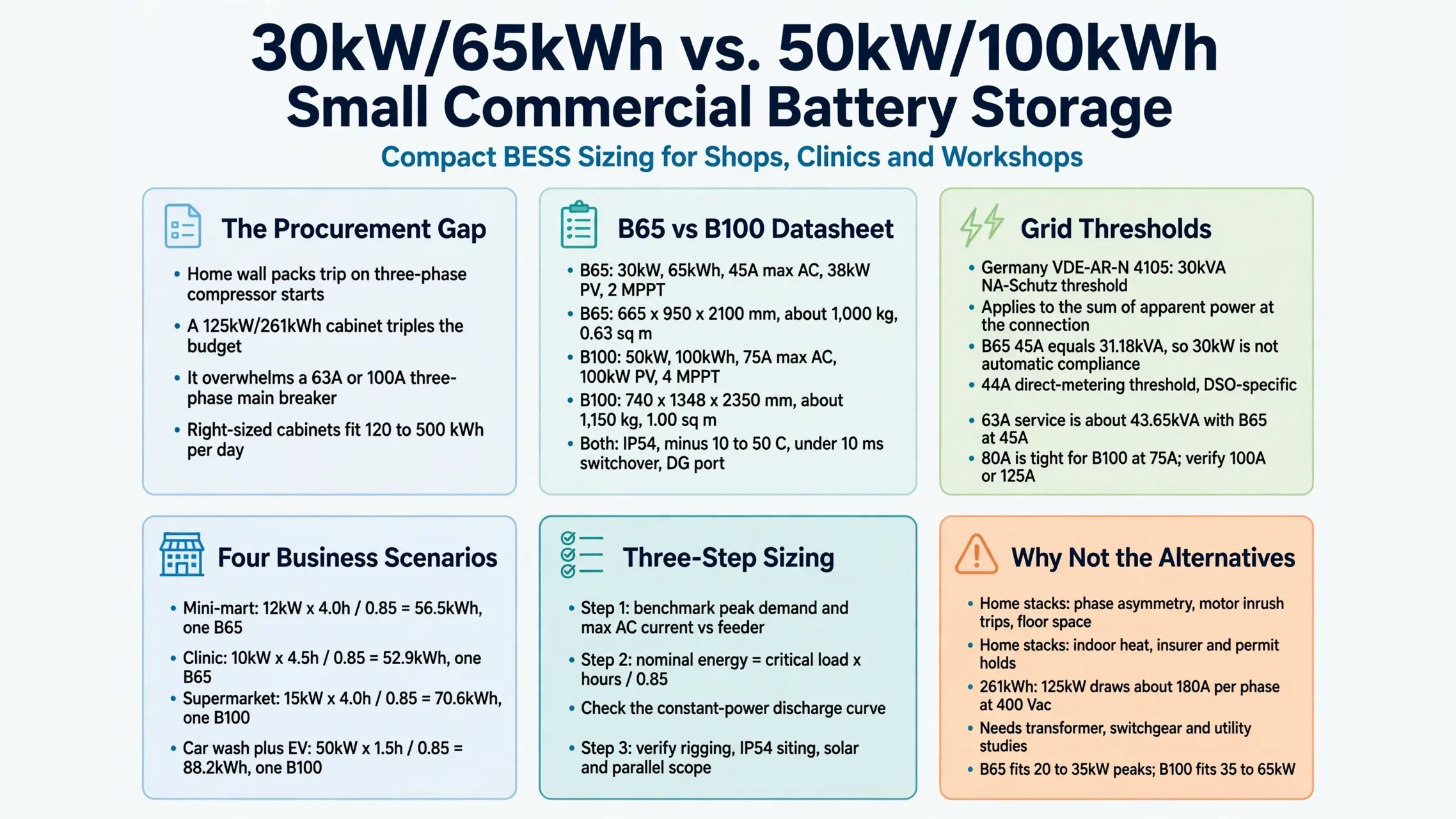
For commercial buildings consuming 120kWh to 500kWh per day, right-sized upright cabinets fill the exact gap. Comparing the KRL-B65 (30kW/65kWh) and KRL-B100 (50kW/100kWh) aligns peak shaving, backup runtime, and local grid thresholds directly with real small-business electrical panels.
Why Stacked Home Batteries Fall Short and 261kWh Cabinets Overshoot Small Sites
Buyer Takeaway: Stacked home packs struggle with commercial three-phase loads and insurer audits, while 261kWh industrial cabinets trigger costly panel and grid-protection upgrades on small shops.
Most small-commercial energy storage disappointments start with mismatched capacity sizing. Two recurring procurement mistakes erode payback before commissioning even begins.
1. Three Risks of Stacking Residential Batteries in a Commercial Store
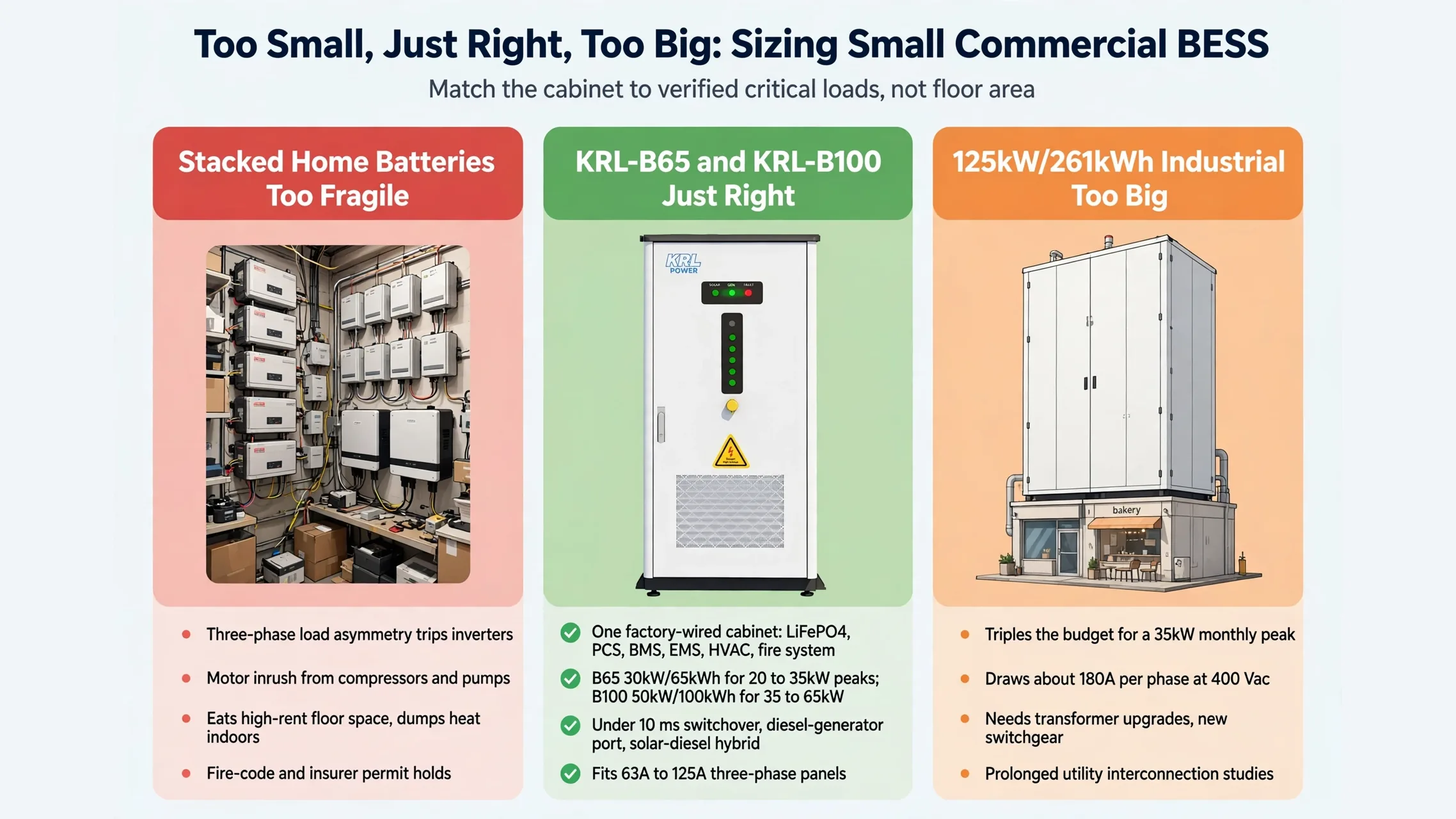
Commercial sites mix single-phase lighting, POS terminals, and display chillers with three-phase compressors, hydraulic lifts, and tunnel-wash pumps. Multi-pack home assemblies expose three weak points in active retail and workshop environments:
- Three-phase load asymmetry and motor inrush: Residential inverters built for balanced home appliances frequently trip on phase imbalance or inductive motor inrush when refrigeration or air compressors cycle on.
- Lost high-rent floor space and indoor heat: Mounting four to six wall packs plus separate inverters eats up valuable storage walls while dumping waste heat and fan noise into conditioned shop areas.
- Commercial fire-code and insurer friction: Commercial underwriters review system safety documentation (such as UL 9540 / IEC 62619 and UL 9540A thermal-runaway test data where required by jurisdiction) plus engineered fire mitigation, exposing residential stacks to permit holds.
2. Why Oversizing to 261kWh Triggers Grid Protection and Panel Upgrades
Buying a 125kW/261kWh industrial unit for a store with a 35kW monthly peak wastes capital on unused capacity and crosses strict low-voltage grid thresholds.
At 400Vac three-phase, a 125kW cabinet draws roughly 180A per phase at unity power factor. Connecting that unit to a shop with a 63A or 100A service feeder requires expensive transformer capacity upgrades, new switchgear, and prolonged utility interconnection studies.
Larger factories exceeding 100kWh daily backup or 65kW peaks benefit from KRL's liquid-cooled KRL-B261L 125kW/261kWh liquid-cooled cabinet.
Multi-hundred-kilowatt facilities can review our mid-to-large C&I BESS class selection guide. Small shops below 65kW peak demand achieve far stronger ROI with a compact 30kW or 50kW unit.
KRL-B65 (30kW/65kWh) vs. KRL-B100 (50kW/100kWh): Side-by-Side Comparison
Buyer Takeaway: Choose KRL-B65 (30kW, 45A max AC, 38kW PV) for 20kW to 35kW shop peaks; step up to KRL-B100 (50kW, 75A max AC, 100kW PV) for 35kW to 65kW commercial loads.
KRL Power builds two dedicated compact all-in-one BESS for small business deployments. Both integrate LiFePO4 modules, bidirectional PCS, BMS, EMS, HVAC cooling, fire suppression, and solar-diesel hybrid ports inside one factory-wired cabinet.
Inspect the entry-level KRL-B65 30kW/65kWh all-in-one solar-diesel cabinet for compact commercial feeders.
Higher-demand stores and workshops step up to the KRL-B100 50kW/100kWh all-in-one cabinet.
Table 1: KRL-B65 vs. KRL-B100 Electrical & Solar Datasheet Comparison
| Electrical & Solar Parameter | KRL-B65 (30kW / 65kWh) | KRL-B100 (50kW / 100kWh) | Engineering Selection Note |
|---|---|---|---|
| Rated AC Power / Nominal Energy | 30kW / 65kWh (~2.17h nominal E/P ratio) | 50kW / 100kWh (2.0h nominal E/P ratio) | Usable AC runtime depends on DoD, RTE & aux load |
| 400V Theoretical Current (PF=1) | 43.3A (PF=0.9 theoretical: 48.1A) | 72.2A (PF=0.9 theoretical: 80.2A) | Calculated via I = P / (1.732 x 400V x PF) |
| Published Max. AC Current Cap | 45A (~31.18kVA apparent; ~28.1kW @PF 0.9) | 75A (~51.96kVA apparent; ~46.8kW @PF 0.9) | Continuous output stays bounded by 45A / 75A cap |
| Max. DC PV Input & MPPT | Up to 38kW max PV input (2 MPPT) | Up to 100kW max PV input (4 MPPT) | AC output remains capped at 30kW / 50kW PCS rating |
| Grid / Backup / DG Integration | <10ms switchover + built-in DG port | <10ms switchover + built-in DG port | Supports solar-diesel-grid hybrid coordination |
At a 0.90 power factor, the published maximum AC current limits (45A on B65; 75A on B100) correspond to approximately 28.1kW of active power on the KRL-B65 (31.18kVA x 0.90 = 28.06kW) and 46.8kW on the KRL-B100 (51.96kVA x 0.90 = 46.77kW) at 400V.
Actual active-power delivery at non-unity power factors stays within the PCS current ceiling, apparent-power rating, overload curve, and reactive-power control settings.
Table 2: KRL-B65 vs. KRL-B100 Physical, Thermal & Environmental Specifications
| Physical & Enclosure Spec | KRL-B65 (30kW / 65kWh) | KRL-B100 (50kW / 100kWh) | Site Installation Impact |
|---|---|---|---|
| Dimensions (W x D x H) | 665 x 950 x 2100 mm (~0.63m2 base) | 740 x 1348 x 2350 mm (~1.00m2 base) | Compact upright footprint fits narrow alleys |
| Approximate Cabinet Weight | ~1,000 kg | ~1,150 kg | Verify rated forklift, lifting points & slab load |
| Enclosure Protection & Temp | IP54 rated / -10°C to 50°C operating | IP54 rated / -10°C to 50°C operating | Verify outdoor rain canopy & ventilation clearance |
| Battery Thermal & Fire System | Integrated HVAC cooling + fire system | Integrated HVAC cooling + fire system | Active cabin thermal & fire protection included |
Navigating 30kVA NA-Protection and 44A Metering Thresholds in Germany
European installers must separate three distinct low-voltage parameters: active power rating (30kW on B65), apparent power (kVA), and continuous phase current (A).
Under Germany's VDE-AR-N 4105 (including VDE-AR-N 4105:2026-03 and its applicable exceptions), the 30kVA threshold for external central protection (zentraler NA-Schutz) applies to the sum of maximum apparent power across all countable grid-facing inverters at the connection point.
Because the KRL-B65 publishes a 45A maximum AC current (corresponding to 1.732 x 400V x 45A = 31.18kVA at 400V), a 30kW active-power rating is distinct from automatic 30kVA compliance.
The distribution system operator (DSO) assesses the certified maximum apparent power on the inverter certificate alongside aggregate site inverter kVA.
Where VDE rules allow reducing countable apparent power through a permanent power limit, that restriction must satisfy applicable VDE technical requirements, carry required certification or technical proof, and remain protected against removal via routine software updates or end-user operation.
For retrofit sites pairing storage with an existing rooftop PV inverter, cumulative apparent power sums each unit's certified maximum apparent power (kVA) under applicable summation rules.
Separately, some German DSOs specify a 44A continuous-current threshold for direct metering (Direktmessung) of non-domestic continuous loads before requiring semi-indirect CT metering (Wandlermessung).
That 44A figure serves as a DSO-specific example alongside broader 2026 BDEW TAB templates (which also address direct-metering coordination from 63A up to 100A). Installers must confirm the exact limit against the local DSO's current TAB and VDE-AR-N 4100 rules.
Three-Phase Service Panel Matching: 63A vs. 80A, 100A, and 125A Switchboards
Existing service entrance ratings require careful current-sharing verification:
- 63A Service with KRL-B65 (45A Max AC): At 400V three-phase, a 63A main breaker equals roughly 43.65kVA theoretical capacity. Evaluate the B65's 45A maximum AC current alongside concurrent shop loads, charge/discharge direction, CT import/export limits, cable ratings, and breaker coordination.
- 80A, 100A, and 125A Services with KRL-B100 (75A Max AC): Because KRL-B100 reaches 75A maximum AC current, an 80A service provides tight margin. Verify simultaneous building loads, continuous-duty derating, conductor cross-sections, and protection selectivity across 80A, 100A, or 125A panels before retaining the feeder.
4 Small Commercial Scenarios: Matching KRL-B65 & KRL-B100 to Real Business Loads
Buyer Takeaway: Size cabinet kW and kWh around verified critical load circuits, PCS current caps, and EMS load-sharing logic over building floor area alone.
Real commercial billing structures combine per-kWh time-of-use rates with monthly peak kW or kVA demand charges. Four small-business profiles show how 30kW 65kWh commercial energy storage compares against a 50kW 100kWh BESS cabinet.
1. Neighborhood Supermarkets and Convenience Stores (KRL-B65 or KRL-B100)
Continuous display coolers and walk-in freezers run 24 hours a day. Even a three-hour grid outage can spoil USD 15,000 to USD 40,000 in chilled meat, dairy, and frozen inventory.
Store engineers size the cabinet by summing actual critical refrigeration and POS load (kW) plus target backup hours instead of relying on floor area alone.
Mini-marts with 10kW to 12kW of essential cold-chain circuits fit one KRL-B65, while larger supermarkets with 15kW+ of critical compressors and multi-aisle defrost spikes step up to one KRL-B100.
2. Dental, Veterinary, and Outpatient Medical Clinics (KRL-B65)
Clinics combine brief 15kW to 25kW power bursts from panoramic dental CT scanners and steam autoclaves with continuous backup needs for vaccine refrigerators and IT servers.
Positioning an outdoor KRL-B65 (665 x 950 x 2100 mm) saves indoor clinical space and provides <10ms switchover for general facility backup feeders.
Critical medical imaging, life-safety, or surgical equipment requiring certified zero-break UPS continuity pairs the BESS with a separately validated medical-grade online UPS on the critical-load sub-panel.
3. Auto Repair Garages and Automated Tunnel Car Washes (KRL-B100)
High-pressure tunnel wash pumps, dryers, and shop air compressors create 40kW to 60kW surges every time a vehicle enters the bay, driving steep monthly demand charges.
Many forecourt owners also add a 50kW DC EV fast charger. The 50kW KRL-B100 buffers up to its rated 50kW / 75A AC output limit according to battery SOC and site thermal conditions.
When a 50kW EV charger operates simultaneously with wash pumps, the EMS allocates BESS output across active loads while the utility grid feeder supplies the remaining concurrent demand.
4. Small CNC Machining, Woodworking, and Metal Workshops (KRL-B65 or KRL-B100)
Three-axis and five-axis CNC mills, laser cutters, and dust extractors run heaviest during peak daytime industrial tariffs, while sudden grid dropouts risk tool damage and scrapped workpieces.
Routing KRL-B100's <10ms backup output to a dedicated critical-load sub-panel supports PLC/controller continuity, program-state saving, and controlled spindle retraction or orderly shutdown. Sensitive laser sources or high-speed servo drives requiring sub-cycle voltage conditioning retain a dedicated online UPS stage upstream.
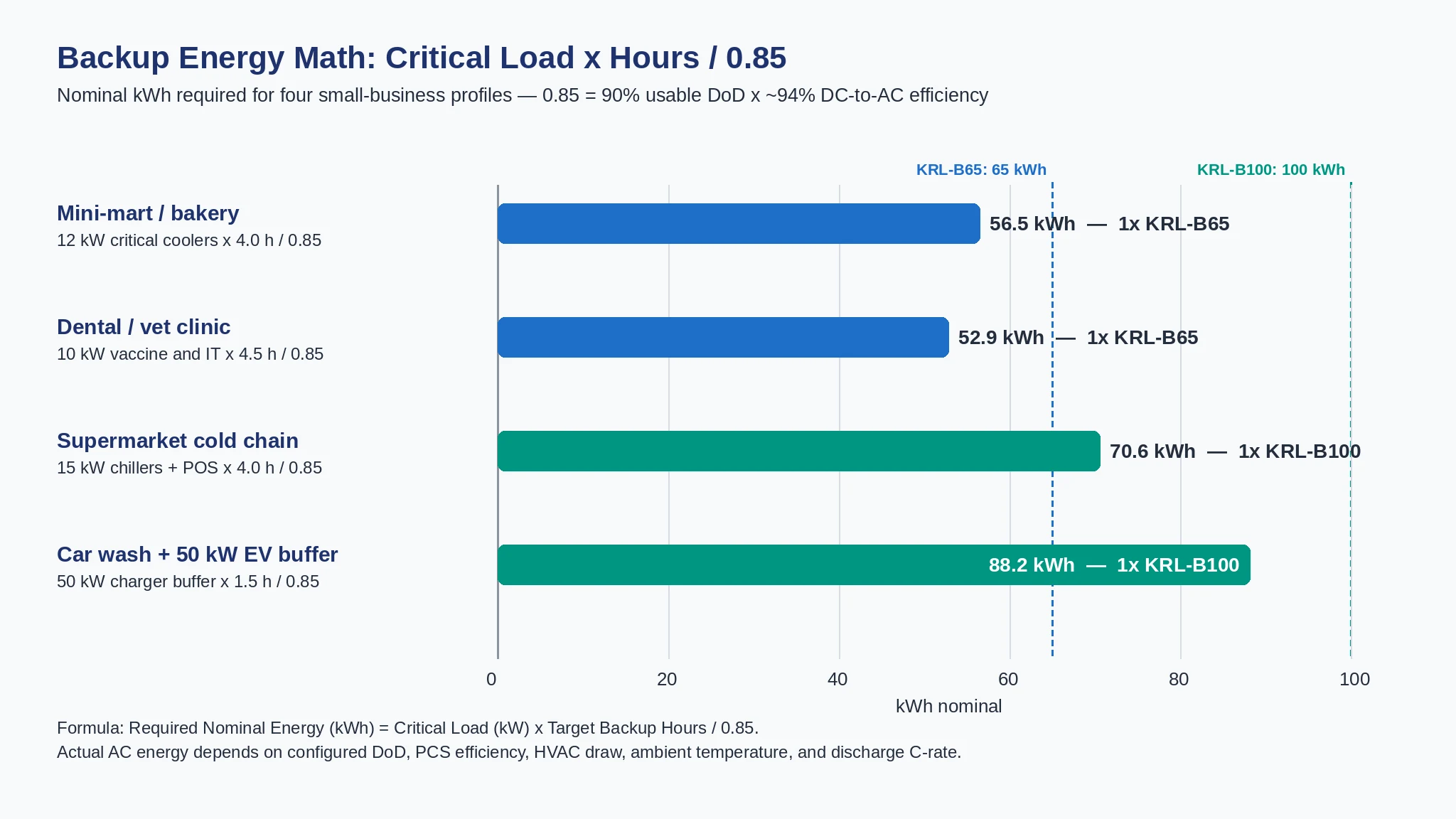
Table 3: Small Business Solar Battery Sizing & Nominal Backup Math Examples
| Commercial Facility Profile | Peak / Critical Backup Load | Nominal Energy Math (Load x Hrs / 0.85) | Candidate KRL Model |
|---|---|---|---|
| Mini-Mart / Bakery | 25kW peak / 12kW critical coolers | 12kW x 4.0h / 0.85 = 56.5kWh nominal | 1x KRL-B65 (30kW / 65kWh) |
| Dental / Vet Clinic | 22kW peak / 10kW vaccine & IT | 10kW x 4.5h / 0.85 = 52.9kWh nominal | 1x KRL-B65 (30kW / 65kWh) |
| Supermarket Cold Chain | 48kW peak / 15kW chillers + POS | 15kW x 4.0h / 0.85 = 70.6kWh nominal | 1x KRL-B100 (50kW / 100kWh) |
| Car Wash + 50kW EV Buffer | 55kW peak / 50kW charger buffer | 50kW x 1.5h / 0.85 = 88.2kWh nominal | 1x KRL-B100 (verify 50kW discharge curve) |
Explore published specifications and architecture options for KRL-B65 (30kW/65kWh) and KRL-B100 (50kW/100kWh) compact BESS cabinets.
Both models run on KRL's proven Grade-A LiFePO4 battery platform.
Which Cabinet Fits Your Existing Three-Phase Panel? Submit your peak demand, main breaker rating and required backup hours to request a B65/B100 sizing review, feeder compatibility assessment and model-specific discharge information.
3-Step Compact Sizing Formula & Back-Alley Installation Checklist
Buyer Takeaway: Use Critical Load x Backup Hours / 0.85 for initial nominal kWh sizing, then verify constant-power discharge curves, HVAC auxiliary draw, and IP54 siting clearances.
Small-business owners and local solar installers can complete a preliminary small business solar battery sizing check in three steps before finalizing the project SLD.
Step 1: Benchmark Peak Demand and Max AC Current Against Your Feeder
Pull 12 months of commercial utility bills to check peak 15-minute kW or kVA demand. Compare the cabinet's published maximum AC current (45A on KRL-B65; 75A on KRL-B100) against your main switchboard rating, concurrent building loads, and utility import/export limits.
Facilities operating on 480V North American commercial feeders add a matching isolation or step-down transformer at the SLD stage.
Step 2: Calculate Nominal Backup Energy and Check Discharge Curve Limits
Use the preliminary sizing equation: Required Nominal Energy (kWh) = Critical Load (kW) x Target Backup Hours / 0.85 (where 0.85 approximates 90% usable DoD multiplied by ~94% DC-to-AC conversion efficiency, 0.90 x 0.94 = 0.846).
Remember that 65kWh (B65) and 100kWh (B100) represent nominal battery energy ratings. Actual AC energy delivered to load terminals depends on configured DoD, PCS efficiency, internal HVAC cooling draw, ambient temperature, discharge C-rate, and minimum SOC limits.
High-power backup cases, such as discharging 50kW for 1.5 hours (88.2kWh nominal), must always be confirmed against the model's constant-power discharge curve.
Step 3: Verify Back-Alley Rigging, IP54 Placement, and Solar/Parallel Scope
Confirm three physical and compliance checkpoints before releasing your order:
- 1. Rigging and IP54 Siting: B65 (665x950x2100 mm, ~1,000 kg) and B100 (740x1348x2350 mm, ~1,150 kg) carry IP54 protection (-10°C to 50°C) and HVAC cooling. Confirm forklift capacity, lifting points, floor load, turning radius, access, and rain canopies first; consider pallet jacks only if the base, rating, and floor permit.
- 2. Direct DC MPPT vs. AC-Coupled Solar: KRL-B65 supports up to 38kW direct DC PV input (2 MPPT) and KRL-B100 supports up to 100kW direct DC PV input (4 MPPT), while AC output stays bounded by the 30kW or 50kW PCS rating. Retrofit sites can also AC-couple alongside existing PV inverters via smart CT export control per SLD design.
- 3. Model-Specific Certifications and Parallel Scaling: Verify exact multi-cabinet parallel limits, AC combiner protection, and model-specific compliance certificates (such as IEC 62619, UL 1973, UL 9540, UN 38.3, and local grid codes) directly against the KRL-B65 or KRL-B100 configuration supplied.
Installers serving small retail, hospitality, clinic, and workshop clients worldwide can review KRL Power's compact commercial and industrial ESS solutions.
FAQ
What is the rated power and energy difference between the KRL-B65 and KRL-B100?
What are the maximum AC current limits of the two cabinets?
Does a 30 kW BESS automatically satisfy Germany’s 30 kVA NA-protection threshold?
Can a 63 A three-phase service accommodate the KRL-B65?
Is an 80 A main breaker sufficient for the KRL-B100?
How do installers estimate nominal battery capacity for a backup load?
Which cabinet fits a clinic requiring 10 kW of backup for 4.5 hours?
Can the KRL-B100 support a 50 kW EV charger at a car wash?
What backup switching and diesel integration are available?
What should EPCs verify before ordering multiple compact BESS cabinets?
Right-Size Your Small Commercial Energy Storage Today
Skip the safety compromises of stacked home batteries and avoid the feeder upgrades of oversized 261kWh industrial blocks. Matching KRL-B65 (30kW/65kWh) or KRL-B100 (50kW/100kWh) to your verified critical loads, panel current limits, and rooftop PV array protects inventory and trims monthly demand charges.
Send your recent commercial electricity bill (showing peak kW or kVA) and main three-phase breaker rating (such as 63A, 80A, 100A, or 125A) to request a KRL-B65 vs. KRL-B100 commercial bill and sizing review.
KRL Power's engineering team provides an initial response within 24 hours. Model submittal drawings, constant-power discharge verification, compliance documentation, and commercial proposals are prepared according to your confirmed site scope.
Get a Project-Specific Commercial BESS Proposal. Share your electricity bill, critical loads, rooftop PV capacity and site voltage to request model submittal drawings, constant-power discharge verification, compliance documentation and a commercial quotation.