
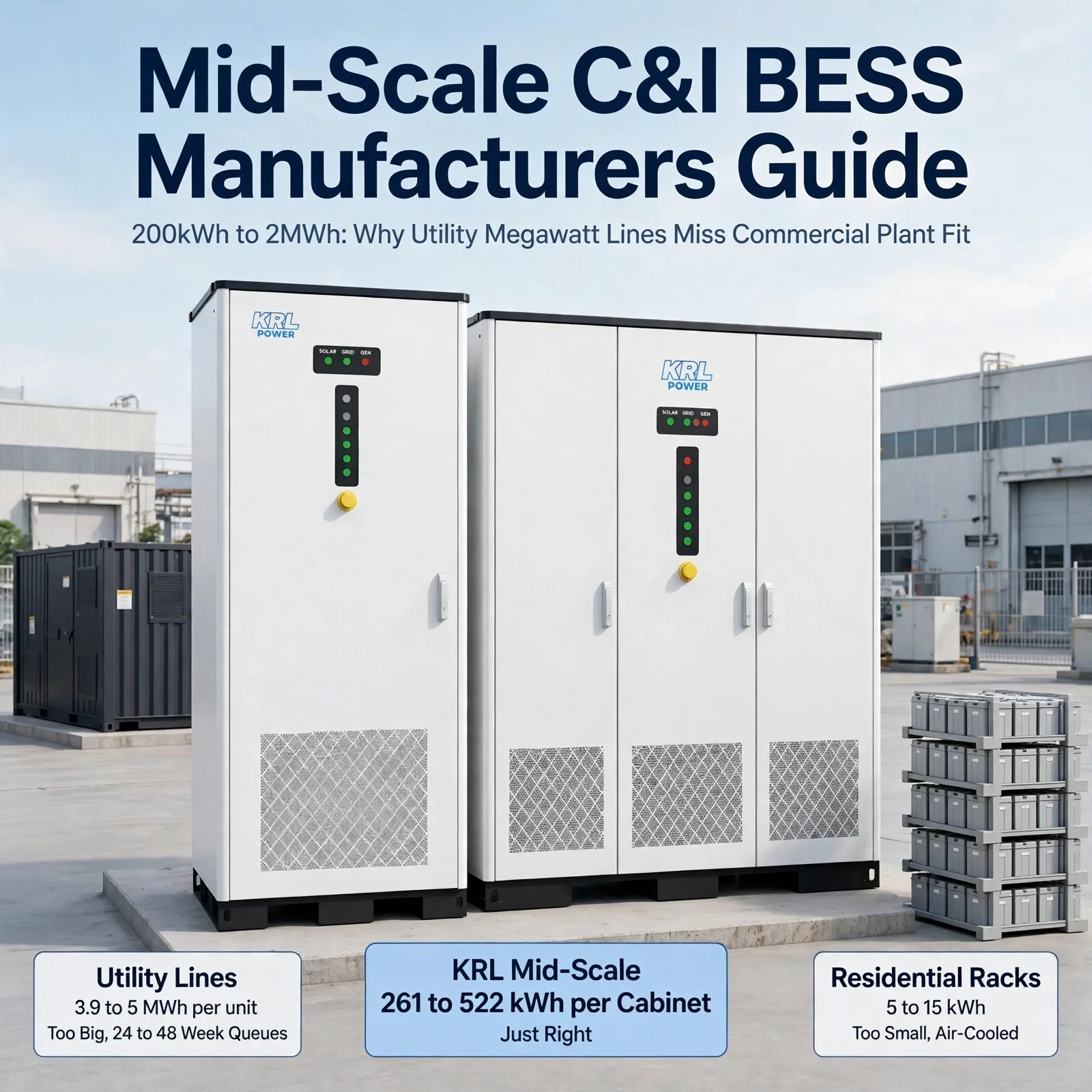
Industrial procurement directors evaluating mid-scale C&I BESS manufacturers for a 500kWh to 1.5MWh factory installation quickly hit a structural gap in the global supplier directory.
Standard inquiries sent into utility-scale megawatt divisions often route through regional distribution tiers, accumulate layered channel costs, and queue behind multi-megawatt grid contracts.
Shifting to low-cost residential rack assemblers creates the opposite engineering exposure. Stacked low-voltage modules built for 10kWh home walls struggle under three-phase industrial motor loads, lack liquid thermal loops, and trigger commercial property insurance rejections during fire-code plan review.
Between 200kWh and 2MWh sits the commercial energy storage segment often called the Missing Middle. Winning IRR and hitting scheduled energization dates depends on matching factory project scale to a dedicated turnkey C&I BESS OEM factory engineered specifically for outdoor liquid-cooled cabinets.
The Missing Middle in C&I Procurement: Why 200kWh to 2MWh Buyers Get Trapped
Buyer Takeaway: Utility megawatt queues inflate small-plant CAPEX and delay cash flow, while stretched residential racks expose factories to thermal aging and insurance holds.
Factory CFOs and regional EPCs rarely fail on battery chemistry alone. Most commercial budget overruns begin during vendor tier selection, when a 500kWh or 1MWh industrial plant enters a sales channel built for completely different order sizes.
1. Utility-Scale Megawatt Lines and Small-Order Friction
Utility-scale lines like Tesla Megapack (~3.9MWh per unit), Sungrow PowerTitan 2.0 (5MWh utility class), and Fluence grid blocks target multi-megawatt utility deployments. Their production scheduling and sales coverage revolve around independent power producer (IPP) orders.
When a single manufacturing plant submits a 500kWh to 1.5MWh inquiry into utility-oriented supply chains, procurement teams frequently encounter four commercial bottlenecks:
- Multi-tier distribution markups: Orders below direct factory minimum order quantities (MOQs) typically route through national importers, regional distributors, and local resellers. Layered channel margins (such as 30% to 45% in multi-step distribution examples) inflate equipment CAPEX before site work starts.
- Extended ex-factory allocation queues: When production slots prioritize large utility allocations, illustrative lead times on constrained lines can stretch to 24 to 48 weeks and push peak-shaving savings into the next fiscal year.
- Rigid product standardization: Plant-specific site realities such as legacy diesel generator synchronization, 480V or 690V step-up/step-down transformer coupling, tight yard clearances, or sub-10ms backup switchover fall outside standardized container templates.
- Lower service ticket priority: During forced downtime, support escalation queues in utility-centric service desks naturally weight multi-megawatt substation outages ahead of single-factory cabinet faults.
2. Scaled-Up Residential Assemblers and Commercial Risk Exposure
Searching for shorter lead times and lower per-kWh quotes drives some buyers toward vendors whose core business consists of 5kWh to 15kWh residential battery packs. Several assemblers stack 30 to 40 low-voltage rack modules inside sheet-metal enclosures and market the assembly as a 200kWh commercial system.
Industrial facilities expose three critical weaknesses in scaled-up residential hardware:
- Air-cooled thermal gradients: High-duty commercial peak shaving cycles daily under ambient factory heat, where basic fan ventilation allows cell temperature spreads above 8°C and accelerates capacity fade.
- Commercial fire-code and insurer gaps: Underwriting engineers check UL 9540 listings, IEC 62619 safety compliance, and unit-level UL 9540A fire propagation test data paired with NFPA 855 spacing. Residential rack packs routinely omit system fire documentation and active suppression.
- Weak three-phase dynamic response: Parallel low-voltage rack buses carry higher internal impedance and limited inverter headroom under unbalanced three-phase industrial feeders and high-inrush motor starts.
Commercial Energy Storage Suppliers Comparison: The 3 Manufacturer Tiers Evaluated
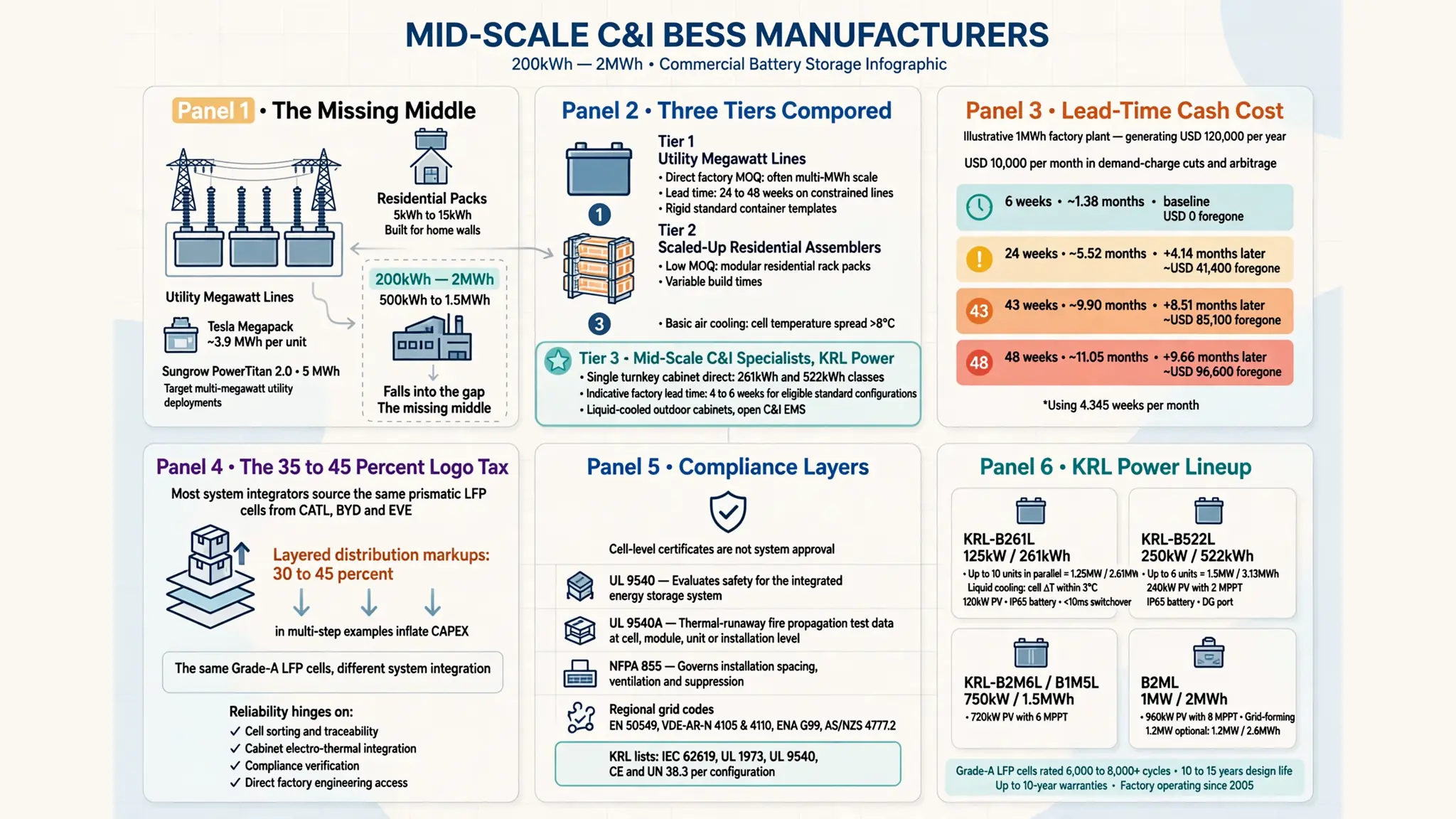
Buyer Takeaway: Dedicated mid-scale C&I BESS manufacturers bridge the 200kWh to 2MWh gap with single-cabinet MOQs, factory-integrated liquid cooling, and open local SCADA control.
Objective commercial energy storage suppliers comparison separates vendors by business model and factory engineering fit over headline brand awareness.
The two tables below evaluate all eight core procurement criteria across the three supplier tiers serving 200kWh to 2MWh battery storage suppliers evaluations.
Table 1: Commercial Supply Chain and Delivery Comparison (200kWh to 2MWh Projects)
| Procurement Criterion | Tier 1: Utility Megawatt Product Lines | Tier 2: Scaled-Up Residential Assemblers | Tier 3: Mid-Scale C&I Specialists (KRL Power) |
|---|---|---|---|
| Core Capacity Sweet Spot | Multi-MWh utility and grid-scale deployments | 10kWh to 150kWh homes and light retail | 200kWh to 2MWh factories, cold chains, microgrids |
| Direct Factory MOQ | High direct threshold (often multi-MWh scale) | Low (modular residential rack packs) | Single turnkey cabinet direct (261kWh / 522kWh classes) |
| Indicative Factory Lead Time | Illustrative 24 to 48 wk queues on constrained lines | Variable build times; limited commercial certs | 4 to 6 wks indicative for eligible standard configs |
| Site Engineering Flexibility | Rigid standard container templates | Enclosure tweaks with basic inverter logic | Pre-configured DG port, under 10ms backup, custom SLD review |
KRL Power's deployment framework separates custom solution engineering, prototype validation, mass production, and site installation or commissioning.
Indicative factory production lead times of 4 to 6 weeks apply to eligible standard configurations, subject to order volume, component availability, customization scope, and confirmed production slots.
Overseas buyers should also budget ocean freight, customs clearance, civil pad work, and utility interconnection approval alongside ex-works factory production. Running civil works and permitting in parallel with a 4 to 6 week indicative factory build compresses total time to energization compared to multi-month utility queue examples.
Table 2: Engineering, Compliance, and Lifecycle Economics Comparison
| Technical & ROI Criterion | Tier 1: Utility Megawatt Product Lines | Tier 2: Scaled-Up Residential Assemblers | Tier 3: Mid-Scale C&I Specialists (KRL Power) |
|---|---|---|---|
| EMS & Protocol Access | Often paired with cloud O&M or software agreements | Consumer mobile app; limited industrial registers | Open C&I EMS (Modbus, RS485, CAN, API) per model scope |
| Thermal & Cell Architecture | Container liquid cooling built for multi-MW blocks | Basic air cooling; wider summer cell temperature spread | Liquid-cooled outdoor cabinets; Grade-A LFP cells |
| Standards & Insurer Readiness | Utility-grade compliance for substation assets | Cell or residential certs; commercial fire-code gaps | IEC 62619, UL 1973, UL 9540, CE, UN 38.3 per config |
| Mid-Scale Project Economics | Pressured by channel costs and longer queues | High risk of early degradation or permit holds | Direct factory pricing; illustrative 2.5 to 3.8 yr model |
Compliance documentation covering IEC 62619, UL 1973, UL 9540, CE, and UN 38.3 is available according to the selected battery and system configuration. Request model-specific certificates, test reports, and scope sheets during contracting.
In project financial modeling, the 2.5 to 3.8 year payback window serves as an illustrative calculation. Actual payback depends on site load profiles, peak-to-off-peak tariff spreads, monthly kW demand charges, annual cycling hours, and local balance-of-plant CAPEX.
Same Tier-1 LFP Cells, Different System Integration: Avoiding a 40% Logo Tax
Overseas procurement directors sometimes assume that paying a brand and multi-tier channel premium (such as an illustrative 35% to 45% quote gap in layered distribution channels) buys proprietary battery electrochemistry.
Across the global energy storage industry, most system integrators source prismatic lithium iron phosphate (LFP) cells from the same leading automotive-grade cell producers, including CATL, BYD, and EVE.
Long-term project reliability in the 200kWh to 2MWh tier hinges on four verifiable factory engineering controls beyond a distributor logo:
- Cell sorting and traceability: Strict incoming screening for open-circuit voltage, capacity, and internal resistance across original Grade-A LFP batches before laser-welded module assembly.
- Cabinet-level electro-thermal integration: Matching liquid cooling plates, bidirectional PCS electronics, BMS balancing logic, and multi-layer fire suppression inside one factory-tested outdoor cabinet.
- Target-market compliance verification: Confirming exact system safety listings, regional grid codes, and transport documentation for the specific destination country prior to purchase-order release.
- Direct factory engineering access: Connecting plant electrical engineers straight to manufacturer firmware and commissioning teams within 24 hours during SLD review, startup, and post-commissioning operations.
On KRL's published KRL-B261L 125kW/261kWh liquid-cooled cabinet, liquid thermal management holds cell temperature differentials within 3°C alongside an IP65-rated battery section.
Verify the cabinet before approving your RFP. Send your factory capacity, voltage, and required commissioning scope to request KRL Power cabinet datasheets, model-specific compliance evidence, and a factory FAT checklist.
5 Hidden Traps in Factory Battery Storage System Procurement
Buyer Takeaway: Low headline kWh prices often hide missing balance-of-plant gear, software rent, cell-only certificates, and massive lead-time opportunity costs.
Evaluating commercial proposals strictly on headline USD/kWh figures causes experienced factory battery storage system procurement teams to miss five major lifecycle cost drains.
Trap 1: Confusing Bare Battery EXW Pricing with Turnkey Cabinet Scope
Some low-bid quotes advertise an aggressive battery price per kWh while stripping out essential balance-of-plant subsystems. Omitted items frequently include the bidirectional PCS inverter, local EMS controller, anti-backflow current transformers (CTs), fire-suppression interlock panels, coolant pre-charging, and pre-shipment integration testing.
Field-integrating mismatched racks, inverters, and fire panels on a live manufacturing site adds tens of thousands of dollars in local electrical engineering labor, extra switchgear enclosures, and multi-vendor commissioning friction.
Trap 2: Recurring Cloud SaaS Subscriptions and Dispatch Revenue Sharing
Some vertically integrated platforms pair basic peak-shaving scheduling, tariff updates, or inverter firmware maintenance with recurring cloud software fees or trading revenue-sharing clauses (such as 15% to 25% in certain aggregator contracts).
Once a multi-year hardware contract matures, plant operators can face ongoing software charges to keep dispatching assets already sitting on their own balance sheet.
KRL Power's C&I EMS platform supports Modbus TCP/IP, Modbus RTU, RS485, CAN Bus, and Open API integration, while unit datasheets for the KRL-B261L and KRL-B522L list RS485/WiFi communication interfaces.
Local protocol integration supports on-premise SCADA or PLC dispatch independent of cloud-only control, subject to the agreed model interface, gateway mapping, and EMS software scope.
Trap 3: Accepting Cell-Level Certificates in Place of System Compliance and UL 9540A Data
Sub-tier assemblers routinely attach raw cell manufacturer test reports (such as cell-level IEC 62619 or UN 38.3 sheets) and present them as full commercial approvals. Authorities Having Jurisdiction (AHJs), fire marshals, and commercial property insurers audit the complete integrated cabinet.
Procurement specifications must separate three compliance layers. UL 9540 evaluates safety for the integrated energy storage system, while UL 9540A provides thermal-runaway fire propagation test data at the cell, module, unit, or installation level.
NFPA 855 serves as the installation fire code governing separation distances, ventilation, and suppression design alongside those reports.
Regional grid-interconnection codes such as EN 50549, VDE-AR-N 4105/4110, ENA G99, or AS/NZS 4777.2 must also be verified against the exact cabinet configuration and destination grid voltage before signing.
Trap 4: Ignoring the Cash-Flow Opportunity Cost of 10-Month Lead Times
Finance teams frequently benchmark equipment quotes solely on upfront CAPEX while overlooking foregone monthly electricity savings during factory waits.
Consider an illustrative 1MWh commercial plant model built on site-specific load and tariff assumptions. Suppose the system generates USD 120,000 per year (USD 10,000 per month) in combined demand-charge cuts and peak-off-peak arbitrage.
Table 3: Illustrative 1MWh Factory Lead-Time Opportunity Cost Model (at 4.345 Weeks/Month)
| Illustrative Supply Scenario | Ex-Factory Production Lead Time | Delay vs. 6-Week (~1.38 Mo) Baseline | Illustrative Foregone Savings (USD 10,000/mo) |
|---|---|---|---|
| Eligible Standard C&I Build | 6 weeks (~1.38 months) | Baseline (0 months) | USD 0 baseline reference |
| Mid-Range Distributor Queue | 24 weeks (~5.52 months) | +4.14 months later COD | ~USD 41,400 illustrative foregone savings |
| Extended Utility Slot Queue | 43 weeks (~9.90 months) | +8.51 months later COD | ~USD 85,100 illustrative foregone savings |
| Peak Utility Backlog | 48 weeks (~11.05 months) | +9.66 months later COD | ~USD 96,600 illustrative foregone savings |
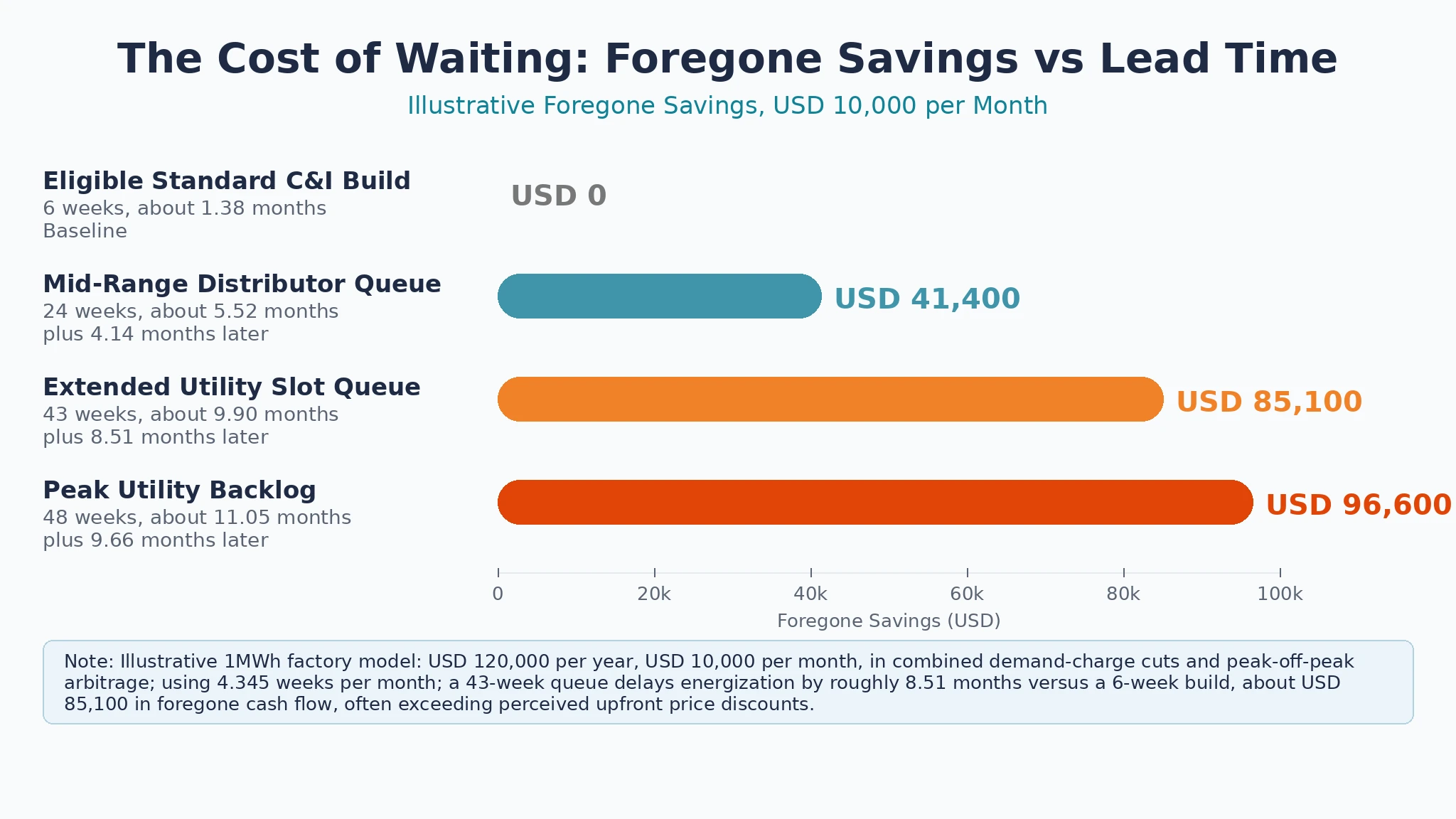
Using 4.345 weeks per month, compare a 43-week queue (~9.90 months) against an eligible 6-week build (~1.38 months). With comparable permitting, pad work, and ocean freight timelines, that production gap delays energization by roughly 8.51 months.
Under the hypothetical USD 10,000 per month savings assumption, that 8.51-month schedule gap represents roughly USD 85,100 in foregone cash flow (and about USD 96,600 at 48 weeks), often exceeding perceived upfront price discounts.
Trap 5: Single-Point Service Bottlenecks and Undefined Spare-Parts Plans
Commercial BESS assets generate financial returns only while available during monthly peak-demand windows. Missing even one 15-minute utility peak interval due to a tripped auxiliary power supply or BMS slave board can reset an entire month of demand-charge savings.
Before awarding a contract, procurement leads should verify modular serviceable sub-assemblies, clear spare-parts stocking kits (fuses, contactors, cooling fans, BMS control boards, and PCS modules), remote diagnostic telemetry, and written engineering response SLAs.
Explore KRL Power's turnkey 261kWh to 1MWh+ commercial battery storage cabinets, factory-built with liquid cooling, PCS, BMS, EMS, and fire protection.
Factory Battery Storage System Procurement Checklist: 7 RFP Audit Criteria
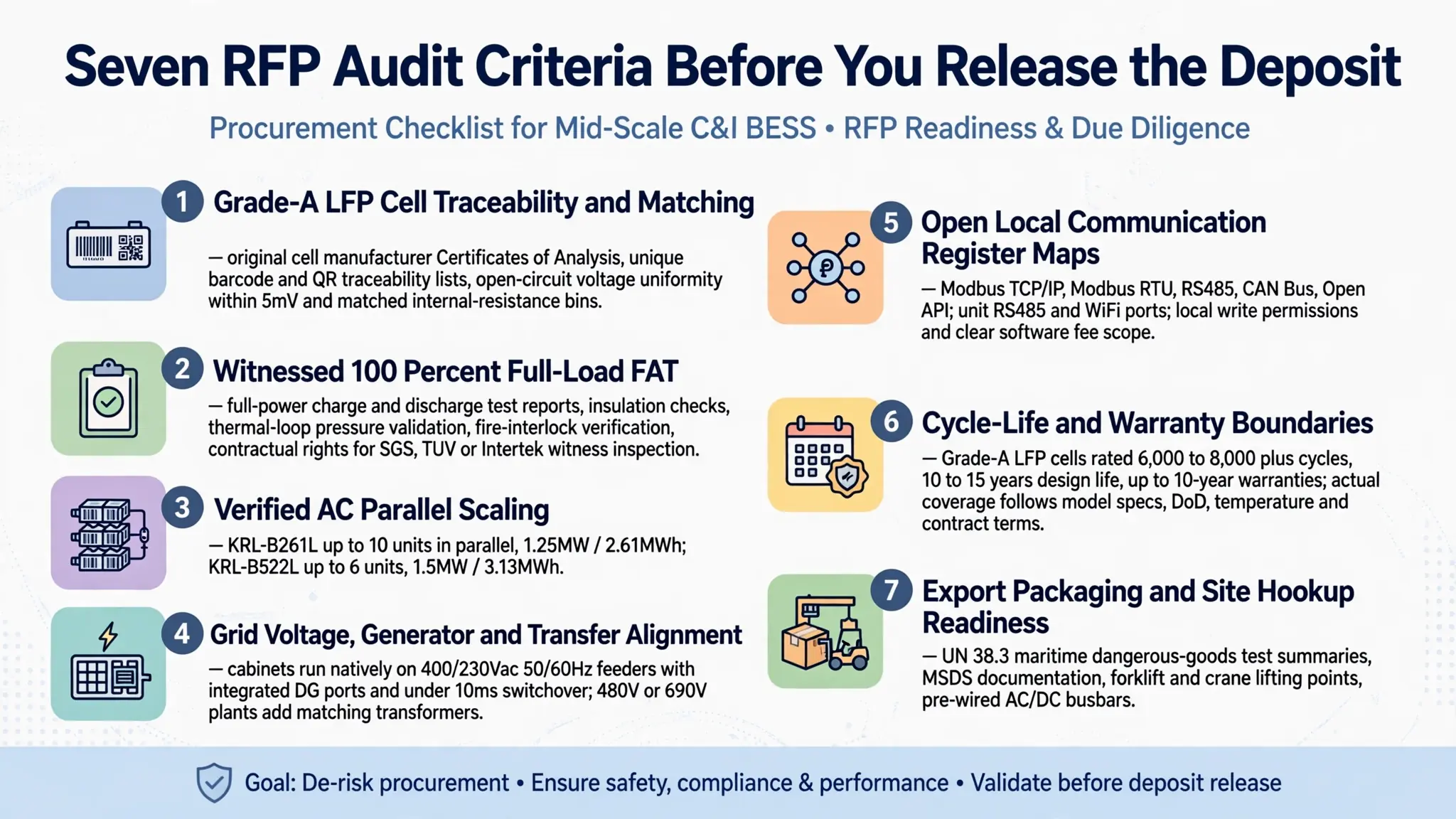
Buyer Takeaway: Enforce cell traceability, witnessed full-load FAT, open Modbus maps, and verified parallel scaling in your RFP before releasing deposits.
Use the seven-point procurement scorecard below inside commercial RFP packages to separate direct turnkey C&I BESS OEM factories from brokers and resellers.
- Grade-A LFP Cell Traceability and Matching: Require original cell manufacturer Certificates of Analysis (COA), unique barcode/QR traceability lists, and incoming pack-matching logs. Specifying open-circuit voltage uniformity (such as within 5mV) and matched internal-resistance bins screens out downgraded cells.
- Witnessed 100% Full-Load Factory Acceptance Testing (FAT): Require full-power charge/discharge test reports, insulation checks, thermal-loop pressure validation, and fire-interlock verification prior to shipment. Include contractual rights for SGS, TUV, or Intertek witness inspection.
- Verified AC Parallel Scaling Across 200kWh to 2MWh+: Confirm published parallel cabinet limits alongside required AC busbars, protection coordination, communication links, and EMS setup. KRL-B261L supports up to 10 units in parallel (1.25MW / 2.61MWh) and KRL-B522L supports up to 6 units (1.5MW / 3.13MWh), subject to project configuration.
- Grid Voltage, Generator, and Uninterrupted Transfer Alignment: Match cabinet AC voltage to the facility single-line diagram. KRL's standard C&I cabinets run natively on 400/230Vac 50/60Hz feeders with integrated DG ports and under 10ms switchover; 480V or 690V plants add matching transformers during SLD design.
- Open Local Communication Register Maps: Require contractual delivery of applicable protocol register lists, local write permissions, and clear software fee scope. Confirm unit-level RS485/WiFi ports versus EMS-level Modbus TCP/RTU, CAN Bus, Open API, or gateway mappings.
- Explicit Cycle-Life and Warranty Boundary Conditions: KRL C&I platforms feature Grade-A LFP cells rated for 6,000 to 8,000+ cycles (10 to 15 years design life) and up to 10-year warranties. Actual cycle counts and coverage follow model specs, DoD, temperature, throughput, and contract terms.
- Export Packaging and Site Hookup Readiness: Verify UN 38.3 maritime dangerous-goods test summaries, MSDS documentation, forklift/crane lifting points, and pre-wired AC/DC busbars that trim physical field installation time once concrete pads and utility permits clear.
Engineering teams reviewing cell sourcing and scalability can inspect KRL's Grade-A LiFePO4 cell and pack architecture alongside published unit datasheets.
High-demand commercial sites scale with the KRL-B522L 250kW/522kWh high-capacity cabinet across multi-cabinet arrays.
Multi-megawatt yards deploy the KRL-B2M6L megawatt container series in standard B1M5L (750kW/1.5MWh) or B2ML (1MW/2MWh) blocks, plus an optional 1.2MW/2.6MWh custom configuration.
Table 4: KRL Power Mid-Scale C&I Liquid-Cooled BESS Platform Alignment
| KRL Model / Config | Unit Nameplate Rating | Parallel / Deployment Scope | Key Published C&I Attributes |
|---|---|---|---|
| KRL-B261L | 125kW / 261kWh | Up to 10 units (1.25MW / 2.61MWh) | Liquid cooling (≤3°C delta), 120kW PV, IP65 battery, under 10ms |
| KRL-B522L | 250kW / 522kWh | Up to 6 units (1.5MW / 3.13MWh) | Liquid cooling, 240kW PV (2 MPPT), IP65 battery, DG port |
| KRL-B2M6L (B1M5L Std) | 750kW / 1.5MWh | Standard 20ft container block | 720kW max PV input (6 MPPT), 400Vac 50/60Hz, under 10ms transfer |
| KRL-B2M6L (B2ML Std) | 1MW / 2MWh | Standard 20ft container block | 960kW max PV input (8 MPPT), liquid cooling, grid-forming |
| KRL-B2M6L (1.2MW Opt) | 1.2MW / 2.6MWh | Optional custom configuration | PCS, PV input, and MPPT parameters per project specification |
Compare real factory-direct economics before finalizing your commercial shortlist by reviewing our factory-direct C&I liquid-cooled BESS solutions.
Every cabinet system is built by the KRL Power source-factory engineering team, operating integrated battery pack manufacturing since 2005.
FAQ
What separates Tier 1, Tier 2, and Tier 3 suppliers for a 200kWh to 2MWh factory?
What is the indicative KRL Power production lead time for standard C&I storage cabinets?
What should buyers compare beyond the advertised EXW battery price per kWh?
Which system safety documents and regional grid requirements must C&I EPCs verify?
What local EMS and BMS communication access should an industrial buyer request?
How can KRL-B261L cabinets scale from 261kWh to about 2.61MWh?
What is the KRL-B522L rated output and parallel expansion limit?
Which standard and optional KRL-B2M6L container variants are described?
How is the opportunity cost of a 43-week factory queue estimated?
What project details should an EPC submit to request a KRL factory proposal?
Get a Direct Factory Proposal for Your 200kWh to 2MWh Project
Keep capital focused on kilowatt-hours that cut peak demand charges, avoiding lost months of cash flow inside utility allocation queues and multi-layer distributor markups.
Plant procurement directors preparing industrial BESS RFPs and regional solar-plus-storage EPCs bidding 200kWh to 2MWh projects rely on KRL Power for transparent factory-direct engineering and rapid cabinet delivery.
Submit your target project capacity, facility grid voltage, and destination country to KRL Power to request a direct factory quotation and 200kWh–2MWh RFP technical checklist.
KRL Power engineers respond within 24 hours with a tailored cabinet configuration, compliance verification roadmap, factory-direct pricing, and current production slot scheduling.