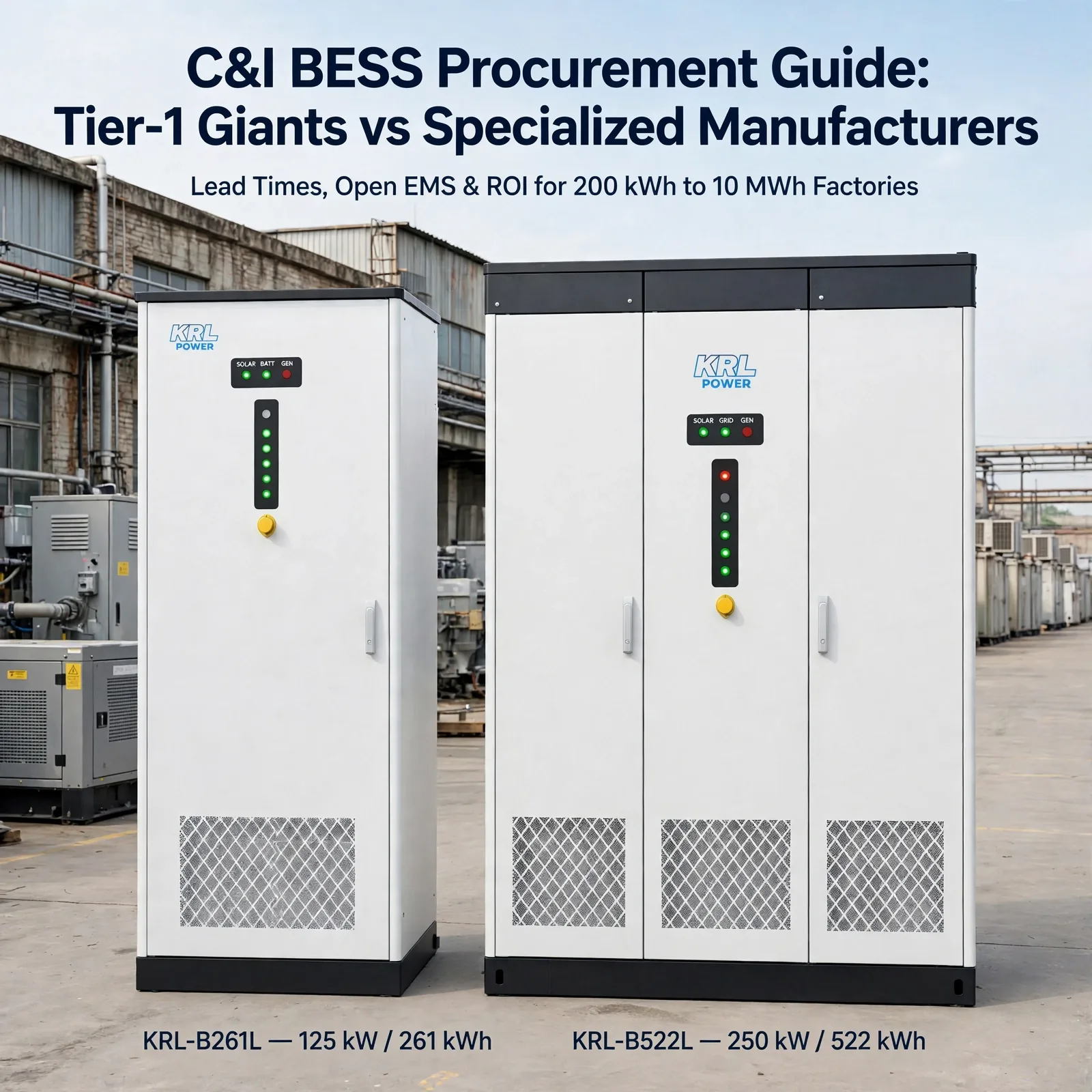
At the final investment review for a commercial battery project, every EPC director and factory CFO faces the same boardroom question. Why choose a specialized C&I BESS manufacturer over a utility-scale giant like CATL, Sungrow, or Tesla?
Selecting a utility-scale megawatt product line feels safe in a board presentation. Yet for 200kWh to 10MWh industrial facilities, some utility-focused procurement channels bring multi-quarter allocation schedules, contract-bound cloud fees, and standardized catalog hardware that clashes with legacy plant switchgear.
This C&I BESS procurement guide quantifies the three financial and engineering ledgers that decide real project IRR: communication protocol ownership, lead-time cost of delay, and brownfield site engineering alongside bankability verification.
Open Architecture vs. Proprietary Walled Gardens: Auditing the Software Tax
Buyer Takeaway: Proprietary cloud lock-in and restricted local Modbus registers drain commercial margins over 10 to 15 years; open C&I EMS control protects plant SCADA and VPP autonomy.
Hardware CAPEX represents only part of commercial storage ownership. Long-term software governance determines who controls asset dispatch and trading revenue.
1. Proprietary Cloud Lock-In and Multi-Vendor Site Deadlocks
Some utility-focused storage ecosystems bundle hardware with long-term service agreements (LTSAs) and proprietary cloud portals. In specific commercial contract scenarios, closed-ecosystem packages introduce USD 15 to USD 30 per kW per year in cloud O&M fees, or 15% to 25% revenue-sharing terms inside tied VPP contracts.
Site integration bottlenecks often hurt industrial EPCs even faster than subscription bills. Several vertically integrated platforms restrict local Modbus write registers to enforce cloud dispatch.
Factories often need to tie storage into Siemens or Schneider SCADA, coordinate Cummins or Caterpillar gensets on ComAp or Deep Sea panels, or switch local electricity aggregators. Closed ecosystems turn those routine integrations into costly API fees and long approval queues.
2. Local Protocol Ownership Under Open C&I EMS Architecture
Open-architecture BESS platforms decouple hardware ownership from mandatory cloud subscriptions. KRL Power's C&I EMS platform supports Modbus TCP/IP, Modbus RTU, RS485, CAN Bus, and Open API integration. Individual datasheets for the KRL-B261L and KRL-B522L specify RS485 and Wi-Fi hardware interfaces.
Regional utilities, grid operators, or third-party VPP aggregators sometimes mandate SunSpec, IEC 60870-5-104, IEC 61850, MQTT, or IEEE 2030.5 (CSIP-AUS). EPC teams specify the required protocol gateway and complete register map inside the procurement contract.
Owning local read and write permissions preserves data sovereignty across the asset's 10 to 15 year design life. Plant operators switch energy retailers or upgrade microgrid logic freely on their own schedule.
Tier-1 Energy Storage Manufacturers Comparison: Engineering, Lead Times & ROI
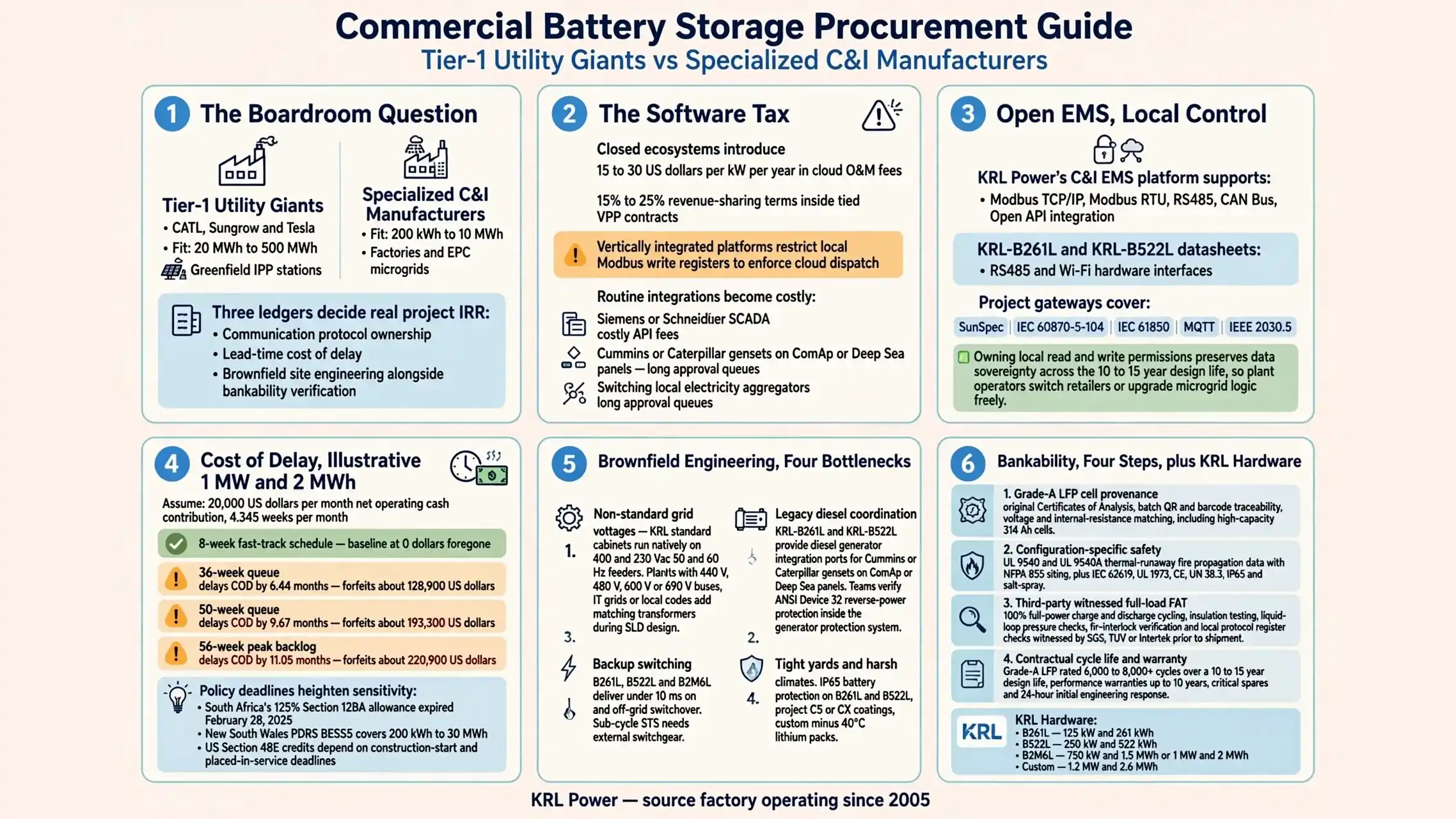
Buyer Takeaway: Utility megawatt platforms fit multi-tens-of-MWh greenfield stations, while specialized C&I OEMs excel on 200kWh to 10MWh brownfield agility, open EMS, and written schedule discipline.
Objective Tier-1 energy storage manufacturers comparison matches supplier operating models to project scale. Each supplier tier serves a distinct commercial deployment profile.
Table 1: Utility-Scale Megawatt Lines vs. Specialized C&I BESS Manufacturers
| Boardroom Evaluation Criterion | Tier-1 Utility Megawatt Lines | Specialized C&I OEMs (KRL Power) | Commercial & Engineering Impact |
|---|---|---|---|
| Ex-Works Lead-Time Structure | Illustrative multi-quarter queues (e.g. 36–56 wks) | Confirmed per model, volume & production slot | Written ex-works schedule protects COD & tax windows |
| EMS Protocols & Software Scope | Often paired with cloud LTSA / VPP agreements | Open C&I EMS (Modbus, CAN, RS485, API) | Preserves local SCADA & aggregator choice |
| Brownfield & Grid Flexibility | Standardized multi-MW catalog blocks | SLD-driven transformer, DG & site integration | Cuts civil & switchgear rework on legacy sites |
| Core LFP Cells & Thermal Spec | In-house or Tier-1 LFP + liquid cooling | Grade-A LFP cells (e.g. 314Ah) + liquid cooling | Verified cell traceability & liquid thermal control |
| Typical Comparison Project Scale | 20MWh to 500MWh+ greenfield IPP stations | 200kWh to 10MWh factories & EPC microgrids | Right-sized vendor tier strengthens lifecycle ROI |
Indicative factory production lead times for specialized C&I systems are confirmed by model, order volume, component availability, customization scope, and production-slot allocation. Buyers should obtain a written ex-works schedule before comparing supplier delivery commitments.
Overseas EPCs should also schedule ocean freight, customs clearance, concrete pads, and utility interconnection alongside the confirmed factory build slot. Running site civil works and permitting in parallel with production compresses total time to energization.
The Hidden Math of Lead Times: Cost of Delay and Project IRR
Buyer Takeaway: On an illustrative 1MW/2MWh asset earning USD 20,000 monthly net cash contribution, a 9.67-month schedule slip forfeits roughly USD 193,300 and risks tax deadlines.
Procurement spreadsheets often focus on upfront USD/kWh quotes while ignoring the BESS lead time impact on project IRR. Finance directors track this schedule gap as Cost of Delay (CoD).
Quantifying Cost of Delay on a 1MW / 2MWh Commercial Asset
Consider an illustrative financial sensitivity model for a 1MW / 2MWh industrial storage asset.
Assume USD 20,000 per month (USD 240,000 per year) in illustrative net operating cash contribution after variable battery degradation, variable O&M, and trading costs, with fixed operating costs and financing assumptions held constant.
Using 4.345 weeks per month and holding ocean shipping, permitting, and site construction timelines comparable, compare an illustrative 8-week (~1.84 months) fast-track ex-factory schedule against extended multi-quarter supplier delivery scenarios.
Table 2: Illustrative 1MW / 2MWh Schedule Delay Sensitivity Model (4.345 Weeks/Month)
| Illustrative Delivery Scenario | Ex-Factory Schedule Assumption | Delay vs. 8-Week (~1.84 Mo) Baseline | Illustrative Foregone Net Cash Contribution |
|---|---|---|---|
| Fast-Track Schedule Scenario | 8 weeks (~1.84 months) | Baseline (0.00 months) | USD 0 baseline reference |
| Moderate Queue Scenario | 36 weeks (~8.29 months) | +6.44 months later COD | ~USD 128,900 foregone net cash |
| Extended Queue Scenario | 50 weeks (~11.51 months) | +9.67 months later COD | ~USD 193,300 foregone net cash |
| Peak Backlog Scenario | 56 weeks (~12.89 months) | +11.05 months later COD | ~USD 220,900 foregone net cash |
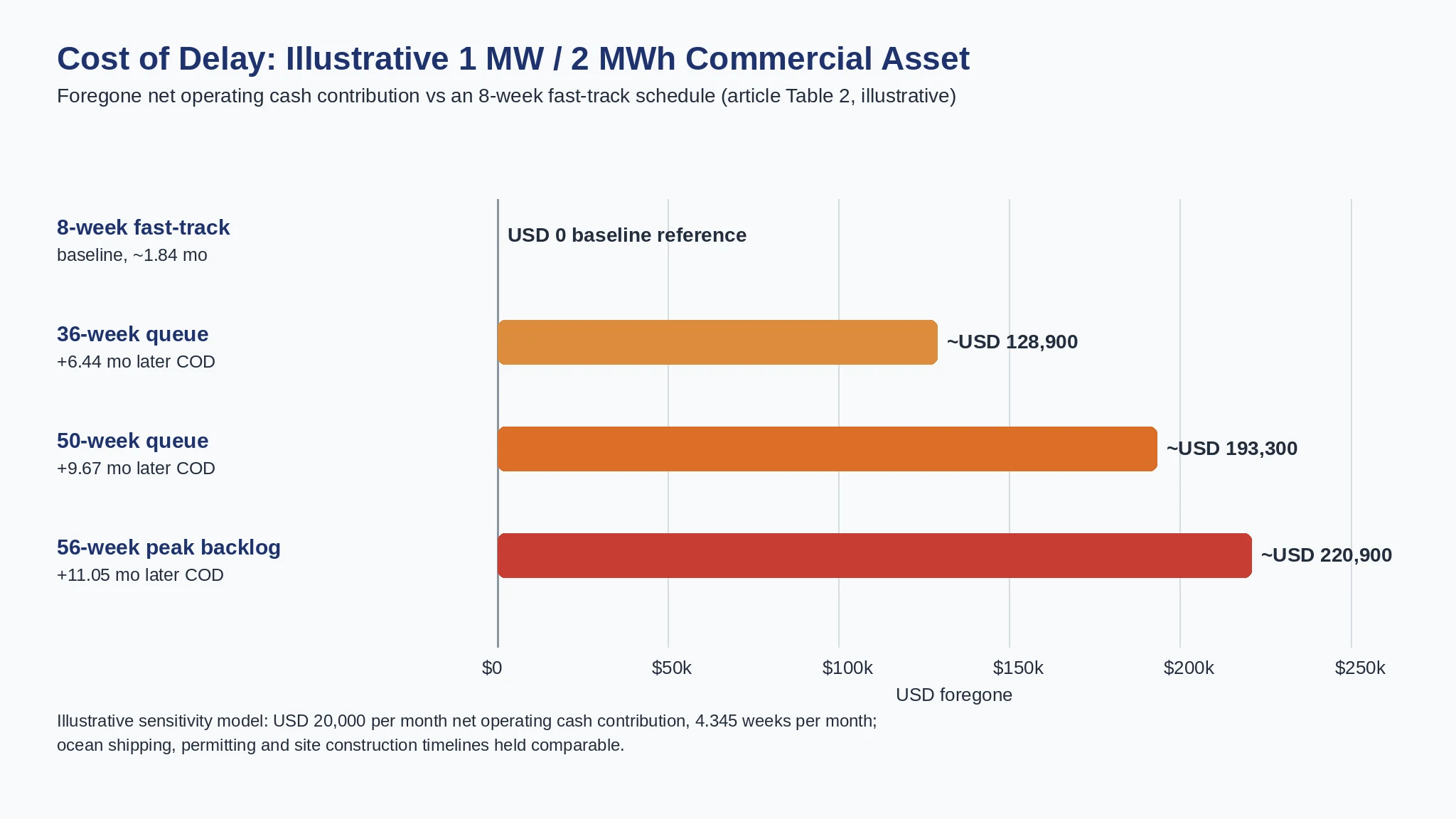
Under this sensitivity model, a 50-week schedule (~11.51 months) versus an 8-week schedule (~1.84 months) delays revenue operation by roughly 9.67 months. That slip forfeits about USD 193,300 in illustrative net operating cash contribution (or ~USD 220,900 at 56 weeks).
Extended cash-flow lag compresses project IRR and exposes EPC contractors to contractual Liquidated Damages (LDs).
Policy deadlines heighten schedule sensitivity across jurisdictions. South Africa's temporary 125% Section 12BA allowance expired on February 28, 2025.
New projects now follow permanent Section 12B rules, where tax deductions depend on qualifying asset classification, taxpayer status, capacity thresholds (such as 1MW for year-one treatment), and statutory compliance.
Similar statutory windows govern New South Wales PDRS commercial storage certificates (BESS5 for qualifying 200kWh to 30MWh industrial assets).
In the United States, Section 48E standalone storage Investment Tax Credits also depend strictly on construction-start dates, placed-in-service deadlines, statutory eligibility criteria, and prevailing wage and apprenticeship rules.
Need an Open EMS and Delivery-Slot Review Before the Project Deposit? Share your existing SLD, SCADA protocol needs and required commissioning date. KRL Power engineering can review the local interface scope, available production slot and cabinet configuration for your project.
Custom Battery Energy Storage System Engineering for Brownfield Facilities
Buyer Takeaway: Real industrial plants run legacy gensets, non-400V feeders, and harsh yards; SLD-driven custom engineering avoids costly switchgear overhauls.
Greenfield desert substations accept standardized shipping containers easily. Operating manufacturing plants present brownfield electrical and physical constraints that rigid catalog hardware struggles to accommodate.
Effective custom battery energy storage system engineering resolves four common brownfield bottlenecks during pre-shipment design:
- Non-Standard Grid Voltages and Earthing: KRL's standard C&I liquid-cooled cabinets run natively on 400/230Vac 50/60Hz feeders. Plants with 440V, 480V, 600V, or 690V buses, IT grids, or local codes (VDE-AR-N 4110, ENA G99, AS/NZS 4777.2) add matching transformers and verified settings during SLD design.
- Legacy Diesel Coordination and ANSI 32 Protection: KRL's B261L and B522L provide dedicated diesel generator integration ports for EMS coordination with Cummins or Caterpillar gensets (ComAp or Deep Sea panels). Verify ANSI Device 32 reverse-power protection inside the generator protection system and control architecture.
- Backup Switching and External STS Boundaries: KRL's published B261L, B522L, and B2M6L systems deliver <10ms on/off-grid switchover for commercial backup. Sensitive loads needing sub-cycle STS performance or high-rate pulse profiles add external STS switchgear or project-engineered packs during SLD sizing.
- Tight Yards and Harsh Climates: Standard B261L, B522L, and B2M6L published temperature limits apply to standard cabinets. Harsh sites combine split layouts, IP65 battery protection (B261L/B522L), project-specific C5/CX coatings, and custom -40°C lithium packs.
Custom environmental options apply by project specification. Project-specific ISO 12944 C5 or CX (legacy C5-M) coating systems require coating specification and verification.
KRL's custom -40°C low-temperature NCM and LiFePO4 packs with BMS self-heating remain subject to cell selection, pack qualification, and project-specific thermal management validation.
Table 3: KRL Power C&I BESS Hardware & Custom Engineering Alignment
| KRL Platform / Option | Published Nameplate Rating | Scaling / Engineering Scope | Verified C&I Attributes |
|---|---|---|---|
| KRL-B261L | 125kW / 261kWh | Up to 10 parallel (1.25MW / 2.61MWh) | Liquid cooling (<=3°C delta), 120kW PV, IP65 battery, <10ms |
| KRL-B522L | 250kW / 522kWh | Up to 6 parallel (1.5MW / 3.13MWh) | Liquid cooling, 240kW PV (2 MPPT), IP65 battery, DG port |
| KRL-B2M6L (B1M5L Std) | 750kW / 1.5MWh | Standard 20ft container block | 720kW max PV (6 MPPT), 400Vac 50/60Hz, <10ms transfer |
| KRL-B2M6L (B2ML Std) | 1MW / 2MWh | Standard 20ft container block | 960kW max PV (8 MPPT), liquid cooling, grid-forming |
| KRL Custom / 1.2MW Opt | 1.2MW / 2.6MWh or custom packs | Project-engineered SLD & packs | Custom PCS/PV specs or qualified -40°C Li packs |
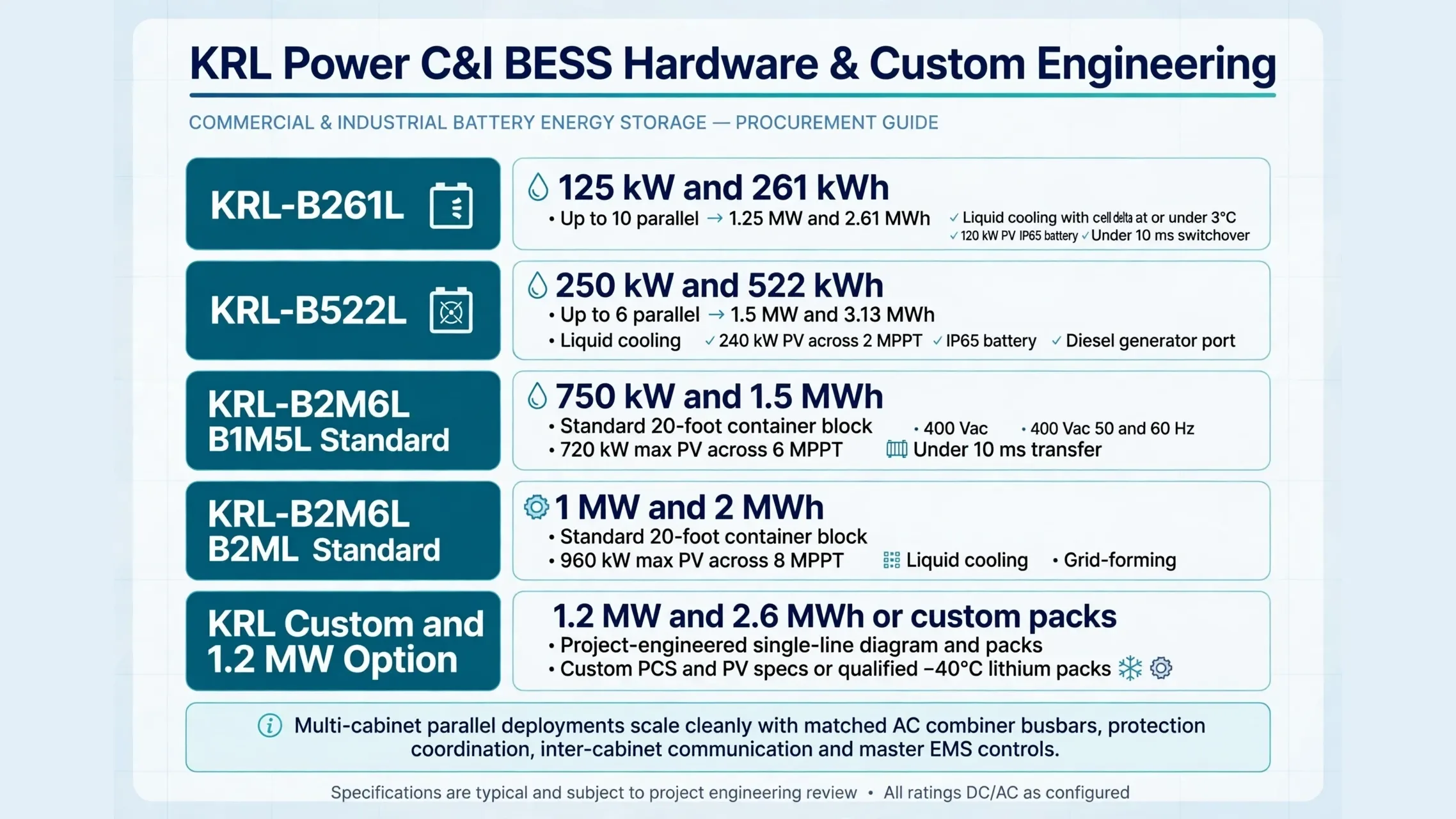
Multi-cabinet parallel deployments scale cleanly when paired with matched AC combiner busbars, protection coordination, inter-cabinet communication, and master EMS controls.
Review KRL's published C&I cabinet and container class selection guide to compare unit footprints across the 261kWh to 2MWh+ tier.
For mid-scale plants, inspect the KRL-B261L 125kW/261kWh liquid-cooled cabinet.
Higher-demand factories deploy the KRL-B522L 250kW/522kWh commercial cabinet.
Larger industrial yards scale into the KRL-B2M6L 1MW/2MWh megawatt container series.
Need to fit complex brownfield switchgear or legacy gensets on a tight project timeline? Explore KRL Power's turnkey custom C&I energy storage engineering solutions.
Solving the Boardroom Bankability Question: 4-Step De-Risking Framework
Buyer Takeaway: Lenders and commercial insurers underwrite verifiable cell provenance, configuration-matched safety documents, witnessed full-load FAT, and contractual warranty terms.
When a CFO asks how lenders and property insurers will evaluate a specialized manufacturer, procurement teams replace brand assumptions with a documented Tier-1 BESS bankability checklist.
1. Grade-A LFP Cell Provenance and Bill-of-Materials Traceability
Lenders focus closely on cell electrochemistry and cycle longevity. Require original cell manufacturer Certificates of Analysis (COA), batch QR/barcode traceability, and incoming voltage and internal-resistance matching records.
KRL Power specifies Grade-A LFP cells (including high-capacity 314Ah cells) and provides cell-level traceability documentation. Confirm the exact cell manufacturer and model directly in the project-specific bill of materials.
2. Configuration-Specific System Safety and Fire Test Packages
Separate cell paperwork from system compliance. Underwriting engineers review UL 9540 integrated safety evaluations alongside empirical UL 9540A thermal-runaway fire propagation test data (at cell, module, unit, or installation level) used with NFPA 855 siting rules.
KRL also lists IEC 62619, UL 1973, CE, UN 38.3, IP65, and salt-spray testing capabilities. Certification documents, test reports, and their applicable product configurations must be verified against the exact model, battery assembly, and PCS supplied before purchase-order release.
3. Third-Party Witnessed Full-Load FAT Before Final Payment
Eliminate field commissioning surprises by tying Factory Acceptance Testing (FAT) directly to milestone payments.
Specify 100% full-power charge/discharge cycling, insulation testing, liquid-loop pressure checks, fire-interlock verification, and local protocol register checks witnessed by your engineer or SGS, TUV, or Intertek prior to shipment.
4. Contractual Cycle-Life, Warranty, and Spare-Parts SLAs
Anchor long-term uptime in clear contract schedules. KRL C&I platforms promote Grade-A LFP cells rated for 6,000 to 8,000+ cycles (10 to 15 years design life) and performance warranties up to 10 years. Actual terms follow model specs, DoD, temperature, annual throughput, and signed contract conditions.
Lock in a critical spare-parts list (fuses, contactors, cooling fans, BMS boards, and PCS modules) alongside remote diagnostic telemetry and KRL Power's 24-hour initial engineering response commitment.
Evaluate Grade-A cell integration with open local control across our open-protocol commercial and industrial ESS systems.
Every cabinet is manufactured by the KRL Power source-factory engineering and manufacturing team operating since 2005.
FAQ
Does a Tier-1 battery supplier automatically offer better economics for a 200 kWh to 10 MWh factory?
What cloud EMS and VPP fees should industrial buyers check before signing?
Which communication protocols does the KRL Power C&I EMS support?
What information should an EPC provide for brownfield BESS single-line diagram engineering?
How much capacity can the KRL-B261L deliver when installed in parallel?
What are the KRL-B522L ratings and maximum published parallel count?
What container formats does KRL offer around 750 kW to 1 MW?
What should a witnessed factory acceptance test include before final payment?
How can procurement teams verify system safety instead of relying only on cell certificates?
Which warranty and spare-parts terms belong in a C&I BESS supply contract?
Partner with an Engineering-First Manufacturer Built for C&I Speed
Smart capital allocation turns CAPEX into operating kilowatt-hours on a confirmed schedule and under your own operational control. Match your plant's real switchgear, protocol, and delivery requirements to an engineering-driven C&I factory.
Share your facility single-line diagram (SLD), target protocol stack, and interconnection deadline to schedule an engineering SLD, protocol, and lead-time review.
KRL Power's engineering team provides an initial response within 24 hours. Cabinet configuration, compliance documentation, production scheduling, and commercial proposals are prepared according to the confirmed project scope.
Secure the Technical Package Before Awarding Your C&I BESS Contract. Submit your site SLD, target system power and energy, grid voltage and required schedule to request model-specific drawings, FAT and compliance document lists, and a project-based factory quotation.