

Engineering review by Liu, KRL Power R&D Director—20 years of C&I energy-storage engineering experience, formerly in Huawei R&D.
A spinning mill in Bangladesh needs a battery energy storage system to keep 900 kW of critical production load operating for four hours after a utility outage. The factory’s maximum demand is 1,553 kW. It already has a 200 kW Huawei AC-coupled PV system, plans to add 700 kW of solar, receives utility power at 33 kV, and has a 1,500 kVA gas generator plus a 50 kVA diesel generator.
This is an excellent application for a solar-storage-generator microgrid, but the solution cannot be selected from nominal MWh alone. KRL must distinguish battery nameplate energy from usable AC energy, isolate the critical process bus, confirm how the existing PV inverter behaves during an outage, and coordinate the BESS with the generators, transformer, switchgear and protection system.
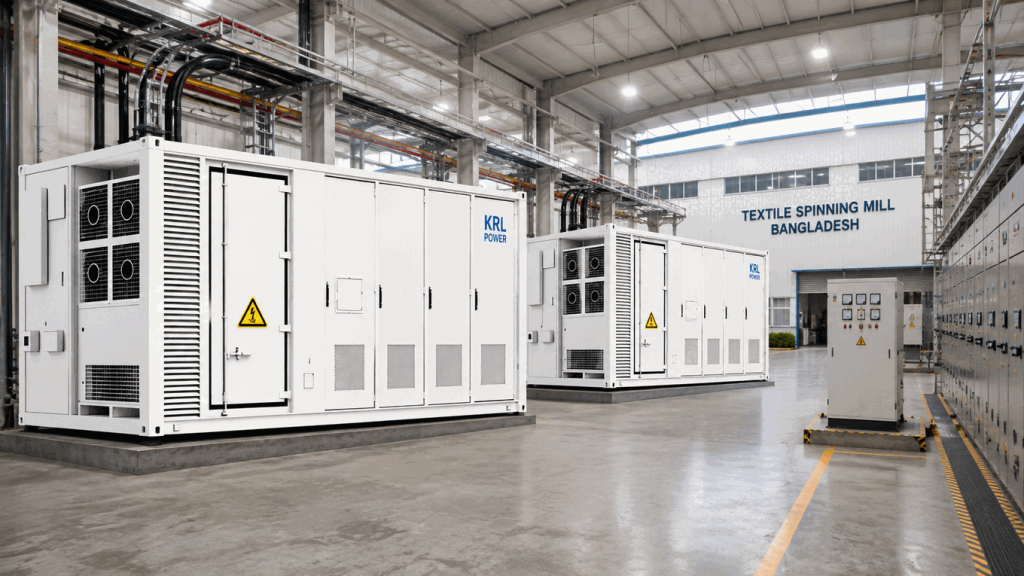
KRL Power’s 1 MW / 2 MWh all-in-one platform is a strong building block for this project. Battery, PCS, MPPT, BMS and EMS are integrated in one liquid-cooled 20-foot unit, so the new DC-coupled PV array does not require a separate PV inverter.
Customer Requirements and Engineering Meaning
| Design input | Customer data | Engineering meaning |
|---|---|---|
| Maximum factory load | 1,553 kW | Basis for the full-factory option |
| Critical outage load | 900 kW | Requires a dedicated critical-load bus |
| Backup duration | 4 hours | Requires 3.60 MWh net AC energy |
| Existing PV | 200 kW Huawei, AC-coupled | Island compatibility must be verified |
| Planned PV | 700 kW | Can use KRL’s integrated MPPT inputs |
| Utility supply | 33 kV, 50 Hz | Requires transformer and MV/LV coordination |
| Generators | 1,500 kVA gas + 50 kVA diesel | Gas unit is the relevant production backup |
| Installation | Indoor | Requires structural, cooling and fire review |
The matched KRL product data supplied for this project is:
| KRL product parameter | Approved project value |
|---|---|
| Battery energy | 2 MWh per unit |
| Bidirectional PCS | 1 MW per unit |
| Integrated MPPT | 960 kW, eight inputs |
| Operating mode | Grid-connected, off-grid and seamless switching |
| Integration | BMS, PCS and EMS |
| Mechanical design | Liquid-cooled 20-foot container; battery enclosure IP65 |
| Communications | RS485, WiFi or 4G |
This article describes an engineering proposal, not a completed installation. Final runtime, quantities and ROI remain conditional on the load profile, site single-line diagram, transformer data, PV module datasheet and indoor-room conditions.
Energy Verification: Why 4 MWh Is a Hybrid Backup Option
The critical load requires:
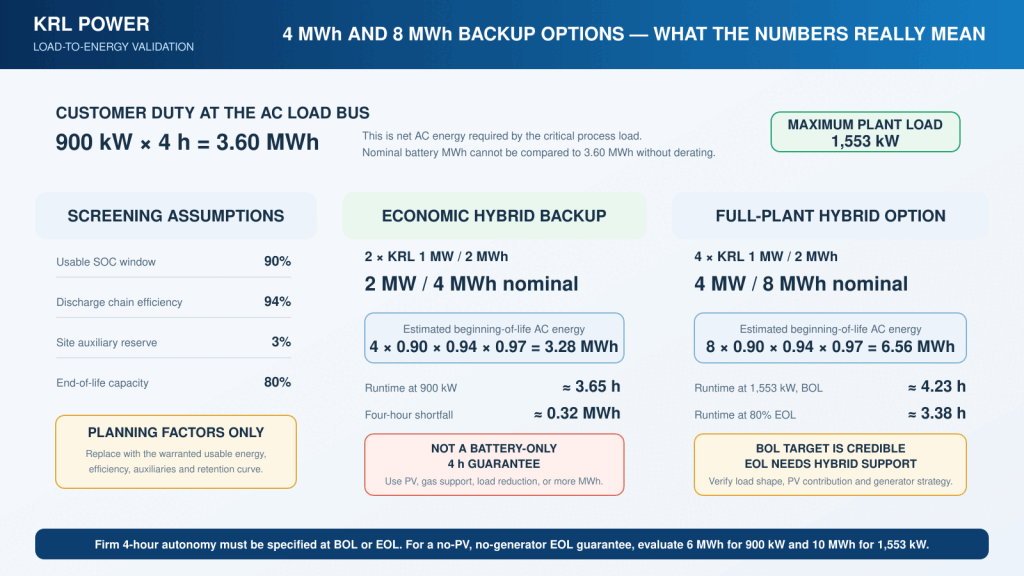
900 kW × 4 h = 3,600 kWh = 3.60 MWh AC
That is energy delivered at the load bus. Nominal battery energy must still cover reserve SOC, PCS and cable losses, cooling and control auxiliaries, temperature effects and future capacity fade.
For a preliminary screening calculation, assume a 90% operating SOC window, 94% discharge-chain efficiency and a 3% auxiliary reserve. These are planning factors, not product warranty values:
4.00 MWh × 0.90 × 0.94 × 0.97 ≈ 3.28 MWh AC
At a constant 900 kW load, 3.28 MWh provides approximately 3.65 hours. Therefore, two 2 MWh units should not be sold as an unconditional battery-only four-hour guarantee. They form a credible economic hybrid solution when the 700 kW PV array, the 1,500 kVA gas generator or controlled load reduction supplies the remaining energy and operating reserve.
If the customer requires four hours with no PV and no generator support, the contract must state whether the guarantee applies at beginning or end of battery life. A 6 MWh nominal configuration should be evaluated for a firm end-of-life 900 kW duty, subject to the actual warranted usable energy and retention curve.
Option 1: 2 MW / 4 MWh for the 900 kW Critical Load
The economic solution uses two KRL 1 MW / 2 MWh all-in-one units in parallel. The combined system provides 2 MW PCS power, 4 MWh nominal energy and 1.92 MW integrated MPPT capacity.
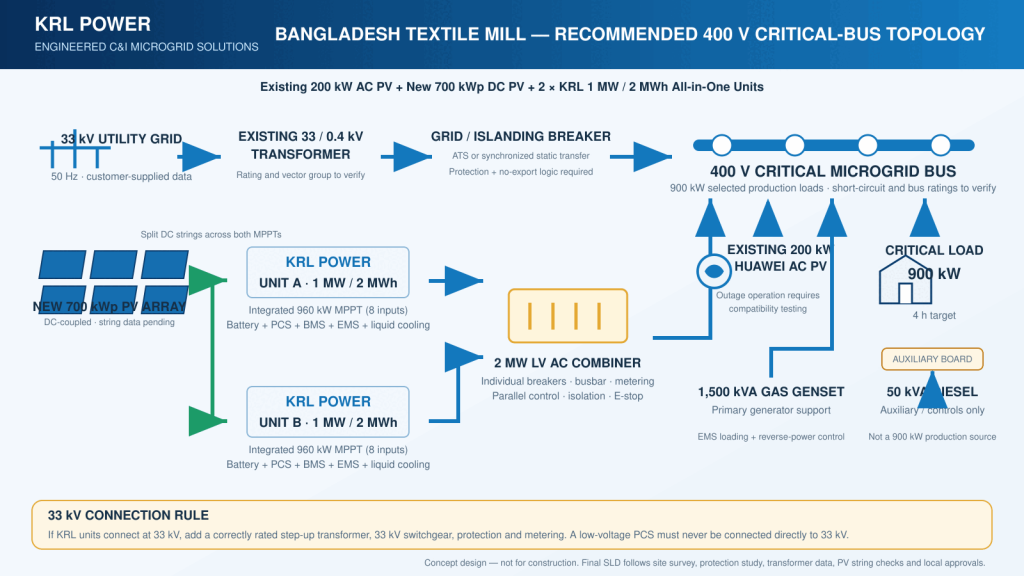
An engineered low-voltage AC combiner cabinet is required. Each PCS output needs its own breaker, metering, isolation and coordinated protection before connection to the common microgrid bus. This is an AC output combiner, not an external PV inverter or PV combiner.
The 2 MW PCS rating provides substantial headroom above the 900 kW steady load, but motor-start performance must still be verified. KRL needs the largest motor rating, VFD or soft-starter data, acceleration time, transformer inrush, starting sequence and PCS overload curve.
In normal operation, the EMS maintains the required backup SOC while using available capacity for peak shaving. After a grid failure, the islanding device separates the critical bus and the PCS supports the islanded network. New PV serves the load first and charges the battery with surplus energy. At the generator-start SOC threshold, the EMS calls the 1,500 kVA gas generator and applies loading and reverse-power limits. The 50 kVA diesel generator remains an auxiliary source and cannot carry the production bus. This configuration uses the existing gas generator as resilience margin instead of oversizing the battery for an occasional worst-case event.
Option 2: 4 MW / 8 MWh for Full-Factory Backup
Four KRL units provide 4 MW PCS power and 8 MWh nominal energy. The theoretical energy required by the 1,553 kW maximum factory load is:
1,553 kW × 4 h = 6.212 MWh AC
Using the same screening factors, 8 MWh provides approximately 6.56 MWh AC at beginning of life, or about 4.23 hours at 1,553 kW. At 80% retained capacity, this falls to about 5.25 MWh or 3.38 hours. A firm end-of-life target therefore needs PV or generator support, controlled load shedding, different warranted performance, or evaluation of approximately 10 MWh nominal capacity.
The preliminary 3.5–4.5-year payback must not be published as a guarantee. ROI should be calculated from tariffs, demand charges, fuel, outage hours, production losses, PV yield, CAPEX and operating strategy.
PV Integration Without an External PV Inverter
The existing 200 kW Huawei PV system remains AC-coupled. It can operate inside a battery-formed island only if its model, firmware, anti-islanding settings, voltage/frequency response, curtailment and reconnection logic are compatible with the KRL controller. Until verified, it should not be counted as firm outage generation.
The new 700 kW array connects directly to the KRL units’ integrated MPPT inputs. Although it is below one unit’s 960 kW MPPT rating, splitting strings across two units improves power sharing. Final design still requires module Voc, Vmp, Isc, temperature coefficients, MPPT limits and cable data. Variable PV can extend runtime but should not support a contractual autonomy guarantee without a conservative energy model.
400 V or 33 kV: Closing the Interconnection Boundary
At 400 V and unity power factor, 2 MW is approximately 2,887 A and 4 MW is approximately 5,774 A. A dedicated 400 V critical bus can simplify backup, but switchgear, busbars, cables and fault duty must support these currents.
For a 33 kV connection, the low-voltage PCS must feed a correctly rated step-up transformer and MV switchgear; it must never connect directly to 33 kV. The 4 MW option may require split LV sections or unit transformers. Seamless switching remains a system-level commissioning result determined by the transfer device, protection, transformer, controls, motors and PV compatibility.
Indoor Installation Review
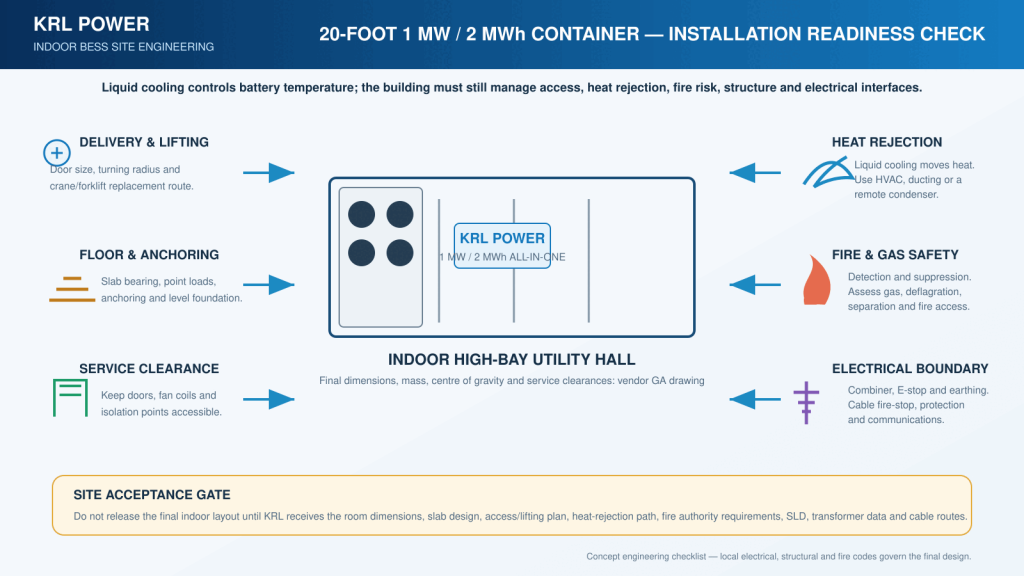
IP65 does not by itself approve a 20-foot BESS for indoor use. The review must confirm delivery access, floor loading, anchoring, maintenance and emergency clearances, liquid-cooling heat rejection, fire detection and suppression, gas/deflagration risk, ventilation, earthing, fire stopping, emergency stop and isolation. Final design must follow Bangladesh requirements without claiming undocumented certification.
Data Required Before the Final Proposal
- Seven days of 15-minute kW, kVA, power-factor and phase-current data.
- Critical-load list, motor ratings and starting methods.
- Site SLD, transformer rating/vector group, LV bus rating and fault level.
- Huawei inverter model, firmware and protection settings.
- PV module datasheet, layout and cable distances.
- Beginning- or end-of-life autonomy requirement and reserve SOC.
- Generator real-power rating, governor/AVR data and operating limits.
- Room dimensions, slab design, access, ambient conditions and heat-rejection path.
- Electricity bills, outage logs and fuel costs for the ROI model.
Engineering Conclusion
Two KRL 1 MW / 2 MWh units, an AC combiner, 700 kW of new DC-coupled PV, the existing 200 kW AC PV and the 1,500 kVA gas generator form a technically credible hybrid microgrid for the 900 kW critical load. The 4 MWh option should be presented as an economic hybrid-backup solution rather than an unconditional battery-only four-hour guarantee.
Four KRL units provide a credible 8 MWh beginning-of-life option for the 1,553 kW maximum factory load. Final approval depends on closing the 400 V versus 33 kV connection, verifying the indoor site, testing existing PV compatibility and defining whether runtime applies at beginning or end of battery life.
Review the KRL B2M6L 1–2 MW / 2–6 MWh product family, the KRL commercial and industrial energy storage portfolio, and contact KRL Power with the load profile, SLD, transformer data, PV datasheet and room drawings.