 Skip to content
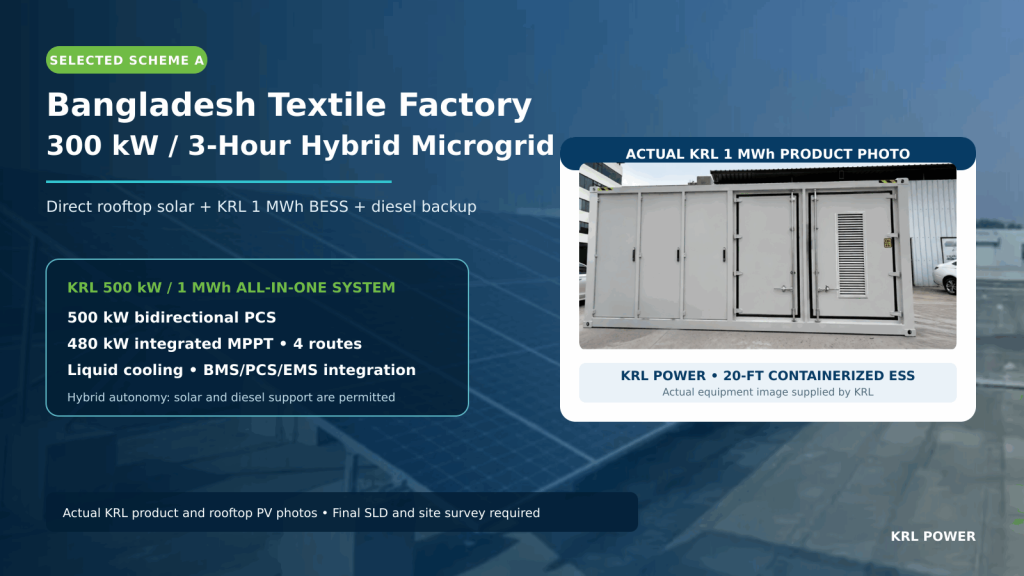
A Bangladesh textile factory is evaluating lithium battery storage for a 300 kW critical load, three hours of backup and direct solar charging. The site has an 11 kV/415 V, 630 kVA transformer and a diesel generator. A current quotation is based on four 241 kWh units, or 964 kWh nameplate.
The decisive question is whether the battery alone must carry 300 kW for three hours, or whether solar and the generator may contribute. That boundary changes capacity, controls, acceptance testing and price.
Quick answer
- The critical load requires 900 kWh delivered to the AC bus: 300 kW × 3 hours.
- A 964 kWh nameplate battery is not automatically a three-hour battery. Depth-of-discharge limits, conversion losses, auxiliaries, reserve and ageing all reduce deliverable energy.
- Under a preliminary screen—90% operating window, 94% discharge efficiency and 3% auxiliary allowance—964 kWh delivers approximately 791 kWh, or 2.64 hours at 300 kW.
- A KRL 500 kW / 1 MWh all-in-one system is a strong power match and can anchor the grid–solar–diesel microgrid. Under the same screen, however, 1 MWh provides about 821 kWh, or 2.74 hours, battery-only.
- The selected solution is therefore a KRL 500 kW/1 MWh hybrid system, with direct solar and automatic diesel support maintaining the complete three-hour operating window.
The correct commercial offer therefore depends on one written answer: battery-only autonomy, or hybrid-system autonomy?
Project facts and design boundaries
| Item | Customer information | Engineering implication |
|---|---|---|
| Facility | Textile factory, about 42,000 sq ft | Roof area is not the same as usable PV area; a structural and shading survey is required |
| Critical load | 300 kW | Confirm average, peak, step load, motor starts and power factor from measured data |
| Backup duration | 3 actual operating hours | Acceptance criteria must define whether PV and diesel may contribute |
| Existing transformer | 630 kVA, 11 kV/415 V | Verify spare kVA, impedance, vector group, LV bus rating and fault level |
| Existing backup | Diesel generator | Obtain nameplate, minimum loading, controller, breaker and synchronization data |
| Battery technology | Lithium required | Specify safety, usable-energy warranty, thermal management and commissioning tests |
| Solar requirement | Direct solar charging plus complete PV solution | Route PV strings to the KRL system’s integrated MPPT; no separate PV inverter is required for this DC-coupled concept |
The customer should remain anonymous publicly without written permission. These are pre-design calculations, not a final EPC drawing or warranty.
Start with delivered energy, not catalogue capacity
The requested service is 300 kW for three hours:
Required AC energy = 300 kW × 3 h = 900 kWh
Nameplate capacity cannot be compared directly with the 900 kWh duty. Account for the permitted state-of-charge window, conversion losses and auxiliaries.
For an initial screen:
Deliverable AC energy = nameplate kWh × 0.90 × 0.94 × 0.97
| Configuration | Nameplate energy | Screened AC energy | Runtime at 300 kW |
|---|---|---|---|
| Four 241 kWh units | 964 kWh | ≈791 kWh | ≈2.64 h |
| KRL standard energy block | 1,000 kWh | ≈821 kWh | ≈2.74 h |
| Preliminary battery-only minimum | ≈1,097 kWh | 900 kWh | 3.00 h |
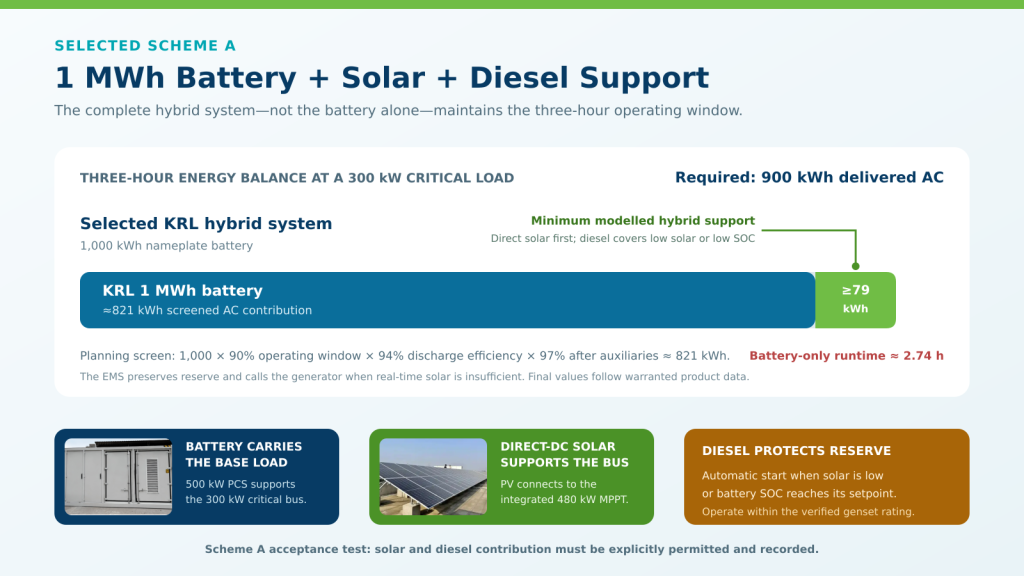
These factors are planning assumptions, not guaranteed values. Final sizing must use warranted usable energy, PCS efficiency, site temperature, auxiliaries, degradation and the end-of-life guarantee.
The recommended solution is hybrid three-hour resilience: use the KRL 500 kW/1 MWh system with direct solar and automatic generator support. If the customer later changes the acceptance criterion to battery-only autonomy, the energy capacity must be recalculated and increased.
Check power separately from energy
The 500 kW PCS exceeds the stated 300 kW continuous load, but motor starting and process transients still require verification.
List every protected motor, starting method, starting current, allowable voltage dip and restart sequence. A staged restart can reduce instantaneous power.
At 415 V, the 630 kVA transformer is about 876 A full-load. A 300 kW load at 0.95 power factor is roughly 439 A; a 500 kW PCS at unity power factor could approach 696 A at full output. The EMS must limit charging against live factory demand. “Reserved capacity” does not replace interval data and protection calculations.
Recommended KRL hybrid architecture
The concept uses one controlled 415 V microgrid bus:
- The 11 kV utility feeds the existing transformer, then the 415 V main board and a segregated critical-load bus.
- PV strings connect directly to the KRL system’s integrated 480 kW MPPT, arranged across four MPPT routes. This is the requested direct-from-sun charging path; an external PV inverter is not added to this concept.
- The KRL 500 kW PCS connects bidirectionally to the 415 V bus and manages charge, discharge, grid-connected operation and off-grid support.
- The diesel generator remains a separate AC source through its own breaker and engineered ATS or synchronization interface.
- The EMS coordinates grid import, PV priority, battery state of charge, generator start/stop, transformer import limits and load shedding.
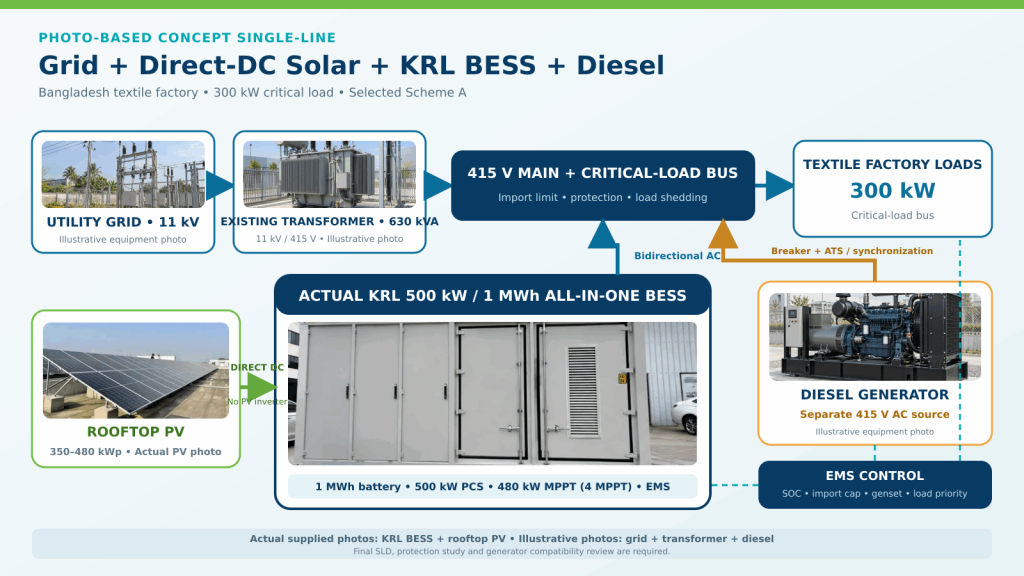
The KRL platform combines a 1 MWh lithium battery, 500 kW PCS, 480 kW total MPPT with four routes, BMS/PCS/EMS controls, liquid cooling, an IP65 battery cabinet and RS485/Wi-Fi/4G communications in a 20-foot container. It supports on-grid and off-grid operation with seamless switching. Final selection is subject to the approved single-line diagram and site study.
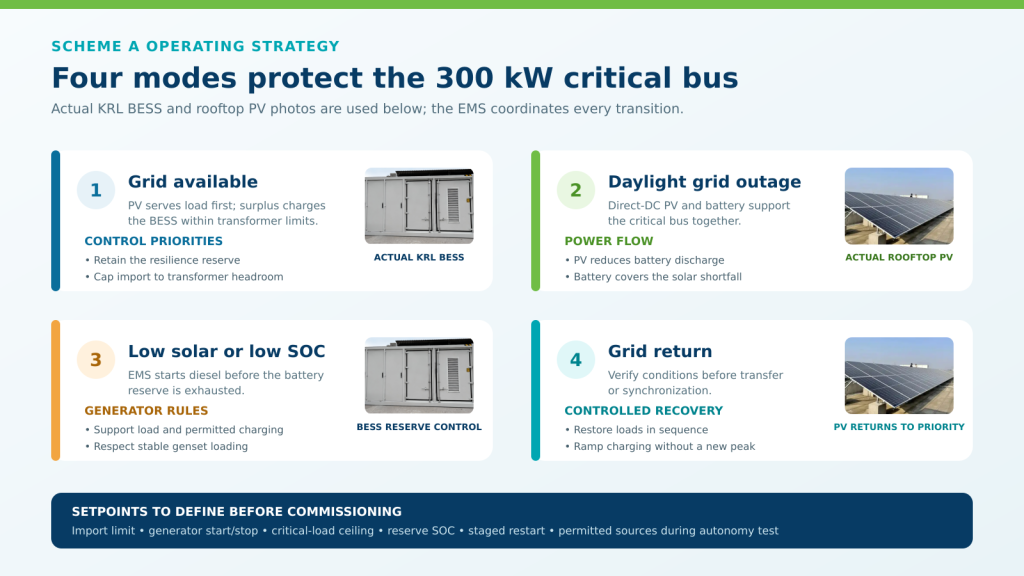
How the system should operate
Normal grid operation. Solar serves loads and charges the battery within the transformer limit. The EMS retains the agreed resilience reserve.
Daylight outage. The PCS supports the critical bus while PV continues through the integrated MPPT. Surplus PV charges the battery; the battery covers a PV shortfall.
Low solar or low state of charge. The EMS starts the generator before the reserve is exhausted, while respecting its stable loading range.
Grid return. Controls verify electrical conditions, transfer or resynchronize under the approved scheme, then ramp charging without creating a new peak.
Solar scope for a 42,000 sq ft factory
The gross building area is about 3,902 m², but usable PV area is reduced by structure, shading, drainage, skylights, fire setbacks and access lanes.
KRL can screen a direct-DC PV array in the 350–480 kWp range. Final size depends on the roof survey, module/string design, temperature and the 480 kW MPPT envelope. Generation, recharge time and any grid export require site data and the current Bangladesh utility/SREDA approval path.
Business case: measure the four value streams
A proposal should quantify rather than assume:
- avoided production loss during outages and voltage disturbances;
- diesel fuel, maintenance and low-load operating hours displaced by solar and battery dispatch;
- solar self-consumption and reduced grid energy purchases;
- demand-charge or time-of-use savings, if those mechanisms apply to the customer’s tariff.
Use 12 months of bills, interval load data, outage history, generator fuel/run hours, diesel price, production losses, roof results and the customer’s financial horizon.
Safety, approvals and acceptance testing
Confirm requirements with the local authority, utility, insurer and EPC. Relevant international references include IEC 62619, IEC 63056 and IEC 62933-5-2.
Before handover, test protection, emergency stop, communications-failure behaviour, transitions, generator control, PV curtailment, load shedding and autonomy. Record initial state of charge, load, allowed source contribution, ambient conditions and pass/fail boundary.
RFQ checklist before a firm quotation
Send the following information to KRL:
- One-line diagram from 11 kV incomer to the 415 V critical bus.
- Transformer nameplate photograph, impedance, vector group and protection settings.
- Generator kVA/kW rating, voltage, controller model, breaker and minimum stable loading.
- Seven days of interval load data, plus the 300 kW critical-load list and motor-starting data.
- Written confirmation of battery-only versus hybrid three-hour autonomy.
- Required usable-energy guarantee at beginning of life and end of life.
- Roof layout, structural report, shading constraints and available cable routes.
- Site temperature, flooding/drainage, fire-access and container-placement information.
- Utility tariff, outage record, diesel consumption and target operating strategy.
- Required standards, local approvals, commissioning tests and project schedule.
Conclusion
The project should not be sold as “964 kWh equals three hours.” Its real requirement is 900 kWh delivered to a 300 kW AC load, and the initial energy screen shows a meaningful gap after normal operating limits and losses. The KRL 500 kW / 1 MWh all-in-one platform is a credible centrepiece for the requested solar–grid–diesel microgrid, especially when PV or the generator may support the outage window. If the customer requires three hours from the battery alone, KRL should size a larger energy block against a written usable-energy and end-of-life guarantee.
Review KRL’s commercial and industrial energy storage systems, explore C&I ESS solutions, or send the project data to KRL for a validated single-line concept, capacity calculation and commercial proposal.
Frequently asked questions
Sources
- Sustainable and Renewable Energy Development Authority (SREDA), Net Metering Guideline 2025: https://www.nshd.sreda.gov.bd/page?pid=15
- Bangladesh Power Division, Net Metering Application: https://nem.powerdivision.gov.bd/
- IEC 62619:2022, industrial secondary lithium cells and batteries: https://webstore.iec.ch/en/publication/64073
- IEC 63056:2020, lithium cells and batteries for electrical energy storage systems: https://webstore.iec.ch/en/publication/29224
- IEC 62933-5-2:2025, safety requirements for grid-integrated electrochemical EES systems: https://webstore.iec.ch/en/publication/68297
